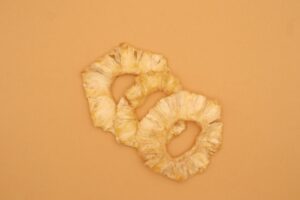
Dried pear


TOC
Product Overview of Dried Pear (Nijisseiki Pear)
We use the green pear "Gold Nijisseiki," grown at an orchard in northern Kyoto. characterized by refreshing acidity and restrained sweetness This green pear is dried slowly at low temperature, concentrating the sweetness while a faintly lingering acidity becomes an accent, finished into a taste that is new yet nostalgic.
The sliced dried pear shifts from a crisp texture to a moist mouthfeel, giving firm satisfaction with each slice. Pairing with black tea and Japanese tea, it is also a popular item as a snack for cheese and Western liquor, or as an appetizer material.
Brand site: A Letter from the Pear
Three Commitments Behind Our Dried Pear
01 Selecting the Kyotango green pear "Gold Nijisseiki"
We use the green pear "Gold Nijisseiki," grown in the Tango region of northern Kyoto. A pear whose sugar content does not assert itself too strongly and whose acidity is firmly felt has an excellent flavor balance when dried, raising its completeness as a dried fruit.
02 Low-temperature drying to concentrate sweetness and make acidity the accent
High-temperature drying drives off the aroma along with the pear's moisture. At Agriture, by drying slowly at low temperature, we achieve both a deep sweetness with concentrated sugar content and a restrained acidity that lingers in the aftertaste.
03 Material development that looks ahead to branding
This dried pear is developed not only as a commercial material but also under our own brand "Letter from a Pear (Nashi kara no Tegami)." Because we have know-how spanning packaging, brand story, and sales channels, we can make practical proposals for other companies' OEM inquiries as well.
Product catalog showing the items we handle
Flexible support from small lots to large lots
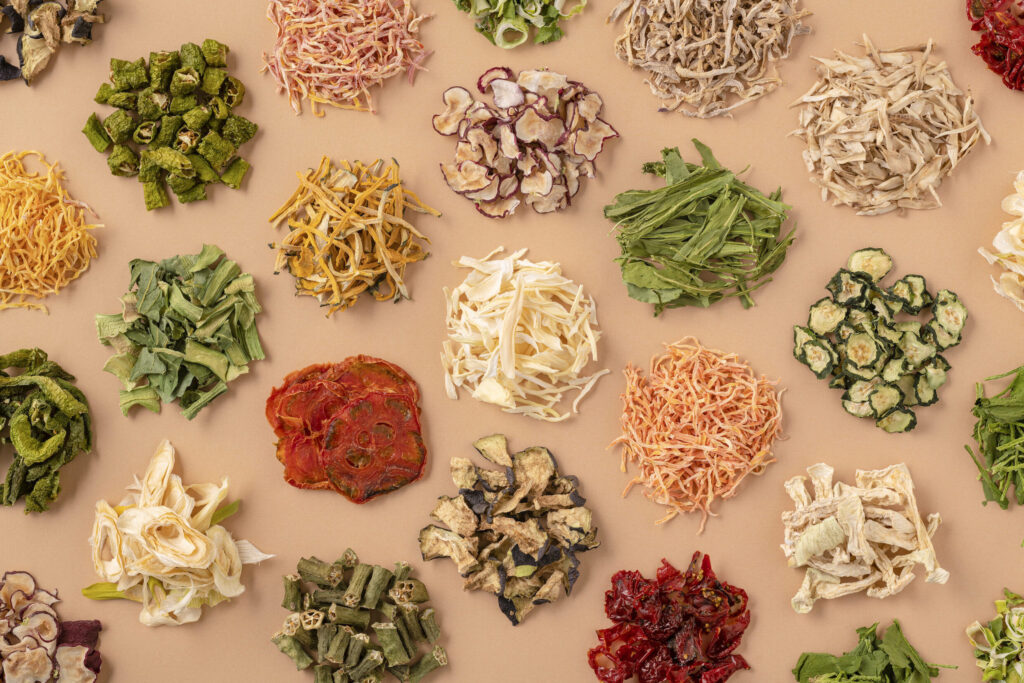
- Sold in small lots from 1 kg
- Handling heirloom vegetables from across Japan
- Dried fruits and herbs also supported
Features of Commercial Dried Pear
Kyoto-grown Gold Nijisseiki
Uses a green pear characterized by refreshing acidity and gentle sweetness. It is a material that can add value as a dried fruit of rare Japanese-grown green pear.
A crisp-then-moist texture
The moment it enters your mouth it is crisp and light, and the more you chew, the more it moistens and blends in the mouth. Designed to give firm satisfaction with each slice.
A pairing material for tea and black tea
Adding it alongside Japanese tea or black tea lets the pear aroma melt into the drink. It can also be used for blend teas mixed directly into the tea leaves.
As a snack for Western liquor
Combined with cheese and nuts as an appetizer for wine or whiskey. Together with the story unique to a Japanese-grown fruit, it is also chosen as a component of gift sets.
Unsweetened, uncolored, additive-free
An additive-free specification that stands on the ingredient's sweetness alone. Development into natural-oriented brand OEM and health foods can also be discussed.
A highly rare Japanese-grown material
Dried-fruit material of Japanese-grown pear has limited distribution volume nationwide, and there are almost no suppliers able to supply it stably. Through a collaboration structure with Kyotango partner farmers, Agriture is able to build a production plan every year.
Main use
It can be developed as a pairing material for Japanese tea and black tea, a snack for wine or whiskey combined with cheese and nuts, a topping for crackers and appetizers (canape, salad material), and an OEM product ingredient (unsweetened dried fruit, gift fruit).
Product specifications
Item | Details |
|---|---|
Raw material growing region | Kyoto Prefecture (partner farm) |
Specification | Sliced |
Storage method | Room temperature (store away from high heat and humidity) |
Best-before date | 6 months from the shipping date |
Minimum lot | From 10 bags / 100 g |
Powder | Not possible |
Manufacturing period | September |
Customization support
Custom size support (cut-thickness change, shape adjustment): can be discussed for orders of 10kg and up. OEM support: available. Large-lot production: available (consultation required 3 months before the production period). Past initiative case studies are here。
POWDER
Fruit and vegetable powder materials can also be discussed
Dried pear on its own cannot be made into powder, but combinations with other vegetable and fruit powders can be discussed. Put it to use for blend development of tea and baked-goods ingredients.
Variety, grower, origin
BRAND
Cultivar:Gold Nijisseiki (green pear). Characterized by refreshing acidity and restrained sweetness, it is a variety type whose sweetness concentrates through drying.
PRODUCER
Producer:Pear farmers in Kyotango, Kyoto. Depending on the season, they grow multiple varieties such as Nijisseiki, Akizuki, Shinko, Osshu, and Atago, and for drying we mainly use Nijisseiki harvested in September.
REGION
Production area:Kyotango, Kyoto. The Tango area of northern Kyoto, known as a Kyoto-vegetable and rice-producing region, also has a certain scale as a pear-producing region, harvesting multiple varieties from late August through December.
CULTIVATION
Cultivation method:A system of variety relays matched to the harvest season avoids continuous-cropping obstacles and secures good-quality fruit throughout the year. For drying, we also look at using off-spec fruit that is hard to ship by fresh-eating standards.
*Reference: OYAOYA product page
Low-temperature drying that keeps the pear's delicate flavor
Pear is a fruit with very high moisture content and one of the more difficult materials to dry. At Agriture, by removing moisture slowly over time at low temperature, we curb enzymatic browning and finish it into a dried fruit while keeping a sense of freshness.
💡 TIPS | Drying-processing trivia
Pear is high in moisture, and drying it as-is means longer drying time, which makes oxidation and browning more likely to occur. Being able to concentrate the sweetness without losing the acidity, through meticulous design of cut thickness and temperature range, is a strength unique to low-temperature drying.
Use cases
Gift development as a Japanese-grown dried fruit
Dried fruit of Japanese-grown green pear is rare even in the market, making it a material easy to differentiate for gift and present applications. Combined with packaging that suits the recipient, such as washi paper or paulownia boxes, its added value increases.
Blend material for Japanese tea and black tea
Floating it directly in Japanese tea or black tea, or adding it to blend teas, transfers the pear's natural sweet aroma to the tea. It also pairs well with cafe menus and OEM of original blends.
Cheese and wine pairing
Combined with cheese and nuts, it can be used as a wine snack. The pear's gentle acidity and sweetness set off the saltiness of the cheese, and it is also adopted for the appetizer of hotel and bar course menus. Easy to handle at room temperature, it is also easy to build into small-quantity, multi-item platters.
As a salad and appetizer material
Scattered over canapes or salads, it adds an accent of seasonality and texture. Besides Western appetizers, it is also a material easy to incorporate into Japanese appetizers as a Japanese-Western fusion expression.
How to Use Commercial Dried Pear
Dried-fruit pear is a material that can tell a "brand story," not merely serve as a raw material. Under our own brand "Letter from a Pear (Nashi kara no Tegami)," we have accumulated development know-how covering packaging design and sales-channel development, and there are also media coverage cases.
- Releasing the Nijisseiki Pear Dried Fruit "Letters from a Pear"
- "Letters from a Pear" Was Featured in Brain, March 2024 Issue
- Products from OYAOYA, A Letter from a Pear, and Agriture featured on "Urelio"
Product catalog showing the items we handle
Flexible support from small lots to large lots
- Sold in small lots from 1 kg
- Handling heirloom vegetables from across Japan
- Dried fruits and herbs also supported
Frequently asked questions (FAQ)
Q. About what is the minimum lot?
A. You can try it from 10 bags / 100 g. For full-scale development, please consult us in units of 1 kg to 10 kg.
Q. Can you tell me a rough price?
A. It varies with lot, packaging, and delivery. We will provide a quote together with a sample request.
Q. How much lead time is needed?
A. Around two weeks for stocked items, and for planned production, we ask for consultation up to three months ahead, timed to the September harvest.
Q. Can you disclose the origin of the raw material?
A. We mainly use Nijisseiki pears produced by partner farmers in Kyotango, Kyoto.
Q. Are you HACCP-compliant?
A. At our own plant we carry out hygiene management based on HACCP principles, and we have a track record of accommodating audits as well.
Q. Is consultation including brand development and packaging possible?
A. Making the most of the development know-how of our own brand "Letter from a Pear (Nashi kara no Tegami)," we can make proposals that step into the OEM client's branding as well.
RETAIL
For those looking to purchase in small packs
If you want to purchase fresh pears or season-limited dried pear from a small quantity, please use the online shop of our sister brand OYAOYA. Depending on the season, it sells the seasonal varieties.
Yakuzen properties (for fresh pear)
In yakuzen (medicinal cooking), pears are known as a food that "generates body fluids (shin'eki) and moistens dryness."
Its juicy texture and sweet-and-sour flavor can be enjoyed regardless of season, not only eaten as-is but also processed into juice, compote, and the like.
💡 TIPS | Yakuzen trivia
Pear is a representative ingredient for "moistening the lungs (junpai)," moistening the body's dryness, and is prized on the autumn-winter table when dryness is a concern. Compote combined with honey, or pear steamed together with rock sugar, is known in the Chinese-speaking world as a classic recipe for throat care.
Taking it in as dried pear lets you easily bring yakuzen wisdom into daily life regardless of season.
YAKUZEN
For those who want to know more about pear from a yakuzen view
The yakuzen properties of pear and seasonal ways to eat it are introduced in detail at our sister media Yasai Yakuzen. Please make use of it as inspiration for product planning.
Recommended reading
- Releasing the Nijisseiki Pear Dried Fruit "Letters from a Pear"(News)
- Letter from a Pear featured in the March 2024 issue of Brain(News)
- Featured on Urelio(News)
Download the product catalog
We will send the materials to your email address based on the information you provide.