

Disaster Stockpiles for Companies and Local Governments
Your 5-year staples can stay as they areWhat's missing isVegetables, contained in burdock and cocoa.
You have alpha rice and water. But open the shelf and that's all there is. Dried vegetables have a best-before date of 6 months, so they won't work as a stockpile you just leave in place. Instead, we deliver them every six months and have you finish off the previous batch within the company. The task of disposing of expired stock turns into tasting sessions and in-house distribution.
Let us know your employee count and what's currently in your stockpile, and we'll send back the amount you need and how to structure the rotation.
Tokyo's three-day guideline (per person)
Drinking water3 L/day × 3 days = 9 L
Staples3 meals/day × 3 days = 9 meals
Blanket1
Vegetables and side dishesEach company's own judgment
6 months
Best-before date from the shipping date. Don't just leave it in place; swap it out every six months
2 per year回
With each delivery, the previous lot is finished off at tasting sessions or through in-house distribution
About 3㎡
The floor area for stacking three days of water, food, and blankets for 100 people one meter high. Vegetables are only a small part of this.
WHY
Things that last 5 years all expire at once, 5 years later
Long-term emergency food leaves the person in charge the moment it's purchased. The next time anyone touches it is five years later. What awaits is the disposal of several hundred meals' worth and a reorder of the same amount.
Stockpile left in place
Five years later, disposal and reordering arrive all at once
- No one opens the shelf until the date draws near
- General affairs takes on the disposal cost and the time to arrange it
- When the person in charge changes, it slips through the handover
- Since people eat it for the first time during a disaster, there's no telling whether it suits their taste
→
Stockpile cycled every six months
Because it gets eaten, only fresh stock remains on the shelf
- It arrives every six months and is consumed in-house, oldest first
- With no disposal, there's no cost or effort of discarding
- Tastings can be built into disaster drills
- You can prepare knowing the taste
Ordinance
A three-day stockpile is a duty of effortTokyo Metropolitan Ordinance on Measures for Stranded Persons, Article 7, Paragraph 2. It applies to all employees working at the workplace, regardless of employment type.Guideline
9 L of water, 9 meals of staple food, 1 blanketThe per-person amounts set out in the implementation plan. It is explicitly stated that these are guidelines and have no legal binding force.Blank
Vegetables are left to each company's judgmentThe listed item examples center on staple foods, with side foods such as canned goods treated as supplementary notes. What to hold and how much is not specified.Source: Tokyo Metropolitan Ordinance on Measures for Stranded Persons/Tokyo Metropolitan Handbook on Measures for Stranded Persons (PDF). It also states that you should stockpile roughly 10% extra for outside stranded persons, such as customers visiting your office.
ROLLING STOCK
Bringing the rotation method that caught on at home into the company stockpile
The Ministry of Agriculture, Forestry and Fisheries explains rolling stock to households this way.
It is a method for keeping a constant amount of food stockpiled at home at all times: buy a little extra of your everyday foods, consume them oldest first with the best-before date in mind, and replenish the amount you've used.
Source: Ministry of Agriculture, Forestry and Fisheries, Household Stockpile Portal, “Easy! Rolling Stock”(The Ministry advises households to “stock up on a week's supply if you can.”)
Household
Everyday meals are the point of consumptionJust replenishing what you've eaten keeps it cycling naturallyCompany
There's no point of consumptionNo one eats it, the date advances, and it all ends up being disposed of at onceThat's why
Decide where it will be eaten firstTasting sessions at disaster drills, distribution to each department, serving at in-house eventsOnly once this occasion exists does the cycle of restocking keep going. We build the delivery cycle we provide to fit that occasion.
For reference, Tokyo recommends a 3-day supply for corporate stockpiles, a different standard from the 1-week supply advised for households. The practical approach is to borrow only the concept and size the quantity to your company's own standard. For an explanation of rolling stock itself, see The Complete Guide to Rolling Stock.
CYCLE
In the fourth month after delivery, we create an occasion to use it all up
We don't fix it to a set calendar month. We build it as a relative cycle anchored to the delivery date, so stock never runs out before the next lot arrives.
Delivery
6 months until the best-before dateStore it in the stockroom. Split delivery to each location is also availableMonth 4
Tasting and in-house distributionTiming it with a disaster drill makes it easier to runMonth 5
The next lot is deliveredCreate a period where the old stock and the new stock overlapMonth 6
Use up the old stockOnly stock with plenty of shelf life left remains on the shelfWhatever can't be eaten up can be handed out internally. In exchange for eliminating the disposal of expired stock, you purchase twice a year. Which suits your company is best judged by comparing it against the time and cost you currently spend on disposal. The procedure is described in How to Hold an In-House Tasting Event for Stockpiled Food and Explanation of rolling stock.
COMPARE
Choosing between this and long-life emergency food
Your staple foods and water can stay as long-life stock. This is a comparison of how to hold the vegetables you place alongside them.
| 5-year emergency food | Dried vegetables rotated every six months | |
|---|---|---|
| Replacement | All at once, every 5 years | A little at a time, every six months |
| Disposal of expired stock | Several hundred servings disposed of at once | No disposal, since it is all eaten up |
| Checking the taste | Eaten for the first time only during a disaster | Can be checked at every tasting session |
| Storage space | Stored as whole sets | Fits into the gaps between staple foods |
| Cooking | Many products need only water or hot water added | Needs heating. Used as an ingredient in soups |
| Burden on the person in charge | Disposal and reordering concentrated after 5 years | Spread across twice-yearly distribution and ordering |
Long-life vegetable soups and vegetable juices are also viable options. But switching to a 5-year shelf life doesn't do away with replacement, and the fact that everything reaches its expiry at once after 5 years remains unchanged. On another note, most emergency vegetable sets don't go so far as to explain how to combine them with staple foods. What we propose is a way of using them: adding them to the soups you already have with your staples.
HOW TO EAT
How to make a meal with alpha rice
There's no need to replace your stockpile. You simply add a bag of vegetables to the staple food you already have.
As an ingredient in miso soup or soup
If you can boil water, put the dried vegetables straight into the pot and simmer. We keep the cut sizes uniform so you can use them without waiting for them to rehydrate. It takes the same hot-water step as preparing your staple food.
Add them to cup noodles or instant miso soup
Just add a pinch to the soup you already stock. No extra dishes, no extra steps. Since they aren't bulky, you can tuck them into the gaps in your staple-food case.
Mix them into alpha rice
Adding them to the hot water used to rehydrate alpha rice changes the flavor and texture. It's a way to vary the menu when the same staple food runs for three days straight.
There are two limitations we want to mention up front
- You need water and a heat source. These are ingredients to be cooked and eaten. Plan for cooking water separate from drinking water, and a heat source such as a portable gas stove. Tokyo's handbook also lists a portable gas stove and a pot among its examples of stockpile items
- It is not emergency food you bite into as is. If you need something edible without using water, combine it with another form such as hardtack or biscuits
VOLUME
How much to keep on hand
When used as a soup ingredient, a guide is 2 to 3 bags per person per day (3 to 8g per individually wrapped bag), or 6 to 9 bags for a 3-day supply. For the amount needed by headcount, see Corporate Disaster Stockpile Checklist table, and for how to choose items, see 7 recommended vegetables for stockpiling.
The space needed is small compared with water and staple foods. The dried vegetables fit into a single cardboard box, and need neither refrigeration nor freezing. Delivery can be split and sent to the locations you specify.
6–9 bags
3-day supply per person (3 to 8g per bag)
Room temperature
No refrigeration or freezing equipment required
SERVICE
Overview of what we provide
Vegetables handled
ItemDomestic dried vegetables that work as ingredients in miso soup and soups, such as cabbage, carrot, burdock, komatsuna, kabocha, lotus root, and mushrooms
FormSupply of single items, and mixes blended by the meal. Specifications with different blends can also be discussed
Delivery and operation
Best-before dateAbout 6 months from the shipping date
CycleDelivered every six months. We set it up so tasting and in-house distribution fall in month 4 and the next lot arrives in month 5
Refrigerator neededRoom temperature. No refrigeration or freezing equipment required
Delivery destinationCan be shipped separately to each location
What we'd like you to tell us when you reach out
Number of employeesIf your sites are spread out, the headcount at each site
Current stockpileThe contents of your staple foods and water, the quantities, and the timing of your next replacement
Where it will be consumedThe timing of disaster drills, and whether in-house distribution is possible
For the items we carry, see List of dried vegetables Please take a look. If you also want to address everyday vegetable shortfall, keeping Office Yaoya (office greengrocer) on hand in the office is another option.
STEPS
You can start in 3 steps
1
Tell us your current stockpileLet us know your headcount and the contents of your staple foods and water. You're welcome to send us your stockpile list as it is.2
Receive the required amount and rotation planWe'll send back the amount needed and how to arrange the twice-yearly replacement. We set the schedule to line up with your tasting timing.3
Delivery, and the rotation beginsWe deliver to the locations you specify. The next lot is arranged to coincide with when you finish up the previous one.
FAQ
Frequently asked questions
Isn't a 6-month best-before date too short for a stockpile?
For an emergency food meant for long-term storage, that is short. For this reason, we assume a rotation every six months rather than a stockpile you simply leave in place. The practical approach is to keep using your five-year-storage staples and water as they are and rotate only the vegetables.
Do we have to replace our entire current stockpile?
No. Your precooked emergency rice and stored water can stay as they are. We suggest simply adding the vegetables you are missing.
Will you take back the stock that has grown old?
We do not offer take-back. We assume you will use up the stock through in-house tasting sessions or by handing it out. We have written up how to go about this in our article on tasting events, so please see that.
Can it be eaten even when water is not available?
Since it is meant to be eaten heated, you need water for cooking and a heat source. Please budget for this separately from your drinking-water stockpile. If you need something that can be eaten as-is without water, combine it with another format such as hardtack.
We have several locations. Can you deliver to them separately?
Yes. Please let us know the number of people and the shipping address for each location. We charge for the shipping work and the actual shipping costs.
Can you also handle stockpiles for local governments?
Please get in touch. If you let us know the quantity, delivery timing, and any specification requirements, we will tell you what we can handle.
Why not add vegetables to your stockpile shelf?
Let us know your number of employees and what is in your current stockpile. We will provide the quantity you need and how to set up the rotation every six months.
To review the contents of the stockpile itself, see Corporate Disaster Stockpile Checklist and emergency food for stranded commuters; and to consider BCP and health management together, stockpiling for BCP × health management.
Let us know your number of employees and your current stockpile, and we will tell you the quantity you need and how to rotate it
Talk to us about your stockpileLearn about Office Yaoya
We have prepared materials
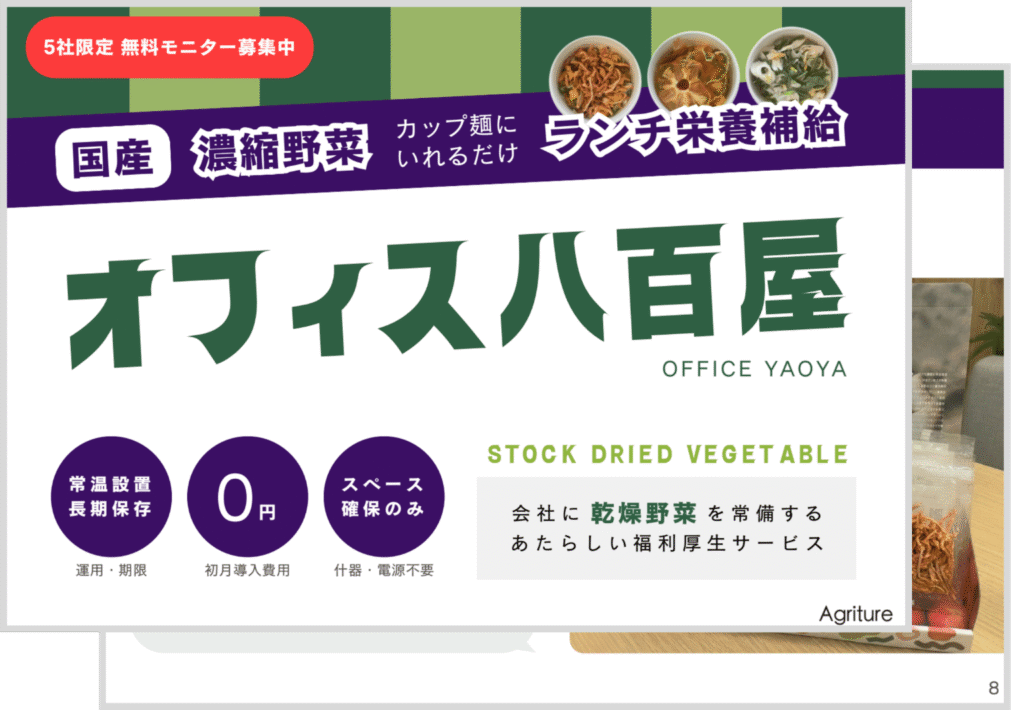
- Service details and vegetable lineup
- Pricing and plans
- How adoption and operation work
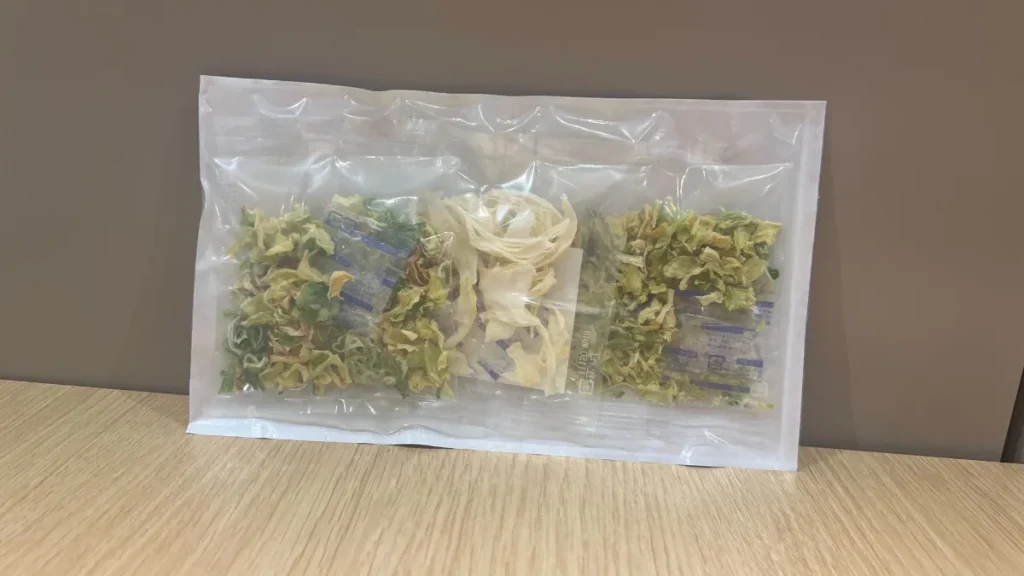
Sample sets are also available. Download the materials for details!
We offer sample sets so you can try Office Yaoya in small quantities. See the materials for details.
Download the office dried vegetable materials
We will send the materials to your email address based on the information you provide.