
Corporate Disaster-Stockpile List, 2026 Edition | Office Disaster Supplies & Checklist

Summary of this article
We’ve organized the corporate disaster-stockpile list as a 2026-edition guide for staff: three-day guides for both home and company, office disaster supplies, checklists for the three settings of home, shelter, and workplace, required amounts by number of employees, rolling-stock operation, use of the “office greengrocer” driven by health management x BCP, and an FAQ.
When putting together a corporate disaster-stockpile list, what’s easily overlooked are the “essentials other than food and water.” You need to prepare portable toilets, power, sanitary supplies, and even office disaster supplies according to the number of employees. This article, following the latest 2026-edition guidelines, organizes disaster-stockpile lists for both home and company, and provides—as a checklist staff can use directly—checkpoints for office disaster supplies and disaster-countermeasure stockpiles, required amounts by number of employees, checklists for the three settings of home, shelter, and workplace, rolling-stock operation, how to use the “office greengrocer” that coexists with health management, and an FAQ.
TOC
Basics of the Disaster-Stockpile List | The 2026-Edition Approach
Following the September 2025 revision of the Nankai Trough long-term evaluation and the December 2025 update of the damage estimates for an earthquake directly beneath Tokyo, reviewing the disaster-stockpile list remains ongoing as of 2026. This article organizes the items to have on hand as of April 2026 and how to operate them, from the perspective of building the list not as a mere shopping list but as “infrastructure that protects family and employees when a disaster strikes.”
Why “Three Days” Is the Standard
It’s because relief supplies are assumed to take about 2–3 days to arrive. The Cabinet Office’s Guidelines for Measures Against Stranded Commuters in an Earthquake Directly Beneath Tokyo call on companies to keep three days’ worth of stockpiles per person, based on the principle of “not starting to move recklessly” and the assumption of keeping employees on the premises for about three days. The specific grounds are these three points.
- Arrival Time of Relief Supplies: Reviews of the Great Hanshin-Awaji and Great East Japan Earthquakes confirm it takes about 72 hours for wide-area supply transport to function
- The Occurrence of Stranded Commuters: In an earthquake directly beneath Tokyo, an estimated roughly 4.53 million people in Tokyo would be temporarily unable to get home, on the premise of waiting at the workplace or where they are for 72 hours
- The Limits of Hydration: The limit for a person to function without water is roughly 72 hours, so securing three days’ worth of water is the lifeline until utilities are restored
Three days is the minimum line for both home and company. Under BCP, a growing number of companies expand in stages up to a week’s worth.
7 Categories Common to Home and Company
Organizing the disaster-stockpile list into the following seven categories makes it easier to prevent omissions.
- Food (staples and side dishes): alpha rice, hardtack, dried vegetables, canned goods, retort foods
- Drinking water: bottled water, water-supply bags
- Sanitary and Toilet Supplies: portable toilets, masks, alcohol
- Medical Supplies: first-aid kit, regular medications, prescription drugs
- Power and communications: portable power station, mobile battery, disaster radio
- Disaster supplies: helmet, work gloves, flashlight, blanket, thermal sheet
- Information and Records: BCP documents, contact chain, go-home support map
New Trends to Note in the 2026 Edition
Among the consultations we’re hearing more of from corporate stockpile staff in 2025–2026 are the following four points. This article organizes them with a method for building stockpiles on the premise of everyday consumption.
- Linking Rolling Stock and Health Management: A method of working foods consumed day to day into the stockpile, reducing expiration-related waste
- A Distribution Allotment for Teleworking Employees: Office stockpiles alone can’t cover home-based workers. Manage a company distribution allotment separately
- Distributed Storage: Concentrated single-site storage is weak against earthquake and flood risk. Switch to distributed placement by floor and department
- Integration with Sustainability: Work off-spec vegetables and regional products into the stockpile, linking them to the food-loss-reduction metrics in your CSR report
Household Disaster-Stockpile List (Reference, Three-Day Guide)
Base your household stockpile on three days for a family of four, and add dedicated items if you have pets, infants, or older adults. Whether employees’ household preparedness is complete directly affects a company’s assembly rate and recovery rate. A growing number of companies have BCP staff distribute a household-stockpile guide to employees, so get the household minimum line in place first, then move on to the corporate stockpile.
Household Essentials (Guide for a Family of Four, Three Days)
| Category | Examples | Family of four, three days |
|---|---|---|
| Drinking water | Long-life bottled water | 36 L (3 L × 4 people × 3 days) |
| Staples | Alpha rice, retort rice, hardtack | 36 servings |
| Side dishes and nutrition | Dried vegetables, canned goods, vegetable juice | 24–36 packs of dried vegetables + 12 cans |
| Portable toilets | Coagulant type | 60 uses |
| Cassette stove | Unit + gas canisters | 1 unit + 6 canisters |
| Sanitary | Wet wipes, toilet paper | One month’s worth for the family |
Dedicated Stockpiles for Infants, Older Adults, and Pets
Add dedicated stockpiles according to your family makeup. We’ve organized them as a checklist by attribute.
| Attribute | Essential Items | Stockpile Amount Guide |
|---|---|---|
| Infants | Formula, bottles, baby food, diapers, wet wipes | 3 days to 1 week |
| Older adults | Prescription drugs, adult diapers, thickening agent, a copy of the medication notebook | 1 week of prescription drugs |
| Pets | Pet food, water, carrier bag, pet portable toilet, spare lead | 3 days or more |
| People with Allergies | Elimination-diet emergency foods, EpiPen, allergen-label checking | For 3 days |
For households with infants or those needing nursing care, the time until utilities are restored can be “critical,” so at least a week’s worth of preparedness gives peace of mind. For allergy-friendly foods, check the ingredient labels at the stockpile-selection stage, doing it in one go for everyone in the family.
Emergency Go-Bag (For First Evacuation)
Also prepare a backpack-style set you grab immediately when evacuating. The basic rule is one backpack per person, packed on the criteria of “lightweight, bare essentials, immediately usable.”
- Information and Communications: portable radio, mobile charger, spare batteries (plenty of AA and AAA)
- Light and Tools: flashlight, LED headlamp, whistle, work gloves, multi-tool, rope (3–5 m)
- Water and Food: water 500 ml × 2 bottles, nutritional supplements, calorie foods
- Sanitary and Cooking: disposable paper plates, plastic wrap, wet wipes, toothbrush, sanitary products (for women)
- Warmth and Cold Protection: disposable heat packs, aluminum blanket, thermometer
- Life-Saving Basics: cash (including coins), copies of ID, regular medications, first-aid kit, contact memo
The standard practice is to keep the go-bag by the entrance or at your bedside, and check and replenish the contents once a year. Since evacuation to a shelter or waiting for rescue can drag on depending on the situation, prepare one for each family member and adjust the weight so you can carry it out yourself when it counts.
FOR BUSINESS
乾燥野菜のミックスを、まとめてお探しですか
用途に合わせて複数の品目を配合した乾燥野菜ミックスをお作りしています。法人の備蓄やローリングストックのご相談も承っています。配合の考え方は 法人向けローリングストック に掲載しています。
少量でのご購入は、姉妹ブランドの通販サイト OYAOYA で承っています。
Corporate Disaster-Stockpile List | Office Disaster Supplies & Disaster-Countermeasure Stockpiles
Unlike a household, a corporate stockpile is characterized by being built on the premise of “business continuity” and “employees staying for three days.” Add office-specific disaster supplies too, and put together a comprehensive disaster-countermeasure stockpile.
Food and Drinking Water (Three Days per Employee)
Drinking water: 9 L per person (3 L × 3 days). For a 50-person office, that's 450 L, equivalent to 900 500 ml bottles. Choosing long-life types (5-7 year shelf life) makes management easier. Staple foods: alpha rice, retort rice, and hardtack, 9 meals per person. Side dishes are often overlooked; spending 3 days on only staple foods and canned goods tends to leave you short on vitamins, minerals, and dietary fiber, with an unbalanced diet.
For details on how to choose stockpile vegetables, see Solving the Vegetable Shortage in Corporate Disaster Preparedness | 7 Recommended Stockpile Vegetables.
Sanitary, Medical, and Toilet Supplies
This is preparedness on the premise that water and sewage are cut off. Portable toilets are guided at 15 uses per person (5 uses/day × 3 days), so 50 people need 750 uses. Keep toilet paper, sanitary products, sanitizing alcohol, and about 10 masks (nonwoven) per employee, with wet wipes placed in each department too. Keep one or more first-aid kits company-wide, stocked with painkillers, digestive regulators, and stomach medicine.
Power and Communication Tools
If a power outage drags on, charging smartphones, doing PC work, and gathering information all become difficult. Clarifying the deployment unit and intended use for each item speeds up spec decisions at purchase time.
| Item | Deployment Unit | Intended Use |
|---|---|---|
| Portable power station (500–1500 Wh) | 1–2 per department | Securing power for PCs, small fridges, and medical devices |
| Mobile charger (10,000 mAh or more) | 1 per employee | Two smartphone charges’ worth; maintaining a means of contact |
| Disaster radio (hand-crank / solar-capable) | 1 per floor | Receiving emergency broadcasts and public information |
| Spare batteries (AA, AAA) | 10 each per person | Flashlights, radios, thermometers |
For 50 people on one floor, water and power are premised on distributed storage. Communication devices, if concentrated at a single site, are wiped out by earthquake or flooding, so deploy them split across at least two systems.
Office Disaster Supplies (Items Homes Don’t Have)
List out office-specific disaster supplies too. As a countermeasure against falling objects in an earthquake, giving each employee a helmet (a folding type saves space) and deploying a personal kit—work gloves, dust mask, whistle, flashlight, thermal sheet as a set—in each desk drawer speeds up the initial response. For employees walking home, also prepare go-home support maps (distributed by local governments) and a walk-home set (sneakers, water, light snacks, rain jacket).
Checklists for the Three Settings of Home, Shelter, and Workplace
There’s no predicting where you’ll be when disaster strikes. When you’re at home / when you evacuate to a shelter / when you’re caught at the workplace—splitting your preparedness into these three settings speeds up your response when it counts. Here’s a rundown organizing the required amount and method per person.
Essential List for Staying at Home (Home Sheltering)
If your home isn’t destroyed, there are many cases where home is safer and more comfortable than a shelter. On the premise that electricity, water, and gas are cut off, the basic idea is to keep a generous stock of the things you use in everyday life. The minimum line per person is 3 liters of drinking water a day, three days’ worth of food, a cassette stove and canisters, and 15 uses of a portable toilet.
- Water and Food: drinking water 9 L/person, staples 9 meals/person, no-cook retort foods, canned goods, dried vegetables
- Cooking: cassette stove, 6 canisters, disposable paper plates, plastic wrap (usable in place of plates too)
- Sanitary: portable toilet 15 uses/person, toilet paper, wet wipes, toothbrush, sanitary products for women
- Light and Power: flashlight, spare batteries, mobile charger, portable radio
- Cold Protection: blanket, disposable heat packs, aluminum blanket
Checklist for Using a Shelter
When your home is uninhabitable, you move to a shelter. Shelters have stockpiles too, but in many cases they’re insufficient for the number of people, so prepare on the premise of bringing your own share. On top of the go-bag, items for securing privacy and sanitary supplies become important. Prepare 3–7 days’ worth of living supplies in case rescue drags on.
- Must-Carry: ID, cash, regular medications, first-aid kit, thermometer
- Sanitary and Grooming: toothbrush, towel, disposable underwear, dry shampoo
- Privacy: a poncho for changing clothes, eye mask, earplugs
- For Children and Older Adults: diapers, formula, medication notebook, spare batteries for hearing aids
- Tools: work gloves, rope, multi-tool, duct tape (for repairs and patching)
Checklist for Being Caught at the Workplace
If a disaster happens during working hours, the premise is staying in the office for three days while using the company stockpile. On top of the corporate stockpile list above, keeping a small disaster kit at your personal desk speeds up the initial response. Preparing gear for the case where walking home is permitted also gives peace of mind.
- Personal Desk Kit: folding helmet, whistle, small flashlight, spare batteries, one day of regular medications, thermometer
- Walk-Home Set: sneakers, whistle, water 500 ml, nutritional supplements, go-home support map
- Information Infrastructure: portable radio, mobile charger, contact list (kept on paper too)
Using the Office Greengrocer That Coexists with Health Management
For staff who feel that “keeping up the corporate disaster stockpile is a burden” or want to “advance dietary improvement under health management,” Agriture runs, as part of the Kai Group, Office Yaoya (office greengrocer). It’s a setup that keeps dried vegetables on hand in the office, so employees consume them day to day while the same stock also becomes a disaster stockpile.
Basic Service Specifications
| Item | Details |
|---|---|
| Ingredient | Dried vegetables (about 100 varieties), dried fruit, and instant miso soup |
| Specifications | Individually wrapped 3–8 g portions, no rehydration needed, room-temperature storage of 3 months or more |
| Price | Per serving From 100 yen |
| Setup Cost and Monthly Fee | Free (a plan with zero cost to the company is available) |
| Installation space | Enough desktop space to lay out Nekopos-size packs |
| Target Scale | Supported from small offices of 10 people or fewer |
| Raw materials | 100% domestically grown vegetables, no added sugar or additives, low-temperature dried |
A four-pillar approach: disaster preparedness, health management, employee benefits, and sustainability
- Disaster stockpiling: Dried vegetables that keep for 3 months or more at room temperature stay stocked in the office at all times. Rolling stock rotates automatically, providing a countermeasure against vegetable shortages in a disaster
- Health management: Helps close the vegetable gap for Japanese people (an average shortfall of about 70 g per day) and works well as an example of the dietary-improvement measures behind Certified Health & Productivity Management Organization recognition
- Employee benefits: You can choose meal subsidies, an employee purchase plan, or delivery to remote workers, making it well suited to busy professionals in their 20s to 40s
- Sustainability: Upcycling off-spec vegetables by purchasing from producers at a fair price helps cut food loss. It can be linked to CSR initiatives
A Three-Way Partnership (a Win-Win-Win Structure)
It’s a structure that solves the challenges of three parties with a single service: busy professionals struggling with vegetable shortages, companies wanting to advance employee health management, and farmers troubled by the disposal of off-spec vegetables.
- Employees: Can conveniently top up, right at their desk, the vegetables they fall short of by an average of about 70 g a day
- Company: Balances health-management dietary-improvement measures and disaster stockpiles on a single system
- Farmers: Purchases off-spec vegetables at a fair price, securing revenue while cutting food loss
Agriture operates on the philosophy of “becoming a help in supporting Japan’s food and health through initiatives that broaden the possibilities of familiar vegetables” (comment from CEO Rei Kojima).
The path to adoption
- Download materials:Request the company overview materials from the official office greengrocer page
- Consultation: Confirm the number of employees, locations, and purpose (stockpile-focused / health-management-focused)
- Sample-set trial: test the employee response and operational feel with a small quantity
- Full adoption: decide the delivery cycle and lineup and start operation
- Regular replenishment: Deliveries once every few months keep the stock rotating automatically, and the disaster stockpile is maintained too
Learn about Office Yaoya
We have prepared materials
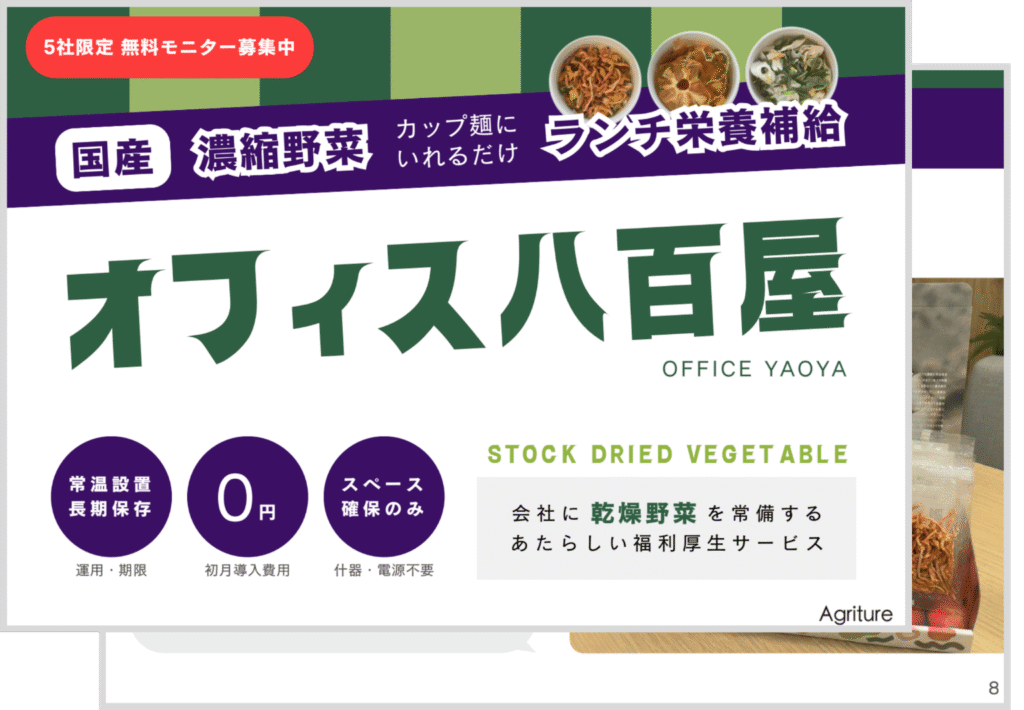
- Service details and vegetable lineup
- Pricing and plans
- How adoption and operation work
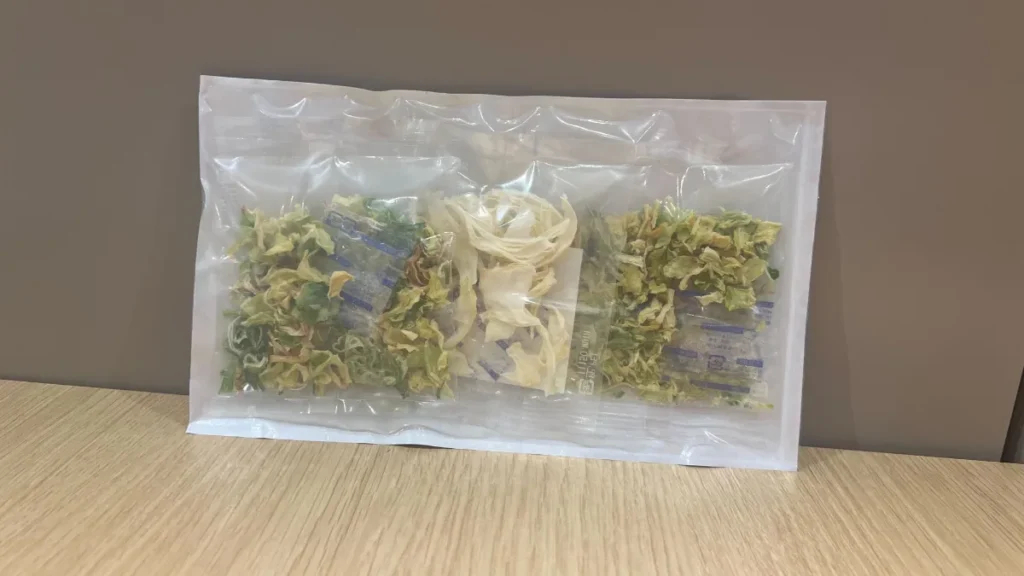
Sample sets are also available. Download the materials for details!
We offer sample sets so you can try Office Yaoya in small quantities. See the materials for details.
Checklists by Number of Employees and Rolling-Stock Operation
Stockpile volume scales with the number of employees. Here we organize required-amount guides for scales from 10 to 1,000 people, and the basics of rolling stock that turn operations into a “system you can keep going.”
Required Amounts by Number of Employees (Three Days, Sample Estimates)
| Number of employees | Drinking water | Staples | Dried vegetables | Portable toilets | Initial Investment Guide |
|---|---|---|---|---|---|
| 10 people | 90L | 90 meals | 60–90 packs | 150 uses | 30,000–50,000 yen |
| 50 people | 450L | 450 meals | 300–450 packs | 750 uses | 150,000–250,000 yen |
| 100 people | 900L | 900 meals | 600–900 packs | 1,500 uses | 300,000–500,000 yen |
| 500 people | 4500L | 4,500 meals | 3,000–4,500 packs | 7,500 uses | 1.5–2.5 million yen |
| 1,000 people | 9000L | 9,000 meals | 6,000–9,000 packs | 15,000 uses | 3–5 million yen |
Initial investment varies greatly by product grade and composition. Combining a benefit service with rolling stock lets you keep the setup cost down while operating continuously.
The Basics of Rolling Stock
A method of consuming stockpiled items day to day and replenishing only what you use. Building a system that consumes not only long-life alpha rice and bottled water but also short-shelf-life dried vegetables, canned goods, and retort foods within the company minimizes waste. There are three tips.
- Everyday Consumption as an Employee Benefit: Distribute to employees as meal subsidies or an in-house stock
- Consume in Order of Shortest Shelf Life: Manage first-in, first-out, and register reminders on your calendar
- Link with Disaster Drills: Actually taste and check functionality in 1–2 drills a year, consuming items before their best-before date
FOR BUSINESS
乾燥野菜のミックスを、まとめてお探しですか
用途に合わせて複数の品目を配合した乾燥野菜ミックスをお作りしています。法人の備蓄やローリングストックのご相談も承っています。配合の考え方は 法人向けローリングストック に掲載しています。
少量でのご購入は、姉妹ブランドの通販サイト OYAOYA で承っています。
Automation That Eases the Burden on Staff
Running rolling stock manually in-house takes staff effort. Using a benefit service like Office Yaoya (office greengrocer) automates the delivery cycle, so you don’t need to keep track of replenishment timing. You can leave the risk of “oops, it expired” to the service.
FAQ | Disaster-Stockpile List Q&A
Summary | Operate the Disaster-Stockpile List as a “System You Can Keep Going”
For both home and company, organizing the disaster-stockpile list into the seven categories of “food, water, sanitary, medical, power, disaster supplies, information” cuts down on omissions. Three days per person is the basis, and the Cabinet Office’s guidelines for stranded-commuter measures are the grounds. For a 50-person company, the guide is 450 L of drinking water, 450 staple servings, 300–450 packs of dried vegetables, and 750 portable-toilet uses.
The key to making stockpiling a “system you can keep going” is rolling-stock operation. Rotating stock through everyday consumption and replenishment to minimize waste is the 2026-edition standard. To ease the burden on staff, automating it with a benefit service like Office Yaoya (office greengrocer) is also an option. Being able to balance disaster stockpiles and health management on a single system is what wins praise from companies.
Related article:
- What is corporate disaster preparedness? 2026 edition | A practical guide advanced through BCP × health management (parent article)
- 10 Corporate Disaster-Preparedness Case Studies | 2026 Edition
- Complete rolling-stock guide 2026
- [2026 Edition] 7 Recommended Emergency Foods | How to Choose, Checked by Preserved-Food Category
- Solving the Vegetable Shortage in Corporate Disaster Preparedness | 7 Recommended Stockpile Vegetables
- Office Yaoya | Just-place-it dried vegetables for disaster preparedness × health management

Download the office dried vegetable materials
We will send the materials to your email address based on the information you provide.