10 examples of corporate disaster-preparedness efforts | 2026 edition: a practical guide to health management × BCP

Summary of this article
A 2026-edition guide organizing information that managers can use in practice on corporate disaster-preparedness efforts, covering the 3 necessary reasons, 5 implementation areas, 10 examples by industry and scale, new efforts advanced through health management × BCP (office greengrocer), the 5 implementation steps and common failures, and an FAQ. We introduce effort patterns for large companies, SMEs, and telework-based companies respectively.
Corporate disaster-preparedness efforts are a theme all companies face, to protect employees and business when disaster strikes. Following the September 2025 revision of the Nankai Trough long-term evaluation and the December 2025 update of the Tokyo metropolitan direct-hit earthquake damage estimate, more companies are reviewing their efforts in 2026. This article organizes information managers can use as-is in practice—the reasons corporate disaster-preparedness efforts are necessary, the 5 implementation areas, 10 examples by industry and scale, new efforts advanced through health management × BCP (office greengrocer), the 5 implementation steps and common failures, and an FAQ.
TOC
What are corporate disaster-preparedness efforts | The 2026-edition overview
Corporate disaster-preparedness efforts are a series of activities a company continuously carries out to protect employees, customers, and business assets from emergencies such as earthquakes, typhoons, torrential rain, fire, and infectious disease. Rather than a one-off event, they need to be grasped as a "systematized activity" combining stockpiling, drills, BCP operation, and education.
3 backgrounds to reviewing efforts in 2026
- Re-evaluation of Nankai Trough and metropolitan direct-hit risk: The September 2025 revision of the Nankai Trough long-term evaluation by the Headquarters for Earthquake Research Promotion, and the December 2025 update of the Tokyo metropolitan direct-hit earthquake damage estimate by the Cabinet Office (for the latest trends, we recommend continuing to check the Cabinet Office disaster-prevention information page and each local government's hazard map)
- Linkage with health management: Under METI's Certified Health & Productivity Management Outstanding Organizations Recognition Program, more companies are linking disaster stockpiling with welfare and dietary-improvement measures
- Response to telework and distributed work: Responding to safety confirmation and stockpiling support not only for office attendees but also for those working from home has become essential
The difference between corporate disaster-preparedness efforts, BCP, and disaster countermeasures
| Term | Main purpose | Coverage |
|---|---|---|
| Corporate disaster preparedness (efforts) | Activities in general to protect employees and business | Advance measures, initial response, aftermath, education and drills |
| BCP (business continuity plan) | Not stopping the business, early recovery | Procedure manuals and alternative measures for business continuity |
| Disaster countermeasures | Preparedness for individual disaster types | Individual: earthquake, typhoon, fire, and so on |
In practice, organizing it as an inclusive relationship in which BCP and disaster countermeasures are contained within corporate disaster-preparedness efforts makes it easier to understand. For details, see What is corporate disaster preparedness? 2026 edition | A practical guide advanced through BCP × health management (parent article).
3 reasons corporate disaster-preparedness efforts are necessary
1. For business continuity
If business stops for a long period due to disaster, it directly leads to delivery delays to clients, loss of trust, worsening cash flow, and in the worst case, going out of business. The SME Agency's BCP guidelines also explain that companies without a BCP risk prolonged recovery after a disaster, raising the risk of downsizing or closure. Efforts are an investment to protect the business.
2. Legal obligation (duty of care for safety)
Article 5 of the Labor Contract Act imposes on companies a "duty of care for safety" to protect employees' life and body. In the Great East Japan Earthquake, there was the "77 Bank case" lawsuit in which a bank branch's rooftop-evacuation judgment became a point of contention over breach of the duty of care; the claim was ultimately dismissed, but a company's disaster response became the object of a judicial ruling. It is not a matter of choosing to "do or not do," but of "at what level to satisfy it."
FOR BUSINESS
乾燥野菜のミックスを、まとめてお探しですか
用途に合わせて複数の品目を配合した乾燥野菜ミックスをお作りしています。法人の備蓄やローリングストックのご相談も承っています。配合の考え方は 法人向けローリングストック に掲載しています。
少量でのご購入は、姉妹ブランドの通販サイト OYAOYA で承っています。
3. Improving recruitment and employee engagement
Employees who feel in a disaster that "the company will protect us" gain higher trust in the company, which also connects to lower turnover and higher engagement. Efforts that integrate disaster preparedness and health management also become appeal material in job interviews, and in some cases contribute to a higher application rate among young people and the child-rearing generation.
The 5 areas of corporate disaster preparedness
Corporate disaster-preparedness efforts are easier to grasp in overall picture when organized into the following 5 areas. Managers should decide priorities against their own current situation and proceed.
1. Advance measures (stockpiling, equipment, earthquake resistance)
The hardware-side efforts prepared before a disaster. This includes stockpiling food, water, medical supplies, power, and simple toilets, securing furniture, seismic reinforcement, developing evacuation routes, and deploying disaster-preparedness supplies. For details, see Corporate disaster stockpile list, 2026 edition.
2. Initial response (safety confirmation, evacuation guidance)
The efforts from immediately after a disaster through the first several hours. This includes confirming employees' safety, evacuation guidance, standing up a disaster response headquarters, and contacting customers and clients. Introducing a safety-confirmation system, developing an emergency contact network, and internally publicizing the disaster message dial (171) are keys.
3. Business continuity (activating BCP)
The BCP activation phase for continuing operations without stopping after the initial response. This includes selecting priority-recovery operations, resuming operations at an alternative site, maintaining the supply chain, and switching to a remote-work setup. Documenting procedure manuals and escalation routes in advance is necessary.
4. Aftermath response (recovery, prevention of recurrence)
The efforts from days to weeks after the disaster. In addition to grasping and recording damage, insurance claims, reporting the situation to clients, and considering recurrence-prevention measures, employees' physical and mental care (mental health) also becomes important.
5. Education and drills (everyday preparedness)
Efforts that routinely raise employees' disaster awareness, such as disaster drills, evacuation drills, BCP drills, and first-aid training. To avoid a "made and done" plan, regular implementation once or twice a year is common. The more a cycle of always gathering feedback after drills and updating the plan takes hold, the higher a company's response capability in an emergency.
10 examples of corporate disaster-preparedness efforts | By industry, scale, and theme
We introduce 10 examples of efforts companies are actually carrying out, by industry, scale, and theme. Referring to examples close to your own scale and industry and starting from just one is realistic.
Efforts of large companies (1,000+ people)
- Example 1: Thorough BCP × company-wide drills: BCP formulation, twice-yearly company-wide disaster drills, introduction of a safety-confirmation system, and securing alternative sites run as a set. A mutual-backup system across nationwide locations is also developed.
- Example 2: Supply-chain BCP including overseas: Securing multiple alternative sources for raw-material procurement and logistics routes both domestically and abroad, minimizing the risk of supply stoppage in a disaster. Effectiveness is confirmed with an annual simulation.
- Example 3: Employee-family support system: Distributing a disaster-preparedness guide to employees' families and setting up a welfare system where a household stockpile kit can be bought at the employee price. Securing family safety improves employees' turnout rate.
Efforts of SMEs (100–500 people)
- Example 4: Minimal stockpiling + rolling stock: Starting from "minimal stockpiling + employee contact means" due to budget constraints. Maintaining the stockpile through daily consumption with rolling stock while curbing disposal costs.
- Example 5: Using local-government BCP subsidies: Using SME BCP-formulation support subsidies from Tokyo, Osaka, and others, bringing in an outside consultant to document the BCP.
- Case 6: Regional Disaster-Preparedness Partnerships: Companies in the same building or commercial complex pool their stockpiles, evacuation, and go-home support, sharing both cost and operational burden.
Approaches for Remote-Work-Centered Companies (Under 100 Employees)
- Case 7: Stockpile Subsidies for Home-Based Workers: Instead of office stockpiles, the company pays a disaster-preparedness allowance of a few thousand yen per employee each month, so staff can build up their own home stockpiles.
- Case 8: Cloud-Based Safety Confirmation Plus Emergency Chat: With no one coming into the office, priority goes to setting up a SaaS safety-confirmation service plus chat tools such as Slack or LINE WORKS.
Approaches Integrated with Health-Focused Management
- Case 9: “Disaster Preparedness x Health Management” Through the Office Greengrocer: A setup where dried vegetables are kept on hand in the office, and employees consume them day to day while the same stock doubles as a disaster stockpile. When disaster-time supplies skew toward carbohydrates and protein, problems like constipation, mouth sores, and fatigue set in easily, so simply having vegetables on hand helps keep employee performance from dropping during recovery. It works well as an example of the dietary-improvement measures behind Certified Health & Productivity Management Organization recognition (discussed below).
- Case 10: Community-Contributing Shelter Site for Stranded Commuters: On the premise of opening its own office to the community as a temporary shelter for people unable to get home, the company secures stockpiles for employees plus the expected number of outside arrivals. In some cases, signing an agreement with the local government brings subsidies scaled to the stockpile volume, making it an initiative that serves both CSR and business continuity.
New Corporate Disaster Preparedness Driven by Health Management x BCP | Office Greengrocer
As a service that delivers the “disaster preparedness x health management” of Case 9, here is the offering Agriture runs as part of the Kai Group, Office Yaoya (office greengrocer). It keeps dried vegetables, dried fruit, and instant miso soup on hand in the office, so employees consume them day to day while the same stock doubles as a disaster stockpile.
Basic Service Specifications
| Item | Details |
|---|---|
| Ingredient | Dried vegetables (roughly 100 varieties handled in total, delivered as a combination of several seasonal picks), dried fruit, and instant miso soup |
| Specifications | Individually wrapped 3–8 g portions, no rehydration needed, room-temperature storage of 3 months or more (premised on rolling-stock rotation through everyday consumption) |
| Price | Per serving From 100 yen (The split between company-paid and employee-paid portions can be customized) |
| Setup Cost and Monthly Fee | Free (a plan with zero cost to the company is available) |
| Raw materials | 100% domestically grown vegetables, no added sugar or additives, low-temperature dried |
| Sustainability | Off-spec vegetables upcycled by purchasing from producers at a fair price |
A four-pillar approach: disaster preparedness, health management, employee benefits, and sustainability
Covering four management themes with a single service is what wins praise from the people in charge.
- Disaster stockpiling: Dried vegetables that keep for 3 months or more at room temperature stay stocked in the office at all times. Rolling stock rotates automatically, providing a countermeasure against vegetable shortages in a disaster
- Health management: Helps close the vegetable gap for Japanese people (an average shortfall of about 70 g per day) and works well as an example of the dietary-improvement measures behind Certified Health & Productivity Management Organization recognition
- Employee benefits: You can choose meal subsidies, an employee purchase plan, or delivery to remote workers, making it well suited to busy professionals in their 20s to 40s
- Sustainability: Upcycling off-spec vegetables helps cut food loss. It can be linked to CSR initiatives
Positioning as an Initiative
Traditional disaster stockpiling has tended to be managed as “a standalone measure of the general-affairs department.” Using the office greengrocer naturally creates collaboration with HR, health-management staff, and CSR departments, turning it into a cross-organizational initiative. It also sends employees the message that “the company is serious about our health and our readiness for emergencies,” which helps boost engagement.
Learn about Office Yaoya
We have prepared materials
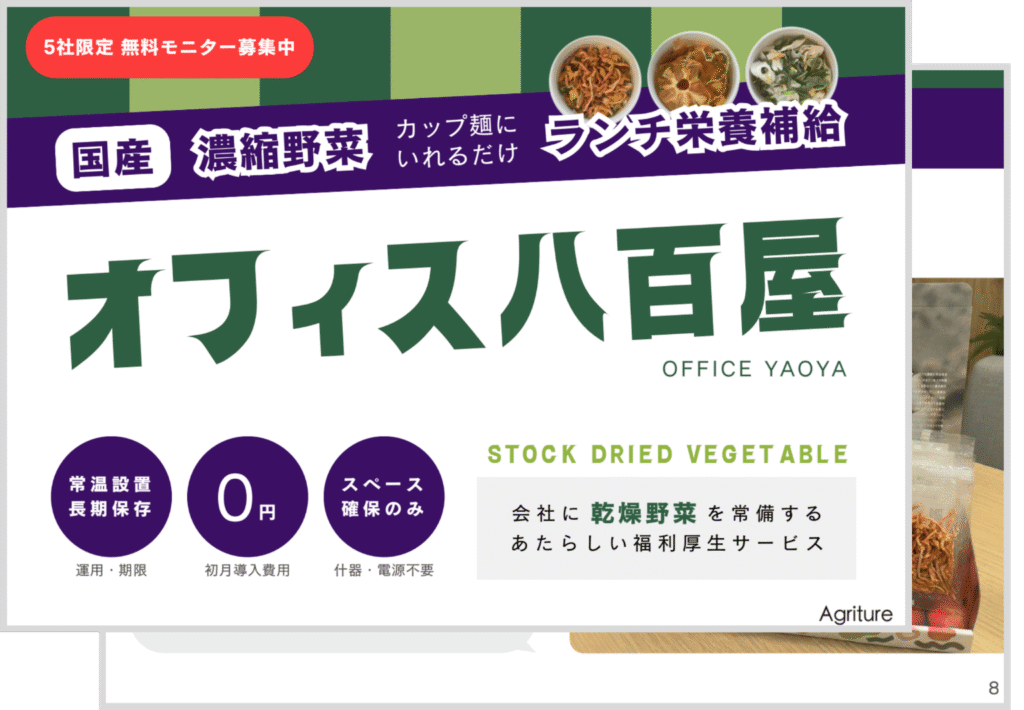
- Service details and vegetable lineup
- Pricing and plans
- How adoption and operation work
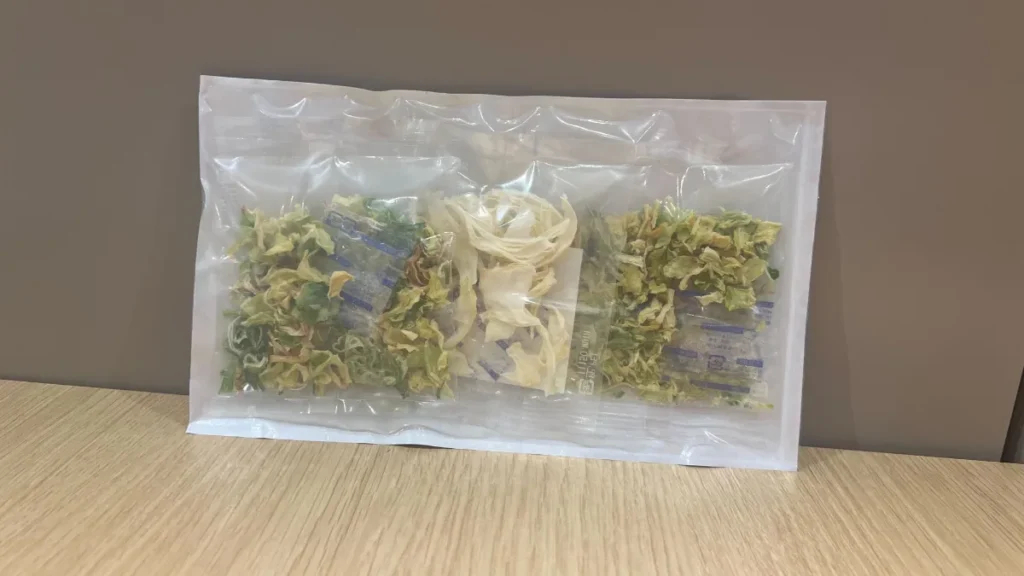
Sample sets are also available. Download the materials for details!
We offer sample sets so you can try Office Yaoya in small quantities. See the materials for details.
5 Steps to Get Started and Common Mistakes
5 Steps to Roll Out the Initiative
- Assess the Current State: Take inventory of existing stockpiles, BCP, and safety-confirmation arrangements
- Identify the Risks: Map out risks such as earthquakes, typhoons, and heavy rain by location
- Set Priorities: Decide the scope of response in the order “protect employees → continue the business → recover”
- Put Systems in Place: Phase in stockpiles (rolling stock), BCP documents, and a safety-confirmation system
- Drill and Review: Confirm effectiveness with 1–2 drills a year and update as needed
You don’t need to have everything perfect from the start. Beginning with “one area that’s easy to tackle” and expanding gradually makes it easier to make the practice stick.
Common Mistake 1: Buying the Stockpile and Calling It Done
“Bought it, then let it expire at the back of the shelf” is the most common pattern. The fix is to build a rolling-stock system (consuming day to day and replenishing). Using a meal-subsidy benefit service or the office greengrocer makes it easier for the person in charge to keep the operation going.
Common Mistake 2: Writing a BCP You Can’t Actually Execute
If the BCP document is thick and only the person in charge understands its contents, it can’t be executed in a disaster. The fix is to distill the procedures into a one-page summary, share it with all employees, and confirm the steps with an annual drill. Having management take part in the drill accelerates buy-in on the front line, too.
Common Mistake 3: Safety Confirmation That Doesn’t Work
Typical cases are leaving the contact chain on paper, or introducing a safety-confirmation system but never using it in drills. The fix is to actually run the system in 1–2 drills a year so employees learn how to operate it. Building safety-confirmation operation into new-hire training keeps it from fading.
FOR BUSINESS
乾燥野菜のミックスを、まとめてお探しですか
用途に合わせて複数の品目を配合した乾燥野菜ミックスをお作りしています。法人の備蓄やローリングストックのご相談も承っています。配合の考え方は 法人向けローリングストック に掲載しています。
少量でのご購入は、姉妹ブランドの通販サイト OYAOYA で承っています。
Common Mistake 4: Overlooking Preparedness for Remote Workers
An office-centered disaster plan alone leaves home-based workers isolated in a disaster. The fix is to add stockpile subsidies for home-based workers and distributed handling via a safety-confirmation app as part of the system. Introducing cloud-based safety confirmation as in Case 8 is also effective.
FAQ | Corporate Disaster Preparedness Initiatives Q&A
Summary | Build Initiatives as a “System You Can Keep Going”
The modern approach to corporate disaster preparedness is to organize it into five areas—advance measures, initial response, business continuity, post-event response, and education and drills—and phase it in to fit your own size and industry. As the 10 cases show, there are patterns scaled to size: large companies pair BCP with company-wide drills, SMEs use minimal stockpiles plus rolling stock, and remote-work companies use subsidies for home-based workers plus cloud safety confirmation.
What draws attention in the 2026 edition is the integration of health management with BCP. Office Yaoya (office greengrocer) Using an employee-benefit service like this lets you balance disaster stockpiles and health management on a single system, easing the burden on the person in charge while also boosting employee engagement.
Related article:
- What is corporate disaster preparedness? 2026 edition | A practical guide advanced through BCP × health management (parent article)
- Complete rolling-stock guide 2026
- [2026 Edition] 7 Recommended Emergency Foods | How to Choose, Checked by Preserved-Food Category
- Corporate Disaster-Stockpile List, 2026 Edition | Office Disaster Supplies & Checklist
- Solving the Vegetable Shortage in Corporate Disaster Preparedness | 7 Recommended Stockpile Vegetables
- Office Yaoya | Just-place-it dried vegetables for disaster preparedness × health management

Download the office dried vegetable materials
We will send the materials to your email address based on the information you provide.