[2026 Edition] 7 Recommended Emergency Foods | How to Choose, Checked by Preserved-Food Category

Summary of this article
On recommended emergency food, we've organized a pre-purchase checklist for the 2026 edition: 6 axes for choosing (shelf life, cookability, nutrition, allergies, taste, quantity), a 7-category classification, stockpile design for households and companies, rolling-stock operation, use in health management × BCP, tips on storage locations, and frequently asked questions.
Emergency food is a genre with a huge number of recommended products, where it's easy to be lost over how to choose. This article narrows it to three things — 6 axes for choosing / 7 categories / stockpile design for households and companies — and organizes them in a checklist format you can use as is before purchasing.
TOC
What is emergency food | The 2026-edition basics and the difference from preserved food and disaster food
Emergency food is stockpiled food for protecting life and health in a situation where lifelines are cut off when a disaster strikes. It's easily confused with "preserved food" and "disaster food," but there are differences in use and shelf life. Following the September 2025 revision of the Nankai Trough long-term assessment and the December 2025 update of the Tokyo metropolitan earthquake damage estimate, both households and companies are continuing to review their emergency food.
The difference among emergency food, preserved food, and disaster food
The three terms overlap a lot, but there are differences in their original definitions. To put the conclusion first, remembering "emergency food = for the 3 days right after a disaster / preserved food = for everyday and disaster use both / disaster food = the contents of set products" will keep you from getting lost at purchase. Building a stockpile while confusing them causes problems like "can't eat it in daily life" and "letting the best-before date lapse."
| Name | Main meaning | Shelf-life guide | Central use |
|---|---|---|---|
| Emergency food | Food for surviving the 72 hours right after a disaster strikes | 3-7 years | During power outages, water outages, and evacuation |
| Preserved food | Long-storable food in general (including umeboshi and dried goods) | 6 months–several years | Everyday + disaster use both |
| Disaster food | Food designed for disaster preparedness (porridge, bread, etc.) | 3–5 years | Within a disaster-supply set |
In this article, centered on "emergency food" usable by both households and companies, we organize recommendations across a wide range of options including preserved food and disaster food.
Emergency-food trends to watch in 2026
The prominent moves in the 2025-2026 emergency-food market are the following four. Each connects directly to how you choose, so grasp them before purchasing.
- The mainstreaming of 5-7-year storage types: a shift from the conventional 3-year type to long-storage products, reducing the replacement cycle
- Emphasis on tastiness: more products developed with taste-testing by professionals, reducing "tastes you don't want to eat in a disaster"
- Integration with rolling stock: the style of stockpiling while consuming day to day becoming standard for households and companies
- Support for allergies and dietary restrictions: expansion of gluten-free, vegan, and halal-compatible emergency food
Three reasons emergency food is necessary
Stockpiling emergency food is not "insurance you might use someday" but infrastructure that directly supports survival and business continuity when a disaster strikes. Organizing the reasons to prepare — in both households and companies — keeps your selection priorities from wavering.
Surviving the 72 hours until relief supplies arrive
It usually takes 2-3 days from the occurrence of a major disaster until relief supplies from local or national government arrive. Verification of the Great Hanshin-Awaji and Great East Japan earthquakes confirmed that about 72 hours is the guideline until wide-area supply transport functions. To ride out the first three days on your own, 3 days of emergency food per person and 9 L of drinking water are the minimum line for households and companies alike.
Preventing nutritional deficiency and worsening health
Spending three days on staples and canned goods alone leads to a shortage of vitamins, minerals, and dietary fiber, making health problems like constipation, mouth sores, and fatigue more likely. To maintain the performance of family and employees, keeping 6-9 packs of side dishes or vegetable-based emergency food per person gives peace of mind. For detailed nutritional measures, see Solving the Vegetable Shortage in Corporate Disaster Preparedness | 7 Recommended Stockpile Vegetables.
For companies, business continuity and the duty of care for employee safety
For companies, the duty of care under Article 5 of the Labor Contract Act, the Tokyo Metropolitan ordinance on stranded persons, and the like require a stockpile of 3 days per employee. From a BCP (business continuity plan) standpoint too, an emergency-food stockpile connects directly to maintaining the productivity of employees carrying out recovery work, so it's positioned as business infrastructure. For details, see What Is Corporate Disaster Preparedness? 2026 Edition | A Practical Guide Driven by BCP x Health Management.
FOR BUSINESS
乾燥野菜を業務用でお探しですか
国産の野菜・果物を乾燥し、必要に応じて粉砕してお出ししています。扱っている品目は100種前後で、規格は 乾燥品の一覧・パウダーの一覧 に掲載しています。
少量でのご購入は、姉妹ブランドの通販サイト OYAOYA で承っています。
How to choose emergency food | 6 points to avoid failure
Emergency food has a huge number of recommended products, with a range of prices, shelf lives, and tastes. We organize how to choose without failing into six points. These are basic axes common to households and companies alike.
1. Shelf life (3 years / 5 years / 7 years)
The longer the shelf life, the less frequent the replacement and the lower the disposal cost. Alpha rice and hardtack are mainly 5 years, long-storage bread 5 years, and long-storage water 5-7 years. On the other hand, dried vegetables, canned goods, and retort food are shorter at 6 months to 3 years, but they suit an operation of stockpiling while consuming day to day via rolling stock.
2. Ease of cooking (whether water, fire, or power is needed)
During power and water outages, cooking equipment and water are limited. Prioritize products with little cooking effort, such as "just pour hot water," "eat as is at room temperature," or "5 minutes on a portable stove." Considering the stress and fatigue during a disaster, no-heat, no-equipment types should be central. Alpha rice, retort rice, canned goods, and nutritional supplement foods are representative examples you can eat as is.
3. Nutritional balance (staple, main dish, side dish)
Staples alone can't support three days of nutrition. Assembling the three groups — staples (rice, bread, noodles), main dishes (canned goods, retort), and side dishes (dried vegetables, dried goods, vegetable juice) — is the basic. How you supplement vitamins, minerals, and dietary fiber becomes the dividing line for maintaining health during a disaster.
4. Support for allergies and dietary restrictions
If there are people needing allergy accommodation among family or employees, always check the ingredient listing. In addition to the 7 specified ingredients — egg, milk, wheat, peanut, shrimp, crab, and buckwheat — emergency food supporting all 28 allergen items is also increasing. Options by dietary restriction — gluten-free, vegan, halal, and so on — are also expanding in 2026.
5. Closeness to familiar, preferred tastes
Under the stress of a disaster, there are cases where people can't touch unfamiliar tastes. Even in survivors' accounts, many say "I could eat with peace of mind when it was the taste of a maker I eat day to day." We recommend actually taste-testing at the annual disaster drill to confirm it suits the tastes of family or employees.
6. Stockpile amount according to family or employee numbers
"1 person × 3 meals a day × 3 days = 9 meals" is the basic unit. For a family of 4 that's 36 meals; for a 50-person office, 450 meals. Furthermore, drinking water is 1 person × 3 L × 3 days = 9 L, 36 L for a family of 4, and 450 L for 50 people. Stock dried vegetables at a guide of 6-9 packs per person, to reinforce nutritional balance. Detailed required amounts by employee number are Corporate disaster stockpile list, 2026 edition we've put into a table.
The 7 emergency-food categories by genre
Emergency food has different roles by genre. Leaning on just one genre creates a bias in nutrition and taste, so combining multiple categories is the basic. This article's "7 recommended picks" also selects one item from each of these 7 categories.
| Category | Representative products | Role | Storage period |
|---|---|---|---|
| Staple (rice-based) | Alpha rice, retort rice, porridge | Carbohydrate source, staying power | 3–5 years |
| Staple (bread-based) | Long-storage bread, hardtack | Breakfast substitute, for children | 1–5 years |
| Staple (noodle-based) | Cup noodles, instant noodles | Variety in taste, done with just hot water | 6 months |
| Main and side dishes | Canned goods (tuna, mackerel, corn) | Protein Source | 2–3 years |
| Side dish, nutritional reinforcement | Dried vegetables, dried goods, vegetable juice | Vitamins, minerals, dietary fiber | 6 months–1 year |
| Soup / broth dishes | Instant miso soup, freeze-dried soup | Hydration and salt replenishment | 6 months–1 year |
| Snacks and nutritional supplements | Yokan, biscuits, jelly, nutrition bars | For children and elderly, calorie supply | 3–5 years |
Stockpiling emergency food so as to fill in this category table rounds out the variety of nutrition and taste. In the next section, we introduce the "7 recommended picks," one representative item selected from each of the 7 categories.
7 recommended emergency foods | The selection axis within each category
Once you've grasped the whole picture with the category table, the next issue is "specifically which type to choose" within each category. Even the same "alpha rice" varies in use between plain-rice, mixed-rice, and porridge types, so selecting in two stages — category → type — is the basic.
| We organize in a list the 22 Miyagi heirloom vegetables certified by the Japan Heirloom Vegetable Promotion Association, and in the following section explain 7 representative items in detail. First, let us grasp the whole picture. | Category | Type to select | The axis for choosing |
|---|---|---|---|
| No.1 | Staple (rice) | Alpha rice: plain-rice type / seasoned type / porridge type | Divide by taste preference and salt intake. In a disaster, the porridge type is handy as it doubles for hydration |
| No.2 | Side dish, nutritional reinforcement | Dried vegetables: leafy (spinach) / root vegetables (daikon) / mushrooms | Choose a combination that supplements the often-lacking vitamins A and C and dietary fiber |
| No.3 | Main dishes (protein) | Canned goods: fish (tuna, mackerel) / beans (soybeans, chickpeas) / meat (yakitori, corned beef) | Use by purpose: fish = omega-3, beans = dietary fiber, meat = high calorie |
| No.4 | Staple (bread) | Long-storage bread: plain / chocolate / fruit | Sweeter for children; a sweet taste is effective for easing stress |
| No.5 | Staple (noodles) | Cup noodles: non-fried / fried-noodle / broth-heavy type | Fried noodles for calorie priority; non-fried for a family with salt restrictions |
| No.6 | Soup / broth dishes | Miso soup / consommé / Chinese-style soup | Stock a rotation of 3 flavor lines that don't overlap with the staples' flavors |
| No.7 | Snacks and nutritional supplements | Yokan / biscuits / nutrition bar | Yokan = high-sugar for fatigue recovery, bar = portability, biscuits = for children |
Choosing with an awareness of type, not just category, lets you avoid overlapping flavors and biased nutrition. No.2 dried vegetables and No.3 canned goods are especially important for a stockpile whose nutrition tends to be biased toward staples alone. For details on how to choose stockpile vegetables, see Solving the Vegetable Shortage in Corporate Disaster Preparedness | 7 Recommended Stockpile Vegetables.
An example combination of 3 days per person
Here's an example combination of 3 days per person using the 7 picks above. Two staple types + a side dish + soup + a snack make a day's menu.
- Day 1: breakfast = long-storage bread + soup / lunch = alpha rice + canned goods / dinner = cup noodles + dried vegetables
- Day 2: breakfast = hardtack + yokan / lunch = retort rice + canned tuna / dinner = alpha rice + miso soup + dried vegetables
- Day 3: breakfast = nutrition bar + soup / lunch = cup noodles + canned goods / dinner = alpha rice + dried vegetables + a snack
Be sure to prepare drinking water separately, at 3 L a day × 3 days = 9 L. Households with children, elderly people, or those with allergies should add dedicated items.
Usable for company stockpiles too | Emergency-food operation in health management × BCP
For company stockpiles, unlike households, you build on the premise of "business continuity" and "employees staying for 3 days." For a 50-person office, guides are 450 L of drinking water, 450 meals of staples, 150 cans of canned goods, 300-450 packs of dried vegetables, and 750 uses of simple toilets. The Office Yaoya (office greengrocer) operated by Agriture is a mechanism that keeps dried vegetables and instant miso soup stocked as an employee benefit, where employees consume it day to day and the same stock also becomes emergency food.
Why a benefit-style inventory operation suits companies
The conventional model of bulk-buying general emergency food and storing it in a locker has three problems specific to companies.
- Disposal cost from best-before dates lapsing: it becomes a bulk disposal once every 5 years, and about 145,000 yen for 50 people becomes garbage all at once
- The handover between staff breaks down: when the stockpile officer changes due to a personnel transfer, best-before-date management tends to stop
- Employees aren't used to the "disaster-use" taste: when it comes to it, they don't touch it / digestive trouble occurs
The way to solve these three is a benefit-style operation that "keeps everyday-consumed ingredients constantly in stock as a stockpile." It minimizes the officer's effort, prevents best-before dates from lapsing, and keeps a familiar taste.
Basic Service Specifications
We've put the main specifications of Office Yaoya into a table. Centered on dried vegetables and miso soup, it's designed to be kept at employees' desks or the pantry and consumed day to day.
| Item | Details |
|---|---|
| Ingredient | Dried vegetables (about 100 varieties), dried fruit, and instant miso soup |
| Specifications | Individually wrapped 3–8 g portions, no rehydration needed, room-temperature storage of 3 months or more |
| Price | Per serving From 100 yen |
| Initial cost | Free (a plan with zero cost to the company is available) |
| Target Scale | Supported from small offices of 10 people or fewer |
| Raw materials | 100% domestically grown vegetables, no added sugar or additives, low-temperature dried |
For officers who feel "it's hard to keep running emergency food in-house" or "we also want to advance dietary improvement in health management," a benefit service with an automated delivery cycle is a realistic option. For detailed case studies of introduction, see 10 examples of corporate disaster-preparedness initiatives.
Learn about Office Yaoya
We have prepared materials
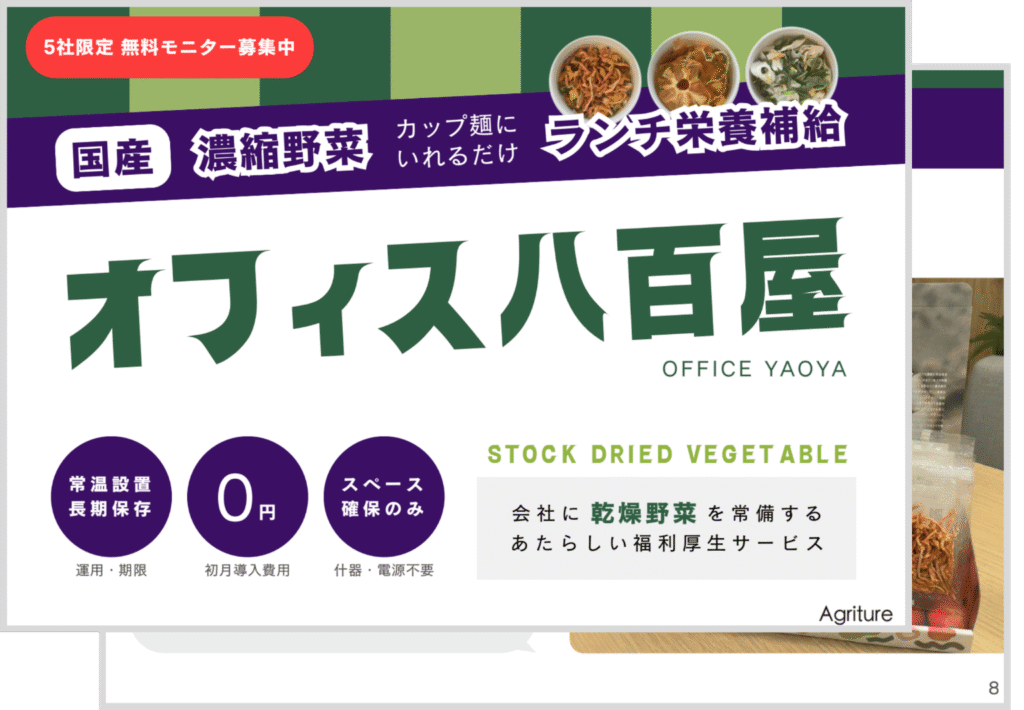
- Service details and vegetable lineup
- Pricing and plans
- How adoption and operation work
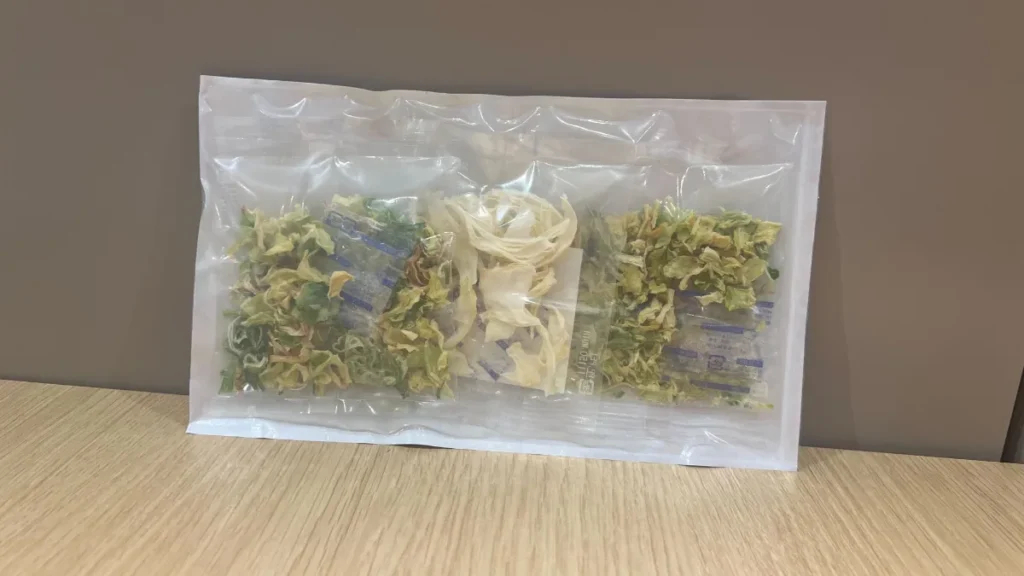
Sample sets are also available. Download the materials for details!
We offer sample sets so you can try Office Yaoya in small quantities. See the materials for details.
How to rotate emergency food with rolling stock
Switching from the model of "bulk-buy once every 5 years → total disposal at the best-before date" to rolling stock, where you "consume day to day and replenish what you use," can bring disposal cost close to effectively zero. In a 50-person company's estimate, simply switching from the conventional model, which disposed of about 145,000 yen every 5 years, to a rolling-stock operation leads to cost savings.
Emergency food suited to rolling stock
Not all emergency food suits rolling stock. The balance between best-before date and ease of everyday consumption is the key.
- Suited: dried vegetables (6 months-1 year), canned goods (2-3 years), retort food (1-3 years), cup noodles (6 months)
- Not suited: alpha rice (5 years, hard to eat day to day), hardtack (5 years, not everyday-friendly), long-storage water (7 years, hard to consume in bulk)
A two-layer structure — managing long-storage types separately as "disaster-only stock" and rotating the shorter-best-before categories through everyday consumption + replenishment — is efficient. For detailed operational design, see Complete rolling-stock guide 2026.
Tips for storing and managing emergency food
For emergency food, "where you keep it" and "how you manage it" change how easy the operation is to keep up. Distributed storage is the basic for households and companies alike.
Household storage locations
- Under the kitchen / pantry: everyday-consumed items like dried vegetables, canned goods, and retort
- Closet / storage cupboard: disaster-use stock like alpha rice, long-storage water, and hardtack
- Entryway / bedroom: emergency go-bag (the first-tier set to carry out when evacuating)
Company storage locations
- Pantry / break space: everyday-consumed rolling-stock items (dried vegetables, miso soup, snacks)
- Warehouse / locker room: long-storage items (alpha rice, long-storage water, simple toilets)
- Each desk drawer: personal kits (nutrition bar, 500 ml water, regular medication)
Concentrating storage at a single site risks total loss in an earthquake or flooding, so distributed placement by floor and department is safer. Avoid direct sunlight and high heat and humidity, choosing a place with little temperature change.
FOR BUSINESS
乾燥野菜を業務用でお探しですか
国産の野菜・果物を乾燥し、必要に応じて粉砕してお出ししています。扱っている品目は100種前後で、規格は 乾燥品の一覧・パウダーの一覧 に掲載しています。
少量でのご購入は、姉妹ブランドの通販サイト OYAOYA で承っています。
How to manage best-before dates
"First in, first out" — consuming in order of the nearest best-before date — is the basic. Some companies manage it with a spreadsheet, but simpler is an operation of "write the purchase date and best-before date on the product label with a permanent marker + inspect once a month." Setting a reminder to review in bulk during September's disaster-preparedness month lets 1-2 inspections a year suffice.
Frequently asked questions | Recommended emergency-food Q&A
Summary | Prepare emergency food with "full category coverage × a sustainable mechanism"
The 2026-edition standard is to think of recommended emergency food not as one specific product but as a "stockpile makeup covering the 7 categories." Combining 2-3 staple types, a main dish (canned goods), a side dish (dried vegetables), soup, and snacks, and rounding it out to 3 days per person × your family or employee count, prevents biased nutrition and taste.
The key to keeping a stockpile going is rotating everyday consumption + replenishment via rolling stock. For a household, keep dried vegetables and canned goods stocked in the kitchen; for a company, there's the option of automating it with a benefit service like Office Yaoya (office greengrocer). Being able to achieve both health management and BCP with a single mechanism is what companies value.
Related article:
- The Complete Rolling Stock Guide 2026 | 7 Recommended Foods and How to Use Dried Vegetables
- Corporate Disaster-Stockpile List, 2026 Edition | Office Disaster Supplies & Checklist
- Solving the Vegetable Shortage in Corporate Disaster Preparedness | 7 Recommended Stockpile Vegetables
- What Is Corporate Disaster Preparedness? 2026 Edition | A Practical Guide Driven by BCP x Health Management
- Office Yaoya | Just-place-it dried vegetables for disaster preparedness × health management

Download the office dried vegetable materials
We will send the materials to your email address based on the information you provide.