What's the Difference Between Yakuzen and Kampo? A Gentle Look at Food vs. Crude Drugs, Purpose, and Philosophy

Summary of this article
Yakuzen (medicinal cuisine) and kampo share the same foundation in Eastern medicine but stand in different positions — "meals" versus "medicine." A dried-vegetable maker that runs the yakuzen media "Yasai Yakuzen" gently sorts out the differences in purpose, ingredients, and legal positioning, and the relationships among Eastern medicine, Chinese medicine, kampo, and yakuzen.
Have you ever felt "yakuzen and kampo seem similar — where do they differ?" Because both have Eastern medicine as a backdrop, they tend to be confused, but they're distinctly different things with clearly different positions.
This page sorts out the difference between yakuzen and kampo in order — purpose, thinking, ingredients used, and legal positioning — from the angle of "meals" versus "medicine." Along the way, we'll also untangle the relationships among the confusing terms Eastern medicine, Chinese medicine, kampo, and yakuzen. From our standpoint running the yakuzen media "Yasai Yakuzen" as a group, we convey specialized content in terms closer to everyday intuition. Note that this article introduces the traditional ideas of Eastern medicine and does not guarantee the treatment or prevention of any specific illness.
TOC
The difference between yakuzen and kampo in a word: "meals" or "medicine"
Before getting into the details, let's cover the biggest difference. Roughly dividing it as "kampo = medicine" and "yakuzen = meals" makes the overall picture easier to grasp.
Kampo is "medicine" using crude drugs
When people say kampo, they usually mean "kampo medicine." Kampo medicine is a drug that combines crude drugs made from plant roots, bark, minerals, and the like according to fixed formulas. It's prescribed at medical institutions or bought at pharmacies, and used for physical ailments. Being treated strictly as a pharmaceutical is a major characteristic of kampo.
Yakuzen is "meals" using familiar ingredients
Yakuzen, on the other hand, is meals using everyday ingredients. Based on the ideas of Eastern medicine, ingredients are chosen to match the body's state and the season, but what's used is mainly vegetables and dried goods you can get at the supermarket. Since it's meals rather than medicine, it's something to keep up within reason as part of the daily table.
The shared foundation is the thinking of Eastern medicine
The forms differ — "medicine" and "meals" — but both are founded on the same thinking of Eastern medicine. The properties of ingredients and crude drugs, such as warming or cooling the body, and the ways of grasping the body's balance, are shared. That's exactly why they look similar, but the situations they're used in and how they're treated clearly differ. We've summarized the main differences in a table.
| Point of comparison | Kampo (kampo medicine) | Yakuzen |
|---|---|---|
| Form | A medicine combining crude drugs | Meals using ingredients |
| Main purpose | Approach to ailments | Everyday self-care and health maintenance |
| Ingredients used | Crude drugs (specialized materials) | Mainly familiar ingredients |
| How it's treated | Pharmaceutical | Food |
| People involved | Doctors, pharmacists, and the like | You can practice it yourself day to day |
Sorting out the terms: the relationship among Eastern medicine, Chinese medicine, kampo, and yakuzen
To grasp the differences correctly, sorting out the relationships among the surrounding terms keeps things from getting confusing. Eastern medicine, Chinese medicine, kampo, and yakuzen each refer to something different.
Eastern medicine, the largest umbrella
The broadest umbrella is "Eastern medicine." It refers to the system of traditional medicine originating in China, and the thinking behind using crude drugs, acupuncture and moxibustion, and self-care through food all fall within this large frame. Kampo and yakuzen are like siblings raised from the same soil of Eastern medicine.
Kampo developed independently in Japan
Chinese medicine is said to have reached Japan around the 5th–6th century, after which it developed independently to suit Japan's climate and the Japanese constitution. Against Western medicine, which was called "ranpo" (Dutch medicine) in the Edo period, the Japanized medicine of Chinese origin was called "kampo" to distinguish it — this is said to be the origin of the term. It differs little by little from China's "Chinese medicine," which shares the same source, in how diagnosis proceeds and how formulas are conceived.
FOR BUSINESS
乾燥野菜を業務用でお探しですか
国産の野菜・果物を乾燥し、必要に応じて粉砕してお出ししています。扱っている品目は100種前後で、規格は 乾燥品の一覧・パウダーの一覧 に掲載しています。
少量でのご購入は、姉妹ブランドの通販サイト OYAOYA で承っています。
Yakuzen is based on the food ideas of Chinese medicine
Yakuzen is a style of meals based on the idea within Chinese medicine of "self-care through food." In Japan, yakuzen based on Chinese medicine is widely known, but there's also a Japanese food-based self-care that incorporates the ingredient wisdom of kampo. In any case, yakuzen can be understood not as "medicine itself" but as its thinking translated to the table.
The difference in purpose and thinking: treatment versus self-care
The difference in the situations they're used in comes from the difference in purpose. Kampo and yakuzen differ in the object they face and the distance of their approach.
Kampo is an approach to ailments and illness
Kampo medicine is a pharmaceutical used against ailments that have already appeared. The basic flow is that a specialist assesses one's constitution and symptoms, then selects the formula that suits that person. Understanding that what to choose is decided not by self-judgment but by consulting a doctor or pharmacist gives peace of mind.
Yakuzen is for pre-illness and everyday self-care
What yakuzen faces is less clear illness than the state before it, called "mibyo" (pre-illness), and daily health management. Eastern medicine has a way of thinking that grasps as mibyo a state that isn't illness but isn't in top form either, and yakuzen stands on the idea of being mindful of this stage through everyday meals. It's closer to the image of tuning than curing.
The ancient Chinese idea of the "food physician"
A story showing how much self-care through food was valued is the ancient Chinese "food physician." At the time, physicians were divided by role, and the "food physician," who tuned one's condition through meals, was placed at the top, while the "disease physician," who treated illness, was said to be beneath. The idea of valuing self-care through food before falling ill can be understood as a thinking at the root of yakuzen.
The difference in ingredients used: crude drugs and food ingredients
When the purpose differs, the ingredients used differ too. In kampo and yakuzen, the character of the materials handled is clearly divided.
Crude drugs are materials handled by specialists
The crude drugs that are the raw materials of kampo medicine are plant roots, bark, fruit, minerals, and the like, processed by fixed methods. There are detailed rules on type, formulation, and amount, and they're handled under specialized knowledge. Their character differs from ingredients you use casually as everyday food.
Yakuzen is centered on familiar ingredients
What yakuzen uses is mainly things you can get at a food store — ginger, green onion, daikon, shiitake, jujube, hato-mugi, and so on. Even without gathering special crude drugs, you can start by re-selecting familiar vegetables and dried goods from the perspective of Eastern medicine. At Yasai Yakuzen too, we value this idea of "yakuzen that starts from the ingredients at hand."
Things used in both, like ginger and jujube
Yakuzen and kampo are easily confused because the boundary isn't cleanly divided. There are things used both as crude drugs and as food ingredients, and ginger, jujube, and cinnamon (keihi) appear in kampo-medicine crude drugs as well as in yakuzen ingredients. The idea of ishoku-dogen — "food and medicine share the same source" — appears in these overlaps. Even the same material is handled differently in yakuzen versus kampo.
| Material | Handling in yakuzen | Handling in kampo |
|---|---|---|
| Ginger | As a garnish for dishes or an ingredient in soups | In formulas as the crude drug "shokyo" (ginger) |
| Jujube | Eaten as is or in simmered dishes | In formulas as the crude drug "taiso" (jujube) |
| Cinnamon (keihi) | For flavoring sweets and drinks | In formulas as the crude drug "keihi" (cinnamon bark) |
The difference lies less in what you use than in for what purpose and how you handle it. The dividing line is that in yakuzen you use it as a food ingredient in everyday amounts in cooking, while in kampo you use it as a crude drug in fixed formulas and amounts as medicine.
The difference in legal positioning: pharmaceuticals and food
It's surprisingly overlooked, but kampo and yakuzen are clearly treated differently in law. Knowing this helps in how you take in information too.
Kampo medicine is a pharmaceutical
Kampo medicine is treated as a pharmaceutical and is permitted to indicate efficacy and effects. That's exactly why there are rules on quality and use, and why using it under a specialist is the premise. Being able to explain "this formula is for this kind of ailment" is something unique to pharmaceuticals.
Yakuzen is food (efficacy can't be claimed)
In contrast, yakuzen is, after all, food. Even the same ingredient is food if served as ordinary cooking, but selling it claiming "this illness will be cured" becomes a problem as a drug-like expression. This is why yakuzen recipes and ingredient introductions avoid expressions that assert efficacy. This article too introduces the workings of ingredients in the form "in Eastern medicine it's said to be ~," because yakuzen stands in the position of food.
How to work it into life: how do you use each?
Once you understand the differences, it becomes clear which to rely on and how. Rather than as opposites, use them by situation as things with different roles — that's recommended.
For lingering ailments, consult a specialist
When a troubling ailment continues, or when there are clear symptoms, the basic approach is not to rely on your own judgment and meals alone, but to consult at a medical institution or pharmacy. Whether kampo medicine is needed is also something to leave to a specialist's assessment for peace of mind. Yakuzen is not a substitute for such specialized care.
Bring the thinking of yakuzen to everyday meals
On the other hand, everyday meals are the setting to incorporate the thinking of yakuzen. Small tweaks are enough — adding ginger to miso soup, adding one seasonal vegetable. The habit of choosing ingredients to match your constitution and the season is something you can practice in daily life even without being a specialist. For the full picture of yakuzen, the page explaining what yakuzen is.
From familiar domestic ingredients
Even without seeking out imported crude-drug-like ingredients, you can fully incorporate the thinking of yakuzen with domestic vegetables and dried goods. Which domestic ingredients you can use in yakuzen is the page on domestic yakuzen ingredients sorted out here. Turning them into dried vegetables keeps them well and lets you use them just by adding a little to soups or simmered dishes. The group's D2C brand "OYAOYA” also proposes Kyoto-grown dried vegetables in a yakuzen context.
A product catalog that shows around 100 items we handle
Agriture, flexibly handling everything from small lots to large lots
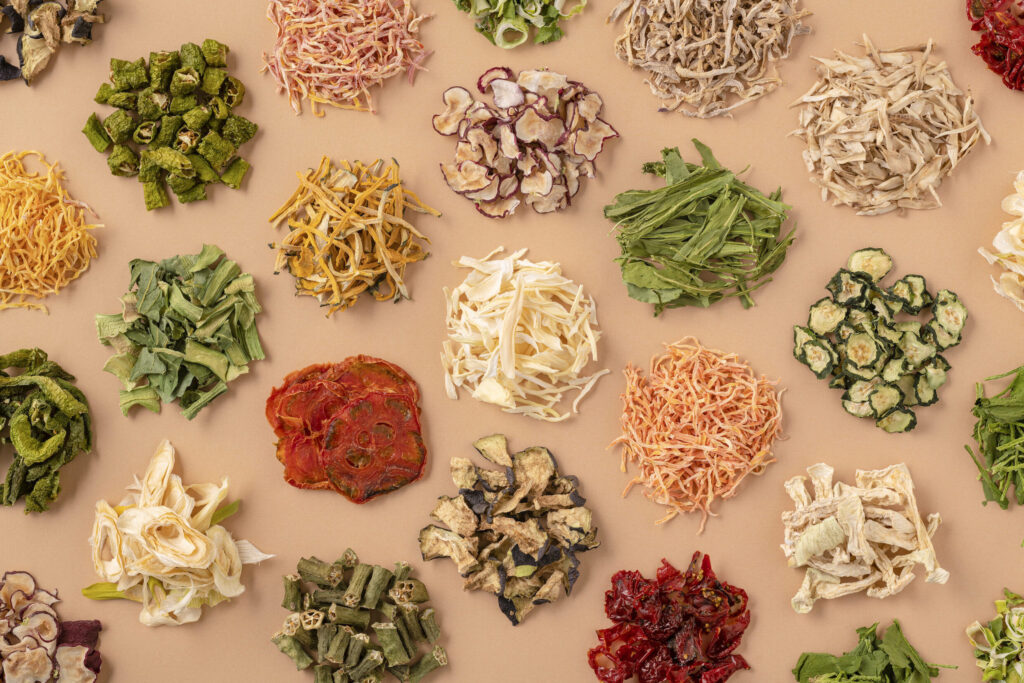
- Available for purchase in small lots from 1 kg
- We handle heirloom vegetables from across Japan
- Dried fruit and herbs also supported
Applying the thinking of yakuzen to product development (for businesses)
From here on is a discussion for businesses developing food products. Given the difference between yakuzen and kampo, what you can make use of in food-making is "the thinking of yakuzen." Since yakuzen stands in the position of food, you can develop it into products and menus with the combination of ingredients and seasonality as the concept, without asserting efficacy. Using dried vegetables, powders, and blend ingredients, you can develop products that make use of the yakuzen context from small lots. There are various forms too — yakuzen tea, yakuzen dashi, yakuzen furikake, and more. For making yakuzen tea, the explanation of yakuzen tea OEM, and for foods other than tea such as dashi, furikake, and powder, the explanation of yakuzen food OEM.
FOR BUSINESS
乾燥野菜を業務用でお探しですか
国産の野菜・果物を乾燥し、必要に応じて粉砕してお出ししています。扱っている品目は100種前後で、規格は 乾燥品の一覧・パウダーの一覧 に掲載しています。
少量でのご購入は、姉妹ブランドの通販サイト OYAOYA で承っています。
Frequently asked questions
Download the product catalog
We will send the materials to your email address based on the information you provide.
Summary: knowing the difference lets you use them well by situation
Yakuzen and kampo, while founded on the same Eastern medicine, stand in different positions — "meals" and "medicine." Keeping in mind the difference — kampo medicine as a pharmaceutical facing ailments, used under a specialist, and yakuzen as meals for everyday self-care that you can practice yourself — makes you less likely to be swayed by information.
Consult a specialist for troubling ailments, and at the daily table, choose familiar ingredients with the thinking of yakuzen. This use-by-situation is a way of getting along with Eastern medicine you can keep up without strain. The group's yakuzen media "Yasai Yakuzen” also introduces yakuzen-focused explanations for each vegetable.