
How to start a yakuzen tea OEM | A product development guide that makes use of the wisdom of Eastern medicine

Summary of this article
Medicinal tea OEM is a system that lets you plan and sell health teas combining tea leaves, crude drugs, and medicinal-cuisine (yakuzen) materials—based on the theories of the four qi and five flavors, meridian tropism, and qi-blood-body fluids in Traditional Chinese Medicine—without your own facilities. This article explains the difference between medicinal tea and herbal or health tea, the four product types of seasonal, constitutional, symptom, and vegetable-yakuzen, the practicalities of raw material selection and blend design, how to choose an OEM manufacturer, 7 leading companies handling medicinal tea and health tea OEM, the manufacturing process and lead time, and sales strategies for mail-order and cafés—delivered by Kyoto-born dried vegetable OEM company Agriture, drawing on its insights from operating a yakuzen media outlet.
Medicinal tea OEM is a system that lets you plan and sell original health teas—crude drugs and tea leaves blended based on the thinking of Eastern medicine—without owning your own manufacturing facilities. Because you can outsource everything from blend design, raw-material procurement, and manufacturing to packaging, you can launch a differentiated health tea brand while keeping initial investment down.
While handling dried vegetable OEM processing in Kyoto, Agriture operates the yakuzen media outlet "Yasai Yakuzen," and under the supervision of a yakuzen practitioner, supports product development combining vegetables and yakuzen materials. This article explains everything about medicinal tea OEM, from the basics to raw material selection, manufacturer comparison, the manufacturing flow, and sales strategy, drawing on hands-on insights from contract processing.

TOC
What is medicinal tea? | The difference from herbal tea and health tea
Medicinal tea is a tea that combines tea leaves, crude drugs, and yakuzen materials to suit one's constitution, season, and symptoms, based on theories of Traditional Chinese Medicine (Eastern medicine) such as the "four qi and five flavors," "meridian tropism," and "qi-blood-water." Its design philosophy differs from herbal teas and health teas that simply claim health effects.
The basics of yakuzen | Four qi and five flavors, meridian tropism, qi-blood-water
In Traditional Chinese Medicine, each ingredient and crude drug is defined with a "nature (four qi)," a "flavor (five flavors)," and "organs it acts on (meridian tropism)," and the basic idea of yakuzen is to balance the body by combining these to suit the reader's condition and the season. In designing medicinal tea, it is common to select raw materials while keeping these three axes in mind.
| Theory | Details | Meaning in blend design |
|---|---|---|
| Four qi | Cold, cool, warm, hot (+ the intermediate "neutral") | Select materials by whether you want to warm or cool the body |
| Five flavors | The five flavors of sour, bitter, sweet, pungent, and salty | Target the organs to act on through combinations of flavors |
| Meridian tropism | The meridians and organs the material relates to (liver, heart, spleen, lung, kidney, etc.) | Work backward to materials from the effect you want to aim for |
| Qi, blood, body fluids (qi-blood-water) | The three elements that circulate through the body. In Japanese yakuzen also called "qi-blood-water" | Used for constitution-based design such as "deficiency of qi" and "stagnation of blood" |
The difference between herbal tea, health tea, and medicinal tea
The boundaries among the three are vague, but there are clear differences in design philosophy, raw materials, and appeal points.
| Type | Design philosophy | Main raw materials | Appeal point |
|---|---|---|---|
| Herbal tea | The aroma and gentle action of Western herbs | Chamomile, peppermint, rooibos, etc. | Relaxation, palatability |
| Health tea | Appeals to the health function of the material (both single-material and blended) | Barley tea, tochu tea, black soybean tea, burdock tea, blended health teas, etc. | The functionality of each material |
| Medicinal tea | Combines multiple materials based on TCM theory | Crude drugs, tea leaves, dried vegetables, fruits | Comprehensive design suited to constitution, season, and symptoms |
Types of medicinal tea OEM and angles for differentiation
Products you can launch with medicinal tea OEM are broadly divided into four types by appeal axis. Which angle you design around changes the target segment, blend content, and sales channel.
4 product types
| Type | Appeal axis | Example | Main target |
|---|---|---|---|
| Seasonal type | Responds to condition changes across the four seasons | Summer heat-clearing tea, winter warming-tonic tea | Gift and D2C segments seeking seasonal products |
| Constitutional type | Designed by constitution of qi-blood-water and yin-yang | For the qi-deficiency type, for the blood-stasis type | E-commerce brands linked with constitution diagnosis |
| Symptom type | Concrete concerns such as fatigue, swelling, coldness, and sleep | Swelling-care tea, sleep-support tea | Health-conscious women, senior segment |
| Vegetable-yakuzen type | The crossing of domestic vegetables × yakuzen materials | Blood-nourishing tea of beet × jujube | Segments seeking a natural feel and affinity with food |
The differentiation angle of vegetables × yakuzen
Many medicinal teas on the market are crude-drug-centered blends, but designs that incorporate dried vegetables or vegetable powder as a base material are relatively rare. In "Yasai Yakuzen," operated by Agriture, familiar vegetables are reorganized through yakuzen theory under the supervision of a professional yakuzen practitioner, making a design you can start from materials available at the supermarket. This angle of "yakuzen starting from vegetables" has the effect of lowering the entry barrier for consumers unfamiliar with crude drugs.
For example, dried beets,is positioned in yakuzen terms as a material that nourishes blood, and dried carrots as a material that supplements qi. By combining these with crude drugs and a base tea leaf, you can create an original category of "domestic vegetables × yakuzen." For contract processing of dried vegetables, please also refer to the explanatory article on vegetable powder OEM.
Design points for raw materials and formulation
The quality of medicinal tea is largely determined by raw material selection and formulation design. To achieve both functionality and drinkability, thinking in a three-layer structure of base tea leaf, crude-drug material, and vegetable material makes it easier to build the blend.
How to choose the base tea leaf
| Base | Features | Yakuzen materials that go well with it |
|---|---|---|
| Green tea | A crisp taste, contains caffeine | Chrysanthemum, Job's tears, mugwort |
| Oolong tea | A light astringency and floral aroma | Aged citrus peel, jujube, ginger |
| Black tea | A rich taste, warms the body | Cinnamon, ginger, goji berry |
| Rooibos, three-year bancha | Caffeine-free | Mugwort, black soybean, mulberry leaf |
Combining crude drugs and yakuzen materials
A practical structure is to decide 1–2 lead materials, add 2–3 supporting materials, and finish with 1 for aroma or flavor adjustment. Choose the lead as a material directly tied to the appeal point (e.g., Job's tears for a swelling-care tea), the support as materials that balance the meridian tropism and four qi, and the finish as a material that improves drinkability (aged citrus peel or ginger).
- Lead material (1–2 kinds): the central material directly tied to the appeal effect
- Supporting materials (2–3 kinds): balance the meridian tropism and four qi
- Finishing material (1 kind): the aroma/flavor arranger (aged citrus peel, ginger, cinnamon, etc.)
How to proceed with prototyping and tasting
At the prototype stage, make 3–5 patterns with varying blend ratios and evaluate taste, aroma, color, cloudiness after brewing, and drinkability after cooling. Taking blind feedback from 5–10 monitors close to the target segment lets you pick up quirks that developers tend to overlook. In Agriture's contract processing, we flexibly support everything from prototyping with client-supplied materials to small-lot manufacturing.
How to choose a medicinal tea OEM manufacturer
Manufacturers able to handle medicinal tea OEM are divided into three types: "health tea / tea-leaf processing," "Chinese medicine / pharmaceutical," and "vegetable processing / drying." Because each has different areas of strength, you are required to choose a partner that fits your product concept.
Confirm quality-control standards
- GMP-certified factory: pharmaceutical-level manufacturing management is possible
- Organic JAS-certified factory: can appeal to organic
- FSSC22000 / ISO22000: a food-safety management system
- A system for conducting residual-pesticide and microbial testing
Small-lot support and custom blends
Because ordering lots of tens of thousands from the first time is high-risk, choosing a manufacturer capable of small-lot support makes the launch safer. There are partners that can handle from 500–3,000 units if you're just putting your own name on a ready-made blend, but when designing a completely original recipe, 1,000–5,000 units often becomes the minimum line. Whether it's OEM that just puts your name on a ready-made blend or ODM that can design a recipe from zero greatly changes the product's originality. If you emphasize differentiation, choose an ODM-capable partner.
Capability for the Pharmaceutical and Medical Device Act and labeling regulations
Medicinal tea is basically sold as a general food, and displaying pharmaceutical-like efficacy or effects violates the Pharmaceutical and Medical Device Act. Regarding expressions on packaging and landing pages, a manufacturer familiar with past cases of official warnings makes it easier to consult on the range of expression and lowers the risk of a recall after sales begin. When registering as a food with functional claims, whether there is a support system for creating scientific-evidence documents is also a check point.
Main companies handling medicinal tea OEM
From among the companies listed on Food OEM no Madoguchi, we have compiled companies able to handle contract manufacturing of medicinal tea, health tea, and herbal tea. We organize their features based on information from their official pages.
| Company name | Base | Area of strength | Features |
|---|---|---|---|
| Takizawa Pharmaceutical Co., Ltd. | Saitama City | Chinese-medicine health teas, crude-drug blends | Holds many approvals for Chinese-medicine decoctions; handles small lots at a GMP-certified factory |
| Kaji Shoten Co., Ltd. | Osaka Prefecture | Tea-leaf processing, health tea | Founded 1968; diverse processing forms such as tea bags, powder, and round granules |
| Olive Academy Co., Ltd. | Kurume City, Fukuoka Prefecture | Health tea using olive leaves | Pesticide-free organic raw materials, roasting by patented technology |
| SUNAO Pharmaceutical Co., Ltd. | Miyazaki Prefecture | Health food and quasi-drug OEM | Uses Kyushu and Miyazaki materials; product design linked with supplements is also possible |
| Be in Museum Co., Ltd. | Shimonoseki City, Yamaguchi Prefecture | Health food OEM such as salacia | A track record of over 200 items of salacia-blended product development |
| Yasai Yakuzen | Kyoto | Blends of vegetables × yakuzen materials | Yakuzen-practitioner supervised; also handles caffeine-free tea, powdered dashi, furikake, etc. |
| Agriture Inc. | Kyoto | Contract processing of dried vegetables and powder | Raw-material supply and original design of yakuzen blends using domestic vegetables |
If you want to broaden your candidates to include other categories as well, you can Food OEM Directory search by specifying conditions (small-lot support, Organic JAS, OEM/ODM).
The manufacturing process and lead time
From planning to delivery, medicinal tea OEM takes 2–3 months as standard. Because specification finalization and prototyping take time the first time, it's safe to allow at least two months even when in a hurry.
The 6 steps from planning to delivery
| Step | Details | Guideline period |
|---|---|---|
| 1. Planning and concept design | Firm up the target, appeal axis, and packaging direction | 2–3 weeks |
| 2. Manufacturer selection and specification meeting | Nail down raw materials, formulation, volume, unit price, and lot | 1–2 weeks |
| 3. Prototyping and tasting | Prototype 3–5 patterns and get monitor evaluation | 2–4 weeks |
| 4. Final specification, quote, contract | Decide the mass-production recipe, agree on the quote, conclude the contract | 1–2 weeks |
| 5. Mass production and quality inspection | Raw-material procurement, manufacturing, microbial and sensory inspection | 3–4 weeks |
| 6. Packaging and delivery | Individual packaging, outer packaging, shipping | 1–2 weeks |
Choosing the package form
| Form | Suited sales channel | Features |
|---|---|---|
| Tea bag | E-commerce, convenience stores, offices | Convenient and the quality per cup tends to be stable |
| Leaf (tea leaves) | Gifts, specialty shops, café commercial use | Has a visual sense of premium and makes it easy to raise the unit price |
| Individually packaged powder | E-commerce, subscription, offices | Excellent portability; solubility design is the key |
| Gift box | For gifting, corporate novelties | Easy to differentiate through design |
How to think about the cost structure
The cost of goods for medicinal tea OEM is composed mainly of four elements: "raw-material cost," "processing cost," "packaging-material cost," and "inspection and shipping." Crude-drug types tend to have higher raw-material unit prices, and the smaller the lot, the higher the per-unit processing cost for tea-bag filling and individual packaging. Rather than working backward from the sales price, it is realistic to first decide the desired retail price range and the assumed lot, then request a quote from the manufacturer.
Sales strategy and marketing
Whether a product sells after it's made is largely determined by three points: target definition, channel design, and content. Medicinal tea resonates easily with "a segment conscious of the relationship between their condition and themselves," and is a genre with good compatibility with information-rich e-commerce × content SEO.
Target and persona design
The main candidates are three personas: health-conscious women in their 30s–50s (a segment with concerns such as coldness, swelling, skin, and sleep), a senior segment wanting to incorporate self-care into daily life, and business people who are desk-bound and seek focus and relaxation. Which you make the main axis changes the blend content, packaging tone, and sales channel (mail-order, directly operated stores, café commercial use, etc.).
E-commerce × content SEO
Medicinal tea is a genre with good compatibility with search-driven traffic and high affinity with mail-order (e-commerce). A design that creates "by constitution," "by season," and "by symptom" articles and sends traffic from there to product pages works well. From compound keywords like "qi deficiency tea," "summer medicinal tea," and "swelling herbal tea," you can create continuous traffic at low cost. In Yasai Yakuzen operated by Agriture too, we design the e-commerce funnel starting from an efficacy encyclopedia of yakuzen ingredients, constitution-diagnosis tools, and recipe-book-style reading content.
How to create the brand story
Telling three points—"why we made this tea," "whose and what concern it answers," and "which material we were particular about"—in the developer's own words creates empathy. Especially medicinal tea is a product bought for both "functionality" and "philosophy," so carefully disclosing elements such as yakuzen-practitioner supervision, the origin of raw materials, the reason for the blend, and the face of the producer makes it more likely to be chosen even at a higher unit price.
We have materials available to help you understand dried processing OEM
Agriture OEM, flexibly handling everything from small lots to large lots
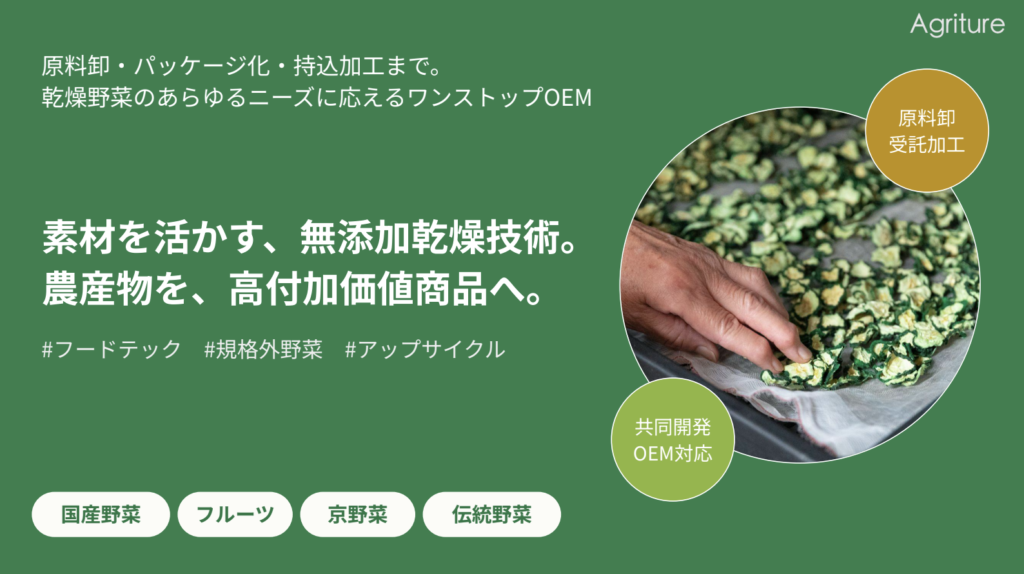
- OEM available from small lots of 10 kg
- Drying of brought-in raw materials also possible
- Support from processing to filling in one place
FAQ
How small is the minimum lot for medicinal tea OEM?
If basing it on a ready-made blend, there are partners that can handle from around 500–3,000 units. For a completely original formulation, 1,000–5,000 units is often the manufacturer's minimum line, and leaf types for gifts or café commercial use tend to require even larger lots.
What is the difference between medicinal tea and a food with functional claims?
Medicinal tea is basically sold as a general food and cannot display concrete efficacy or effects. To sell it as a food with functional claims, creating scientific-evidence documents and notifying the Consumer Affairs Agency are required, so confirm in advance whether the OEM manufacturer has a support system.
Can I develop a product even without knowledge of crude drugs?
If you choose a manufacturer with yakuzen-practitioner supervision, or an ODM-capable manufacturer that arranges existing constitution-based formulations into your own blend, development is possible even without specialized knowledge. Drawing on its insights from operating the yakuzen media outlet "Yasai Yakuzen," Agriture can consult on everything from formulation design to planning.
How long does it take from prototype to delivery?
For the first time, 2–3 months from planning to delivery is a guideline. When repeating prototypes or using special raw materials, it takes even more time. Work backward from the sales launch date and build a schedule with ample margin.
Is a medicinal tea blend using vegetables possible?
A design combining dried vegetables or powder with yakuzen materials is possible at a dried vegetable processing manufacturer like Agriture. By blending beet, carrot, burdock, ginger, and the like in a yakuzen context, you can differentiate from existing medicinal teas.
Summary | The keys to differentiation are "design philosophy" and "crossing materials"
To make a successful product with medicinal tea OEM, a design philosophy grounded in the basic theory of TCM and a crossing of distinctive materials are essential. From among the types—seasonal, constitutional, symptom, and vegetable-yakuzen—you are required to choose an angle that fits your worldview and target, and to design everything in an integrated way, from raw materials, formulation, and packaging to sales channels.
While carrying out contract processing of dried vegetables in Kyoto, Agriture accumulates yakuzen-practitioner-supervised insights through its Yasai Yakuzen media outlet. If you want to design an original product with the angle of vegetables × yakuzen, please feel free to consult us from Agriture's page on Food OEM no Madoguchi.
Download the OEM contract processing materials
We will send the materials to your email address based on the information you provide.
If you are considering product development with off-spec or your own farm's vegetables:From planning to processing, materials, package printing and novelties, you can consult us through a single point of contact. → Learn more about one-stop product development
FOR BUSINESS
乾燥野菜のOEM・受託加工を承ります
国産の野菜・果物の乾燥、100メッシュ相当までの粉砕、10g以上の小袋充填までをお受けしています。小ロットの試作から量産までご相談ください。寄せられた相談の実例は OEM・卸のご相談 に掲載しています。
乾燥品の賞味期限は、出荷日から6ヶ月程度を目安にご案内しています。
- How to Make Vegetable Dashi and Vege-Broth: The Difference and Tips for Using Vegetable Scraps
- ベジタリアンとは?国の規格が分けている4つの区分と食べられないもの
Author of this article
Related articles
-
 Original coffee marketing strategy | Ways to grow sales
 -
 ベジタリアンとは?国の規格が分けている4つの区分と食べられないもの
 -
 長ねぎと白ねぎは同じもの?ねぎの種類と呼び名を国の資料で確かめる
 -
 柚子の種類は何種類あるのか、公の資料で名前が残る系統を数えた
 -
 ゆずの時期は年に二度、青ゆずは7月から黄ゆずは10月から
 -
 ゆずの産地は高知が半分を占め、二位は徳島から愛媛に変わった
 -
 Preventing Food OEM Failures: Common Failure Cases and Countermeasures for Success
 -
 How to find a food OEM | How to efficiently find the best manufacturing partner