Dried shiitake


TOC
Product overview of dried shiitake
Shiitake grown by partner farmers in Kyoto is carefully dried at three temperature stages into a commercial material. Because it is sliced thick, it achieves a softer bite than ordinary dried shiitake and concentrated umami. It has little peculiarity even in dried form, and after rehydration a moist texture close to fresh shiitake returns, while the soaking liquid can be used as a fine dashi.
The shapes are "slice," "whole," and "stem only"in three types, and the cultivation method is also selectable from "log" or "sawdust bed". Matched to product concept and use, it is adopted in a wide range of businesses as a material for time-saving cooking, flavor enhancement, and both an ingredient and dashi source.
01 Careful drying at three temperature stages
Switching the temperature range across the initial, middle, and finishing stages, we remove moisture gently rather than drying it all at once in a short time. This curbs the hardness and harshness common to ordinary dried shiitake, achieving both quick rehydration and a soft texture.
02 Choice of log or sawdust bed, and use down to the stem
You can choose from log cultivation in Kyotango and sawdust-bed cultivation in Keihoku to suit your product design. We also dry the "stem" produced during processing as a separate specification, supplying it as a dashi material. It can also be used for vegetarian and plant-based dashi base material.
03 A moist feel close to fresh even after rehydration
Whereas ordinary dried shiitake rehydrates on the firm side, ours is characterized by a soft, thick-fleshed feel that remains. It is designed to finish so you can enjoy its ingredient presence as-is, as an ingredient for takikomi rice, simmered dishes, and pasta.
Product catalog showing the items we handle
Flexible support from small lots to large lots
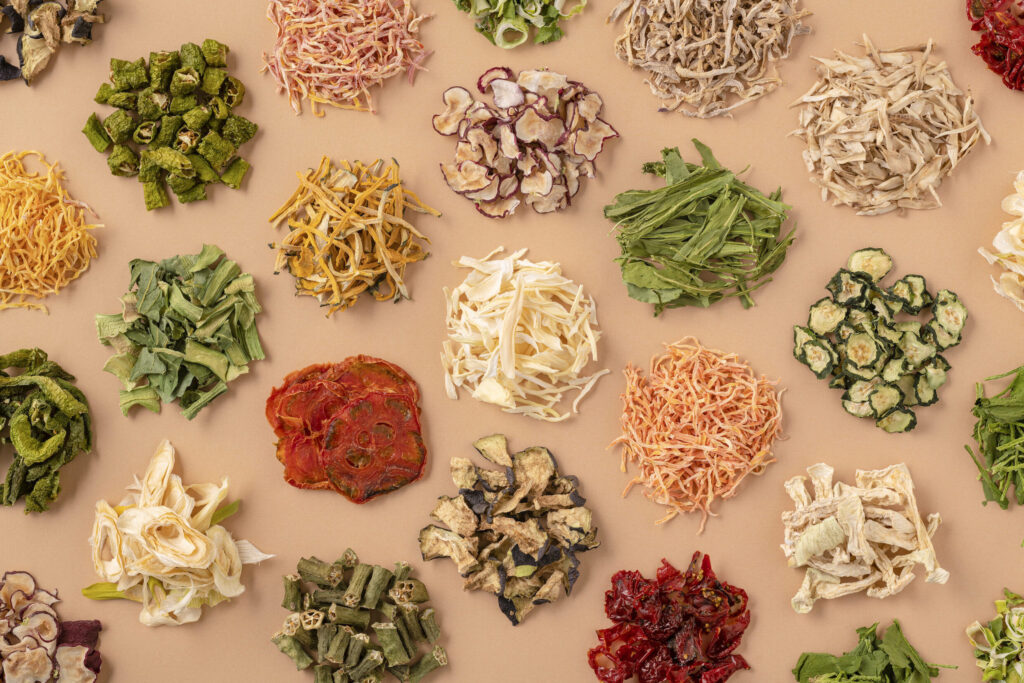
- Sold in small lots from 1 kg
- Handling heirloom vegetables from across Japan
- Dried fruits and herbs also supported
Features of Commercial Dried Shiitake
Kyotango and Keihoku grown
We procure log shiitake and sawdust-bed shiitake from partner farmers in Kyotango, Kyoto and the Keihoku district, using them differently to suit the application. Log excels in aroma and thick flesh, sawdust bed in stable supply, and we can flexibly propose the specifications required for a commercial material.
Three-shape support
We offer three shapes—slice, dice, and whole—as the basic lineup, and cut specifications can be customized by use. It handles a wide range of processed-food development, from ingredients for soups, takikomi rice, and prepared dishes to powder materials.
No glucose added
Without soaking in sugar solution or glucose, it is a natural finish that makes the most of shiitake's inherent umami and aroma. Because deep richness can be produced without chemical seasonings, it can be used in reduced-salt, additive-free-oriented products and as a base material regardless of Japanese, Western, or Chinese cuisine.
Making use of the soaking liquid as dashi
The guanylic acid that dissolves into the soaking liquid pairs well with the umami component glutamic acid, producing a depth comparable to first dashi. It is a material that can be diverted as-is to umami-focused product designs such as dashi packs, instant miso soup, and seasoning bases.
Low-temperature drying
The low-temperature drying process retains aromatic and umami compounds to the maximum. Compared with high-temperature drying, it curbs aroma loss and discoloration, and is characterized by being able to fold the shiitake-like fragrance at opening and rich umami into the product.
Traceability
We centrally manage the log source, cultivation management, and lot number, maintaining a system traceable even after shipping. It is a highly transparent supply structure that even makers who prioritize safety in commercial materials can use with confidence.
Product specifications
Item | Details |
|---|---|
Raw material growing region | Kyoto Prefecture (partner farm) |
Specification | OEM product ingredient (sliced shiitake / stem mix / whole topping) |
Storage method | Room temperature (store away from high heat and humidity) |
Best-before date | 6 months from the shipping date |
Minimum lot | From 10 bags / 100 g |
Powder | Available |
Manufacturing period | Winter |
Customization support
Because shiitake's aroma and texture change with specification and cultivation method, we mass-produce after you decide the specification at the prototyping stage. The main items we can accommodate are as in the table below.
Item | Details |
|---|---|
Custom-size support (cut-thickness change, form adjustment) | Available for consultation from orders of 10kg or more |
OEM support | Available |
Specification selection | OEM product ingredient (sliced shiitake / stem mix / whole topping) |
Cultivation-method specification | Selectable from log / sawdust bed |

We also separately dry the stem portion produced during shiitake processing, and it can be used as a raw material for vegetable dashi. There are increasing cases of using it for vegetarian recipe development and as a base material for plant-based bouillon.
POWDER
We also offer powder products
We also lineup a powder product as "shiitake powder." While keeping the ingredient's flavor and aroma, it can be used in a wide range of applications such as kneading into confectionery and bread dough, drinks, weaning food, and smoothies. It is also ideal for development where you want to control both texture and coloring by combining it with the dried product.
Commitments to variety, grower, and growing region
Dried shiitake is a raw material whose aroma, texture, and price change greatly depending on the cultivation method—log or sawdust bed. At Agriture, we support both cultivation methods and have arranged things so you can choose from the raw-material stage to suit the product concept.
BRAND
Cultivar:We mainly select thick-fleshed varieties with strong umami. We use varieties whose caps close firmly and that have strong aroma for log cultivation, and varieties whose shape comes out uniform for sawdust-bed cultivation, letting us design the flavor to suit the use.
PRODUCER
Producer:Partner farmers in Kyotango and Keihoku are central. For log cultivation we work with growers who spend a year and a half or more raising it in growing yards that make the most of the forest environment, and for sawdust-bed cultivation with farmers who meticulously manage temperature and humidity, continuing raw-material supply that makes the most of each method's strengths.
REGION
Production area:Kyotango and Keihoku are mountainous areas with large day-night temperature swings and moderately maintained humidity. These climate conditions are favorable for shiitake, an environment where thick-fleshed, richly aromatic fruiting bodies grow easily. The cleanliness of the water and air also supports quality at the pre-processing stage.
CULTIVATION
Cultivation method:Logs use Kyoto-produced oak wood, and they are raised in a form close to the natural environment on bed logs inoculated with shiitake spawn. Sawdust beds can be harvested year-round under stable environmental control and are characterized by making it easy to curb variation in shape and size. Both are grown at Agriture.
* Reference: OYAOYA product page
Low-temperature drying technology and quality control
Shiitake drying is a process where, if you drive off moisture all at once at high heat, "dry surface, wet interior"—where only the surface hardens while moisture remains inside—easily occurs. At our company, by switching the temperature range across three stages—initial, middle, and finishing—we align the drying speed of surface and interior, adjusting the moisture value while keeping a fluffy, thick-fleshed feel.
💡 TIPS | Drying-processing trivia
The umami component "guanylic acid" of dried shiitake is best drawn out by rehydrating slowly in cold water. Soaking in water of around 5℃ for 5–8 hours is said to dissolve out about twice the guanylic acid compared with rehydrating in hot water, and in commercial dashi design, "prep the day before plus refrigerated rehydration" becomes the key to recipe differentiation.
Use cases and adoption examples
Dried shiitake is a raw material usable in many directions—in addition to the classic use as a dashi material, its presence as an ingredient and its veggie compatibility. We have organized scenarios of use by business type.
For Japanese and washoku cuisine
This is a use with a track record of adoption as OEM processed products and commercial ingredients for washoku specialty shops and traditional Japanese restaurants. Fresh shiitake poses procurement-management challenges of quality variation by origin and season and a short storage period, but with the dried product, bulk room-temperature storage and planned usage-volume management become possible. Because rehydrating slowly at low temperature draws out ample guanylic acid, we can respond not only to use as an ingredient for takikomi rice, simmered dishes, and chawanmushi, but also to product designs of noodle and prepared-food makers who want to use the soaking liquid as a plant-based umami base.
For processed and retort foods
This is a use frequently adopted by instant-food makers and prepared-food processors as an ingredient for cup noodles, freeze-dried soups, and retort prepared dishes. Fresh shiitake burdens the production site with post-harvest quality change and prep labor, but with dried slices, bulk room-temperature storage is possible, achieving stable procurement while stabilizing yield. Because it rehydrates uniformly just by pouring hot water, it also suits product development that requires texture design and recipe reproducibility.
Shojin cuisine and vegan-compatible menus
This is a use with spreading adoption at temple-affiliated eateries serving shojin cuisine and food makers advancing vegan and plant-based compatibility. Unlike fresh shiitake, the dried material allows bulk room-temperature inventory management, and because it can be used soaking liquid and all as a plant-based bouillon, it contributes to major simplification of the cooking process. The stem-only dried specification also accommodates ingredient development that makes the most of a meat-substitute texture, and can be considered as a differentiating material for OEM brands aiming for vegan certification.
Chinese and ethnic cuisine
It is adopted as a commercial material by makers producing steamed buns, chimaki, lu rou fan, and the like, and by restaurant chains developing Chinese and ethnic menus. Fresh shiitake varies easily in quality by origin and season, and prep and cutting steps lead to increased production-line labor, but the dried whole type allows stable stockpiling at room temperature and lets you move to uniform prep with only the rehydration work. Because it keeps a texture that resists breaking down even with heavy seasoning, it is easy to build in as a fixed differentiating material for stewed and filling-type products, and lot and size can be discussed to your requirements.
Pet food and additive-free food ingredient
This is a case adopted when pet-food makers and OEM brands make "Japanese-grown, additive-free" their differentiating axis. Fresh shiitake is high in moisture, raising storage and transport costs and premised on short-term consumption, but the dried product allows stable room-temperature storage and makes fixed-quantity dosing into production lines easier. We can also accommodate shape consultation such as slicing or grinding, and it can be considered from the small-lot trial stage as an ingredient for low-calorie recipes for senior dogs and cats or for umami-enhancing toppings.
Seasonings and dressings
Powdered shiitake is adopted by food makers and seasoning makers as a development material for clean-label seasonings and dressings that promote no chemical seasonings. Because it needs no moisture management compared with fresh shiitake and allows long-term room-temperature storage, it leads to stable supply to production lines and reduced blending loss. As a highly concentrated material that can draw out umami even with a small addition, it can be discussed as a raw-material cut-out in OEM development, from shio-koji- and soy-based seasonings to Japanese-style dressings.
Commercial usage and rehydration
Basics of rehydrating in water: Rehydrate the slice type in water for about 15–20 minutes, and the whole type in cold water for 5–8 hours as a guide. The rehydration ratio is about fivefold; a guide is roughly 50 g after rehydration per 10 g dry. Rehydrating slowly at low temperature efficiently draws out the guanylic-acid-derived umami components.
When using it as dashi: The soaking liquid can be used as-is as dashi. Combined with kombu for a second dashi, it has a track record of adoption in shojin cuisine and vegan-compatible menus.
Storage and handling after thawing: Unopened, room-temperature storage keeps for six months; after opening, seal it up and use it up within one to two months as a guide in cool, dark storage. When portioning from a large bag, we recommend adding a desiccant to avoid humidity.
Related cases and articles
- Vegetable Broth × Dried Vegetables to Boost Umami: Pro Tips on Use and Selection (OEM article)
- Learning the secrets to success and market strategy from overseas-expansion cases of dried goods (OEM article)
- How to Choose Dried Goods, Taught by a Pro | 5 Important Points and How to Tell Them Apart (OEM article)
Product catalog showing the items we handle
Flexible support from small lots to large lots
- Sold in small lots from 1 kg
- Handling heirloom vegetables from across Japan
- Dried fruits and herbs also supported
Frequently asked questions (FAQ)
Q. Which should I choose, log cultivation or sawdust-bed cultivation?
A. If you prioritize aroma and thick-fleshed feel, log cultivation is recommended; if you prioritize shape uniformity and year-round stable procurement, sawdust-bed cultivation is recommended. It can also be used differently or in combination to suit the product concept.
Q. Tell me the difference between slice, whole, and stem
A. Slice is generally used as a dashi and retort ingredient, whole as a lead ingredient for Chinese and Japanese cuisine, and stem as a raw material for plant-based dashi. All are finished with the same drying process, so the flavor design is common.
Q. What are the minimum lot and delivery time?
A. We can handle from 10 bags~ / 100 g. If a stock lot is available, we advise 1–2 weeks as a guide; for custom cuts and specification designations, about 3–4 weeks.
Q. Can you do powder processing?
Q. What is the rehydration ratio?
A. A guide is about 50 g after rehydration per 10 g dry. It varies somewhat with water temperature and rehydration time, but cold-water rehydration tends to draw out umami components more readily. In the past we have shipped dried-goods materials to Southeast Asia and North America, and required documents can also be discussed individually.
RETAIL
For those looking to purchase in small packs
For prototype uses and personal consumption, on the online shop of the sister brand OYAOYA At OYAOYA's online shop as well, you can purchase small packs of dried shiitake. Please also make use of them for texture checks before product development, or as purchases for in-house tasting.
Yakuzen properties (for fresh shiitake)
In the world of yakuzen, shiitake is sweet and neutral in nature, classified as a mushroom. Neutral nature means a gentle character that neither warms nor cools the body, characterized by being easy to incorporate for a wide range of people regardless of constitution. In traditional Chinese medicine it is positioned in the "qi-tonifying" category, helping the function of the stomach and intestines and supplementing qi as an ingredient.
It is considered an ingredient long familiar to those concerned about "qi deficiency," such as being prone to fatigue or having a reduced appetite. Because dried shiitake especially increases in umami, it has long been used in simmered dishes, soups, and hot pots. Simply adding it to simmered dishes, soups, and hot pots spreads umami and yakuzen properties at once, with a background of being long enjoyed within Japanese food culture.
💡 TIPS | Yakuzen trivia
Because shiitake is "neutral in nature," it pairs well with both body-cooling summer vegetables and warming root vegetables, an ingredient easy to handle as a foundation for yakuzen recipes. Because extract remains in the soaking liquid after taking dashi, adding it to soups and simmered dishes rather than discarding it is said to let you take in umami and yakuzen workings at once.
Shiitake's yakuzen workings are thought not to be greatly impaired even after drying. Because Agriture's dried shiitake is carefully dried at three temperature stages, the soaking liquid's umami and flavor are rich, and it can be used in a wide range of commercial applications—shojin cuisine, veggie-compatible menus, yakuzen soups, and more—as a yakuzen material that serves as both dashi and ingredient.
YAKUZEN
For those who want to know more about shiitake from a yakuzen view
On the sister site that introduces recommended ingredients and yakuzen recipes by constitution, Yasai Yakuzen , we explain shiitake's properties and how to incorporate it in even more detail.
Recommended reading
- Vegetable Broth × Dried Vegetables to Boost Umami: Pro Tips on Use and Selection (OEM article)
- Learning the secrets to success and market strategy from overseas-expansion cases of dried goods (OEM article)
- How to Choose Dried Goods, Taught by a Pro | 5 Important Points and How to Tell Them Apart (OEM article)
- Shiitake powder
Download the product catalog
We will send the materials to your email address based on the information you provide.