What is yakuzen? Its meaning, the difference from kampo, and the basics of starting with familiar ingredients explained

Summary of this article
A dried vegetable manufacturer that runs the medicinal-cuisine media “Yasai Yakuzen” gently explains what yakuzen (medicinal cuisine) is—covering how it differs from kampo, the foundational concepts of the four natures, five flavors, meridian tropism, and qi-blood-fluids, why familiar vegetables count as yakuzen ingredients, and how to incorporate it into everyday life.
“Yakuzen sounds good for the body, but doesn't it require special ingredients or crude drugs?” Many people may feel this way. In fact, yakuzen is a style of eating grounded in the ideas of Eastern medicine that you can start with familiar vegetables available at the supermarket.
On this page, we clearly lay out what yakuzen is—covering how it differs from kampo, the foundational concepts of the four natures, five flavors, meridian tropism, and qi-blood-fluids, why familiar vegetables count as yakuzen ingredients, and how to incorporate it into everyday life. As the operator, within our group, of the medicinal-cuisine media “Yasai Yakuzen”, we translate specialized content down to the size of the everyday table. Note that this article introduces the traditional ideas of Eastern medicine and does not guarantee the treatment or prevention of any specific illness.
TOC
What is yakuzen? The basic idea
Yakuzen is an approach to eating in which ingredients are chosen to match the body's condition and the season, based on the theory of Eastern medicine (traditional Chinese medicine). As the phrase “medicine and food share the same source” suggests, the idea behind yakuzen is to regard daily meals, too, as part of caring for the body.
Choosing ingredients to match constitution and season
In yakuzen, even the same ingredient is thought to suit or not suit a person depending on their constitution, physical condition, and the season. In hot seasons you choose ingredients said to cool the body's heat, and in cold seasons you choose ingredients said to warm the body. A flexible mindset—listening to the body and choosing ingredients accordingly—is its defining feature.
The idea of “mibyo” (pre-illness)
Eastern medicine has a concept of “mibyo,” a state that is not clearly an illness yet not fully well either. Yakuzen is an eating habit grounded in this idea from Eastern medicine. Rather than doing anything special, it becomes more approachable when you think of it as facing your body through everyday meals.
The difference between yakuzen and kampo
Yakuzen and kampo share the same background of Eastern medicine, but they are different things. Whereas kampo refers to kampo medicines that combine crude drugs, yakuzen refers to meals using everyday ingredients. Broadly, they can be separated as “kampo = medicine” and “yakuzen = food.” The differences in their purpose, materials, and legal standing are the page explaining the difference between yakuzen and kampo laid out in detail on.
FOR BUSINESS
乾燥野菜を業務用でお探しですか
国産の野菜・果物を乾燥し、必要に応じて粉砕してお出ししています。扱っている品目は100種前後で、規格は 乾燥品の一覧・パウダーの一覧 に掲載しています。
少量でのご購入は、姉妹ブランドの通販サイト OYAOYA で承っています。
The foundational theory of yakuzen | yin-yang, the five phases, and qi-blood-fluids
The foundation for choosing yakuzen ingredients rests on three ideas from Eastern medicine. They may look difficult, but knowing the framework makes how to choose ingredients clearer.
Yin-yang
This is a way of viewing everything through the two natures of “yin” and “yang.” Yin evokes cold, dark, and still; yang evokes warm, bright, and active. The body and ingredients alike are viewed through this balance, and ingredients are chosen so as to ease any imbalance.
The five phases, the five viscera, and the five flavors
The five phases are a way of dividing the natural world into five natures: wood, fire, earth, metal, and water. These are thought to correspond to the body's “five viscera” (liver, heart, spleen, lung, kidney), the “five flavors” (sour, bitter, sweet, pungent, salty), and the seasons. That each of the five flavors is said to care for its corresponding organ is one axis of choosing yakuzen ingredients.
Qi-blood-fluids
This is a way of viewing the elements that support the body through three components: qi, blood, and fluids. Qi is said to be energy, blood is blood and nourishment, and fluids are the moisture that hydrates the body; Eastern medicine considers a person healthy when these are sufficient and circulating smoothly. In yakuzen, the idea is to attend to the balance of these through diet.
The properties of yakuzen ingredients | the four natures, five flavors, and meridian tropism
In yakuzen, each ingredient is thought to have properties. The representative indicators are the “four natures,” “five flavors,” and “meridian tropism.” Knowing these lets you see familiar vegetables, too, as yakuzen ingredients.
| Metrics | Meaning | Example |
|---|---|---|
| The four natures | The property of warming or cooling the body | Hot, warm, neutral, cool, cold |
| The five flavors | The five flavors and the idea of their corresponding actions | Sour, bitter, sweet, pungent, salty |
| Meridian tropism | Which organ an ingredient is said to act on | Liver, heart, spleen, lung, kidney, and others |
The four natures (warming and cooling properties)
The four natures express whether an ingredient is said to warm or cool the body. Warm and hot ingredients include ginger and green onion, while cool and cold ingredients include tomato and cucumber. There are also “neutral” ingredients that lean neither way. They serve as a guide when choosing according to season or physical condition.
The five flavors (the idea of flavor and action)
The five flavors are sour, bitter, sweet, pungent, and salty, and each is said to care for its corresponding organ. For example, sweetness is thought to correspond to the spleen (said to be involved in digestion), and pungency to the lung. Taking a variety of flavors in good balance is valued in yakuzen.
Meridian tropism (where it acts)
Meridian tropism expresses which organ an ingredient is said to act on. Even among “sweet” ingredients, a different meridian tropism means a different organ is said to be cared for. By viewing the four natures, five flavors, and meridian tropism together, you can understand an ingredient's standing in yakuzen terms.
Familiar vegetables become yakuzen ingredients
When people hear “yakuzen,” they tend to picture special ingredients like jujube, goji berries, or crude drugs, but in reality many familiar vegetables available at the supermarket are yakuzen ingredients. You can start yakuzen without buying anything special.
Supermarket vegetables are fine yakuzen ingredients too
Ginger, green onion, daikon, shiitake, eggplant, tomato—the vegetables on the everyday table are each said to have their own four natures, five flavors, and meridian tropism. At Yasai Yakuzen, we value this idea of “entering yakuzen from the vegetables already on hand.” We have summarized in a table one example of the traditional Eastern-medicine classification of familiar vegetables (classifications vary by source).
| Vegetables | Four natures (attributed property) | Five flavors | Easy-to-use dishes |
|---|---|---|---|
| Ginger | Warm | Pungent | Soups, simmered dishes, condiments |
| Green onion | Warm | Pungent | Hot pot, condiments |
| Daikon | Cool | Sweet and pungent | Simmered dishes, grated daikon |
| shiitake | Neutral | Sweet | Dashi, simmered dishes |
| Eggplant | Cool | Sweet | Grilled, stir-fried |
| Tomato | Cool to cold | Sweet and sour | Salads, chilled dishes |
Yakuzen can begin simply by re-examining familiar ingredients from a yakuzen perspective.
Choosing by season and physical condition
Seasonal vegetables are often said to suit the body in that season. Choosing with the season in mind—summer vegetables said to cool the body's heat in summer, and root vegetables and ginger said to warm the body in winter—naturally leads to seasonally appropriate ingredient choices. In cold seasons, ingredients considered warming in nature are chosen.
Dried vegetables make yakuzen easy
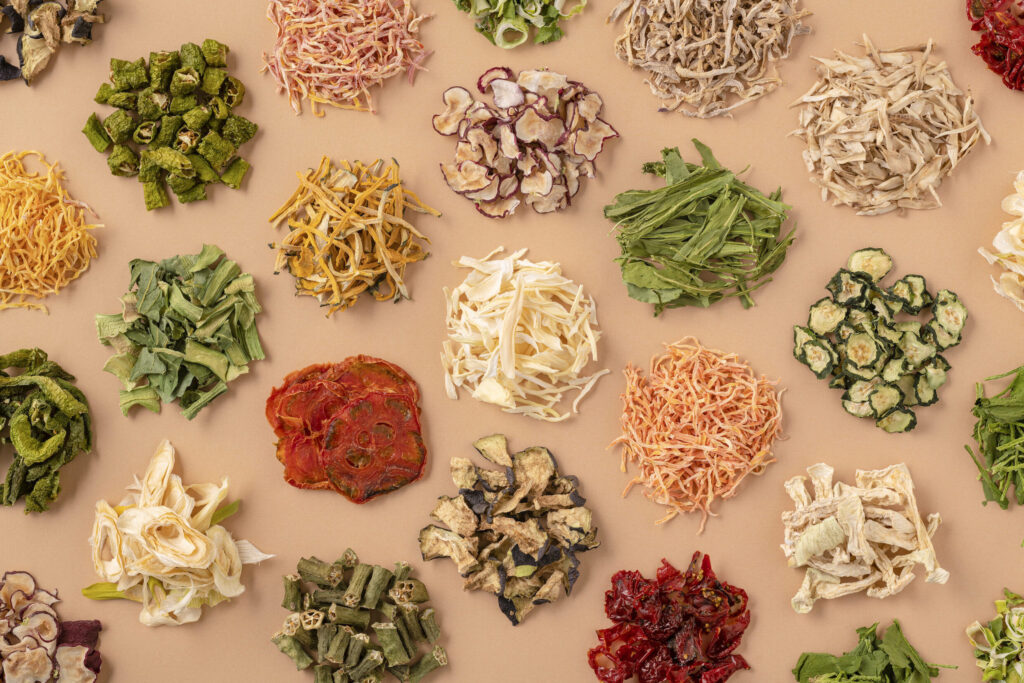
As dried vegetables, yakuzen ingredients keep well and are convenient to use a little at a time when needed. Simply adding dried vegetables to soups and simmered dishes lets you easily incorporate the yakuzen approach. Our group's D2C brand “OYAOYA” also proposes Kyoto-grown dried vegetables in a yakuzen context.
A product catalog that shows around 100 items we handle
Agriture, flexibly handling everything from small lots to large lots
- Available for purchase in small lots from 1 kg
- We handle heirloom vegetables from across Japan
- Dried fruit and herbs also supported
How to incorporate yakuzen, and domestically grown yakuzen ingredients
The knack for yakuzen is to incorporate it into daily meals a little at a time. Here we lay out how to start with familiar domestically grown ingredients.
A little at a time in daily meals
We recommend starting with small touches—adding ginger to your usual miso soup, or adding one seasonal vegetable dish. Rather than aiming for perfection, being able to keep it up is what's valued. Referring to a constitution assessment to learn which ingredients suit you is also one approach.
Start with familiar domestically grown ingredients
You can practice yakuzen well enough with domestically grown vegetables and dried goods, without searching for imported crude-drug-like ingredients. Sticking to domestically grown produce makes the growing region easy to trace, so you can incorporate it into daily life with peace of mind. Which domestically grown ingredients can be used for yakuzen is the page explaining domestically grown yakuzen ingredients introduced in detail on.
Using yakuzen in product development (for businesses)
From here, this is a discussion for food-developing businesses. The yakuzen approach can also be applied to food product development. As interest grows in products and menus built around a yakuzen concept, using dried vegetables, powders, and blended materials lets you develop products that leverage the yakuzen context from small lots. The forms are varied, too—yakuzen tea, yakuzen dashi, yakuzen furikake, and more. For making yakuzen tea, see the explanation of yakuzen tea OEM, and for foods other than tea such as dashi, furikake, and powders, see also the explanation of yakuzen food OEM.
FOR BUSINESS
乾燥野菜を業務用でお探しですか
国産の野菜・果物を乾燥し、必要に応じて粉砕してお出ししています。扱っている品目は100種前後で、規格は 乾燥品の一覧・パウダーの一覧 に掲載しています。
少量でのご購入は、姉妹ブランドの通販サイト OYAOYA で承っています。
Frequently asked questions
Download the product catalog
We will send the materials to your email address based on the information you provide.
Summary: yakuzen can begin with familiar ingredients
Yakuzen is a style of eating in which ingredients are chosen to match the body and the season based on the ideas of Eastern medicine; unlike kampo medicine, it is practiced within everyday meals. Knowing the frameworks of yin-yang, the five phases, and qi-blood-fluids, and the ingredient properties of the four natures, five flavors, and meridian tropism, lets you see familiar vegetables, too, as yakuzen ingredients.
Even without buying special ingredients, simply adding seasonal vegetables to your usual miso soup or simmered dishes is a first step into yakuzen. Try incorporating it from familiar domestically grown ingredients, to the extent you can keep it up. Our group's medicinal-cuisine media “Yasai Yakuzen” also introduces yakuzen-focused explanations for each vegetable.
- 山椒はうなぎ以外に何に使う?年4回、姿を変えて出回ります
- What's the Difference Between Yakuzen and Kampo? A Gentle Look at Food vs. Crude Drugs, Purpose, and Philosophy