Complete guide to using dried mugwort | From rehydrating to popular recipes and storage tips

Summary of this article
Dried yomogi (mugwort) can be rehydrated in water or hot water for kusa-mochi and dango, yomogi tea, or a yomogi bath, and as a powder it can be mixed straight into bread and baked goods. This explains how to rehydrate, how much to use, storage, and how to choose domestically grown, low-temperature-dried yomogi that keeps its aroma and color, from home to commercial use.
Have you bought dried yomogi only to freeze up over "how much water do I rehydrate it in?" or "how do I use it for kusa-mochi or yomogi tea?" Unlike fresh yomogi, dried yomogi has its prep and bitterness-removal already done, so once you get the hang of rehydrating and portioning, you can easily enjoy it in cooking, sweets, and daily life.
In this article, Agriture, which processes dried vegetables in Kyoto, has put together everything from the basics of rehydrating dried yomogi, to popular recipes such as kusa-mochi, dango, and yomogi bread, to using it in yomogi tea and a yomogi bath, storage and best-before dates, and how to choose without going wrong. Beyond home cooking, information for commercial and OEM use is introduced in the latter half.
TOC
What is dried yomogi? The difference from fresh yomogi and why it's chosen
Dried yomogi is made by drying the young leaves of yomogi (mugwort), which sprouts in spring. Fresh yomogi has a strong aroma, but its harvest season is limited to spring and it requires prep such as removing bitterness. Dried yomogi resolves this effort and the seasonal constraint, and being usable year-round is the reason it's chosen.
Yomogi, long used in Japanese sweets and daily life
Yomogi is also called the "queen of herbs" and has long been cherished as an ingredient for Japanese sweets such as kusa-mochi and dango. Its distinctive young-grass aroma lends a springlike note to cooking, and it has a history of being brought into daily life as tea and for bathing. Its wide range of uses -- Japanese sweets, tea, and body care -- is a big part of yomogi's appeal as an ingredient.
The difference between fresh yomogi, dried yomogi, and yomogi powder
Yomogi comes broadly in three forms: "fresh," "dried (whole leaf)," and "powder." Which you use changes the prep and the dishes it suits, so knowing the differences first makes choosing easier.
| Form | Prep | Suitable use | Aroma and color |
|---|---|---|---|
| Fresh yomogi | Needs bitterness removal and boiling | Tempura, dishes used on the spot | Strongest aroma but doesn't keep |
| Dried yomogi (cut, leaf) | Rehydrate in water or hot water | Kusa-mochi, dango, yomogi tea, bathing | Aroma and color enjoyable year-round |
| Yomogi powder | Can be folded into dough without rehydrating | Kusa-mochi and dango, bread, baked goods, latte, smoothie | Colors well and mixes easily |
If you prioritize ease, the powder, which can be mixed straight into dough, Mugwort powder is convenient. For the rustic texture of kusa-mochi, or when you want to simmer it for tea or bathing, dried yomogi with the leaf shape intact is the better fit.
How to rehydrate dried yomogi | basic steps and tips
The first step in using dried yomogi in cooking is the "rehydrating" process. The leaf type and powder type rehydrate differently, so check the basics of each. Once you've learned how to rehydrate, all that's left is to use them to suit your purpose.
How to rehydrate the cut (leaf) type
- Put the dried yomogi in plenty of water or warm water
- Soak for about 15 to 30 minutes, waiting until the leaves soften and open
- Drain in a colander and lightly squeeze out the excess water by hand
- Chop finely to suit your use (for kusa-mochi and the like, you may blend it into a paste)
Rehydration is shorter with hot water and longer with cold water. When using it in cooking, wringing out the water well is the trick to avoid a watery result. For kusa-mochi in particular, too much water after rehydrating makes the dough sticky, so how you wring it changes the texture. If it seems too firm, boiling it for 1 to 2 minutes after rehydrating gives a softer mouthfeel. The chop width also changes the result: the finer you chop, the more it blends into the dough, while a coarser chop leaves texture and color.
How to use the powder type
Yomogi powder needs no rehydrating and can be mixed straight into dough or drinks. It suits bread, baked goods, lattes, and smoothies where you want the color and aroma spread evenly. If a floury quality bothers you, dissolving it first in a small amount of warm water (about five times the powder) makes it less prone to clumping.
FOR BUSINESS
乾燥よもぎを、原料としてお探しですか
国産のよもぎを乾燥・粉砕してお出ししています。カット形状や粒度の指定、継続してのお取引もご相談ください。規格は Dried mugwort・Mugwort powder に掲載しています。
少量でのご購入は、姉妹ブランドの通販サイト OYAOYA で承っています。
Tips to avoid mistakes when rehydrating
An example of adding too much powder and turning it bitter
Adding a lot of powder to "make the color deeper" can push yomogi's characteristic bitterness too far forward. From Agriture's experience on the production floor, the powder colors strongly even in small amounts, so the way to avoid mistakes is to add it modestly at first and adjust while tasting.
Dried yomogi quick-reference chart | amounts and prep by use
Dried yomogi has a wide range of uses, from Japanese sweets like kusa-mochi to yomogi tea and bathing. We've put together a list by use of "whether to use leaf or powder" and "how much to use as a guide." If it's your first time, using this quick-reference chart as a guide and trying a small amount first avoids waste.
| Use | Suitable form | Guideline amount | Prep |
|---|---|---|---|
| Kusa-mochi and dango | Leaf (rehydrate) / powder | A handful of rehydrated leaf per 1 go of mochi rice, or 1 to 2 teaspoons of powder | Rehydrate and chop the leaf / use the powder as is |
| Yomogi bread and baked goods | Powder | 1 to 2 teaspoons of powder per 100g of flour | Mix with the flour |
| Mugwort tea | leaves | 5 to 10g per 1L of water | Simmer as is |
| Yomogi bath | leaves | A handful (about 5g) | Chop and simmer |
| Yomogi steam (at home) | leaves | A handful (about 15 to 30g) | Simmer and use |
The amounts are only guides. Preferences for aroma and color differ from person to person, so start small and adjust as you go to get closer to your own taste.
A product catalog that shows around 100 items we handle
Agriture, flexibly handling everything from small lots to large lots
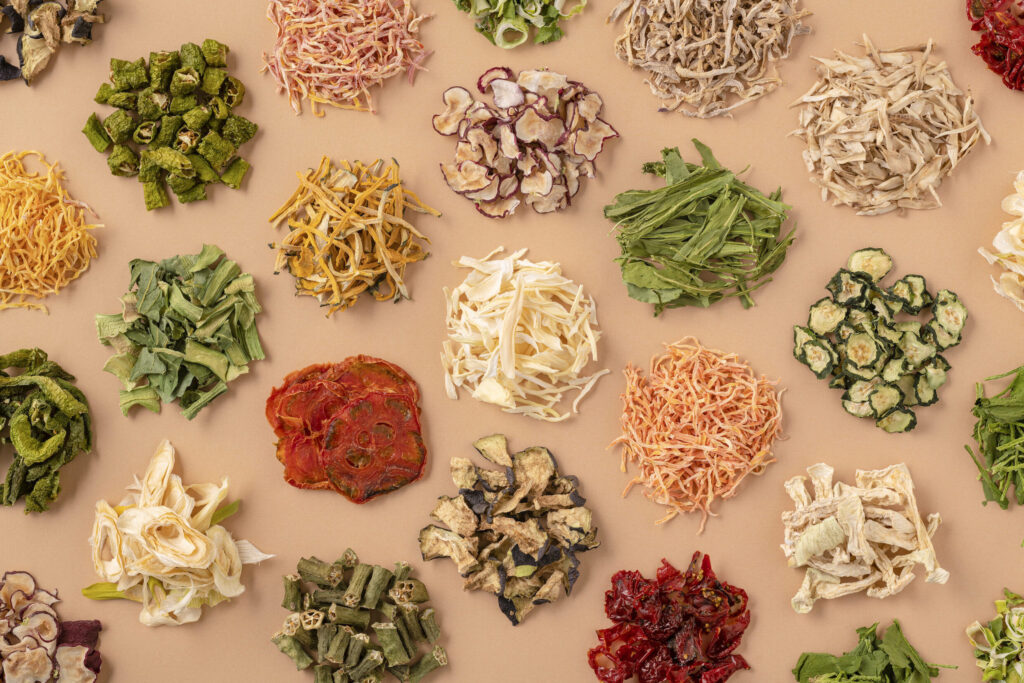
- Available for purchase in small lots from 1 kg
- We handle heirloom vegetables from across Japan
- Dried fruit and herbs also supported
Popular recipes made with dried yomogi
Once you know how to rehydrate and portion, all that's left is to make it. Here we introduce standard, popular recipes you can make with dried yomogi, from Japanese sweets to bread. None require special tools, and all are easy to enjoy at home.
How to make yomogi mochi (kusa-mochi)
A spring standard, yomogi mochi (kusa-mochi) is a representative use of dried yomogi. If you want to keep an authentic texture and color, use the cut (leaf) type; if you want to make it easily, use the powder. Fold rehydrated and chopped yomogi, or the powder, into a dough of shiratamako and joshinko with added sugar. Knead in warm water little by little to an earlobe softness, wrap around tsubuan, and steam it through to finish. Using the powder gives an even color and makes an easy, springlike treat.
- Shiratamako and joshinko (dough base)
- Rehydrated and chopped dried yomogi, or yomogi powder
- Sugar (for a hint of sweetness in the dough)
- Tsubuan (for wrapping)
- Warm water (for adjusting firmness)
Yomogi dango and chewy variations
Mix yomogi into shiratamako and roll into balls for chewy, delicious yomogi dango. Served with kinako, anko, or kuromitsu, they work for both a snack and hospitality. Adding tofu makes them slower to harden even after time passes, which is recommended. A daifuku-style variation wrapping anko is popular too.
Yomogi bread, scones, and baked goods
Yomogi powder keeps its aroma even after baking and suits bread and baked goods. For yomogi scones, add yomogi powder and butter to cake flour and bring the dough together without over-mixing before baking -- that's the trick. For a pound cake, bringing the eggs and butter to room temperature first mixes the ingredients evenly. When baking yomogi shokupan in a bread machine, adding the powder along with the milk gives a fluffy, tinted dough.
Beyond that, easy powder-only variations such as yomogi lattes and smoothies open up too. For how to use vividly colored yomogi powder, see Uses for yomogi powder also explained in detail in.
How to make yomogi tea and points to note when drinking it
Dried yomogi can also be used as an aromatic yomogi tea. It's good for using up leaves you couldn't finish in cooking, and being caffeine-free, it's enjoyed as a cup after a meal or during a break.
How to make yomogi tea in a teapot or by simmering
- Brewing in a teapot: put 1 tablespoon (about 5g) of dried yomogi in a teapot (about 350ml), pour in boiling water, and steep for 3 to 4 minutes
- Simmering: add 5 to 10g of dried yomogi per 1L of water, bring to a boil, then simmer on low for 1 to 2 minutes
You can adjust the strength to taste. Steep or simmer longer when you want a strong aroma, and shorter for a lighter drink, to tune it to the flavor you like.
Things to keep in mind when drinking
Yomogi is a plant in the Asteraceae family. If you've had an allergic reaction to Asteraceae plants such as ragweed, try just a small amount to be safe, or consult a doctor before adding it. Those who are pregnant or nursing, or who have chronic conditions, will also feel more at ease consulting their regular physician before drinking it. It's also important, according to your constitution, not to drink too much at once.
How to use it for a yomogi bath or yomogi steam
Dried yomogi is not only for eating; it can be used for an aromatic bath or yomogi steam. Being able to bring the same dried yomogi into daily life for different purposes is another convenient point.
How to make a yomogi bath
Chop a handful of dried yomogi finely with scissors and put it in a tea pack. Simmer it in a pot for about 10 minutes, then put the decoction, pack and all, into the bath for a finished yomogi bath. Even just putting several yomogi tea bags together into the bath gives a faintly scented soak. It suits times when you want to relax slowly, wrapped in the young-grass aroma.
Using dried yomogi for at-home yomogi steam
Dried yomogi is also handy as a material when using an at-home yomogi steam set. A handful (about 15 to 30g) simmered per session is a good guide, and dried yomogi with the leaf shape intact gives off aroma readily, making it easy to use for home yomogi steam. The method is How to do yomogi steam at home explained in detail here. For salons or classes that use large amounts, the commercial dried yomogi described later is appropriate.
Storage and best-before date to protect the flavor
Even fine dried yomogi loses its color and aroma if stored the wrong way. Dried yomogi has little moisture and keeps well, but there are storage tips for enjoying the aroma longer.
How to store after opening
- Put it in an airtight container or storage bag to keep out moisture and insects
- Avoid direct sunlight and store in a cool, dark place with little temperature change
- If you won't use it for a long time, portioning it and freezing keeps the flavor from dropping
Best-before date guide and tips for using it up
The best-before date for store-bought dried yomogi varies by product. Agriture's dried mugwort In the case of, the guide is about 6 months from manufacture at room temperature. Even yomogi, whose season is limited to spring, can be used on a plan as a dried product, so you can enjoy it without missing the season.
An example of leaving it long at room temperature and losing the aroma
We sometimes hear that someone left the pack open on a shelf, and when they went to use it, the aroma had weakened. After opening, seal it and use it up soon, and when you've bought a lot, moving it to the freezer is the best way to preserve the aroma.
How to choose dried mugwort without failing
Since differences in appearance are hard to tell with dried yomogi, how you choose it changes the result. The more you value the aroma and color of your cooking or tea, the more judging the quality matters.
Judging by color, aroma, and the state of the leaves
- Color: The more vivid or deep green it is, the better a guideline for its condition
- Aroma: Whether the fresh-grass aroma firmly remains
- State of the leaves: Whether they are not excessively crumbled into powder
Why domestic sourcing and low-temperature drying affect the flavor
Yomogi's green color breaks down and fades easily when dried at high heat. Agriture uses low-temperature hot-air drying with restrained temperature and airflow to achieve both a deep green color and the young-grass aroma. For the raw material, it uses domestically grown yomogi with strong aroma and color, centered on Mie Prefecture, finished to a clean specification with no additives or glucose. For how to judge the growing region and processing, see Quality standards for domestic yomogi.
An example of raw material dulled in color by high-temperature drying
Rushing the drying at high heat can leave the finished green tinged with brown. High-temperature drying fades the color easily, and managing the drying temperature is essential to keep the green and the aroma. On the production floor too, a vivid green serves as a gauge of whether the drying temperature was carefully managed.
Up to here we've focused mainly on home use. For simply enjoying it at home, the content so far is enough. When you use large amounts at a shop, salon, or in product development, the way you think about procurement changes, so read on to check.
If you're using dried yomogi commercially or for OEM
For places that want to use dried yomogi in large amounts as a raw material -- Japanese sweet shops, yomogi steam salons, health-tea brands and the like -- commercial procurement is realistic. Since the volume and specifications differ from home use, choosing a supplier you can consult on processing form and supply volume gives peace of mind.
Customizing the processing form (cut or powder)
Commercial dried yomogi can be chosen as a cut shape or as a powder to suit the use. Fine-powder processing suits folding into kusa-mochi and dango dough, while cuts with the leaf shape intact are used for yomogi steam and bathing. As an ingredient for smoothies, green juice, and baked goods too, powdering allows it to be developed into a wide range of products.
- Cut (leaf): as a raw material for yomogi steam, bath additives, and simmering
- Fine powder: for folding into kusa-mochi and dango, baked goods, and smoothies
- Small-lot prototypes: for new product development and recipe testing
- Blend and packaging specs: adjusted to suit the use or product form
Year-round supply and small-lot support
Even yomogi, with its short season, can be procured on a plan year-round as a dried raw material. For commercial use, not just the color of the appearance but the year-round stability of the lot is the deciding factor in selection. Commercial and OEM dried mugwort handles everything from small-lot prototypes to full production, and can be used both to replace an existing raw material and for new product development. For raw material procurement and how OEM proceeds, see Food OEM Directory.
A product catalog that shows around 100 items we handle
Agriture, flexibly handling everything from small lots to large lots
- Available for purchase in small lots from 1 kg
- We handle heirloom vegetables from across Japan
- Dried fruit and herbs also supported
FOR BUSINESS
乾燥よもぎを、原料としてお探しですか
国産のよもぎを乾燥・粉砕してお出ししています。カット形状や粒度の指定、継続してのお取引もご相談ください。規格は Dried mugwort・Mugwort powder に掲載しています。
少量でのご購入は、姉妹ブランドの通販サイト OYAOYA で承っています。
Summary
Dried yomogi is a handy ingredient you can enjoy year-round -- from dishes like kusa-mochi and yomogi bread to yomogi tea and a yomogi bath -- once you have the basic rehydration and amounts down. The tricks to using it well are to switch between leaf and powder, store it sealed in a cool, dark place, and choose one that keeps a vivid green and aroma. At home or commercially, choose the dried yomogi that suits your use and bring the scent of spring into daily life.
Frequently asked questions
Recommended reading
- Dried mugwort (product page)
- Mugwort powder
- Uses for yomogi powder | applications in food, beauty, and health
- What are the quality standards for domestic mugwort? Points to judge by growing region, cultivation, and processing
Download the product catalog
We will send the materials to your email address based on the information you provide.