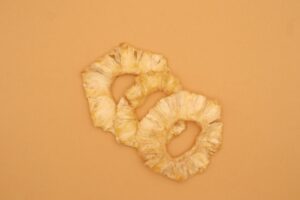
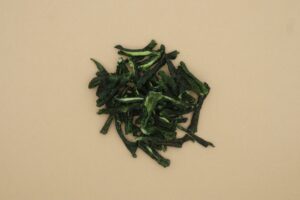
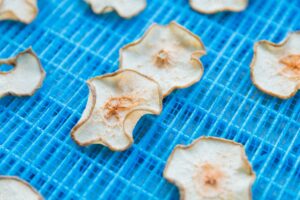
dried celery

Celery has a distinctive aroma and refreshing quality, making it indispensable as an aromatic vegetable in Western dishes and soups. Dried celery is domestically grown material dried at low temperature, keeping its aroma and color intact. Rehydrated, it recovers a crisp texture, comes through with good aroma, and can be used in a wide range of processed foods such as soups, sauces, and prepared dishes. Powdered, it can also be used in dressings, seasonings, snack seasonings, and more.
Dried celery: three points of care
Agriture's dried celery is rigorously designed for quality so it can be adopted as a commercial raw material. Here we introduce three perspectives we treat as particular strengths.
01 Using domestically grown celery, stalk and leaf alike
We process domestically grown celery with a cut design that suits the application so both stalk and leaf can be used. Because you can use both the aroma of the leaf and the crisp texture of the stalk, it is a material well suited to soup stock and as an aromatic vegetable.
02 Low-temperature hot-air drying preserves the aroma
Celery's characteristic green, fresh quality is a component easily lost when processed at high heat. With low-temperature hot-air drying at reduced temperature and airflow, we achieve a finish where the aroma rises firmly when rehydrated.
03 Specifications easy to handle as an aromatic vegetable
Additive- and glucose-free, with cut specifications available as slices, chips, and dice. A strength is our range of specifications easy to use as an aromatic vegetable, such as for soup stock, bouillon, prepared dishes, and dressings.
Product catalog showing the items we handle
Flexible support from small lots to large lots
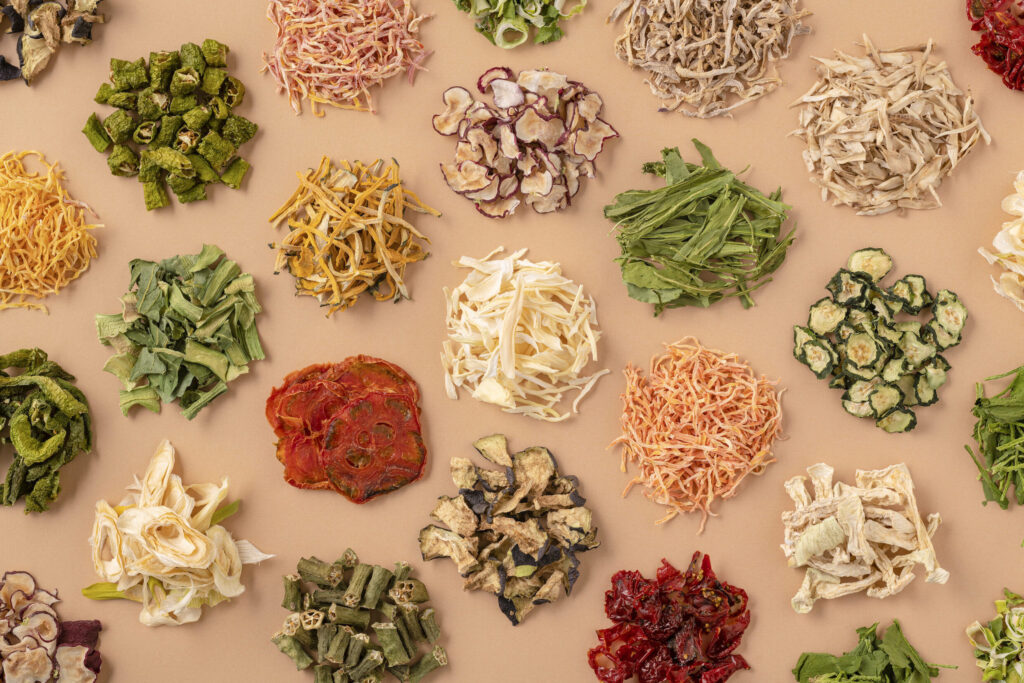
- Sold in small lots from 1 kg
- Handling heirloom vegetables from across Japan
- Dried fruits and herbs also supported
TOC
Characteristics as a commercial raw material
We summarize, from six perspectives, the advantages of choosing dried celery as an OEM raw material. Use it as a reference for both replacing existing raw materials and developing new products.
Aroma ideal for soup stock
Because the aroma comes through firmly when rehydrated, it is adopted in professional settings as a base material for bouillon and soup stock.
Choose stalk and leaf separately
You can choose among three patterns to match the application—stalk-based, leaf-based, or mixed—so you can finely adjust the strength of aroma and the color.
Long-term storage enables year-round supply
Room-temperature storage with a 6-month best-before date. Because raw material can be secured regardless of celery's season, it stabilizes procurement planning for soup and prepared-dish makers.
Powdering expands it into seasoning material
Processed into powder, its range of applications broadens to snack seasoning, dressings, powdered soups, and more.
Additive-free, clean label
Because the ingredient list is simple, it is an easy raw material to adopt even in clean-label-oriented OEM and PB products.
One-stop from prototype to volume production
We handle everything from 1kg prototypes to full production of 10kg and up. From recipe design to packaging, it can all be advanced end-to-end on our own line in Kyoto.
Product specifications (commercial)
The product's basic specs are as follows. Cut specifications and packaging specs can be individually adjusted on a contract basis, so please consult us to match your OEM requirements. We have organized raw-material origin, best-before date, production method, and minimum lot so they can be checked at a glance.
Item | Details |
|---|---|
Raw material | Celery (domestically grown) |
Net content | 100g (commercial unit) |
Production method | Low-temperature hot-air drying |
Best-before date | About 6 months from production |
Annual supply volume | About 100kg (varies by season) |
Processing plant | Factory in Kyoto Prefecture |
Shipping unit | 100g〜 |
Minimum-lot OEM | Prototype from 1kg / full production from 10kg |
Customization support
For each OEM project, we respond flexibly to changes in cut shape, powdering, small-lot prototyping, blending, and packaging specs. In addition to the response table below, please consult us about individual adjustments to match your requirements.
Item | Available | Details |
|---|---|---|
Size change | ◎ | Slice, chip, dice, and more available |
Powdering | ◎ | Fine-powder processing available |
Small-lot OEM prototyping | ◎ | Available from 2kg |
Mixed materials and blends | ◎ | Blending with other raw materials available |
Packaging changes | ◎ | Both commercial and individual packaging available |
POWDER
We also offer powder products
At Agriture, we also handle powder processing of dried celery. From our vegetable-powder lineup, you can check combinations with other materials and processing examples.
Variety, grower, and origin information
Agriture's dried celery keeps quality stable through procurement from partner farmers and contracted growing regions. Please refer to it when you want to make use of origin information at the product-planning stage.
BRAND
Variety: We select domestically grown celery, sourcing it on the basis of the stalk-to-leaf balance.
PRODUCER
Producer: We work with domestic partner farmers and origin partners, minimizing the lead time from harvest to processing.
REGION
Growing region: Domestic growing regions (multiple prefectures). We maintain a multi-region sourcing system that prioritizes stable supply.
CULTIVATION
Cultivation method: Cultivation by partner farmers centered on conventional growing. We specify harvest timing and plant size to keep lots stable.
Low-temperature drying to protect the ingredient's natural flavor
At Agriture, to protect celery's aroma, color, and umami, we use low-temperature hot-air drying with finely controlled temperature and airflow. A strength is that we preserve the components easily lost in high-heat drying through a process designed to match the ingredient's nature.
Because we take in the raw material at our own processing facility in Kyoto and manage the whole flow in one place—sorting, cutting, drying, and inspection—we can hold quality variation between lots to a minimum. Combining procurement from partner farmers and contracted regions, we can start the drying process while the raw material is still fresh, which ties directly to finished quality.
💡 TIPS | Drying-processing trivia
Celery's aromatic compounds, the phthalides, are highly volatile and are greatly lost in high-heat processing. Hot-air drying at reduced temperature removes moisture thoroughly to the interior while retaining aroma, giving a finish that easily reproduces a "near-fresh aroma" when rehydrated. Drying the leaves as-is and the stalks after cutting shapes the raw material to make the most of each part's traits.
Commercial use cases
Because dried celery has ample aroma, texture, and umami even on its own, a single ingredient can be developed into multi-use product development. Here we introduce five representative use cases.
Soup stock and bouillon material
Usable as a staple bouillon material for Western, French, and Italian cooking. Because you can extract umami and aroma by adding it straight to soup without assuming rehydration, it shortens the prep process. It can be kept at room temperature as part of the aromatic vegetables (mirepoix), enabling stable procurement while curbing the waste loss and seasonal fluctuation of fresh celery.
Prepared-dish and simmered-dish material
It shines in simmered dishes where aromatic vegetables are indispensable, such as minestrone, pot-au-feu, stew, and hayashi rice. Because it is pre-prepped and easy to weigh and add, it is a material easy to build into retort and frozen prepared-dish production lines.
Dressing and seasoning material
Usable as a seasoning base for celery dressing, shio-koji dressing, herb salt, and more. Powdered, it disperses evenly into liquid seasonings and seasoning salts, and suits commercial-blend raw materials.
Snack and bakery material
Usable as an aromatic material for salty snacks and savory breads. Just a small amount of powder brings out celery's refreshing aroma, finishing with a grown-up flavor. Mixed into doughs or seasonings, the flavor remains.
Aromatic material for health-conscious menus
As a fragrant aromatic vegetable, it suits differentiating health-conscious menus and low-calorie prepared dishes that emphasize vegetables. Because room-temperature storage lets you use only the amount needed, it is an easy-to-handle raw material even in small-lot, multi-item product design.
Commercial usage and case examples
For commercial use, we handle everything from 1kg prototypes to full production of 10kg and up. It is adopted as an OEM raw material by soup, prepared-dish, and seasoning makers, and also as a prep ingredient for restaurant chains.
At Agriture, we provide end-to-end support on our own line in Kyoto, from raw-material selection and primary processing to cutting, powdering, blending, and small-portion packaging. Because we can adjust specifications to match an OEM client's spec sheet and design recipes for launching new brands, you can entrust everything with confidence from the prototype stage through volume production and ongoing supply.
We welcome first-time inquiries and considerations of switching from existing raw materials. For sample provision, quotes, and technical questions about the production process, feel free to reach out via the inquiry form.
Related case examples and reference articles:
- Vegetable Broth × Dried Vegetables to Boost Umami: Pro Tips on Use and Selection
- How to Make Vegetable Broth | Straight from the Pros: Basics and Tips for Drawing Out Maximum Umami
- What Is Vegetable Broth? An Introduction to Broth Culture That Draws Out Plant-Based Umami
Product catalog showing the items we handle
Flexible support from small lots to large lots
- Sold in small lots from 1 kg
- Handling heirloom vegetables from across Japan
- Dried fruits and herbs also supported
FAQ (OEM and commercial dried celery)
We have compiled frequently asked questions about OEM and commercial dried celery. Please use them as decision-making material before contracting.
Q. About what are the minimum lot and unit price?
A. Prototypes start from 1kg, and full production is 10kg and up as a guide. The unit price varies with cut specification (slice / dice / powder) and packaging specs. We present it in an individual quote.
Q. When is the price / unit price determined?
A. It fluctuates each time depending on celery's harvest conditions and market prices. For annual contracts we base it on the unit price at the time of contract; for spot transactions we present it each time.
Q. About how long are the delivery time and lead time?
A. For stock items, around 2 weeks; for full production, 3 to 6 weeks as a guide. When cutting or powdering is involved, we provide a separate delivery time.
Q. Can you provide raw-material origin certification or origin information?
A. We can provide origin information certifying that it is domestically grown. As needed, we can also share the grower's name and cultivation information. Please specify the inspection items at the time of inquiry.
Q. Can you handle HACCP and export requirements?
A. Our production line complies with HACCP. We also handle the preparation of English-language documents and hygiene certificates for export.
Q. What is the flow for an OEM consultation?
A. It proceeds in the flow: ① inquiry → ② interview → ③ sample provision → ④ quote and contract → ⑤ prototyping → ⑥ full production → ⑦ delivery.
Medicinal-food properties (in the case of fresh celery)
From the yakuzen perspective, celery has traditionally been used as an ingredient that cools heat in the body.
It's an ingredient that can be used widely in soups, stir-fries, smoothies and more. As an angle for branding, it's a raw material that pairs well with keywords such as "cool," "refreshing" and "circulation."
💡 TIPS | Yakuzen trivia
Because celery's aromatic compounds fly off quickly with too much heat, adding it as a finishing touch or heating it briefly at low temperature preserves the most flavor. In soups and simmered dishes, the trick is to design it in during the last 2 to 3 minutes.
Agriture's dried celery is a low-temperature-dried product that rehydrates quickly and brings up its aroma, so it can be adopted as-is as a raw material for medicinal-food soups, functional foods, and wellness brands.
YAKUZEN
For those who want to learn more about celery from a medicinal-food perspective
Yasai Yakuzen explains the medicinal-food workings of vegetables including celery, along with recommended ways to eat them by constitution and season. Please use it as a hint for product development as well.
Recommended reading
- Vegetable Broth × Dried Vegetables to Boost Umami: Pro Tips on Use and Selection
- How to Make Vegetable Broth | Straight from the Pros: Basics and Tips for Drawing Out Maximum Umami
- What Is Vegetable Broth? An Introduction to Broth Culture That Draws Out Plant-Based Umami
- Celery powder
Download the product catalog
We will send the materials to your email address based on the information you provide.