
Kintoki Carrot: A Vividly Colored, Strongly Sweet Kyoto Vegetable

Summary of this article
Kintoki carrot is one of Kyoto's heirloom vegetables—an Oriental-type carrot characterized by a vivid red from lycopene rather than the beta-carotene of Western carrots, and a strong sweetness with little carrot smell. Slender and about 30cm long, it is in season from November to February, with Kyoto Prefecture plus Kagawa and Tokushima as its main growing areas. It came to Japan via China in the 16th century, and its name derives from Sakata Kintoki (the red-faced Kintaro). It is beloved as a staple ingredient in osechi nishime, red-and-white namasu, and Kagawa's "anmochi zoni."
Kintoki carrots (Kintoki carrot) is one of Japan's traditional varieties, grown in the Kansai region including Kyoto. Its greatest feature is a vivid red unlike the usual orange Western carrot, and it is often used at celebratory occasions such as osechi and New Year's simmered dishes.
TOC
Features and Appearance of Kintoki Carrot
Unlike the usual orange Western carrot, it has a vivid red color. This red comes from a nutrient called lycopene, which is also found in tomatoes. Kintoki carrot has firm flesh that holds its shape even when heated, making it perfect for simmered and steamed dishes. It also has little of the smell characteristic of carrots.
Differences from Western Carrots
| Comparison item | Kintoki carrot (Oriental type) | Western carrot |
|---|---|---|
| Color | Vivid red (from lycopene) | Orange (from beta-carotene) |
| Shape | Slender, tapered tip (about 30cm) | Thick and short (about 15–20cm) |
| Texture | Soft and smooth | Firm |
| Turnip and daikon look similar, but there is a clear difference in their characteristics after drying. Please use this as a reference for material selection. | Strong | Somewhat restrained |
| Smell | Little | Has a carrot smell |
| Season | November–February | Shipped year-round |
| Main use | Simmered dishes, osechi, namasu | Salads, stir-fries, curry |
Season and production area
Kintoki carrot is in season in winter, from November to the following February. Its main growing areas are western Japan, including Kyoto Prefecture plus Kagawa and Tokushima. Kagawa in particular is among the nation's top producers of Kintoki carrot, and it is an essential ingredient in local home cooking too. In Kyoto, demand rises toward osechi at year-end and New Year, and December is when shipment volume peaks.
JA Kyoto official site – Kintoki Carrot
History of Kintoki Carrot and the Origin of Its Name
The carrot's place of origin is said to be Afghanistan; those later brought to Europe became the Western type, and those brought to Asia became the Oriental type. Oriental-type carrots are said to have come to Japan via China in the 16th century.
The name Kintoki carrot derives from Sakata Kintoki (childhood name Kintaro), famed for his red face. Because Sakata Kintoki always had a red face, red things are sometimes likened to "Kintoki." Beyond the carrot, there are other ingredients named after Sakata Kintoki, such as "kintoki beans" and "kintoki mikan."
Kintoki Carrot as a Kyoto Heirloom Vegetable
Kintoki carrot is a variety certified as a "Kyoto Heirloom Vegetable." With a history of cultivation in Kyoto since the Edo period, it was indispensable as a splash of color in Kyoto cuisine. Farmers within Kyoto Prefecture still protect its fixed-variety seeds, and it remains an heirloom vegetable essential to the winter table in Kyoto. List of Kyoto vegetable varieties, where you can also check other traditional varieties.
A Deep Connection to Osechi Cuisine
The reason Kintoki carrot is indispensable to osechi lies in its vivid red. Red is considered an "auspicious color" in Japanese food culture and has been chosen as an ingredient fitting for celebratory occasions. In osechi nishime, Kintoki carrot decoratively cut into plum blossoms or hexagons adds splendor. In red-and-white namasu, the contrast of white daikon and red Kintoki carrot creates a festive splash of color for the New Year.
Reference 1 Reference 2 Reference 3
Kintoki Carrot's Vivid Red and Strong Sweetness
The charm of Kintoki carrot is its eye-catching vivid red and a sweetness so strong you'd hardly think it was carrot. This red comes from a pigment called lycopene, in the same family as the red of tomatoes. Whereas the usual orange Western carrot has the pigment beta-carotene, Kintoki carrot is rich in the pigment lycopene, dyeing it a distinctive deep red.
A Vivid Red That Shows Even When Heated
Kintoki carrot's red is characterized by resisting fading even when heated. Because the vivid color remains whether simmered or stir-fried, it has been prized in dishes where color matters, such as osechi nishime and red-and-white namasu. Cooked with oil, its color and sheen grow even more vivid, finishing into an appetizing plate. Beautiful both raw and heated, it can be used widely as an accent color in dishes.
Why Even Carrot-Haters Find It Easy to Eat
Compared with Western carrots, Kintoki carrot has little of the distinctive carrot smell and a strong sweetness. It is known as a variety easy to eat even for those who dislike carrots and for children. Because its sweetness is strong, it's delicious even eaten raw in salads or as sticks. Heating brings out even more sweetness, so simmered dishes and potages let you fully enjoy the ingredient's flavor. Shogoin turnip A potage paired with is recommended as a winter staple soup.
Recommended Ways to Eat Kintoki Carrot
With its vivid color and strong sweetness, it's an ingredient suited to simmered dishes. Indispensable to osechi as well, the red of Kintoki carrot used in nishime and namasu splendidly colors the celebratory table. In Kagawa, where Kintoki carrot cultivation thrives as it does in Kyoto, it is beloved in the local dish "anmochi zoni." Kintoki carrot cut into rounds, in a wish for family harmony, is an essential ingredient of anmochi zoni.
Kinpira and Simmered-Dish Recipes
Kintoki carrot kinpira is a popular side dish. It's a simple dish of thinly sliced Kintoki carrot stir-fried in sesame oil and seasoned with soy sauce and mirin, but the carrot's sweetness and aroma come alive and it goes perfectly with rice. For nishime, cut Kintoki carrot decoratively into plum shapes and simmer it in dashi, soy sauce, mirin, and sugar. Simmering slowly over low heat finishes it vividly colored into a beautiful dish. Shogoin daikon Cooked together with , the contrast of white and red is festive.
Delicious Ways to Eat It Raw
Because Kintoki carrot is strongly sweet with little bitterness, it's delicious raw too. Enjoying it in salads or pickles is also recommended. A simple salad of thin slices dressed with olive oil and lemon lets Kintoki carrot's vivid red shine and brightens the table. Red-and-white namasu, a simple dish of julienned daikon and Kintoki carrot dressed with sweet vinegar, also enjoys enduring popularity as an osechi staple.
How to Choose and Store Kintoki Carrot
How to Spot a Good Kintoki Carrot
When choosing Kintoki carrot, pick one with a vivid, even red. One with a glossy surface and few fine roots is fresh. One that feels heavy in the hand holds plenty of moisture. A good-quality Kintoki carrot is even in thickness to the tip, with no breaks or blemishes. Those with leaves attached are proof of high freshness, so if you spot them, choose them first.
How to store it and tips for keeping it fresh
Because Kintoki carrot is sensitive to humidity, the basic method is to wrap it in newspaper or paper towels, place it in a plastic bag, and store it standing up in the refrigerator's vegetable drawer. Lying it down makes it bend easily, so keeping it upright is the key. This method keeps it about two weeks. To freeze it, cut it to suit your use, parboil it firm, and freeze—it keeps about a month. Kyoto vegetable calendar Check the seasons of other winter Kyoto vegetables at as well.
Combining Kintoki Carrot with Other Kyoto Vegetables
Combining Kintoki carrot with other Kyoto vegetables brings out even more of a dish's looks and flavor. Shogoin turnip Simmered together with , the white-and-red contrast is beautiful, and Kujo green onion scattered on top adds a green accent. In osechi, arranging it alongside makes an elegant, Kyoto-cuisine-like plate. A simmered assortment combining winter Kyoto vegetables is a recommended dish that recreates restaurant flavor at home. Horikawa gobo Kintoki Carrot as a Dried Vegetable
Kintoki carrot is delicious dried too. It can be stored long-term, and rehydrated in water it can be used quickly whenever you need it. With dried vegetables you can enjoy its flavor and color through all four seasons and widen your cooking range. Drying also concentrates the umami and sweetness, so even a small amount adds deep flavor and vivid red to dishes.
How to Use Dried Kintoki Carrot
Dried Kintoki carrot can be used just like fresh by adding it to soups and simmered dishes. Rehydrate it in water for about 10 minutes, or add it straight to the pot and rehydrate it as you simmer. Because lycopene and sweetness dissolve into the soaking liquid, using it as part of your dashi is recommended. Since its fine color remains intact, it also has the effect of brightening a dish's appearance.
handles drying of Kyoto vegetables including Kintoki carrot. Dried-vegetable OEM Frequently Asked Questions About Kintoki Carrot
FOR BUSINESS
乾燥金時人参を、原料としてお探しですか
国産の金時人参を乾燥・粉砕してお出ししています。カット形状や粒度の指定、継続してのお取引もご相談ください。規格は Dried kintoki carrot に掲載しています。
少量でのご購入は、姉妹ブランドの通販サイト OYAOYA で承っています。
What's the difference between Kintoki carrot and ordinary carrots?
Recommended reading
List of Kyoto vegetable varieties / Kyoto vegetable calendar / Commercial dried vegetables / Kyoto Vegetables and Sake. The Happy Relationship of a Dish and a Cup. / Vessels and Kyoto Vegetables. Creating the Scenery of Plating.
We have materials available to help you understand dried processing OEM
Agriture OEM, flexibly handling everything from small lots to large lots
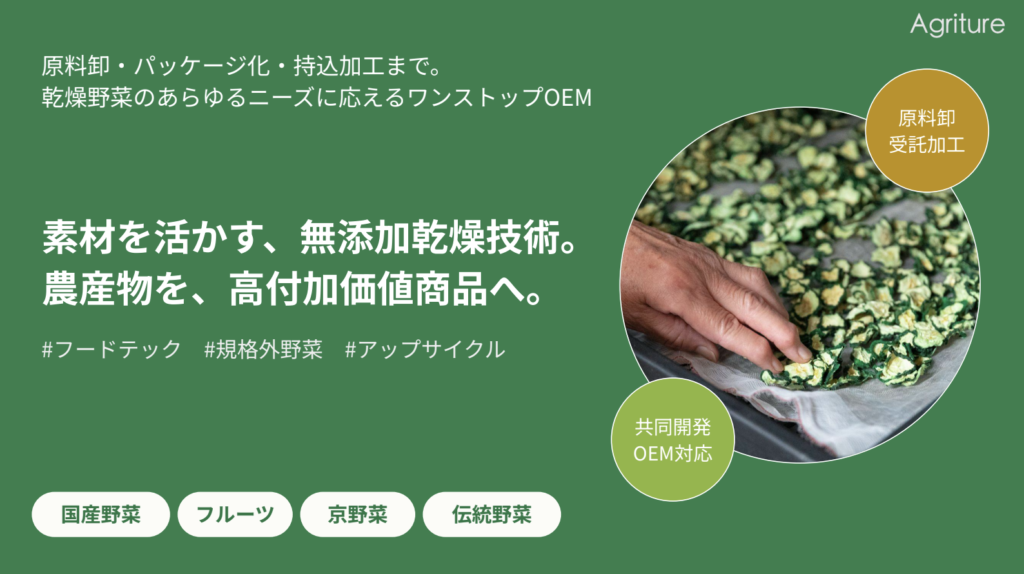
- OEM available from small lots of 10 kg
- Drying of brought-in raw materials also possible
- Support from processing to filling in one place
At Agriture, we handle commercial dried Kintoki carrot Kintoki carrot slowly dried at low temperature, as a commercial ingredient for prepared foods, soups, confectionery, and more. Its vivid red and strong sweetness come through in the dried product too.
Related articles
- Shogoin Daikon | A Kyoto Vegetable That Colors Winter Simmered Dishes
- Shogoin Turnip | A Fine Winter Kyoto Vegetable
- Horikawa Burdock | A Kyoto Heirloom Vegetable Used in Osechi Too
- A list of Kyoto vegetable varieties — famous heirloom vegetables and their characteristics
- Kyoto vegetable calendar — check the seasons of the four seasons at a glance
Download the OEM contract processing materials
We will send the materials to your email address based on the information you provide.
Author of this article
Related articles
-
 京野菜は何品目あるのか、読み方の一覧と認定の枠組みから確かめる
 -
 Drying Is Another Kind of Cooking
 -
 The Technology to Lock In the Season. The Seasonal Story Dried Vegetables Connect.
 -
 The Cut Face of a Vegetable. The Difference the Cut Makes.
 -
 Tasting Kyoto Vegetables by Aroma. The Pleasure of Cooking That Begins at the Tip of the Nose
 -
 Vessels and Kyoto Vegetables. Creating the Scenery of Plating.
 -
 Vegetables and Heat Control. Between High and Low Flame
 -
 Kyoto Vegetables and Sake. The Happy Relationship of a Dish and a Cup.