
How many Kyoto vegetables are there? Checking through a reading list and the certification frameworks

Summary of this article
The term "Kyoto vegetables" has no official definition; what are defined are two things: "Kyoto Heirloom Vegetables" (Kyoto Prefecture, 37 items) and "Kyoto Brand Products" (certified by the Kyoto Furusato Sanpin Association). Along with a furigana reading list of 27 items that are easy to misread, we've organized from published sources what each of the four frameworks guarantees — including Manganji amato and Kyo Kamo nasu registered as geographical indications, and Kyoto Manganji No. 1 and No. 2, which Kyoto Prefecture bred and registered as varieties.
京野菜を調べはじめると、最初に引っかかるのが名前の読みです。九条ねぎ、Shishigatani kabocha、聖護院大根、柊野ささげ。どれも京都の地名がそのまま品目名になっているため、地名を知らないと読めません。そしてもうひとつ引っかかるのが品目数です。37品目と書いてあるページもあれば、40品目、21品目、31品目と書いてあるページもあります。
The numbers not matching up doesn't mean any of them is wrong. Kyoto has several certification frameworks that differ in character, and each counts a different set of items. This article lays out the readings in a table and then organizes, framework by framework, what each one guarantees, following official sources.
TOC
The term "Kyoto vegetables" has no official definition
先に結論を書きます。「京野菜」そのものを定義した公的な文書は、京都府にも京都市にも、認証を担う公益社団法人京のふるさと産品協会にも見当たりません。定義が置かれているのは「Kyoto Heirloom Vegetables」と「京のブランド産品」という2つの枠組みのほうです。
Kyoto Prefecture defines only two frameworks
The page on Kyoto Prefecture's website that covers Kyoto vegetables is titled "Kyoto Heirloom Vegetables and Kyoto Brand Products." What it lists are the five criteria defining Kyoto heirloom vegetables and the certification requirements for Kyoto brand products. A sentence saying "A Kyoto vegetable is such-and-such" appears nowhere on the page. Kyoto City's "About Kyoto Heirloom Vegetables" is the same, presenting only the definition of heirloom vegetables.
JA Kyoto calls every vegetable grown in the prefecture a Kyoto vegetable
JA Kyoto states this plainly. Its Kyoto vegetables page clearly says, "There is no specific definition of 'Kyoto vegetables.' All vegetables grown within Kyoto Prefecture are collectively called Kyoto vegetables," and goes on, "JA Kyoto, too, positions all vegetables produced in its area as 'Kyoto vegetables.'"
Indeed, JA Kyoto's page lists, as "common vegetables in JA Kyoto's area included among Kyoto vegetables," komatsuna, cucumber, edamame, spinach, garden peas, tomato, onion, taro, garland chrysanthemum, carrot, green asparagus, Chinese cabbage, and more. Under this view, tomatoes and asparagus are Kyoto vegetables too. Calling only the vegetables with a distinctly Kyoto image "Kyoto vegetables" is nothing more than a colloquial usage.
Why the item count differs from source to source
The figures 37, 40, 21, and 31 each count something different. 37 is the number of Kyoto heirloom vegetables, 40 adds the three items "treated as equivalent" to heirloom vegetables, 21 is the number of vegetable items among Kyoto brand products, and 31 is the total count of brand products including rice, beans, and seafood. All are correct; they simply cover different sets. Checking first which set the source you're reading is counting will keep you from getting confused.
A list of Kyoto vegetables that are easy to misread
We've put the reading, the framework it belongs to, the season it's available, and a point worth remembering onto a single table. In the framework column, "Heirloom" means Kyoto heirloom vegetables, "Equiv." means items treated as equivalent to Kyoto heirloom vegetables, "Brand" means Kyoto brand products, and "GI" refers to the geographical indication protection system of the Ministry of Agriculture, Forestry and Fisheries.
| Item name | Reading | Framework | Mainly in season | Worth remembering |
|---|---|---|---|---|
| Kujo green onion | kujonegi | Heirloom / Brand | Anniversary | Minami Ward, Kyoto City — the Kujo district gives the name |
| Kyo-mibuna | kyomibuna | Heirloom / Brand | Anniversary | Around Mibu-dera temple, it was once grown |
| Kyo mizuna | kyomizuna | Heirloom / Brand | Anniversary | Outside Kyoto, also called kyona |
| Kamo eggplant | kamonasu | Heirloom / Brand / GI | Summer | The GI name is "Kyo Kamo nasu" |
| Shishigatani kabocha | shishigatani kabocha | Heirloom / Brand | Summer | "Shikagatani" is not how it's read |
| Fushimi togarashi | fushimi Togarashi | Heirloom / Brand | Summer | Long and slender, also called himoto |
| Kyo Yamashina eggplant | kyo yamashina nasu | Heirloom / Brand | Summer | "Yamashiro" is incorrect |
| Manganji togarashi (Manganji amato) | manganji Togarashi | Equiv. / Brand / GI | Summer | The brand name and GI name are amato |
| Kyo natsu zukin | kyo natsuzukin | Brand | Summer | Developed from black soybeans, a summer edamame |
| Hiragino sasage | hiraginosasage | Heirloom | Summer | "Hiiragino" is not how it's read |
| Katsura uri | katsurauri | Heirloom | Summer | Grown in Katsura, Nishikyo Ward |
| Takagamine togarashi | takagamine Togarashi | 準 | Summer | From Takagamine, Kita Ward Togarashi |
| Hanana | hanana | Equiv. / Brand | Spring | The flower buds of rapeseed, eaten as a vegetable |
| Kyo hatakena | kyohatakena | Brand | Spring | Derived from a native rapeseed variety |
| Kyoto bamboo shoots | kyotakenoko | Heirloom / Brand | Spring | By definition, bamboo shoots too are included among vegetables |
| Shogoin daikon | shogoin daikon | Heirloom / Brand | Autumn–winter | "Seigoin" is not how it's read |
| Shogoin turnip | shogoin kabu | Heirloom / Brand | Autumn–winter | Used for senmaizuke, a large turnip |
| Horikawa gobo | horikawa gobo | Heirloom / Brand | Autumn–winter | Cultivated over two years |
| Ebi-imo | Ebi-imo | Heirloom / Brand | Autumn–winter | Also spelled ebiimo a type of taro |
| Kuwai | Kuwai | Heirloom / Brand | Autumn–winter | In kanji, written 慈姑 |
| Murasaki zukin | murasaki zukin | Brand | Autumn–winter | Developed from Tamba black soybeans, an edamame |
| Kyo-kokabu | kyoko kabu | Brand | Autumn–winter | Not among the heirloom vegetables |
| Kintoki carrot | kintoki Carrot | Brand | Autumn–winter | Not among the heirloom vegetables |
| Yama-no-imo | Yama-no-imo | Brand | Autumn–winter | Also called tsukuneimo |
| Suguki na | sugukina | Heirloom | Autumn–winter | A Kamigamo pickle; the raw material for suguki |
| Matsugasaki ukina kabu | matsugasaki ukina kabu | Heirloom | Winter | A variety unique to Matsugasaki, Sakyo Ward |
| Sabaka daikon | sabaka daikon | Heirloom | Winter to spring | Said to have originated in Sabaka, Maizuru City |
| Uguisu na | uguisuna | Heirloom | Winter | Harvested around the time the bush warbler sings |
The place name is the item name
Many of the hard-to-read Kyoto vegetables bear a Kyoto place name. Kujo is in Minami Ward, Kyoto City; Shishigatani and Shogoin are in Sakyo Ward; Horikawa is a street running from Kamigyo Ward into Nakagyo Ward; Matsugasaki is in Sakyo Ward; Takagamine and Hiragino are in Kita Ward; Katsura is in Nishikyo Ward; and Yamashina is in Yamashina Ward. Sabaka, Ouchi, and Maizuru correspond to Maizuru City. Learning the place names first lets you guess not only the reading but also the growing region.
Put the other way, it's only natural that someone who doesn't know the place names can't read them correctly at first sight. Even among people living in Kyoto City, not many can read Hiragino or Sabaka accurately.
Hiragino is read "hiragino," and Sabaka is read "sabaka"
Hiragino sasage tops the list of easily misread names. The character 柊 tempts people to read it "hiiragino sasage," but the place name Hiragino in Kamigamo, Kita Ward, Kyoto City is read "hiragino." Because its pods reach 80 to 90 centimeters long, it's also called sanjaku sasage.
佐波賀だいこんも同じ種類のつまずきがあります。「さばが」と濁って読まれることがありますが、舞鶴市佐波賀は「さばか」です。秋に種をまいて翌年の2月から3月に収穫する晩成型で、一般的な大根が約3か月で収穫できるのとは栽培期間がまるで違います。昭和33年頃から急速に衰退し、平成22年に京都府が保管していた種子を使って生産を復活させるEffortsが始まりました。
"Zukin" and "amato" are relatively new names
Murasaki zukin, Kyo natsu zukin, and Manganji amato are not long-standing names but ones given for distribution. Murasaki zukin is an edamame developed from Tamba black soybeans, and its name is said to come from the pale purple of the bean's inner skin and from the bean's resemblance in shape to a hood (zukin). Manganji amato is a brand name created to sell Manganji togarashi as a non-spicy sweet variety.
These three are seldom misread, but they raise a different question: are they Kyoto heirloom vegetables? Murasaki zukin and Kyo natsu zukin are brand products only, not heirloom vegetables, while Manganji togarashi falls under both the items treated as equivalent to heirloom vegetables and the brand products. From the next section, we get into what these frameworks actually contain.
The five criteria that define Kyoto heirloom vegetables
Kyoto heirloom vegetables were defined in a document issued by Kyoto Prefecture's Department of Agriculture, Forestry and Fisheries in March, Showa 63. The definition published by Kyoto Prefecture consists of the following five criteria.
- Has a history of being introduced and cultivated before the Meiji era
- Covers not only Kyoto City but the entire prefecture
- Includes bamboo shoots
- Excludes mushrooms and ferns (zenmai, warabi, and others)
- Includes items currently cultivated or preserved as well as items that have gone extinct
Not a term that refers to Kyoto City items alone
The second criterion comes into play here. Kyoto heirloom vegetables are not limited to Kyoto City. Sabaka daikon, Sabaka kabu, and Maizuru kabu are said to originate in Maizuru City, and Ouchi kabu also takes its name from a place in Maizuru City. Junsai is likewise not a Kyoto City item. What Kyoto City presents is a list narrowed to items grown within the city, so it contains fewer items than the prefecture-wide list.
If you find yourself thinking, "I looked at a list of Kyoto heirloom vegetables, but a name I've heard of isn't on it," check whether you're looking at the city's list or the prefecture's list.
Bamboo shoots are in; mushrooms and ferns are out
The third and fourth criteria draw the boundaries of what's included. The line follows how foods are treated at the Kyoto table rather than botanical classification. Bamboo shoots are treated as a vegetable and, as Kyo takenoko, fall under both the heirloom vegetables and the brand products. Mushrooms and ferns, on the other hand, including zenmai and warabi, were left out. Tamba mushrooms don't come up in discussions of Kyoto vegetables because of where this line is drawn.
The three items that fall under the separate "equivalent" category
For vegetables that don't meet the before-Meiji criterion yet have become indispensable to Kyoto's market distribution, a separate category exists: "items treated as equivalent to Kyoto heirloom vegetables." The three that qualify are Manganji togarashi, Takagamine togarashi, and hanana (Fushimi kanzaki rapeseed), which together with the 37 heirloom vegetables make a count of 40 items in total.
Manganji togarashi is said to have arisen in Maizuru during the Taisho era, thought to have come about through natural crossbreeding between Fushimi togarashi and an Asian variety that arrived by way of the Sea of Japan. Because it doesn't reach the before-Meiji criterion, it's positioned not as an heirloom vegetable itself but as an equivalent item. This treatment is why "Is Manganji togarashi a Kyoto heirloom vegetable?" is hard to answer in a word.
FOR BUSINESS
Looking for dried vegetables for commercial use?
We dry domestically grown vegetables and fruits, grinding them as needed, to supply them. We handle around 100 items, and specifications are List of dried products・List of powders listed at.
Small-quantity purchases are available through our sister brand's online store, OYAOYA.
The 37 Kyoto heirloom vegetables, and who grows them now
Here are the 37 items arranged by category. In the Showa 63 classification, 34 items were listed as still existing and 3 as extinct.
| Category | Item name (reading) | 数 |
|---|---|---|
| daikon | Karami daikon (karami), Aomi daikon (aomi), Tokinashi daikon (tokinashi), Momoyama daikon (momoyama), Kuki daikon (kuki), Sabaka daikon (sabaka), Shogoin daikon (shogoin) | 7 |
| Q3. Can you powder-process raw material I bring in? | Matsugasaki ukina kabu (matsugasaki ukina), Uguisu na (uguisuna), Sabaka kabu (sabaka), Ouchi kabu (ouchi), Suguki na (sugukina), Maizuru kabu (maizuru), Shogoin kabu (shogoin) | 7 |
| Pickling greens | Mizu na (mizuna), Mibu na (mibuna), Hatake na (hatakena) | 3 |
| Eggplant | Mogi nasu, Kamo nasu (kamo), Yamashina nasu (yamashina) | 3 |
| Togarashi | Fushimi togarashi (fushimi), Tanaka togarashi (tanaka) | 2 |
| kabocha ・Gourds | Shishigatani kabocha (shishigatani), Katsura uri (katsura uri) | 2 |
| Tubers ・Root vegetables | Ebiimo, Horikawa gobo (horikawa), Kuwai, Kyo udo (kyoudo) | 4 |
| Others | Hiragino sasage (hiragino), Kyo myoga (kyomyoga), Kujo negi (kujo), Kyo seri (kyoseri), Kyo takenoko (kyo), Junsai | 6 |
| Extinct items | Kori daikon (kori), Toji kabu (toji), Shogoin kyuri (shogoin) | 3 |
Daikon and turnips make up nearly 40% of the 37 items
Seven daikon and seven turnips come to 14 items, and adding the extinct Kori daikon and Toji kabu brings it to 16. The large place that pickles and simmered dishes have held in Kyoto's food culture shows up directly in this skew toward certain items. Shogoin daikon is said to have become round as a long daikon brought in from Owari went on being grown around Shogoin, where the tilled soil is shallow — it's often cited as a case of the growing region's soil reshaping a vegetable.
For how each item is grown and eaten, see the article on Shogoin daikon introduced in detail on.
The counts of existing and extinct items differ by source
Both sources saying "34 existing, 3 extinct" and sources saying "35 existing, 2 extinct" are in circulation. This isn't a typo but a difference in sources. According to a research response registered in the National Diet Library's Collaborative Reference Database, "Kyo no Dento Yasai" issued by Kyoto Prefecture's Department of Agriculture, Forestry and Fisheries in 1988 lists three extinct kinds — Kori daikon, Toji kabu, and Shogoin kyuri — whereas the table in the same-titled document issued in 2002 by the Kyoto Furusato Sanpin Price and Distribution Stabilization Association lists Shogoin kyuri as still existing.
Whichever figures you look at, the total of 37 items stays the same. The only discrepancy is the single question of how Shogoin kyuri is treated.
In Kyoto City, some items are preserved under contract with a single household
A name appearing on the list of heirloom vegetables and being able to buy the item at market are two different things. Kyoto City has set up the "Kyoto City Specialty Vegetable Preservation Plots," contracting with farmers in the city to grow and maintain the items. Pulling together the number of growing households the city publishes for each item reveals how greatly the depth of production differs.
| Item | Within Kyoto City, growing households | Contracted to, etc. |
|---|---|---|
| Horikawa gobo | 20 households | Still widely grown across the city |
| Ebi-imo | 9 households | Still widely grown across the city |
| Karami daikon | 7 households | — |
| Takagamine togarashi | 5 households | Equivalent item |
| Aomi daikon | 4 households | Continues to save its own seed |
| Yamashina eggplant | 3 households | — |
| Mogi nasu | 2 households | — |
| Shishigatani kabocha | 2 households | — |
| Matsugasaki ukina kabu | 1 household | Contracted to a farmer in Kamigamo, Kita Ward |
| Uguisu na | 1 household | Maintained through preservation plots |
| Katsura uri | 1 household | In Kamikatsura, Nishikyo Ward Kamigamo, Kita Ward |
| Hiragino sasage | 1 household | Contracted to a farmer in Kamigamo, Kita Ward |
| Kyo myoga | 1 household | Maintained through preservation plots |
| Momoyama daikon | 1 household | Mainly for seed preservation |
Matsugasaki ukina kabu, Uguisu na, Katsura uri, Hiragino sasage, Kyo myoga, and Momoyama daikon are each grown by a single farming household within Kyoto City. They almost never appear in ordinary retail stores, so even if you know the name, chances to see the real thing are limited. Shishigatani kabocha being grown by just two households in the city will likely come as a surprise given how well known the name is.
It isn't Kyoto Prefecture that certifies Kyoto brand products
This is the most misunderstood point. It was Kyoto Prefecture that defined the Kyoto heirloom vegetables, but it is the public-interest incorporated association Kyoto Furusato Sanpin Association that certifies the Kyoto brand products. The body that defines and the subject that is examined are both different.
What's examined is the shipment, not the item
Kyoto brand products are a system in which the association certifies, from among Kyoto-grown agricultural, forestry, and fishery products produced under the "Kyoto Kodawari Production Certification System," those carefully selected for quality, standard, and growing region. The certification requirements listed include having an image distinctly of Kyoto, being able to secure an appropriate volume as a shipping unit, being able to standardize quality and specification, and having elements of superiority or distinctiveness relative to other growing regions.
In other words, unlike Kyoto heirloom vegetables, which select items by history, Kyoto Brand Products look at whether each year's shipments meet the standards. Even for the same item, shipments that fall short of the standards receive no mark.
What the Kyo mark indicates
Certified products carry the "Kyoto Brand Products" mark, commonly known as the Kyo mark. The design symbolizes the K of Kyoto, representing the agricultural, forestry, and fishery bounty of Kyoto with three circles and their sources—earth, water, and sun—with three lines. Processed goods made from agricultural, forestry, and fishery products grown in designated brand regions can also use this mark if they meet the standards.
The underlying Kyoto Committed Production Certification System is characterized by following cultivation guidelines that reduce the use of pesticides and chemical fertilizers, by having certification inspectors check cultivation conditions and records, and by making producers identifiable through information disclosure. The mark functions as a sign that lets you trace the growing region and the grower.
31 items, including 21 vegetables, are certified
There are 31 Kyoto Brand Products in total. The breakdown is 21 vegetables, 3 chestnut and bean items, 2 fruit items, 2 seafood items, 2 processed-goods items, and 1 sake rice item. The 21 vegetables are divided by season as follows.
- Year-round (3 items): Kyo mizuna, Kyo mibuna, Kujo negi
- Spring (3 items): Kyo hatakena, hanana, Kyo takenoko
- Summer (6 items): Kamo nasu, Fushimi togarashi, Manganji amato, Kyo Yamashina nasu, Shishigatani kabocha, Kyo natsu zukin
- Autumn–winter (9 items): murasaki zukin, Kyo kokabu, Horikawa gobo, ebiimo, kintoki ninjin, yamanoimo, Shogoin kabu, Shogoin daikon, kuwai
The three items classified as year-round came to be shipped throughout the year as the practice of early harvesting while the plants are still small spread. Kujo green onion also came to be used in restaurants nationwide against the backdrop of this stable supply.
Kintoki ninjin is not included among Kyoto heirloom vegetables
You may see the explanation that "brand Kyoto vegetables are chosen from among Kyoto heirloom vegetables," but this is not accurate. Regarding kintoki ninjin, the Kyoto Hometown Products Association clearly states that there is no historical record of Kyoto being a main growing region before the Meiji era and that it is not included among Kyoto heirloom vegetables. Having long been used to add color to Kyoto cuisine is a separate matter from satisfying the definition of an heirloom vegetable.
Likewise, Kyo kokabu, murasaki zukin, Kyo natsu zukin, and yamanoimo are not heirloom vegetables either. Several of the 21 brand products are not heirloom vegetables, and the two frameworks do not form an inclusive relationship.
It began in fiscal Heisei 1 with 7 items and 18 growing regions
The brand certification program began in Heisei 1. At the start, the certified items were, for spring–summer, Manganji togarashi, Fushimi togarashi, and Kamo nasu (3 items), and for autumn–winter, mizuna, ebiimo, black soybeans, and adzuki beans (4 items)—7 items in all. Eighteen growing regions were designated. From there, the designation of items and regions progressed, expanding to the current 31 items.
What each of the four frameworks guarantees
Kyoto heirloom vegetables, Kyoto Brand Products, geographical indications, and variety registration. These four differ in purpose, governing body, and what they guarantee. Comparing them side by side keeps them from being confused.
| Point of comparison | Kyoto Heirloom vegetables | Kyoto Brand Products | Geographical Indication (GI) | Variety registration |
|---|---|---|---|---|
| Decided by Actor | Kyoto Prefecture | Kyoto Hometown Products Association | Minister of Agriculture, Forestry and Fisheries | Minister of Agriculture, Forestry and Fisheries |
| What is guaranteed | Since before the Meiji era, a history of cultivation | Production method and quality and standards | Linked to the growing region Quality | The variety's distinctness and the breeder's rights |
| Subject of review | Item | Shipments | Producer organization and growing area | Variety |
| Limitation of growing region | All of Kyoto Prefecture | Designated brand growing regions | Registered municipalities only | Not limited |
| Displayable mark | None | Kyo mark | GI mark | None |
| Shelf life | None | Certification requires renewal | None | The breeder's right has a term of protection |
| Kyoto's applicable count | 37 items (the 3 equivalent items are counted separately) | 31 items (of which vegetables, 21 items) | 2 cases | For vegetables, several varieties |
Systems that select items versus systems that select shipments
Kyoto heirloom vegetables are a list of items. Once an item fits the definition, it remains an heirloom vegetable. It is not a system that guarantees whether each individual vegetable on the shelf is good. Kyoto Brand Products, by contrast, look at whether that year's, that region's, that shipment met the standards. From the buyer's point of view, the latter is the quality marker.
Whether the growing region is restricted
The framework that restricts the growing region most strictly is the geographical indication. Anything made outside the registered municipalities cannot use the name, even if it is the same variety. Kyoto heirloom vegetables cover all of Kyoto Prefecture, so within the prefecture the growing region does not matter. Variety registration has no restriction on growing region at all; if you can obtain the seeds and seedlings lawfully, you can cultivate it even in other prefectures.
Only variety registration has a time limit
The breeder's right that arises from variety registration has a term of protection, and when it expires the right lapses. Even when the right lapses, the variety itself does not disappear; rather, anyone becomes free to propagate it. Geographical indications and Kyoto heirloom vegetables have no such time limit. It is useful to keep in mind that, even for the same vegetable, each framework treats time differently.
Two Kyoto products are registered as geographical indications
The Ministry of Agriculture, Forestry and Fisheries' geographical indication (GI) protection system is a scheme in which the state registers and protects the names of products whose quality or reputation is linked to their growing region. The Kyoto Prefecture column of the list of registered products published by the Ministry of Agriculture, Forestry and Fisheries contains 2 entries.
| Registration number | Name | Date of registration | growing area | Registered producer organization |
|---|---|---|---|---|
| No. 37 | Manganji amato (Manganji Amato) | Heisei 29 June 23 | Ayabe City, Kyoto Prefecture, Maizuru City, and Fukuchiyama City | National Federation of Agricultural Cooperative Associations |
| No. 165 | Kyo Kamo nasu (Kyo Kamo nasu) | Reiwa 7 March 18 | Kyoto City, Kyoto Prefecture, Kita Ward and Sakyo Ward | Kamigamo Specialty Vegetable Research Association |
Only three cities may call their product Manganji amato
For No. 37, Manganji amato, the growing area is limited to Ayabe City, Maizuru City, and Fukuchiyama City in Kyoto Prefecture. The registration information notes that it is a sweet, non-pungent variety of pepper, that despite its large fruit the flesh is tender enough to eat whole, and that it is characterized by a constriction at the shoulder and a slightly curved fruit shape.
The section on the ties with the region records that, based on a native variety born from the natural crossing of Fushimi togarashi in the Manganji district of Maizuru City, Kyoto Prefecture bred a variety called "Kyoto Manganji No. 2," and that maintenance of the variety, including seed saving, is managed by the producers' section in the growing area and the local JA. By securing both the variety and the growing region, the name is protected. For its form as an item, see the article on Manganji togarashi.
Kyo Kamo nasu was registered in Reiwa 7
No. 165, Kyo Kamo nasu, is a new product registered on March 18, Reiwa 7. The growing area is limited to Kita Ward and Sakyo Ward of Kyoto City, and the registered producer organization is the Kamigamo Specialty Vegetable Research Association. It is described as a large, round eggplant with a perfectly circular shape, large thorns on the calyx, and a glossy, blackish-purple appearance, with thick flesh and a strong, creamy texture that does not fall apart even when heated.
The section on ties with the region notes the history of working to preserve fixed varieties through self-seed-saving and to pass on traditional cultivation techniques, even as production of smaller Kamo nasu spread in other regions in the late Showa period. In other words, the name "Kamo nasu" itself has also been used in other regions. The fact that the registered name is "Kyo Kamo nasu" rather than "Kamo nasu" can be read as being for that distinction.
The GI for Kyoto's ebiimo is registered in Osaka Prefecture
Here is one confusing example. Ebiimo is both a Kyoto heirloom vegetable and a brand product, but the ebiimo registered as a geographical indication is "Tondabayashi no Ebiimo," registered in Osaka Prefecture. Just because something is a Kyoto heirloom vegetable does not mean a GI for that name exists in Kyoto Prefecture. When checking a GI, look not at the product name but at the registration number and the growing-area column.
Kyoto vegetables that Kyoto Prefecture bred and registered as varieties
The fourth framework is variety registration. Searching the Ministry of Agriculture, Forestry and Fisheries' registered-variety database for varieties whose applicant or breeder's-right holder is Kyoto Prefecture reveals the other side of items that circulate as Kyoto vegetables.
| Variety name | Registration number | Date of registration | Current status |
|---|---|---|---|
| Kyoto Manganji No. 1 | 14680 | 2007 January 22 | The breeder's right January 21, 2024 lapsed on |
| Kyoto Manganji No. 2 | 20759 | 2011 March 28 | The breeder's right remains in effect |
| Kyoto Ebiimo No. 1 | 15655 | 2007 October 22 | The breeder's right remains in effect |
| Murasaki zukin | 4715 | 1995 September 14 | The breeder's right September 15, 2010 lapsed on |
| Murasaki Zukin No. 2 | 17081 | 2008 October 16 | The breeder's right remains in effect |
| Murasaki Zukin No. 3 | 23850 | 2015 February 18 | The breeder's right remains in effect |
| Murasaki Zukin No. 4 | 25185 | 2016 April 27 | The breeder's right remains in effect |
| Kyo Sennihyakunen (turnip) | 4719 | 1995 September 14 | The breeder's right September 17, 2003 lapsed on |
For Manganji, No. 1 and No. 2 are registered
Kyoto Manganji No. 1 was applied for on March 19, 2004, registered on January 22, 2007, and its breeder's right lapsed on January 21, 2024. Kyoto Manganji No. 2 was applied for on February 6, 2009, registered on March 28, 2011, and its breeder's right remains in effect. The variety cited in the geographical indication's registration information is No. 2.
Here the significance of layering frameworks becomes clear. The breeder's right for No. 1 expired and lapsed, but the name Manganji amato continues to be protected by the geographical indication. By securing the variety right and the name protection separately, the brand survives even when one of them expires.
For ebiimo, only No. 1 reached registration
Kyoto Ebiimo No. 1 was registered on October 22, 2007, and its breeder's right remains in effect. Kyoto Ebiimo No. 2, on the other hand, was applied for on March 29, 2011, but was withdrawn on September 30, 2013, and never reached registration. Similarly, Natsudori Tanba Kuro No. 1 was withdrawn on May 21, 2012, and No. 3 was applied for on August 30, 2023 and is in a pre-registration state. This shows that not every bred variety ends up registered.
Murasaki zukin is registered up to No. 4
For murasaki zukin, the first generation was applied for on March 29, 1993 and registered on September 14, 1995, and its breeder's right lapsed on September 15, 2010. After that, No. 2 was registered in 2008, No. 3 in 2015, and No. 4 in 2016, all with breeder's rights still in effect. Which specific variety something sold as "murasaki zukin" in stores actually is cannot be determined from the bag's labeling alone. It is practical to understand it as a brand name whose generations keep being updated.
What to decide when turning Kyoto vegetables into dried products
ここまで見てきたとおり、京野菜には出回る時期が数か月に限られる品目が少なくありません。旬を外した時期にも扱いたいときの選択肢のひとつがDriedです。当社は国産の野菜と果物の温風乾燥と粉砕を受託しており、実際にご相談をいただくときに最初に決めていただく点をまとめます。
Keep the shape, or make it a powder
The first fork in the road is here. Whether you dry it as slices or dice to keep the shape, or grind it into powder after drying, changes how it can later be used. Grinding can go down to about 100 mesh. As a rule of thumb: keep the shape if you will rehydrate it into soups or broths as an ingredient, and powder it if you will mix it into dough or seasonings.
How far to take the preprocessing
Leafy vegetables, root vegetables, and fruit vegetables differ completely in the labor of washing, peeling, and cutting. For thick, long items like Horikawa gobo, or irregularly shaped ones like Shishigatani kabocha, deciding the cutting specifications in advance makes things move faster.." With a refreshing flavor and crisp bite as its charm, it has the depth to enhance both hot pots and salads. It's easily confused with mibuna, another Kyoto vegetable, but the leaf shape and growth are quite different. This article explains, from the standpoint of one who has faced vegetables in the growing region, everything from Kyo mizuna's features and history to how to tell the varieties apart, its differences from mibuna, its season and growing regions, choosing and storing it, cooking with it, and the commercial and OEM use of dried Kyo mizuna. and other leafy vegetables, the finish changes depending on how you drain them after washing.
Best-before date and portioning units
Dried productの賞味期限は、出荷日からおよそ6か月を目安としています。小袋への充填は10グラム以上から対応しています。業務用でまとめて使うのか、小袋で配るのかによって必要な包装が変わるため、想定する使い方を先に共有いただけると仕様が固まりやすくなります。なお、フリーズドライ、焙煎、チップス、レトルトは受託していません。
FOR BUSINESS
Looking for dried vegetables for commercial use?
We dry domestically grown vegetables and fruits, grinding them as needed, to supply them. We handle around 100 items, and specifications are List of dried products・List of powders listed at.
Small-quantity purchases are available through our sister brand's online store, OYAOYA.
FAQ
Summary
There is no official definition of "Kyoto vegetables" itself. What do have definitions are the 37 "Kyoto heirloom vegetables," which Kyoto Prefecture selects by their history of cultivation before the Meiji era, and the 31 "Kyoto Brand Products," which the Kyoto Hometown Products Association selects by production method and by quality and standards, judging shipments. These two are not in an inclusive relationship; there are also items, like kintoki ninjin, that are brand products yet not heirloom vegetables.
Furthermore, the geographical indication, which narrows the growing area down to the municipality level, has 2 registrations—Manganji amato and Kyo Kamo nasu—and variety registration lists varieties bred by Kyoto Prefecture, such as Kyoto Manganji No. 2 and Kyoto Ebiimo No. 1. Because the governing body and what is guaranteed differ by framework, it is only natural that the number of items differs from source to source. Confirming first which framework is being discussed keeps you from getting lost among the discrepancies between sources.
When unsure of a reading, recall the place name. Kujo, Shishigatani, Shogoin, Horikawa, Hiragino, Sabaga. Most item names are the names of the places where the vegetable was grown.
We have materials available to help you understand dried processing OEM
Agriture OEM, flexibly handling everything from small lots to large lots
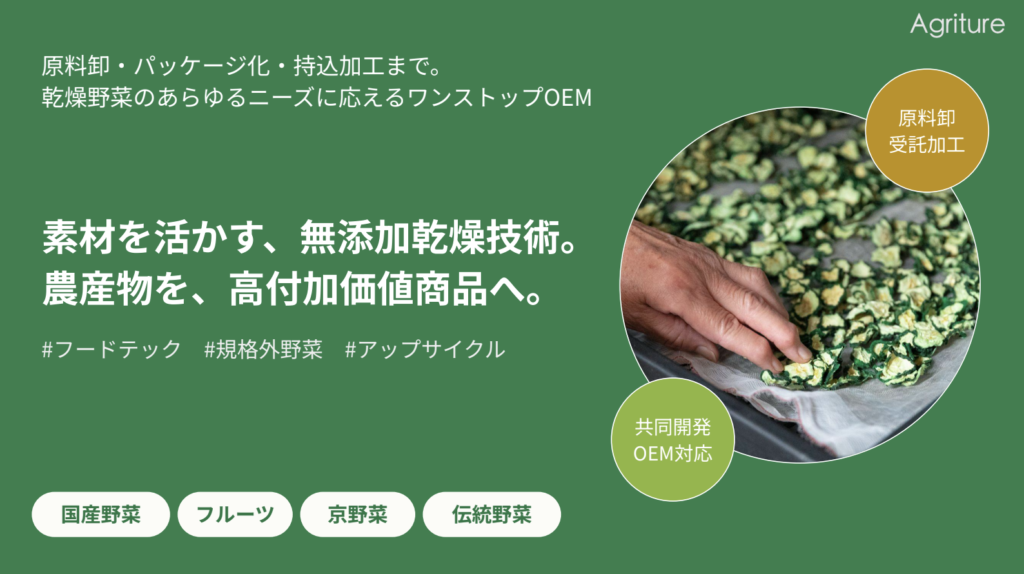
- OEM available from small lots of 10 kg
- Drying of brought-in raw materials also possible
- Support from processing to filling in one place
Recommended reading
Download the OEM contract processing materials
We will send the materials to your email address based on the information you provide.
- How to Build a Seasonal Course Woven with Kyoto Vegetables
- The Work of "Subtraction" That Makes the Most of Kyoto Vegetables
Author of this article
Related articles
-
 Kintoki Carrot: A Vividly Colored, Strongly Sweet Kyoto Vegetable
-
 Drying Is Another Kind of Cooking
-
 The Technology to Lock In the Season. The Seasonal Story Dried Vegetables Connect.
-
 The Cut Face of a Vegetable. The Difference the Cut Makes.
-
 Tasting Kyoto Vegetables by Aroma. The Pleasure of Cooking That Begins at the Tip of the Nose
-
 Vessels and Kyoto Vegetables. Creating the Scenery of Plating.
-
 Vegetables and Heat Control. Between High and Low Flame
-
 Kyoto Vegetables and Sake. The Happy Relationship of a Dish and a Cup.