Dried Shogoin Kabu

Dried Shogoin turnip is a commercial ingredient made from the Kyoto heirloom vegetable "Shogoin turnip" processed into a dried raw material. The Shogoin turnip is one of Japan's largest round turnips, reaching 15 to 20 cm in diameter, with a white, smooth skin and dense, soft flesh and strong sweetness as its signature. Agriture handles contract drying of client-supplied raw material, sealing in the Shogoin turnip's color and sweetness through low-temperature drying. It can run in parallel with the same Shogoin turnip finely milled into Shogoin Kabu Powder, and we propose dried Shogoin turnip for applications that keep the shape of the white flesh pieces, and powder for blending into pastes, batters, and powdered products.
Compared with common small and large turnips, the Shogoin turnip can be differentiated by its "dense flesh that resists falling apart even when simmered," its soft sweetness, and its history as a raw material for senmaizuke. It is an ingredient with many contract-drying inquiries as a white ingredient for senmaizuke-style pickles, kaburamushi, ankake, potage, simmered dishes, and confectionery.
TOC
Agriture's dried Shogoin turnip, three points of care
1. Low-temperature drying that makes the most of the white color and sweetness
The appeal of the Shogoin turnip is its clear white color and soft sweetness. Agriture designs the process to hold the drying temperature down and pull moisture out in a short time, keeping as much of the whiteness and sweetness in the finished product as possible. Whether the white flesh comes back up when rehydrated is a factor that governs the appearance of kaburamushi, ankake, and potage.
2. Shapes you can select to suit the application
The Shogoin turnip is prepared into shapes to suit the application, such as thin slices, wedges, and dice, before drying. The dense flesh readily keeps its shape even after drying and can be used as is in simmered dishes, pickles, and soups. Size and thickness can be adjusted to match the finished product's appearance and texture, and you can select it by balancing good rehydration with presence.
3. Processing a Kyoto heirloom vegetable into raw material through contract drying
Agriture handles contract drying of Shogoin turnips supplied by clients. We set the drying conditions by judging the flesh grain, sweetness, and size, and process it into raw material with specifications geared to mass production. Contract drying with visible provenance is easy to design traceability around, one of the reasons it is chosen for prototyping by pickle, Japanese prepared-food, and confectionery manufacturers.
Product catalog showing the items we handle
Flexible support from small lots to large lots
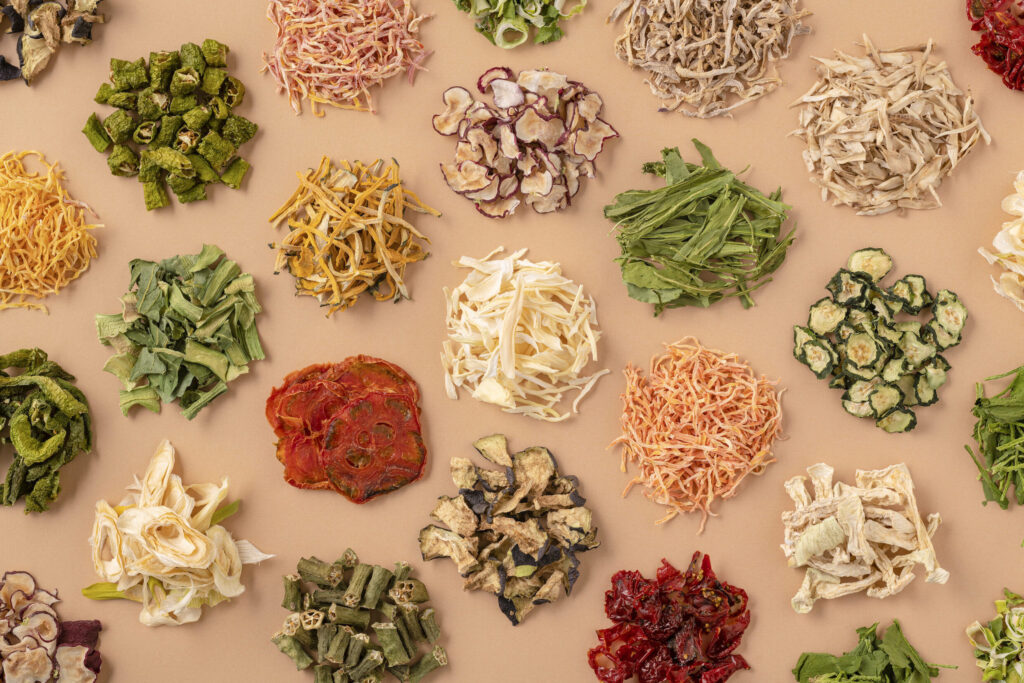
- Sold in small lots from 1 kg
- Handling heirloom vegetables from across Japan
- Dried fruits and herbs also supported
Characteristics of commercial dried Shogoin turnip
Even among dried turnip raw materials, the Shogoin turnip holds a distinct position for its white color, sweetness, and dense flesh. Here are its strengths organized across six points, with contract drying in mind.
White, smooth color
The Shogoin turnip has clear white skin and flesh. Keeping the whiteness through low-temperature drying refines the appearance of products that make use of pale colors, such as kaburamushi, ankake, and white potage.
Dense flesh that resists falling apart when simmered
The dense, fine-grained flesh keeps its smoothness even when simmered. It suits Japanese prepared dishes where you want to retain the shape even after heating, such as simmered dishes cooked in dashi, kaburamushi, and ankake.
Material character akin to senmaizuke
The Shogoin turnip is known as a raw material for senmaizuke, an ingredient that pairs well with the process of thin-slicing and pickling. As a dried product that stores at room temperature, it can be secured as a raw material for pickles and Japanese prepared dishes regardless of season.
Soft sweetness
The Shogoin turnip has little of the harshness characteristic of turnips, with soft sweetness as its signature. It suits recipes that make use of sweetness and whiteness, such as simmered dishes, potage, and baby food design.
Suitability as a soup and paste ingredient
Making use of its whiteness and smooth texture, it can be used as a white ingredient in potage, ankake, and steamed sweets. It suits being a base for product designs that foreground vegetable sweetness and a pale color.
Use in combination with powder
Finely milled Shogoin Kabu Powder used together lets you design recipes that balance an ingredient feel (dried pieces) with blending into pastes and batters (powder).
Product specifications (commercial)
The basic contract-drying specifications are as follows. The quantity, shape, lead time, and packaging format of the supplied raw material are worked out through individual consultation.
| Item | Details |
|---|---|
| Product name | Dried Shogoin Kabu |
| Raw material | Shogoin turnip |
| Shape | Thin slices, wedges, dice. Thickness and size adjusted to the application |
| Appearance | White to pale cream-colored dried pieces |
| Aroma | A gentle sweet aroma characteristic of turnip |
| Net content | Individual quote according to use and lot |
| Best-before date | About 6 months from the shipping date |
| Storage method | Avoid high temperature, high humidity, and direct sunlight; after opening, seal and store in a cool, dark place |
| Minimum prototype lot | Contract-based (consultation according to the quantity of supplied raw material) |
Customization support
From the prototype stage, you can consult us on shape, cut size, packaging, and turning it into a finished product. Because we keep records while refining the drying conditions, the specifications are unlikely to drift between prototype and mass production.
| Item | Available | Details |
|---|---|---|
| Shape adjustment | Thin slices / wedges / dice | Thickness and size designed to match the finished product's appearance and texture |
| Powdering | Fine powder (made to order) | For blending into confectionery, pastes, and soups and for powder design |
| Blend design | Combining with other root and other vegetables | A Japanese prepared-dish mix with daikon, carrot, and turnips |
| Packaging form | Commercial bulk / small bag / individual wrapping | From prepared-dish bulk to packs for confectionery raw material |
| OEM productization | End-to-end support through the finished product | From planning to production of kaburamushi, ankake, soup mixes, and pickle raw materials |
For those considering the fine-powder type
For applications where you want to spread the Shogoin turnip's whiteness and sweetness evenly, such as blending into confectionery, pastes, and soups or powder design, the finely milledShogoin Kabu Powderis well suited. Please also see the list of powder raw materials.
Commitments to variety, grower, and growing region
The Shogoin turnip is a round turnip of the Brassicaceae family, a Kyoto heirloom vegetable said to have been brought to Shogoin in Kyoto from Katata in Omi during the Kyoho years of the Edo period. Agriture designs the drying conditions based on the supplied raw material's provenance, harvest timing, and flesh.
BRAND | The positioning of Shogoin turnip as a raw material
The Shogoin turnip is a round turnip that has been used as a white ingredient in Kyoto cuisine, such as senmaizuke, kaburamushi, ankake, and simmered dishes. Agriture translates this whiteness and sweetness into a commercial raw material through contract drying and supplies it as an ingredient usable in a wide range of finished products, from pickles and Japanese prepared dishes to confectionery and soups.
PRODUCER | Basic policy for contract drying and coordination
We dry the supplied Shogoin turnip while looking at the flesh grain, sweetness, and size. At the prototype stage we evaluate whiteness retention and good rehydration during drying with small quantities, then set the drying conditions for mass-production lots. Securing the raw material is advanced on the client's side, and Agriture collaborates by handling the drying and processing steps.
REGION | Characteristics of the main growing region
The Shogoin turnip is known for the Shino district of Kyoto's Kameoka Basin as a representative growing region, where the large day-night temperature difference and fog-prone climate are said to nurture the dense, soft flesh. It comes into season in winter and appears on the market as a raw material for senmaizuke. Agriture judges the conditions suited to drying based on the supplied raw material's provenance.
CULTIVATION | Harvest timing and flesh
The Shogoin turnip comes into season in winter (around November to December). The colder the season, the more sweetness it carries and the firmer the flesh tends to be. Agriture treats in-season turnips carrying sweetness and flesh as raw material suited to drying.
Low-temperature drying technology and quality control
Prompt drying after cutting
The Shogoin turnip's surface readily oxidizes and dulls in color as time passes after cutting. By moving promptly from cutting to drying, we finish it under conditions that balance whiteness and sweetness.
Retaining whiteness through low-temperature drying
High-temperature drying dulls the whiteness and readily drives off the sweet aroma. By pulling moisture out slowly in a low-temperature range, we finish it so the whiteness remains even when rehydrated. As an ingredient for kaburamushi, ankake, and potage, we aim for a raw material where the character of the Shogoin turnip comes through in its appearance. For simmered dishes, simmering the rehydrated dried pieces in dashi lets the flavor soak in while keeping the whiteness. For soups, using the rehydration liquid too brings out the sweetness.
Use cases
Here are the applications for which we receive contract-drying inquiries at Agriture, organized into six categories. All are examples of recipe design that make use of the Shogoin turnip's whiteness, sweetness, and dense flesh.
1. Pickles and senmaizuke-style processing
It can be used as a pickle raw material that makes use of thin slices, such as senmaizuke-style pickles, light pickles, and sweet-vinegar pickles. Rehydrating the dried product and pickling it lets you bring the Shogoin turnip's whiteness and sweetness into pickle products regardless of season. Being able to secure it as room-temperature stock and cut prep hours during busy periods is also valued in commercial use.
2. Kaburamushi, ankake, and Japanese prepared dishes
It can be used as a white ingredient in Kyoto cuisine, such as kaburamushi, ankake, fukumeni, and shirani. The dense flesh resists falling apart even when simmered, and cooking it in dashi or simmering liquid brings out the sweetness and whiteness. Because it is pre-prepped, it also helps reduce labor in prepared-food manufacturing.
3. Ingredients for simmered dishes and hot pots
It can be used as an ingredient in simmered dishes, oden, hot pots, and soups. The rehydrated dried pieces readily take up dashi and suit a Japanese dish that makes use of whiteness and sweetness. It can also be developed into instant soup and soup mixes, and suits product designs with a short rehydration time.
4. Soups and potage
It can be used as a white vegetable source in potage, consomme soup, and turnip soup. Because the Shogoin turnip has soft sweetness and a smooth texture, it suits being a base for soup design where you want a pale color and sweetness. Combined with the powder, you can balance thickness and an ingredient feel.
5. Retort, frozen foods, and prepared dishes
It can be incorporated as a white vegetable in retort and frozen prepared dishes and meal kits. It can be securely kept as room-temperature stock, and being pre-prepped it reduces labor on the manufacturing line. It also suits products with a short rehydration time, such as ankake, simmered dishes, and soup mixes.
6. Confectionery and vegetable-based products
It can be used as an ingredient for steamed sweets, baked goods, and vegetable-based meals. Making use of its whiteness and soft sweetness, it can be developed into products that foreground a pale, vegetable-derived color and sweetness, such as turnip steamed buns, vegetable pastes, and baby food design. Used together with the powder, you can balance coloring and an ingredient feel.
Commercial usage and rehydration
Rehydration basics
- For Japanese prepared dishes: rehydrate for 10 to 15 minutes in cold water, or 5 to 8 minutes in hot water. For simmered dishes and ankake
- For fukumeni: rehydrate then cook in dashi or simmering liquid so the flavor soaks in while keeping the whiteness
- For pickles: rehydrate then pickle in sweet vinegar or pickling liquid. For senmaizuke-style processing
- Because the rehydration liquid carries the Shogoin turnip's sweetness, it is good to use it as is in soups
Blending guide
- Fukumeni: rehydration amount of 10 to 15 g dried per 100 g of finished dish
- Kaburamushi: rehydrate and use 10 to 15 g dried per serving
- Soups and hot pots: add about 15 to 25 g dried per 1 L of dashi as a guide
- Potage: rehydrate and use 8 to 12 g dried per serving (200 ml)
How to store
- Before opening: store in a cool, dark place at room temperature, away from heat, humidity, and direct sunlight
- After opening: transfer to a zip bag or airtight container and use up within 1 to 2 months
- Best-before date is about 6 months from the shipping date. Note that moisture absorption changes color and texture
- Refrigerated storage is possible. Because condensation forms right after taking it out, return it to room temperature before opening
Related cases and articles
- What is the Shogoin turnip – an explanation of its characteristics as a Kyoto heirloom vegetable
- Dried turnip – turnip raw material
- Dried Shogoin daikon – a Kyoto vegetable daikon
- List of dried vegetable raw materials
- Consult us on food OEM and raw material supply
Product catalog showing the items we handle
Flexible support from small lots to large lots
- Sold in small lots from 1 kg
- Handling heirloom vegetables from across Japan
- Dried fruits and herbs also supported
Frequently asked questions
What is the difference from an ordinary turnip?
The Shogoin turnip is a round turnip among Kyoto's heirloom vegetables, characterized by being one of Japan's largest at 15 to 20 cm in diameter. Compared with small turnips, its flesh is dense and soft, resists falling apart even when simmered, and has strong sweetness with little harshness. Known as a raw material for senmaizuke, it has been used as a white ingredient in Kyoto cuisine such as kaburamushi and ankake. You can choose between it and dried turnip (small-turnip type) by flesh and application.
How much of the whiteness remains?
By moving promptly from cutting to low-temperature drying, we achieve a white to pale cream-colored finish. Even after rehydration, it can be used as a white ingredient in kaburamushi, ankake, and simmered dishes. Because the color readily dulls with high-temperature cooking or long-term storage and moisture absorption, care is needed with the finished product's heating conditions and storage design.
Can you handle client-supplied raw material?
Yes, Agriture handles contract drying of Shogoin turnips. We process raw material secured on the client's side into finished raw material with shapes and drying conditions suited to the application. After hearing the raw material's quantity, shape, and schedule, you can consult us on everything through the drying step and packaging.
How does it differ from Shogoin turnip powder?
Dried Shogoin turnip is for "applications that keep the ingredient feel and whiteness of the dried pieces," while powder is for "blending into confectionery, pastes, and soups or powder design." Simmered dishes, kaburamushi, and pickles suit the dried pieces, while the thickness of potage and blending into steamed-bun batter suit the powder. Using them together makes it possible to design recipes that balance an ingredient feel with even blending.
How large are prototype and contract lots?
Because it is contract drying, we accept it flexibly according to the quantity of raw material you supply. You can prototype multiple conditions in parallel, such as a shape comparison or a simmered-use-versus-pickle-use specification comparison. After hearing the intended finished-product specifications, lot, and schedule, we propose drying conditions, lead time, and packaging individually.
Please tell me the best-before date and how to store it.
The best-before date is about 6 months from the shipping date. Before opening, store in a cool, dark place at room temperature, away from heat, humidity, and direct sunlight. Because the Shogoin turnip readily changes color and texture with moisture absorption, after opening transfer it to a zip bag or airtight container and we recommend using it up within 1 to 2 months. Refrigerated storage is also possible, but take care with condensation right after taking it out, and return it to room temperature before opening.
Recommended reading
- What is the Shogoin turnip – an explanation of the Kyoto heirloom vegetable
- Dried turnip – turnip raw material
- Dried Shogoin daikon – a Kyoto vegetable daikon
- List of dried vegetables
- List of powders
Download the product catalog
We will send the materials to your email address based on the information you provide.