
Kyoto heirloom vegetables: Kyoto specialties with a long history

Summary of this article
Kyoto Heirloom Vegetables are roughly 40 native varieties cultivated in Kyoto since before the Meiji era; in 1987 Kyoto Prefecture organized selection criteria and established a certification system. This article explains the difference between the Kyoto Heirloom Vegetables and the 19 Brand Kyoto Vegetables, and the characteristics and seasons of representative items such as Kamo eggplant, Shogoin daikon, kujo negi, Kyo mizuna, Fushimi togarashi, and Manganji togarashi. We also cover the nutritional value unique to native varieties, ways to use dried Kyoto vegetables, and comparisons with Kaga vegetables and island vegetables.
You may have heard the term "Kyoto vegetables" at least once. Nurtured over a long history in the ancient capital of Kyoto and developed alongside Kyoto's rich natural setting and culture, Kyoto vegetables hold an appeal found in no other produce. This article explains in detail the difference between Kyoto Heirloom Vegetables and Brand Vegetables, a list of certified items, the characteristics of representative varieties, their nutritional aspects, and how to use them as dried vegetables.

TOC
What Are Kyoto Vegetables
The definition of Kyoto vegetables
Vegetables grown within Kyoto Prefecture are basically called "Kyoto vegetables," but those certified under strict criteria are the "Kyoto Heirloom Vegetables" and "Kyoto Brand Products (Vegetables)." Whereas most vegetables eaten today are varieties that came from the West after the Meiji era, Heirloom vegetables refers to vegetables that were cultivated in that region before the Meiji period. They are vegetables with a distinctive appeal not found in mass-produced produce.
The difference between Kyoto Heirloom Vegetables and Kyoto Brand Products (Vegetables)
In March of Showa 63 (March 1988), Kyoto Prefecture organized the criteria for "Kyoto Heirloom Vegetables." Among them, those that clear even stricter quality standards are certified as "Kyoto Brand Products (Vegetables)." The differences between the two are as follows.
| Category | Kyoto Heirloom Vegetables | Kyoto Brand Products (Vegetables) |
|---|---|---|
| Number of items | About 40 items (including extinct items) | 19 items |
| Certification criteria | Grown in Kyoto since before the Meiji era | Among the heirloom vegetables, those clearing high quality standards |
| Scope | Throughout Kyoto Prefecture | Those distributed in the market |
| Brand mark | None | Carries the "Kyoto Brand Products" mark |
| Quality review | None | Passes an expert review panel |
Certification criteria for Kyoto Heirloom Vegetables
Five selection conditions
Kyoto Prefecture selects "Kyoto Heirloom Vegetables" based on the following five conditions (source: Kyoto Prefecture official website)。
1. Has a history of introduction before the Meiji era
2. Covers not only the Kyoto city area but the entire prefecture
3. Includes bamboo shoots
4. Excludes mushrooms and ferns (zenmai, warabi, etc.)
5. Includes items being cultivated or preserved, as well as extinct items
Comparison with heirloom vegetables of other regions
The criterion for Kyoto Heirloom Vegetables is "cultivated before the Meiji era," while Kaga vegetables is certified on the basis of "cultivated before 1945," and Okinawa's island vegetables on the basis of "eaten since before the war." Kyoto can be said to be one of the regions with the most historically stringent criteria.
FOR BUSINESS
乾燥野菜を業務用でお探しですか
国産の野菜・果物を乾燥し、必要に応じて粉砕してお出ししています。扱っている品目は100種前後で、規格は 乾燥品の一覧・パウダーの一覧 に掲載しています。
少量でのご購入は、姉妹ブランドの通販サイト OYAOYA で承っています。
List of the 19 Kyoto Brand Products (Vegetables)
Among the "Kyoto Heirloom Vegetables," those that clear the high-grade brand certification standards, have production volumes distributed in the market, and pass an expert review panel are certified as "Kyoto Brand Products (Vegetables)." As of January 2026, 21 items are registered as Kyoto Brand Products (Vegetables).
| Item | Use example | Peak period |
|---|---|---|
| Shogoin daikon | Round, large, and strongly sweet | Winter |
| Kuwai | Gentle bitterness and texture | Winter |
| Kyoto bamboo shoots | Tender and richly flavorful | Spring |
| Kamo eggplant | Round, thick-fleshed, with a melting texture | Summer |
| Kyo mizuna | A crisp, crunchy bite | Winter–spring |
| Kyo-mibuna | A sharp pungency | Winter–spring |
| Manganji togarashi | Large, thick-fleshed, and sweet | Summer |
| Hanana | A faint bitterness and sweetness | Spring |
| Kyo Yamashina eggplant | Thin, tender skin | Summer |
| Murasaki zukin | Edamame of tanba black soybean | Autumn |
| Shishigatani kabocha | A distinctive gourd shape | Summer |
| Kintoki carrot | A vivid red | Winter |
| Fushimi togarashi | A sweet chili with no heat | Summer |
| Yama-no-imo | Highly viscous and rich in flavor | Autumn |
| Shogoin turnip | The raw material for senmaizuke | Winter |
| Ebi-imo | A shrimp-like striped pattern | Winter |
| Horikawa gobo | Thick with a hollow center | Winter |
| Kyo-kokabu | Small, tender right down to the skin | Winter–spring |
| Kujo green onion | Strong sweetness and rich flavor | Winter |
Characteristics of representative Kyoto vegetables
There are many kinds of Kyoto vegetables; here we pick out and introduce the especially popular ones.
." With a refreshing flavor and crisp bite as its charm, it has the depth to enhance both hot pots and salads. It's easily confused with mibuna, another Kyoto vegetable, but the leaf shape and growth are quite different. This article explains, from the standpoint of one who has faced vegetables in the growing region, everything from Kyo mizuna's features and history to how to tell the varieties apart, its differences from mibuna, its season and growing regions, choosing and storing it, cooking with it, and the commercial and OEM use of dried Kyo mizuna.
Kyo mizuna, with its green leaves and white stems, is often used in salads and hot pots. It has a good bite and a crisp, crunchy texture. It is also rich in vitamins and iron, making it a good choice for the health-conscious.
Kamo eggplant
Kamo eggplant is round and large, with thick, sweet flesh. Grilled as yaki-nasu or made into dengaku, you can savor its melting texture and sweetness. It is one of the ingredients that define summer in Kyoto.
Shogoin daikon
Shogoin daikon, a representative winter Kyoto vegetable, is known for its round shape. Tender and sweet, it is famous as the raw material for senmaizuke. It suits not only pickles but also simmered dishes and salads.
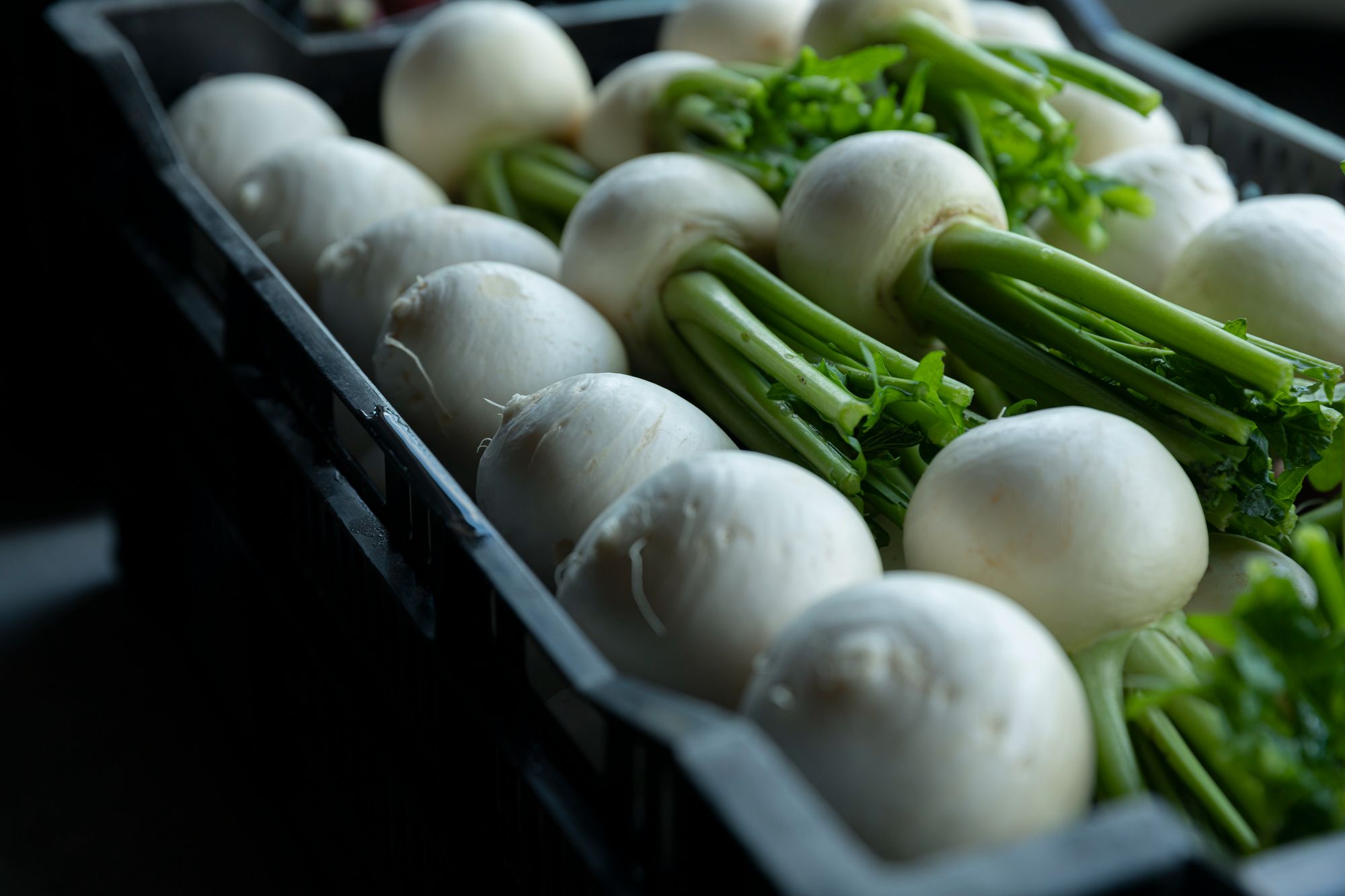
Fushimi togarashi
Fushimi togarashi is low in heat and strongly sweet. Besides stir-fries and simmered dishes, a Kyoto staple is to lightly grill it and eat it with bonito flakes and soy sauce. Along with Manganji togarashi, it is a sweet chili that represents Kyoto.
Kujo green onion
Rich in flavor and sweet, with a full-bodied taste. Used in simmered dishes, hot pots, and as a garnish, it is a fine supporting player that brings out the flavor of a dish. In Kyoto it is also indispensable as a garnish for ramen and udon, with a rooted culture of "leaf negi" — eating mainly the green part.
Nutritional characteristics of Kyoto vegetables
Nutritional value unique to heirloom varieties
Because Kyoto vegetables are native and fixed varieties, they are said to tend toward stronger flavor and higher nutritional value than F1 varieties. Kyo mizuna is rich in vitamin C and iron, and kujo negi in beta-carotene and vitamin K. In addition, Kintoki carrot the red pigment of contains lycopene, which is expected to have antioxidant properties (source: MEXT Food Composition Database)。
The relationship between Kyoto cuisine and health
Kyoto cuisine is characterized by light-seasoned cooking that draws out the flavor of the ingredients, a healthy eating style that keeps salt in check. Kyoto cuisine, which makes lavish use of seasonal Kyoto vegetables, is also excellent in nutritional balance. Kyoto's rich food culture can be said to have been supported by these Heirloom vegetables have supported it.
Using Kyoto vegetables as dried vegetables
The benefits of dried Kyoto vegetables
Many Kyoto vegetables have limited seasons, but turning them into dried vegetables lets you enjoy them year-round. Drying concentrates the nutrients and greatly improves shelf life. Products that make it easy to take in the nutrition of Kyoto vegetables are also on the rise, such as Kyo mizuna dried chips and freeze-dried kujo negi.
How to bring them into daily life
Dried Kyoto vegetables can be used easily as ingredients in miso soup and soups. Incorporating Kyoto vegetables into daily cooking lets you enjoy a sense of season and regional flavor. Being able to feel Kyoto's natural setting casually at home is another attraction. sustainable The method of drying and preserving seasonal Kyoto vegetables is also worth noting when thinking about a diet.
We have materials available to help you understand dried processing OEM
Agriture OEM, flexibly handling everything from small lots to large lots
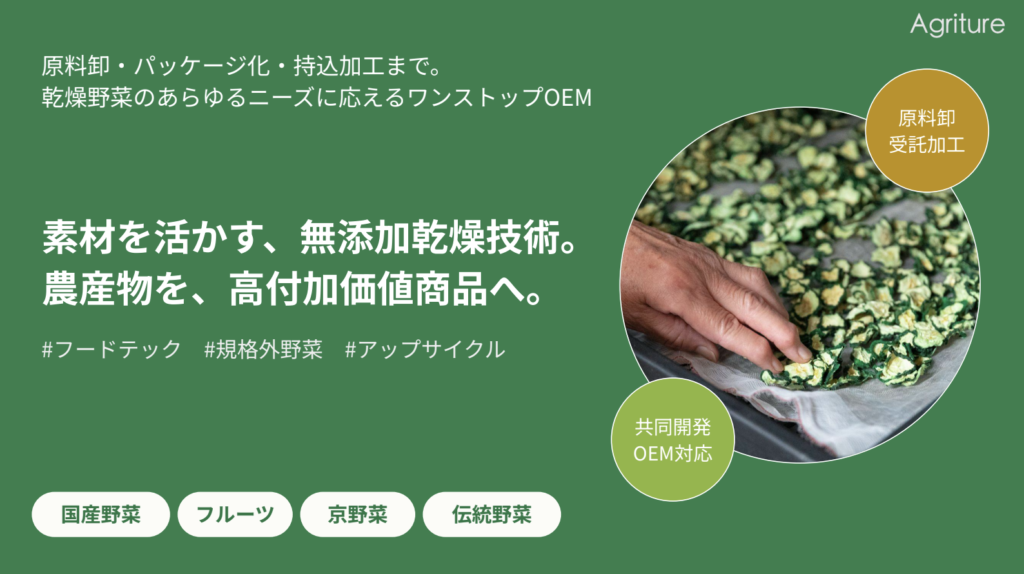
- OEM available from small lots of 10 kg
- Drying of brought-in raw materials also possible
- Support from processing to filling in one place
FOR BUSINESS
乾燥野菜を業務用でお探しですか
国産の野菜・果物を乾燥し、必要に応じて粉砕してお出ししています。扱っている品目は100種前後で、規格は 乾燥品の一覧・パウダーの一覧 に掲載しています。
少量でのご購入は、姉妹ブランドの通販サイト OYAOYA で承っています。
Frequently asked questions about Kyoto vegetables
Summary
Kyoto Heirloom Vegetables, nurtured by Kyoto's rich natural setting and long history. The roughly 40 heirloom vegetables and 19 brand vegetables are colorful and deeply flavorful, brightening the table through the four seasons. From Kamo eggplant dengaku to Shogoin daikon senmaizuke and kujo negi hot pot, the ways to enjoy Kyoto vegetables are endless.
Processed into dried vegetables, the nutrition and flavor of Kyoto vegetables can be brought to the daily table regardless of season. Please experience the appeal of these Heirloom vegetables that represent Japan, starting with Kyoto vegetables.
Related articles
Download the OEM contract processing materials
We will send the materials to your email address based on the information you provide.
- The appeal of Kansai heirloom vegetables | Specialties of Naniwa, Kyoto, and Yamato thoroughly explained
- A list of heirloom vegetables of the 8 prefectures of Kyushu and Okinawa|A thorough introduction to characteristics, growing regions, and seasons
Author of this article
Related articles
-
 Okinawa island vegetables: individualistic vegetables nurtured by a subtropical climate
 -
 Kaga vegetables: Kanazawa brand vegetables where tradition lives on
 -
 The appeal of Kansai heirloom vegetables | Specialties of Naniwa, Kyoto, and Yamato thoroughly explained
 -
 A list of heirloom vegetables of the 8 prefectures of Kyushu and Okinawa|A thorough introduction to characteristics, growing regions, and seasons
 -
 Know the heirloom vegetables of Edo Tokyo | The city’s vanishing food culture
 -
 They'll make you smile! The fun names of heirloom vegetables and their origins
 -
 5 cases and strategies that succeeded in branding heirloom vegetables
 -
 What is the regional character of heirloom vegetables? The tastes and stories handed down across the land