
Shimonita green onion: appealing for its melting sweetness and rich flavor

Summary of this article
Shimonita negi is an heirloom vegetable grown around Shimonita, Kanra District, Gunma Prefecture, notable for a white stalk 6–9 cm in diameter and a sweetness that turns meltingly soft when cooked. This article explains the origin of its "lord's onion" nickname, its history of spreading alongside the Tomioka Silk Mill, how it differs from ordinary green onions, and nutrients such as allicin, of which it contains about 3 times as much as ordinary green onions. Its season is December, and we cover classic dishes such as sukiyaki, hot pot, and negi-nuta, along with tips for choosing and storing it and ways to use it as a dried vegetable.
"Shimonita negi," grown around Shimonita, Kanra District, Gunma Prefecture, is known as a Gunma specialty prized for its distinctive shape and sweetness. This green onion, nicknamed the "lord's onion,"Heirloom vegetables comes into season in winter and is also popular as a year-end gift. This article explains the features, history and flavor of Shimonita negi, recommended ways to eat it, and how to use it as a dried vegetable.
TOC
What is Shimonita negi?
Standout thickness and sweetness
Shimonita negi is characterized by being thicker than ordinary green onions, with the white stalk typically growing to about 2.5–6 cm in diameter. The blanched white portion also grows to around 15–25 cm, with distinctive thick, deep-green leaves. A deep-rooted, summer-type, non-tillering single-stalk onion, it stands out from ordinary green onions. Raw, it is too pungent to use as a condiment, but cooked, its sweetness increases remarkably, spreading a mellow flavor.
Why cultivation continues centered on Shimonita
Cultivation takes about 15 months, and as winter and frost approach the sweetness increases further, with December the peak of the harvest. This region's special environment produces Shimonita negi's sweetness and thickness. Cultivation trials in other prefectures were carried out, but outside Gunma and Nagano the ideal texture and sweetness were not reproduced, and it is said that "Shimonita negi should be grown only in Shimonita." This rarity is one reason it is highly valued as a gift.
How it differs from ordinary green onions
| Comparison item | Shimonita green onion, | Ordinary long green onion |
|---|---|---|
| Thickness | 2.5–6 cm in diameter | 2–3 cm in diameter |
| Cultivation period | About 15 months | About 6–8 months |
| Eaten raw | Too pungent, unsuitable | Usable as a condiment |
| When cooked | Melting sweetness | Crisp texture |
| Season | December (winter only) | Shipped year-round |
Like ordinary green onions, it contains the components responsible for pungency, but Shimonita negi's distinctive sweetness comes out when cooked. As for its cultivation history, an old document from 1805 records the line "The lord orders 200 negi sent at once," and it is also known as "Tonosama Negi" (the lord's green onion), the special onion the lord requested. Kaga vegetables it is one of the heirloom vegetables cherished since the domain era.
Recognition rose thanks to imperial-household offerings in the Showa era and mentions in the Jomo Karuta
When the Tomioka Silk Mill was founded in the Meiji era, demand for Shimonita negi as a gift surged, and offerings to the imperial household and high marks at agricultural fairs boosted its reputation. In this way Shimonita negi came to be known nationwide as a specialty representing the region (reference: Shimonita negi official website)。
The flavor and texture of Shimonita negi
A sweetness that melts when cooked
Shimonita negi is prized for its melting texture and the sweetness that comes out when cooked. The thick white part is especially fleshy, and in hot pots, sukiyaki or stews it turns soft and tender and its sweetness comes to the fore. Raw, it is very pungent, so it's generally used cooked.
Aroma and pungency when chopped
The distinctive aroma and pungency of green onions rise up when they're chopped. Shimonita negi has a strong aroma, and used as a condiment it sharpens a dish. The aroma mellows with cooking and sweetness emerges in its place, so this onion shows a very different character raw and cooked.
FOR BUSINESS
乾燥下仁田ねぎを、原料としてお探しですか
国産の下仁田ねぎを乾燥・粉砕してお出ししています。カット形状や粒度の指定、継続してのお取引もご相談ください。規格は 乾燥下仁田ねぎ・下仁田ねぎパウダー に掲載しています。
下仁田ねぎの少量販売は姉妹ブランドの OYAOYA では取り扱いがありません。ほかの品目はカタログをご覧ください。
The green leaves can be used in cooking too
Not only the white part but also the green leaves can be used in cooking. Shimonita negi leaves are thick, and chopped into miso soup or stir-fries they add good flavor. Among other green onions, Kyoto Heirloom Vegetables Kujo negi, too, has a rooted culture of eating the leaf portion.
Recommended ways to eat
Sukiyaki and hot pot
To make the most of Shimonita negi's appeal, hot pot is the best. Cooked, its silky sweetness stands out, and simmered with other ingredients it draws out umami for a star-level presence. It pairs especially well with sukiyaki, where the sweet-savory warishita sauce harmonizes beautifully with Shimonita negi's melting sweetness. Since Shimonita negi cooks quickly, take care not to overcook it.
Negi-nuta
"Negi-nuta" is a local dish popular in Gunma, made by dressing cooked green onion with vinegar-miso. Softly steamed or boiled onion is finished with ground sesame and vinegar-miso. Popular as a ceremonial dish for weddings, funerals, and the Peach Festival, it is a dish that conveys local tradition.
Grilled and roasted green onion
A simple method of cutting Shimonita negi into chunks and grilling it on a fish grill or in the oven. The outside turns fragrant while the inside comes out meltingly sweet. It is delicious enough with just salt, letting you enjoy the ingredient's flavor directly. Sprinkled with olive oil and coarse salt and grilled, it also becomes a Western-style variation.
How to choose and store Shimonita negi
How to spot good Shimonita negi
When choosing Shimonita negi, pick ones with a thick, firm white portion. Ones that feel heavy in the hand are good quality, packed all the way through. The leaves should be deep green and not wilted, which indicates freshness. Ones that meet the seven conditions set by the Shimonita-town-certified "Shimonita Negi Society" are said to be distinguished as "the genuine article."
Tips for storage
The basic method is to wrap it in newspaper and store it standing in a cool, dark place. If refrigerating, wrap the base in a damp paper towel, put it in a plastic bag, and store it in the vegetable drawer. If you can't use it all, chopping and freezing it keeps the quality for about a month.
Using Shimonita negi as a dried vegetable
The benefits of dried green onion
It is also used as a dried vegetable Shimonita green onion,. With its sweetness and aroma concentrated, it is easy to use across a wide range of dishes — as a condiment for simmered dishes, soups, and noodles — and it keeps well, which is drawing attention. The biggest appeal is that using just a small amount in cooking adds deep flavor. Because it can be stored dried, it can be enjoyed with its quality preserved over a long period.
How to use dried Shimonita negi
Rehydrated with water, its original softness and sweetness return, and it can be used across a wide range of dishes such as simmered dishes, soups, and stir-fries. Added directly as a condiment for miso soup or ramen, it lets you easily enjoy Shimonita negi's flavor. Shimonita negi's season is limited to winter, but as a dried vegetable it can be enjoyed year-round — a major advantage. sustainable Drying and storing seasonal vegetables is a good approach as part of a wholesome diet.
We have materials available to help you understand dried processing OEM
Agriture OEM, flexibly handling everything from small lots to large lots
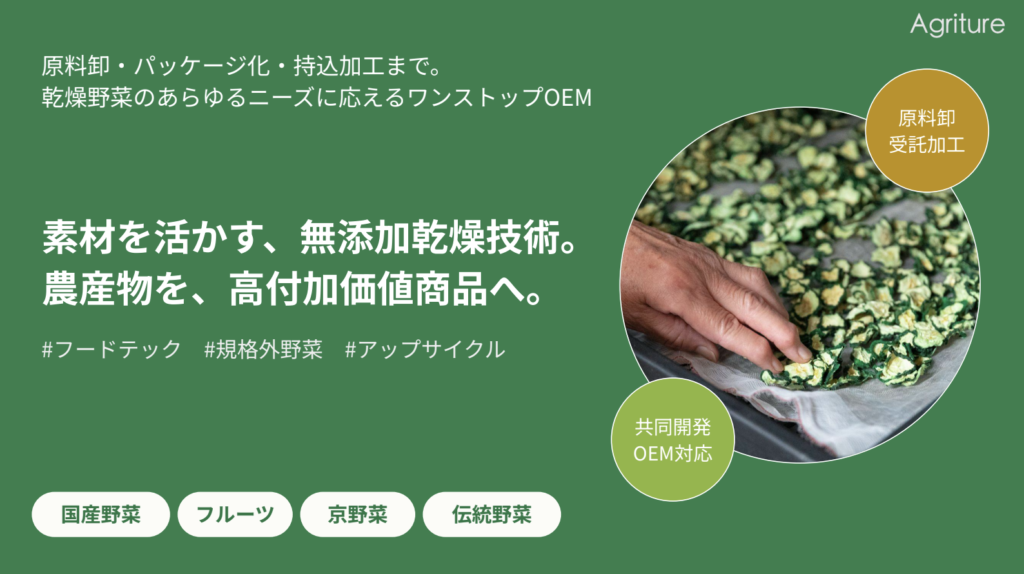
- OEM available from small lots of 10 kg
- Drying of brought-in raw materials also possible
- Support from processing to filling in one place
FOR BUSINESS
乾燥下仁田ねぎを、原料としてお探しですか
国産の下仁田ねぎを乾燥・粉砕してお出ししています。カット形状や粒度の指定、継続してのお取引もご相談ください。規格は 乾燥下仁田ねぎ・下仁田ねぎパウダー に掲載しています。
下仁田ねぎの少量販売は姉妹ブランドの OYAOYA では取り扱いがありません。ほかの品目はカタログをご覧ください。
Frequently asked questions about Shimonita negi
Summary
Shimonita negi is a one-of-a-kind Heirloom vegetables is another option. Its unusual quality of being pungent raw but turning meltingly sweet when cooked is something other green onions don't have. With the historical background of being called "Tonosama Negi," its greatest appeal is the sweetness that melts when cooked.
Processed into a dried vegetable, Shimonita negi's flavor can be enjoyed year-round, beyond its winter-only season. Among Japan's Heirloom vegetables please do try the one-of-a-kind Shimonita negi at least once.
Related articles
Download the OEM contract processing materials
We will send the materials to your email address based on the information you provide.
- Okinawa island vegetables: individualistic vegetables nurtured by a subtropical climate
- Kaga lotus root: featuring a sticky, thick-fleshed texture
Author of this article
Related articles
-
 Okinawa island vegetables: individualistic vegetables nurtured by a subtropical climate
 -
 Kaga vegetables: Kanazawa brand vegetables where tradition lives on
 -
 The appeal of Kansai heirloom vegetables | Specialties of Naniwa, Kyoto, and Yamato thoroughly explained
 -
 Kyoto heirloom vegetables: Kyoto specialties with a long history
 -
 A list of heirloom vegetables of the 8 prefectures of Kyushu and Okinawa|A thorough introduction to characteristics, growing regions, and seasons
 -
 Know the heirloom vegetables of Edo Tokyo | The city’s vanishing food culture
 -
 They'll make you smile! The fun names of heirloom vegetables and their origins
 -
 5 cases and strategies that succeeded in branding heirloom vegetables