
What is the regional character of heirloom vegetables? The tastes and stories handed down across the land

Summary of this article
Japan's heirloom vegetables are the collective term for native varieties nurtured within each region's climate, terrain, and culture—a presence that carries regional stories and food culture. This article introduces regionally distinctive heirloom vegetables, including Kyoto's Shishigatani kabocha and Kamo nasu, Kaga vegetables such as Kaga nasu, Minamiuonuma's Osaki-na and Kagura-nanban, and Bizen kurokawa kabocha revived in Setouchi City, Okayama Prefecture. It also explains regional branding through Geographical Indication (GI) registration, and the challenges of and efforts toward passing them on to the next generation.
Across Japan there are many "heirloom vegetables" nurtured within the climate, terrain, and culture unique to each land. Having taken root in their region over long years and become deeply tied to local people's lives and palates, these vegetables are not mere ingredients but a presence that holds regional stories and memory. This article unravels how heirloom vegetables have come to be tied to regional character, while introducing the "tastes and culture" alive across Japan.
TOC
What are heirloom vegetables? Their definition and value
The definition of heirloom vegetables differs by certifying body. Kyoto Prefecture defines them as introduced before the Meiji era, including bamboo shoots and extinct items; Osaka Prefecture as roughly 100+ years ago; and Nara Prefecture as produced within the prefecture since before the war—the conditions split by locale. Heirloom vegetables handed down across Japan have adapted to their land's climate and terrain and are closely tied to regional food culture.
Generally, they are often defined as "native vegetables for which local governments and people involved in production and distribution set their own conditions on growing region, cultivation calendar, and the like, aiming at their preservation and turning them into specialties."
Heirloom vegetables are not mere ingredients. They are "cultural properties of food" beloved and protected by people over a long history. Their distinctive flavors and nutritional value, tasteable only in that land, have an appeal that the standardized products of mass production do not.
More on heirloom vegetables here
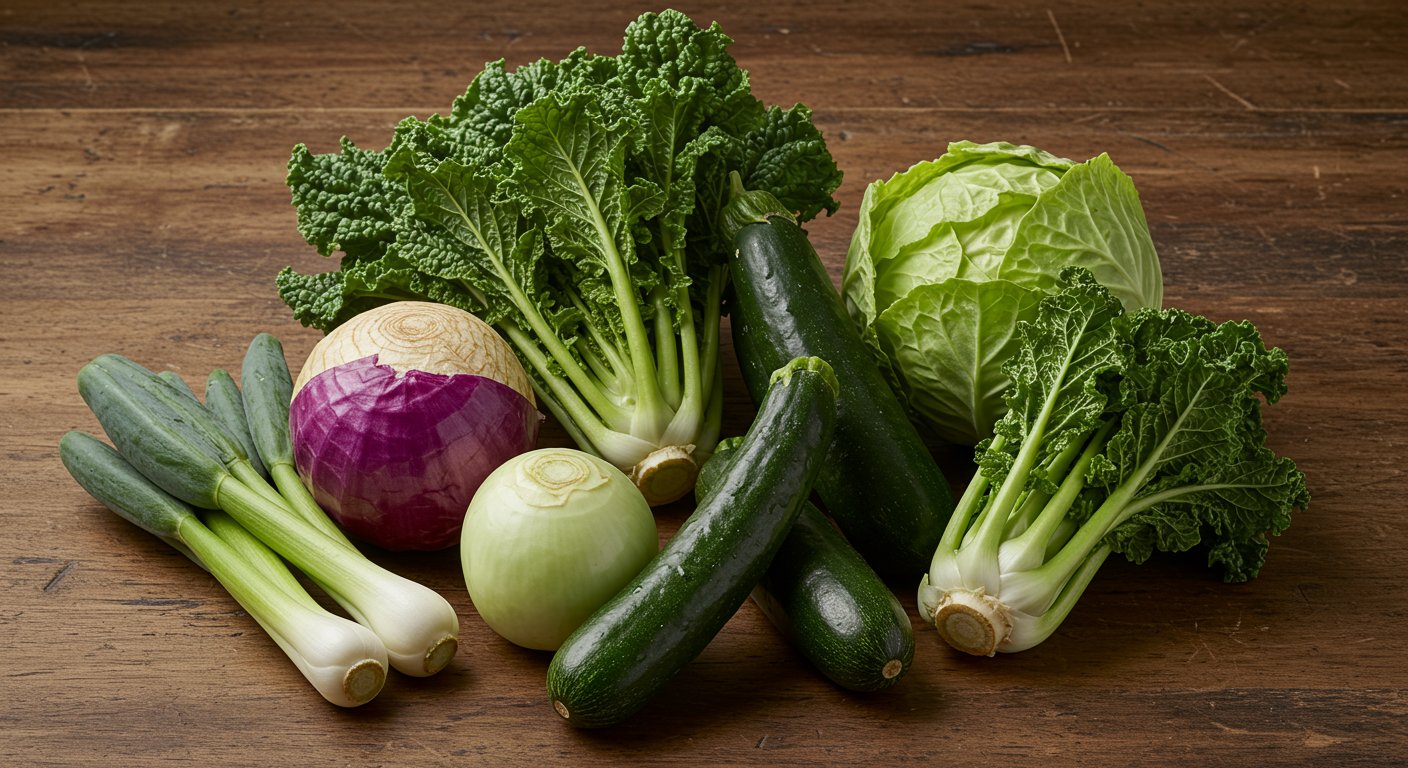
The regional character of heirloom vegetables rooted in each area
Truly diverse heirloom vegetables exist all across Japan. Vegetables nurtured to match each region's climate and terrain have characteristics unique to their land.
Kyoto's heirloom vegetables
Known as Kyoto vegetables, Kyoto's heirloom vegetables have developed against a backdrop of long history and refined food culture. Shishigatani kabocha, Kamo nasu, and others are highly regarded even by chefs for their distinctive flavor and texture.
Kyoto vegetables are known not only for good taste but also for high nutritional value. Some Kyoto vegetables are discussed on the basis of research findings that their nutritional value is higher than that of ordinary vegetables.*1
Kaga heirloom vegetables
In Kanazawa, Ishikawa Prefecture, there is a group of region-rooted heirloom vegetables called "Kaga vegetables." Among the vegetables grown around Kanazawa since before 1945, 15 items especially beloved locally are certified as "Kaga vegetables."
Among them, the representative "heta-murasaki nasu" (a small, short-oval eggplant, suited to overnight pickles, yado-zuke, and simmered dishes) features a rounded, generous shape and a melting texture that holds up well to simmering. Pairing well with oil, it has long been widely used locally in age-bitashi, miso dengaku, and the like. Its rich flavor is highly regarded even among chefs.
Kaga vegetables were nurtured alongside the food culture of Kanazawa, the castle town of the million-koku Kaga domain, and are still carefully carried on today at local markets and ryotei.
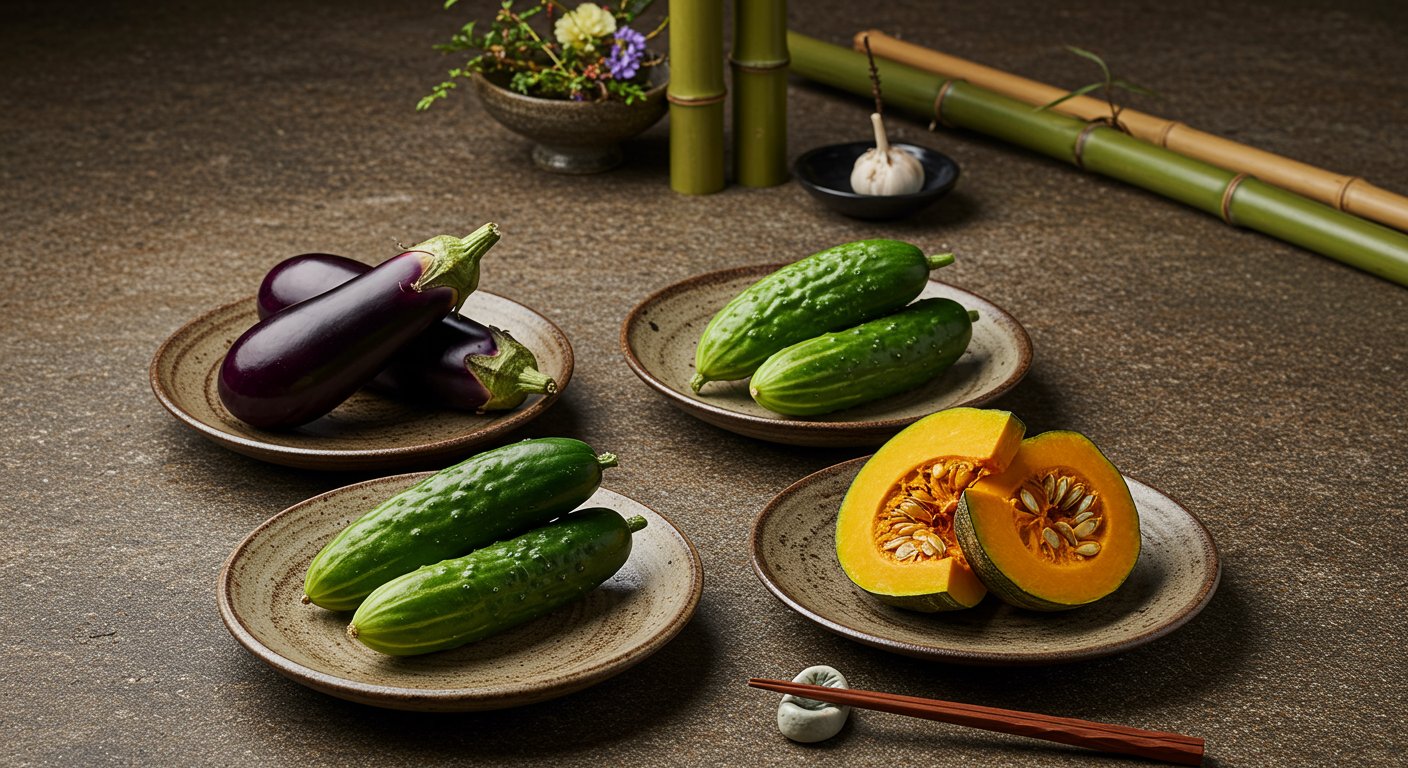
Minamiuonuma's heirloom vegetables
The Minamiuonuma region of Niigata Prefecture has its own heirloom vegetables nurtured in the harsh environment of snow country. "Osaki-na" has 300 years of history, and modern-style ways to enjoy "Kagura-nanban" that make the most of its pungency are also being proposed.
A food culture combining preserved and fermented foods born precisely of this deep-snow land is also part of the appeal of the region's heirloom vegetables. Vegetables packed with local people's wisdom are still carefully carried on today.
FOR BUSINESS
乾燥野菜を業務用でお探しですか
国産の野菜・果物を乾燥し、必要に応じて粉砕してお出ししています。扱っている品目は100種前後で、規格は 乾燥品の一覧・パウダーの一覧 に掲載しています。
少量でのご購入は、姉妹ブランドの通販サイト OYAOYA で承っています。
The revival of heirloom vegetables and regional revitalization
Heirloom vegetables whose production once declined are now the subject of revival efforts in various regions. "Bizen kurokawa kabocha" of Setouchi City, Okayama Prefecture, is a fine example.
Bizen kurokawa kabocha is said to have been born from a cross between a variety called "Tajiri nankin," introduced in the Meiji era, and other varieties. It was widely grown in the early Showa era and was a precious vegetable that sustained many lives during the food shortages of the war and postwar periods.
Production once declined as Western kabocha production increased, but in 2014 the "Association to Revive Japanese Kabocha Bizen Kurokawa," formed by local volunteers, was launched. Putting effort into protecting the variety lineage and managing the seed, it resumed commercial shipments in 2021.
What's more, delightfully, on January 29, 2024, it was also registered under "Geographical Indication (GI)," which protects specialty products as regional brands. This attests to the authenticity and superb quality of Bizen kurokawa kabocha.
In this way, heirloom vegetables revive as regional pride and become a driving force for regional revitalization. Efforts such as farm restaurants and sixth-order industrialization centered on heirloom vegetables are also spreading across the country.
Challenges in passing heirloom vegetables to the next generation
Passing on heirloom vegetables faces a number of challenges. Rooted in each region's terrain and grown with self-saved seed and cultivation repeated over many years, heirloom vegetables can be called a "living cultural property."
But with changes in the growing environment, more varieties are becoming harder to grow by the same methods as before. Some vegetables are grown by only a few farms, and some remain in old lineages, calling for the passing on of techniques and a rethinking of growing conditions.
Beyond maintaining the production system, how to stabilize harvesting and processing in limited quantities and secure sales channels and demand is also an important theme. In some regions, producers and sellers work together to advance contract cultivation and the joint development of processed goods—steadily seeking a sustainable framework through such grounded efforts.
Fostering the next generation of bearers is also essential. Young farmers are beginning to develop new varieties, improve toward easy-to-cook sizes and shapes, and propose recipes suited to the modern table—and a movement to connect the future of region-rooted vegetables while balancing tradition and innovation is gradually spreading.
Summary: The regional future that heirloom vegetables weave
Heirloom vegetables handed down across Japan are precious cultural heritage born of each land's terrain and people's wisdom. With distinctive flavors and nutritional value, they have enriched regional food culture.
Today, their value is being reappraised and they are drawing attention amid regional revitalization and rising health-consciousness. But challenges to their succession also pile up, such as the aging of producers and environmental change.
To carry heirloom vegetables into the future, not only passing on cultivation techniques but also proposing new ways to eat them, bringing in younger generations, and building bonds with consumers are essential. Won't you take part in that succession, too, by eating your region's heirloom vegetables?
Reference:
*1: Kyoto Prefecture "Eat and Be Healthy! Kyoto Vegetables — Know the Appeal of Kyoto Vegetables and Make More Use of Them!" (accessed: 2025/08/04) https://www.pref.kyoto.jp/kenkyubrand/news/kyouyasaikinousei.html
National Federation of Agricultural Cooperative Associations for Tourism "A Taste Revived Across Time! The Heirloom Vegetable 'Bizen Kurokawa Kabocha' That Setouchi City, Okayama Prefecture Is Proud Of" (accessed: 2025/08/04) https://www.znk.or.jp/report/page_514.html

Recommended reading
Heirloom vegetables from across Japan / Heirloom vegetables of Japan / Commercial dried vegetables / Sustainable initiatives / Drying processing service
A list of heirloom-vegetable characteristics by region
| Region | Climate characteristics | Representative varieties | Main food culture |
|---|---|---|---|
| Hokkaido | Cool, short growing period | Sapporo o-dama cabbage, Inca no Mezame | Preserved-food and pickle culture |
| Tohoku | Cold, snowfall | Sendai magari-negi, tonburi, edible chrysanthemum | Pickle, dried-goods, and mountain-vegetable culture |
| Kanto | Mild, urban agriculture | Nerima daikon, Senju negi, komatsuna | Edo food culture (soba, tempura) |
| Hokuriku | Heavy snow, Sea of Japan-side climate | Kaga renkon, Gensuke daikon | Kaga cuisine, winter preserved foods |
| Chubu | Mountainous areas, basins | Nozawana, Koshizu negi | Pickle and miso culture |
| Kansai | Mild, basin | Kujo negi, Shogoin kabu, Tennoji kabura | Kyoto cuisine, obanzai |
| Chugoku and Shikoku | Mild, Setouchi | Hiroshima wakegi, Naruto kintoki | Pairing with Setouchi seafood |
| Kyushu and Okinawa | Mild to subtropical | Shima rakkyo, Sakurajima daikon, goya | Champuru, Satsuma cuisine |
In cold regions, root vegetables suited to pickles and preserved foods developed, and in mild regions leafy greens and fruiting vegetables are abundant. For details on each region, see Tohoku's heirloom vegetables、Kansai's heirloom vegetables、Kyushu and Okinawa's heirloom vegetables.
FOR BUSINESS
乾燥野菜を業務用でお探しですか
国産の野菜・果物を乾燥し、必要に応じて粉砕してお出ししています。扱っている品目は100種前後で、規格は 乾燥品の一覧・パウダーの一覧 に掲載しています。
少量でのご購入は、姉妹ブランドの通販サイト OYAOYA で承っています。
Frequently asked questions (FAQ)
We have materials available to help you understand dried processing OEM
Agriture OEM, flexibly handling everything from small lots to large lots
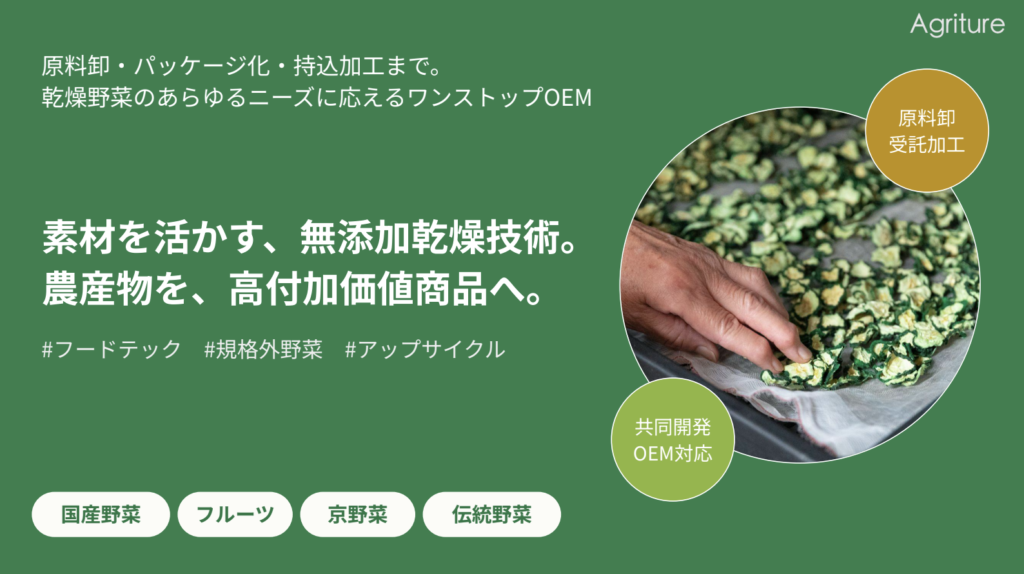
- OEM available from small lots of 10 kg
- Drying of brought-in raw materials also possible
- Support from processing to filling in one place
Download the OEM contract processing materials
We will send the materials to your email address based on the information you provide.
- 5 cases and strategies that succeeded in branding heirloom vegetables
- What is shima-kabocha? Also called "chinkuwa" or "nankuwa"
Author of this article
Related articles
-
 Okinawa island vegetables: individualistic vegetables nurtured by a subtropical climate
 -
 Kaga vegetables: Kanazawa brand vegetables where tradition lives on
 -
 The appeal of Kansai heirloom vegetables | Specialties of Naniwa, Kyoto, and Yamato thoroughly explained
 -
 Kyoto heirloom vegetables: Kyoto specialties with a long history
 -
 A list of heirloom vegetables of the 8 prefectures of Kyushu and Okinawa|A thorough introduction to characteristics, growing regions, and seasons
 -
 Know the heirloom vegetables of Edo Tokyo | The city’s vanishing food culture
 -
 They'll make you smile! The fun names of heirloom vegetables and their origins
 -
 5 cases and strategies that succeeded in branding heirloom vegetables