
Japan's Heirloom Vegetables: Precious Varieties Handed Down in Each Region

Summary of this article
Japanese heirloom vegetables are a collective term for heirloom and fixed varieties long grown in particular regions. This article covers the definition and history of heirloom vegetables, the difference between heirloom varieties and F1 varieties, their value as "edible cultural heritage," and representative items and certification criteria from various regions such as Kyoto vegetables, Kaga vegetables, Yamagata's heirloom crops, Edo Tokyo vegetables, and Okinawa's island vegetables, along with notable nutrients, the significance of local production and consumption and biodiversity conservation, and their use as dried vegetables.
"Traditional vegetables" is a general term for native and open-pollinated vegetable varieties that have long been grown in particular regions. While supermarkets across Japan stock similar varieties, vegetables with names and shapes unique to their regions survive in many areas. This article covers the definition and history of traditional vegetables, representative items from each region, their flavor characteristics and how to use them as dried vegetables.

TOC
The definition of heirloom vegetables
What are heirloom vegetables?
Heirloom vegetables refer to vegetables that continue to be grown in particular regions from long ago. There is no nationwide unified definition; the reality is that prefectures, municipalities, JA, and others set their own criteria and certify them. A common element is that they are heirloom and fixed varieties rooted in that land's food culture and dietary habits, adapted to the region's climate.
The difference between heirloom/fixed varieties and F1 varieties
Many heirloom vegetables are called "heirloom varieties" or "fixed varieties," adapted to the land's climate by repeatedly saving and growing seed of the same variety. On the other hand, most vegetables lining supermarkets today are "F1 varieties (first-generation hybrids)," varieties that prioritize uniformity of shape and stability of yield. Heirloom varieties vary in shape and size, but many are said to have strong individuality of flavor.
Their value as "edible cultural heritage"
A notable trait of heirloom vegetables is that many are varieties tied to local festivals and local cuisine, handed down across generations. With individuality of taste, aroma, and form varying by land, they have played a role in conveying local food culture, not only as ingredients.
The history of heirloom vegetables
Vegetables brought from abroad that took root in the regions
Many of the vegetables eaten in Japan were introduced from abroad from ancient to early-modern times and changed into distinctive varieties by adapting to each region's climate. These developed in various places as heirloom and fixed varieties and were later organized as heirloom vegetables. For example, daikon is said to originate in Central Asia and the Mediterranean coast, but in Japan locally distinct varieties such as Shogoin daikon and Gensuke daikon have emerged.
Decline during the high-growth era and revival
As the high-growth era began, a stable supply of fresh food to urban areas was demanded, and ease of cultivation and stability of yield came to be prioritized. In this current, high-efficiency F1 varieties became mainstream, and cultivation of heirloom and fixed varieties declined.
Against a backdrop of the spread of local production and consumption and rising health consciousness, moves to re-evaluate heirloom vegetables are spreading. Their use at restaurants that make the most of local ingredients and in home cooking is also increasing.
Heirloom vegetables of various regions
Japan's climate and land differ greatly by region, and distinctive heirloom vegetables have taken root in each area. Here we summarize the heirloom vegetables of representative regions.
| Region | Name | Number of items | Representative varieties | Certifying body / criteria |
|---|---|---|---|---|
| Kyoto Prefecture | Kyoto Heirloom Vegetables | 37 items | Kujo negi, Kamo nasu, Shogoin daikon | Kyoto Prefecture Department of Agriculture, Forestry and Fisheries / established March 1988; grown within the prefecture before the Meiji era |
| Ishikawa Prefecture | Kaga vegetables | 15 items | Kaga renkon, Kinjiso, Gensuke daikon | Kanazawa Agricultural Products Brand Association / grown in Kanazawa since before 1945 |
| Okinawa Prefecture | Island vegetables | 28 items | Goya, shima rakkyo, shima kabocha | Okinawa Prefecture "Okinawa's Traditional Agricultural Products" / eaten since before the war |
| Yamagata Prefecture | Yamagata's heirloom crops | About 160 items (research-group organization) / 87 items (prefecture's "Treasures of Food") | Dadachamame, Minden nasu, Atsumi kabu | Yamagata University / Yamagata Heirloom Crops Research Group / Yamagata Prefecture |
| Tokyo | Edo Tokyo vegetables | 52 items | Nerima daikon, komatsuna, Takinogawa gobo | JA Tokyo Chuo-kai "Edo Tokyo Vegetables Promotion Committee" / grown within Tokyo from the Edo period to the mid-Showa era |
Kyoto vegetables (Kyoto Prefecture)
Kyoto's "Kyoto vegetables" are known nationwide, with representative varieties such as "Kujo negi," "Kamo nasu," and "Fushimi togarashi." Kyoto Prefecture established the definition of "Kyoto heirloom vegetables" in March 1988, selecting items grown within the prefecture before the Meiji era, covering 37 items in total including 35 extant and 2 extinct. See the list of Kyoto vegetables here
Kaga vegetables (Ishikawa Prefecture)
The heirloom vegetables "Kaga vegetables" grown around Kanazawa, Ishikawa Prefecture, include "Kinjiso," "Kaga renkon" and "Gensuke daikon." Used in Kaga cuisine such as renkon-mushi and daikon-zushi, the Kanazawa Agricultural Products Brand Association certifies 15 items as "Kaga vegetables" under the criterion of "vegetables grown in Kanazawa since before 1945 and still produced mainly within the old Kanazawa city area."
Yamagata's heirloom crops (Yamagata Prefecture)
Yamagata Prefecture is known as a prefecture with many heirloom-crop varieties, and a survey by Yamagata University and the Yamagata Heirloom Crops Research Group organizes about 160 items. Representative varieties adapted to the cold climate — "Dadachamame," "Minden nasu," "Mogami wase negi" — have also been used in festivals and local cuisine.
Okinawa's island vegetables (Okinawa Prefecture)
Okinawa's "Island vegetables" include "Shima rakkyo," "handama (Suizenji-na)," and "shima kabocha," used in Okinawan local dishes such as goya champuru and irichi. Okinawa Prefecture has selected 28 items eaten since before the war as "Okinawa's Traditional Agricultural Products."

Flavor characteristics of traditional vegetables
Distinctive character of native varieties
Because traditional vegetables are native or open-pollinated varieties, many have more distinctive flavors than F1 varieties. They may be irregular in shape or have unstable yields, but they have unique flavors and textures passed down to suit local cuisine.
What distinguishes representative traditional vegetables
| Heirloom vegetables | Region | Flavor and texture |
|---|---|---|
| Kaga renkon | Ishikawa Prefecture | Strongly chewy and sticky |
| Kujo green onion | Kyoto Prefecture | Tender leaves with a strong aroma |
| Goya | Okinawa Prefecture | Distinctive bitterness and crunch |
| Shimonita green onion, | Gunma Prefecture | Melts and turns sweet when cooked |
| Shogoin daikon | Kyoto Prefecture | Round and fine-textured, holds its shape when simmered |
Using each in dishes that play to its strengths brings out the flavor unique to traditional vegetables.
Local production and consumption of heirloom vegetables, and sustainability
Contributing to the regional economy
Heirloom vegetables are an important element making up local food culture. Continuing to grow them helps sustain regional agriculture, and branding has also produced economic effects. Cultivation experiences at local schools and promotional activities at tourism events are advancing in various places.
Conserving biodiversity
Continued cultivation of heirloom vegetables is also directly linked to conserving the biodiversity of crops. If varieties skew toward F1, genetic diversity is lost, raising the risk of reduced resistance to pests, disease, and climate change. Preserving heirloom varieties is also an effort that supports Sustainability of agriculture as a whole.
Using heirloom vegetables as dried vegetables
Bringing heirloom vegetables closer with dried vegetables
Quite a few heirloom vegetables have limited seasons or are hard to obtain outside their producing areas. Drying them removes moisture and improves storability, making them easier to deliver to areas far from the producing region. Being able to enjoy heirloom vegetables in a form easy to incorporate into the everyday table is a benefit of dried vegetables.
Contributing to reducing food loss
Because heirloom vegetables vary in shape and size, some items are hard to put on the market. Processing into dried vegetables contributes to reducing food loss by making full use of off-standard produce. You can also enjoy buying heirloom vegetables on a trip and bringing them home to incorporate into the family table.
We have materials available to help you understand dried processing OEM
Agriture OEM, flexibly handling everything from small lots to large lots
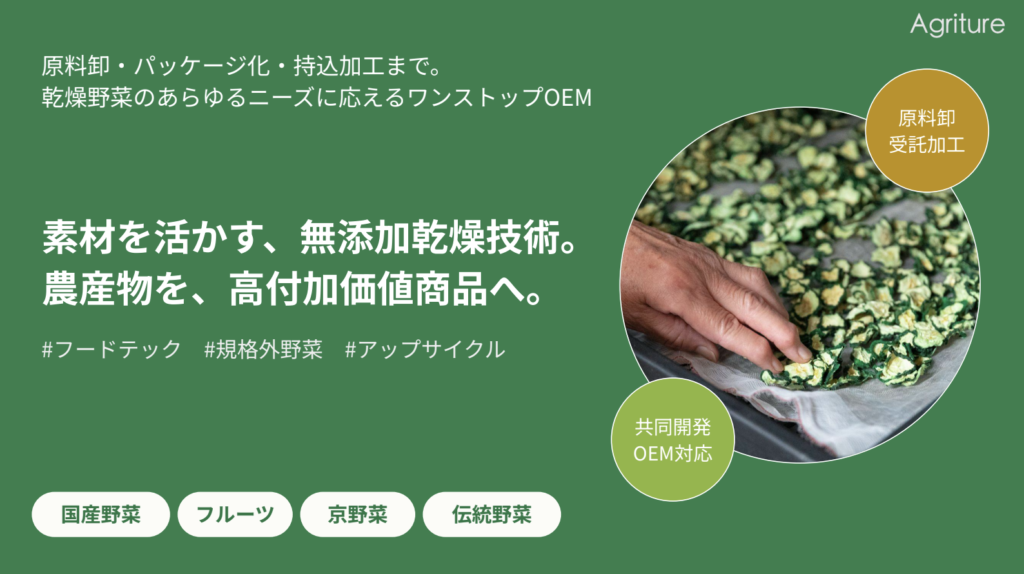
- OEM available from small lots of 10 kg
- Drying of brought-in raw materials also possible
- Support from processing to filling in one place
Frequently asked questions about heirloom vegetables
Summary
Traditional vegetables are a collection of native and open-pollinated varieties nurtured over many years in regions across Japan. Items that reflect the climate and history of their regions, such as Kyoto heirloom vegetables, Kaga vegetables, Okinawa's traditional agricultural products and Edo Tokyo vegetables, are being reappraised for their flavor as well. From the standpoint of local production for local consumption and biodiversity conservation, too, passing on traditional vegetables is an essential effort that supports regional agriculture.
Processed into dried vegetables, they become less constrained by season and producing area, making it easier to bring the flavor and nutrition of Heirloom vegetables to the daily table.
Related articles
Download the OEM contract processing materials
We will send the materials to your email address based on the information you provide.
- A list of heirloom vegetables from the six Tohoku prefectures | The regional food culture we want to protect
- What are the Naniwa heirloom vegetables? An explanation of the features and season of the 25 items Osaka is proud of
Author of this article
Related articles
-
 Okinawa island vegetables: individualistic vegetables nurtured by a subtropical climate
 -
 Kaga vegetables: Kanazawa brand vegetables where tradition lives on
 -
 The appeal of Kansai heirloom vegetables | Specialties of Naniwa, Kyoto, and Yamato thoroughly explained
 -
 Kyoto heirloom vegetables: Kyoto specialties with a long history
 -
 A list of heirloom vegetables of the 8 prefectures of Kyushu and Okinawa|A thorough introduction to characteristics, growing regions, and seasons
 -
 Know the heirloom vegetables of Edo Tokyo | The city’s vanishing food culture
 -
 They'll make you smile! The fun names of heirloom vegetables and their origins
 -
 5 cases and strategies that succeeded in branding heirloom vegetables