
Kaga vegetables: Kanazawa brand vegetables where tradition lives on

Summary of this article
Kaga vegetables are 15 traditional vegetables certified by the Kanazawa City Agricultural Products Brand Association, with the criterion of “vegetables cultivated since before 1945 and still grown mainly in Kanazawa.” This article explains the characteristics and seasons of representative varieties such as Kaga renkon, kinjiso, Kaga futo kyuri, Gensuke daikon, and aka-zuiki; their relationship with local dishes such as hasu-mushi and daikon-zushi; and their nutritional value. It also introduces a list of the 15 varieties and how to use dried Kaga vegetables.
Ishikawa Prefecture is known for the Kaga domain and its "one million koku" of rice. This region, where traditional culture remains strong, has heirloom vegetables called Kaga vegetables. Nurtured by the local climate and land, many with histories dating back to the Edo period, Kaga vegetables are a brand certified by the Kanazawa City Agricultural Products Brand Association. This article explains in detail the characteristics, history, representative dishes and flavors of the 15 Kaga vegetables.
TOC
What Are Kaga Vegetables?
The Definition and Certification Criteria of Kaga Vegetables
“Kaga vegetables” are traditional vegetables certified by the Kanazawa City Agricultural Products Brand Association — vegetables with a long history, beloved locally. Grown mainly in Kanazawa, those certified as brand vegetables by the Kanazawa City Agricultural Products Brand Association are designated “Kaga vegetables.” The certification criterion is a clear condition: “vegetables cultivated since before 1945 and still grown mainly in Kanazawa.”
Currently there are 15 certified Kaga vegetables, and those of especially good quality are shipped with a brand seal affixed. Through this brand management, consumers can pick up high-quality Kaga vegetables with confidence.
The Climate of Ishikawa Prefecture Where Kaga Vegetables Grow
Supporting the cultivation of these Kaga vegetables are Ishikawa Prefecture's distinctive climate and the farmers' high skill. Because the four seasons are clearly defined, you can enjoy the seasonal flavor of each — that's the appeal. Winter snowfall gives moisture to the soil, and the humid wind from the Sea of Japan keeps humidity moderate, creating an environment well suited to vegetable growth. In addition, traditional cultivation techniques handed down since the Edo period are carried on, and Kaga vegetables remain indispensable to the local food culture, beloved by many to this day.
FOR BUSINESS
乾燥野菜を業務用でお探しですか
国産の野菜・果物を乾燥し、必要に応じて粉砕してお出ししています。扱っている品目は100種前後で、規格は 乾燥品の一覧・パウダーの一覧 に掲載しています。
少量でのご購入は、姉妹ブランドの通販サイト OYAOYA で承っています。
A List of the 15 Kaga Vegetables
We introduce the 15 varieties certified as Kaga vegetables in a list. Each has its own history and flavor, beloved on the tables of Ishikawa Prefecture (source: Kanazawa City Agricultural Products Brand Association, variety introductions)。
| Item | Use example | Peak period |
|---|---|---|
| sweet potato, | Fluffy texture and sweetness | Autumn |
| Kaga renkon | Strong stickiness and thick flesh | Autumn to winter |
| Bamboo shoots | Tender and richly flavorful | Spring |
| Kaga futo kyuri | Thick, rounded shape | Spring–summer |
| Kinjiso | A beautiful leafy vegetable with a purple underside | Summer |
| Kaga tsurumame | Thick-fleshed and good flavor | Summer |
| Heta murasaki nasu | Purple down below the stem cap | Summer |
| Gensuke daikon | Tender with strong sweetness | Winter |
| Kanazawa seri | Fragrant and crisp | Winter–spring |
| Utsugi akagawa amaguri kabocha | Vivid red skin and sweetness | Summer–autumn |
| Kanazawa ippon futo negi | A thick, sweet white negi | Winter |
| Futatsuka karashina | A sharp pungency | Winter |
| Aka-zuiki | A vivid vermilion leaf stalk | Summer |
| Kuwai | Gentle bitterness and texture | Winter |
| Kanazawa shungiku | Thick, tender leaves | Winter |
The Characteristics of Representative Kaga Vegetables
From the 15 varieties, we introduce 5 especially popular Kaga vegetables in more detail.
Kaga renkon
Kaga renkon is distinguished by high starch content and strong stickiness, with short, thick internodes and thick flesh. Each node offers a different texture — the tip crisp, the base chewy. Suited to a range of dishes such as simmered dishes, tempura, and stir-fries, it is also used in the Kaga dish “hasu-mushi.”
Kinjiso
Kinjiso is a leafy vegetable with a vivid purple underside, beautiful to look at and useful for adding color to dishes. Also called suizenjina, it has a mild flavor that is perfect for ohitashi (blanched greens) and tempura. When boiled, it becomes slippery like molokhia, and its flavor can be enjoyed as an aromatic vegetable. The purple underside of the leaves is its visual hallmark.
Kaga futo kyuri
Kaga futo kyuri, distinguished by the thick, rounded, hefty shape its name suggests. Compared to ordinary cucumbers, its flesh is juicy and tender, making it well suited to simmered dishes and sunomono as well. Because its texture holds even when heated, it is used widely in a range of dishes. Whereas ordinary cucumbers are mainly eaten raw, the big difference is that Kaga futo kyuri also suits heat-cooking.
Gensuke daikon
Gensuke daikon is a tender, intensely sweet daikon, one of the vegetables indispensable to Kaga's winter. With a stubby shape, it shows its deliciousness especially in simmered dishes and oden, and resists crumbling. It is also used in Kanazawa's local dish “daikon-zushi,” a traditional fermented food in which daikon and herring are pickled with koji.
Aka-zuiki
Aka-zuiki is a general term for the leaf stalks of the red-leaf-stalk satoimo line, such as tou-imo (ebi-imo) and yatsugashira; it is high in fiber and healthy. Eaten as sunomono, pickles, or dried as “hoshi-zuiki,” its refreshing flavor is perfect for summer. Its vivid vermilion color brightens the table.
The Relationship Between Kaga Vegetables and Kaga Cuisine
The History and Characteristics of Kaga Cuisine
Kaga vegetables are ingredients precious to local people, indispensable to Ishikawa's food culture. Kaga cuisine is built on the fish and rice caught in Ishikawa, incorporating ingredients from across the country brought by the Kitamaebune ships and the food cultures of China and Korea, and is distinguished by refinement and depth of flavor. To Kaga cuisine, nurtured precisely because Ishikawa is blessed by both sea and mountains, Kaga vegetables that let you enjoy seasonal flavors are indispensable.
Representative Local Dishes Using Kaga Vegetables
A famous local dish using Kaga vegetables is “hasu-mushi.” A dish of grated Kaga renkon steamed with white fish or shrimp added, it makes use of the stickiness distinctive to Kaga renkon. Also, “daikon-zushi” using Gensuke daikon, ohitashi of kinjiso, and simmered Kaga futo kyuri — Kaga cuisine is distinguished by many dishes that make the most of the ingredient's flavor. When you visit Kanazawa, do try them at a local ryotei or izakaya.
Flavor and texture of Kaga vegetables
What distinguishes the main items
Kaga vegetables are prized for the distinctive flavors that come from being native varieties. The characteristics of representative items are summarized below.
| Item | Flavor and texture | Well-suited dishes |
|---|---|---|
| Kaga renkon | Chewy and sticky | Simmered dishes, surinagashi soup, lotus root mochi |
| Kinjiso | Purple leaf undersides and a slippery texture | Ohitashi (blanched greens), vinegared dishes |
| Gensuke daikon | Tender flesh that holds its shape when simmered | Preheating the frying pan thoroughly is essential. Dry-heat it until thin smoke rises before adding the ingredients, and the moisture evaporates quickly for a clean sear. Adding a smaller amount at a time is another key point. |
| Kaga futo kyuri | Thick, with dense flesh | Dishes with thickened sauce, simmered dishes |
| Aka-zuiki | Vivid red and crisp | Vinegared dishes, dressed salads |
Rich flavor characteristic of native varieties
Native varieties such as Kaga vegetables have more distinctive flavors than F1 (first-generation hybrid) varieties and have taken root in local cuisine. Each item has a clear character: Kaga lotus root is chewy and sticky, while Gensuke daikon has tender flesh that absorbs flavors easily. Choosing them to suit regional dishes brings out the best in the ingredients.
Using Kaga Vegetables as Dried Vegetables
The Benefits of Dried Kaga Vegetables
Many Kaga vegetables have limited seasons, but making them into dried vegetables lets you enjoy them year-round. Drying concentrates the nutrition and greatly improves keeping quality. In particular, dried Kaga renkon chips are delicious eaten as-is or added to simmered dishes, an easy way to take in Kaga vegetables' nutrition.
How to bring them into daily life
Dried Kaga vegetables are easy to use as ingredients in miso soup or other soups. The rehydration time is short too, making them perfect even for a busy breakfast. Why not bring the flavor of Kanazawa's Heirloom vegetables to your daily table? sustainable Considering a sustainable food life too, the method of drying and storing seasonal vegetables is worth noting.
We have materials available to help you understand dried processing OEM
Agriture OEM, flexibly handling everything from small lots to large lots
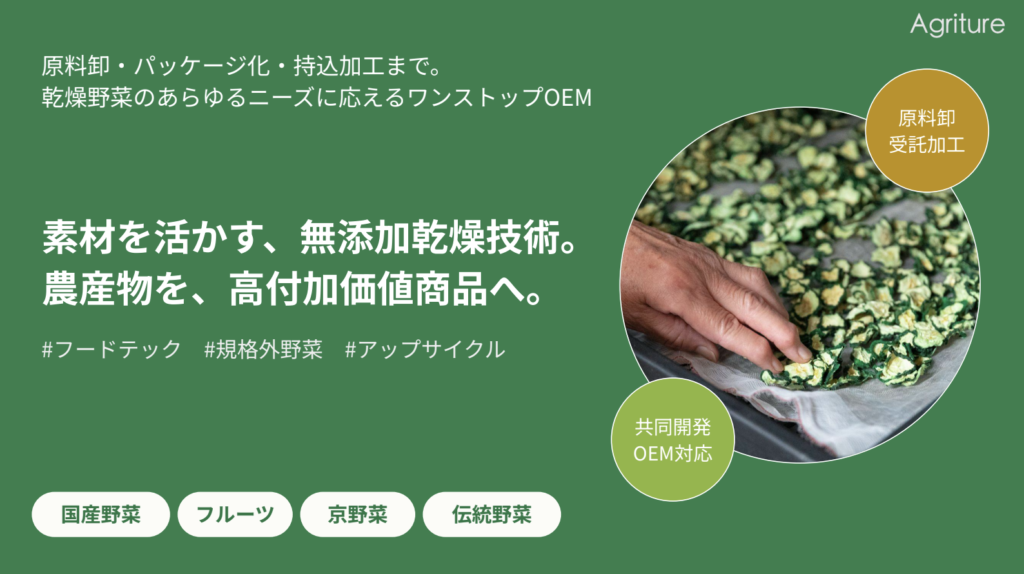
- OEM available from small lots of 10 kg
- Drying of brought-in raw materials also possible
- Support from processing to filling in one place
FOR BUSINESS
乾燥野菜を業務用でお探しですか
国産の野菜・果物を乾燥し、必要に応じて粉砕してお出ししています。扱っている品目は100種前後で、規格は 乾燥品の一覧・パウダーの一覧 に掲載しています。
少量でのご購入は、姉妹ブランドの通販サイト OYAOYA で承っています。
Frequently Asked Questions About Kaga Vegetables
Summary
Kaga vegetables are 15 brand traditional vegetables long beloved by locals, with flavors that evoke Kanazawa's seasonal turns. Along with Kaga cuisine, their appeal has spread nationwide as a presence representing Ishikawa's food culture. Do try, at least once, the local dishes unique to Kaga vegetables, such as Kaga renkon hasu-mushi and Gensuke daikon daikon-zushi.
Processed as dried vegetables, you can bring the nutrition and flavor of Kaga vegetables to your daily table regardless of the season. Heirloom vegetables Why not discover the richness of
Related articles
Download the OEM contract processing materials
We will send the materials to your email address based on the information you provide.
- Kaga lotus root: featuring a sticky, thick-fleshed texture
- The appeal of Kansai heirloom vegetables | Specialties of Naniwa, Kyoto, and Yamato thoroughly explained
Author of this article
Related articles
-
 Okinawa island vegetables: individualistic vegetables nurtured by a subtropical climate
 -
 The appeal of Kansai heirloom vegetables | Specialties of Naniwa, Kyoto, and Yamato thoroughly explained
 -
 Kyoto heirloom vegetables: Kyoto specialties with a long history
 -
 A list of heirloom vegetables of the 8 prefectures of Kyushu and Okinawa|A thorough introduction to characteristics, growing regions, and seasons
 -
 Know the heirloom vegetables of Edo Tokyo | The city’s vanishing food culture
 -
 They'll make you smile! The fun names of heirloom vegetables and their origins
 -
 5 cases and strategies that succeeded in branding heirloom vegetables
 -
 What is the regional character of heirloom vegetables? The tastes and stories handed down across the land