
What are Kagoshima’s heirloom vegetables? Features, season, and ways to eat the 24 items organized by the association (Sakurajima daikon, Anno sweet potato, handama) explained

The heirloom vegetables of Kagoshima Prefecture are a group of varieties passed down in growing regions with differing terrain—from the Satsuma and Osumi Peninsulas with the volcanic soils of Sakurajima and Mount Kaimon, to island groups such as Tanegashima, Yakushima, Amami Oshima, and the Tokara Islands, to the mountainous Kirishima mountain range. The Japan Traditional Vegetable Promotion Association organizes Kagoshima Prefecture's 23 heirloom vegetables.
We introduce items handed down in Satsuma, Osumi, and the islands, including the Guinness World Record–certified Sakurajima daikon, Tanegashima's Anno-imo, Yakushima's kawahiko, oyakui-imo, and koki-imo, Amami's handama and furu, and the Satsuma o-naga reishi (bitter gourd).
TOC
The definition of "heirloom vegetable" and the scope of this article
| Certifying body | Main criteria |
|---|---|
| Kyoto Prefecture "Kyoto Heirloom Vegetables" | Cultivation history predating the Meiji era, covering the entire prefecture |
| Osaka Prefecture "Naniwa Heirloom Vegetables" | Cultivated within Osaka Prefecture from roughly 100 or more years ago |
| Nagano Prefecture "Shinshu Heirloom Vegetable Certification System" | Cultivation, food culture, and varietal traits from before the 1955–1964 period |
| Kagoshima Prefecture, “Heirloom Vegetables of Kagoshima” | Vegetables that the prefecture selects as deeply tied to Kagoshima's environment and food culture, cultivated within the prefecture generally from before 1945 (23 items / Kagoshima Prefecture official) |
In this article, we organize Kagoshima Prefecture's 23 items, as arranged by the Japan Heirloom Vegetable Promotion Association, by category, and explain 7 representative items in detail in the main text.
A list of Kagoshima's 23 heirloom vegetables
6 daikon-type items
| Item | Features | Growing region | Season |
|---|---|---|---|
| Sakurajima daikon | Guinness-certified, up to 31.1 kg | Sakurajima, Kagoshima City | Late December to February |
| Ara daikon | Root weight 2 to 4 kg, excellent flesh quality | Northern Amami Oshima | December to January |
| Kaimon-dake daikon | Up to 20 kg, tender flesh | Kaimon Town, Ibusuki | Late December to January |
| Kokubu daikon | Distinctive pungency and suitability for pickling | Hayato Town, Kirishima | Late December to January |
| Yamagawa daikon | For local cuisine | Yamagawa Town, Ibusuki | Mid-December to January |
| Yokogawa daikon | Ideal for namasu | Yokogawa, Kirishima | November to January |
7 tuber and leaf-stalk items
| Item | Features | Growing region | Season |
|---|---|---|---|
| Anno-imo | The representative “sweet honey potato” | Tanegashima | September–December |
| Oyakui-imo | A taro-type in which the mother corm grows large for eating | Yakushima Town | November–March |
| Kawahiko (mochi-imo) | A taro-type native variety of Yakushima. Locally also called “mochi-imo” | Yakushima Town | November to mid-March |
| Koki-imo | A Yakushima native sweet-potato type, high in sugar as a baked sweet potato | Yakushima Town | August–November |
| Tokara ta-imo | A taro grown exclusively in paddy fields | Toshima Village (Tokara Islands) | Mid-October to March |
| Toimogara | The leaf stalk of the hasu-imo. Used in soups, vinegared dishes, and the like | Aira and others | June |
| Migashiki | The leaf stalk of taro (zuiki), with a crisp texture | Aira and others | June |
Eggplant, gourd, chili, and fruit vegetables
| Item | Features | Growing region | Season |
|---|---|---|---|
| Ishiki naga-nasu | 30 to 50 cm, does not toughen even if harvested late | Ishiki, Kagoshima City | July to mid-September |
| Shiro-nasu | Low in astringency, can also be eaten raw | All of Kagoshima | July to mid-September |
| Satsuma o-naga reishi | Bitter gourd, 35 to 40 cm long | All of Kagoshima | July–September |
| Naga-ui / ito-ui | Sponge gourd, eaten in the immature stage | All of Kagoshima | July–October |
| Hanaoka kosho | Mellow heat | Hanaoka, Kanoya | September to November |
| Hayato-uri (Hayato gourd) | A cucurbit fruit vegetable introduced to Kagoshima in the early Taisho period. Used in pickles and stir-fries | All of Kagoshima | October–November |
| Yabo suika | A native large watermelon with white to pale-yellow flesh and a crisp texture. Under good growing conditions it reaches 14 to 16 kg (association). After cultivation nearly died out in the Yabo district of the former Higashiichiki Town, seeds preserved at a seed company in Nara made a homecoming in 2004 and revived it | Hioki City (Yabo, former Higashiichiki Town) | Early to mid-August |
Leafy greens, condiments, and carrot
| Item | Features | Growing region | Season |
|---|---|---|---|
| Handama | Kinjiso, rich in iron | Amami City and others | Year-round |
| Furu | Leaf garlic, strongly aromatic | Amami City | January to March |
| Yoshino carrot | 30 to 40 cm, strongly aromatic | Yoshino, Kagoshima City | Late November to early January |
A product catalog that shows around 100 items we handle
Agriture, flexibly handling everything from small lots to large lots
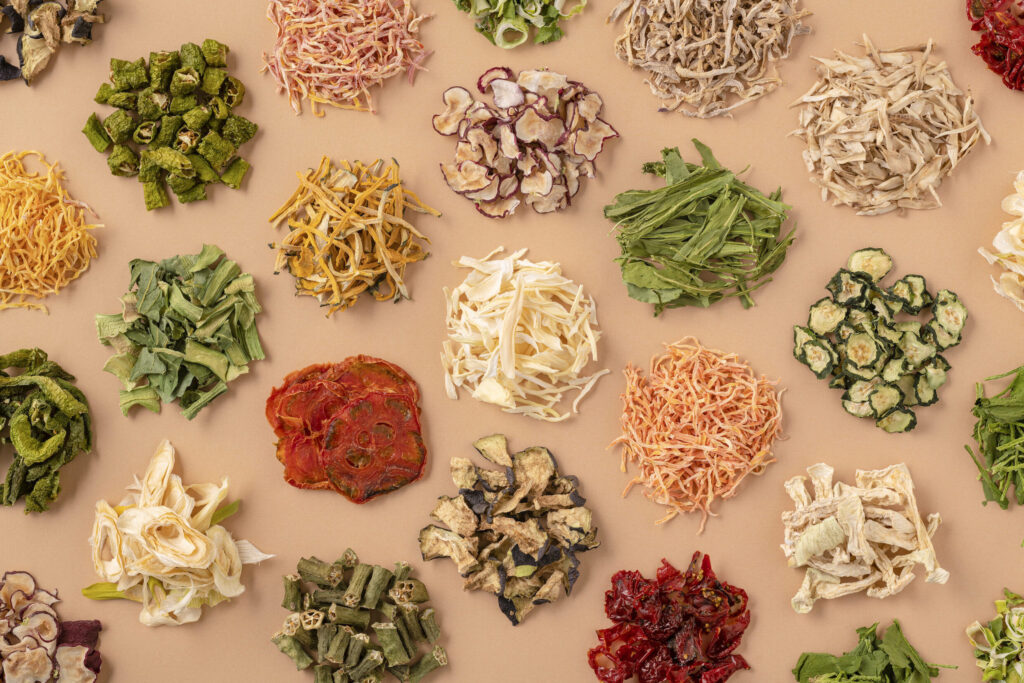
- Available for purchase in small lots from 1 kg
- We handle heirloom vegetables from across Japan
- Dried fruit and herbs also supported
FOR BUSINESS
乾燥野菜を業務用でお探しですか
国産の野菜・果物を乾燥し、必要に応じて粉砕してお出ししています。扱っている品目は100種前後で、規格は 乾燥品の一覧・パウダーの一覧 に掲載しています。
少量でのご購入は、姉妹ブランドの通販サイト OYAOYA で承っています。
Characteristics and preparation of 7 representative Kagoshima heirloom vegetables
Sakurajima daikon — a Guinness-certified daikon among the world's largest
| Season | Late December to February |
| Growing region | Sakurajima, Kagoshima City |
| Well-suited dishes | Simmered dishes, furofuki daikon, pickles, oden |
Sakurajima daikon is one of the largest radishes in the world, grown on Sakurajima in Kagoshima City. In 2003, a 31.1kg specimen was recognized by Guinness World Records as the "heaviest radish" (the record has since been broken by a hybrid grown in Hiroshima Prefecture). Sakurajima's volcanic ash soil and warm climate produce its enormous size. The flesh is dense and sweet, and its texture can be enjoyed in simmered dishes, furofuki daikon and pickles.
In its season of late December to February, it ships from JA farm stands on Sakurajima in Kagoshima City.
Anno-imo — Tanegashima's sweet honey potato
| Season | September–December |
| Growing region | Tanegashima |
| Well-suited dishes | Baked sweet potato, sweet-potato confections, steamed potato, tempura |
Anno-imo is a sweet potato passed down in the Anno district of Nishinoomote on Tanegashima. Its origin is said to be the cultivation in the same district, after the war (around 1947), of potato seedlings that a repatriated soldier returning from the south is said to have brought back from Sumatra. After selection and breeding at the Kumage Branch of the Kagoshima Prefectural Agricultural Experiment Station, it was registered as varieties in 1998 under the names “Anno-beni” and “Anno-kogane,” and in September 2022 it was registered under the Geographical Indication protection system as GI “Tanegashima Anno-imo” (Ministry of Agriculture, Forestry and Fisheries). Distributed nationwide as a “sweet honey potato” that overflows with honey when baked, its sticky texture and strong sweetness stand out in baked sweet potato, sweet-potato confections, and steamed potato.
In its season of September to December, it also ships outside the prefecture via farm stands on Tanegashima, hometown tax donations, and mail order.
Kaimon-dake daikon — the Satsuma Peninsula daikon up to 20 kg
| Season | Late December to January |
| Growing region | Kaimon Town, Ibusuki |
| Well-suited dishes | Simmered dishes, oden, pickles, grated daikon |
Kaimon-dake daikon is a native daikon cultivated in Kaimon Town, Ibusuki, characterized by a large size reaching up to 20 kg and tender flesh. It grows in the volcanic-ash soil of Mount Kaimon and the warm climate of southern Satsuma.
You can enjoy the texture of the large roots in simmered dishes, oden, pickles, and grated daikon. In its season of late December to January, it ships at farm stands within Ibusuki.
Handama — Amami's kinjiso
| Season | Year-round |
| Growing region | Amami City and others |
| Well-suited dishes | Ohitashi, dressed dishes, tempura, stir-fries |
Handama is a leafy vegetable grown in the Amami region. It is a local variety of the same plant (Gynura bicolor, of the genus Gynura in the Asteraceae family) that is also called handama in Okinawa and kinjiso in Ishikawa Prefecture. It is distinctive for the purple underside of its leaves and has long been part of the Amami diet.
Used in ohitashi, dressed dishes, tempura, and stir-fries, its cultivation period spans a long stretch. It is distributed at farm stands within Amami City.
Satsuma o-naga reishi — a large bitter gourd of 35 to 40 cm
| Season | July–September |
| Growing region | All of Kagoshima |
| Well-suited dishes | Goya chanpuru, dressed dishes, tempura, stir-fries |
Satsuma o-naga reishi is a large bitter gourd (goya) 35 to 40 cm long, cultivated throughout Kagoshima. Far larger than common goya (around 20 cm), it is used on the summer table as an ingredient for goya chanpuru and dressed dishes.
In its season of July to September, it is distributed at JA farm stands and supermarkets within Kagoshima Prefecture.
Ishiki naga-nasu — the 30-to-50 cm long eggplant of Ishiki, Kagoshima City
| Season | July to mid-September |
| Growing region | Ishiki district, Kagoshima City |
| Well-suited dishes | Grilled eggplant, agebitashi, dengaku, simmered dishes |
Ishiki naga-nasu is a long eggplant cultivated in the Ishiki district of Kagoshima City, characterized by a large size reaching 30 to 50 cm long and a good texture that does not toughen even if harvested late.
You can enjoy its tender flesh in grilled eggplant, agebitashi, dengaku, and simmered dishes. In its season of July to mid-September, it is distributed at JA farm stands within Kagoshima City.
Oyakui-imo — Yakushima's taro in which the mother corm grows large for eating
| Season | November–March |
| Growing region | Yakushima Town |
| Well-suited dishes | Simmered dishes, dengaku, fukumeni, imoni |
Oyakui-imo is a native taro variety passed down in Yakushima Town, of a type in which the mother corm, not the offsets, is grown large for eating. Its appeal is flesh that is sticky yet resists falling apart when cooked, and it is cultivated in Yakushima's warm, rainy climate and volcanic soil.
Its texture comes through in simmered dishes, dengaku, fukumeni, and imoni, and in its season of November to March it is distributed at farm stands within Yakushima.
How to buy Kagoshima's heirloom vegetables
| Item | Main sources | Timing |
|---|---|---|
| Sakurajima daikon | JA farm stands on Sakurajima, Kagoshima City | Late December to February |
| Anno-imo | Farm stands within Tanegashima, nationwide mail order and hometown tax donations | September to December (winter to spring after curing) |
| Kaimon-dake daikon | Farm stands in Kaimon Town, Ibusuki | Late December to January |
| Handama | Farm stands within Amami City, mail order | Year-round |
| Satsuma o-naga reishi | JA farm stands and supermarkets within Kagoshima Prefecture | July–September |
| Ishiki naga-nasu | JA farm stands in Ishiki, Kagoshima City | July to mid-September |
| Oyakui-imo | Farm stands in Yakushima Town | November–March |
A product catalog that shows around 100 items we handle
Agriture, flexibly handling everything from small lots to large lots
- Available for purchase in small lots from 1 kg
- We handle heirloom vegetables from across Japan
- Dried fruit and herbs also supported
FOR BUSINESS
乾燥野菜を業務用でお探しですか
国産の野菜・果物を乾燥し、必要に応じて粉砕してお出ししています。扱っている品目は100種前後で、規格は 乾燥品の一覧・パウダーの一覧 に掲載しています。
少量でのご購入は、姉妹ブランドの通販サイト OYAOYA で承っています。
FAQ
Summary
Kagoshima's heirloom vegetables span 23 items across the mainland and islands—Kagoshima City, Sakurajima, Ibusuki, Kirishima, Kanoya, Aira, Hioki, Tanegashima, Yakushima, Amami, and the Tokara Islands. Mainland items on volcanic soil and items of the islands and mountains line up by region, including Sakurajima daikon (Guinness-certified), Anno-imo (honey potato), Kaimon-dake daikon, handama (kinjiso), Satsuma o-naga reishi, Ishiki naga-nasu, and oyakui-imo.
References / information sources
- Japan Heirloom Vegetable Promotion Association, “Kagoshima Prefecture”
- National Agriculture and Food Research Organization Genebank "Native Variety Database"
Related articles
- Heirloom vegetables of Japan
- Heirloom vegetables of Miyazaki
- Heirloom vegetables of Oita
- Heirloom vegetables of Kumamoto (Higo vegetables)
Download the product catalog
We will send the materials to your email address based on the information you provide.
Author of this article
Related articles
-
 Okinawa island vegetables: individualistic vegetables nurtured by a subtropical climate
 -
 Kaga vegetables: Kanazawa brand vegetables where tradition lives on
 -
 The appeal of Kansai heirloom vegetables | Specialties of Naniwa, Kyoto, and Yamato thoroughly explained
 -
 Kyoto heirloom vegetables: Kyoto specialties with a long history
 -
 A list of heirloom vegetables of the 8 prefectures of Kyushu and Okinawa|A thorough introduction to characteristics, growing regions, and seasons
 -
 Know the heirloom vegetables of Edo Tokyo | The city’s vanishing food culture
 -
 They'll make you smile! The fun names of heirloom vegetables and their origins
 -
 5 cases and strategies that succeeded in branding heirloom vegetables