
What are Miyazaki’s heirloom vegetables? Features, season, and ways to eat the 15 items organized by the association (itomaki daikon, Sadowara eggplant, Heike daikon) explained

Miyazaki Prefecture's heirloom vegetables are a group of varieties passed down across diverse regions from coast to mountains—Miyazaki City and Nichinan along the Hyuga-nada coast, Nishimera, Shiiba, and Misato in the Kyushu Mountains, the Kobayashi and Saito basins, and Nobeoka and Hyuga in the north of the prefecture. The Japan Traditional Vegetable Promotion Association organizes 15 items in total—12 heirloom vegetables and 3 heirloom fruit trees of Miyazaki Prefecture.
Itomaki daikon, Sadowara Eggplant, Hyuga kurokawa kabocha, Shiiba's Heike daikon and Heike kabu, Miyazaki shironasu, takenoko-imo, and other items passed down in Hyuga are introduced.
TOC
The definition of "heirloom vegetable" and the scope of this article
| Certifying body | Main criteria |
|---|---|
| Kyoto Prefecture "Kyoto Heirloom Vegetables" | Cultivation history predating the Meiji era, covering the entire prefecture |
| Osaka Prefecture "Naniwa Heirloom Vegetables" | Cultivated within Osaka Prefecture from roughly 100 or more years ago |
| Nagano Prefecture "Shinshu Heirloom Vegetable Certification System" | Cultivation, food culture, and varietal traits from before the 1955–1964 period |
| Miyazaki Prefecture | The prefecture's own "heirloom vegetable" certification system is not officially confirmed as of the writing of this article. Within the prefecture, use as regional items is being advanced, and the Japan Heirloom Vegetable Promotion Association organizes 15 items in total—12 heirloom vegetables and 3 heirloom fruit trees |
In this article, of the 15 Miyazaki Prefecture items organized by the Japan Heirloom Vegetable Promotion Association, we cover the 12 vegetable items in the main text, and introduce the 3 heirloom fruit trees (Ningpo kumquat, Hyuganatsu, and Heibeizu) in the "Other regional specialty varieties" section at the end.
A list of Miyazaki's 12 main heirloom vegetables
| Item | Features | Growing region | Season |
|---|---|---|---|
| Itomaki daikon | Reddish-purple thread-like stripes, high sugar content | Nishimera village | November to February |
| Irakabu | A native kabu for pickling greens. Its leaves are deeply indented and thistle-leaf-shaped, with a pungency (passed down in the Tateishi district of former Saigo village, Misato) | Tateishi, Misato (former Saigo village) | November to February |
| Native green-skinned bitter melon | A native bitter melon, pale green, spindle-shaped, said to have strong bitterness (distribution and information are limited) | Centered on home gardens within the prefecture | Summer |
| Native white-skinned bitter melon (nigagori) | Strong bitterness | Miyazaki City | July to early September |
| Sadowara nasu | A pale-purple long nasu that melts when grilled | Sadowara, Miyazaki City / Saito / Shintomi | April to November |
| Takenoko-imo | The parent taro is edible, cylindrical, and holds its shape when simmered | Higashikata, Kobayashi / Kunitomi / Saito | September to February |
| Tsurukubi kabocha | A Japanese kabocha, gourd-shaped, with high storability | Kobayashi and others | July–August |
| Hyuga kurokawa kabocha (kiku kabocha) | Blackish-green, bumpy, with grooves | Ikime, Miyazaki City, and others | December to June |
| Heike kabu | A white kabu whose leaves and root are both edible. In Shiiba's local cuisine it is used in pickles, simmered dishes, and more (MAFF, "Our Local Cuisine") | Shiiba village | Autumn to winter |
| Heike daikon | White with a purple band, with purple and pink color mutations, strong pungency | Shiiba village | November to January (Shiiba Village Tourism Association) |
| Miyazaki shironasu | Pale green to light-green skin; a line that does not accumulate anthocyanin in the skin and does not turn purple even when fully ripe | Miyazaki City and others | July–October |
| Yugao kabocha | Japanese pumpkin / loofah-shaped / late-maturing | Kitakata, Nobeoka City; Saito City; and others | July–October |
A product catalog that shows around 100 items we handle
Agriture, flexibly handling everything from small lots to large lots
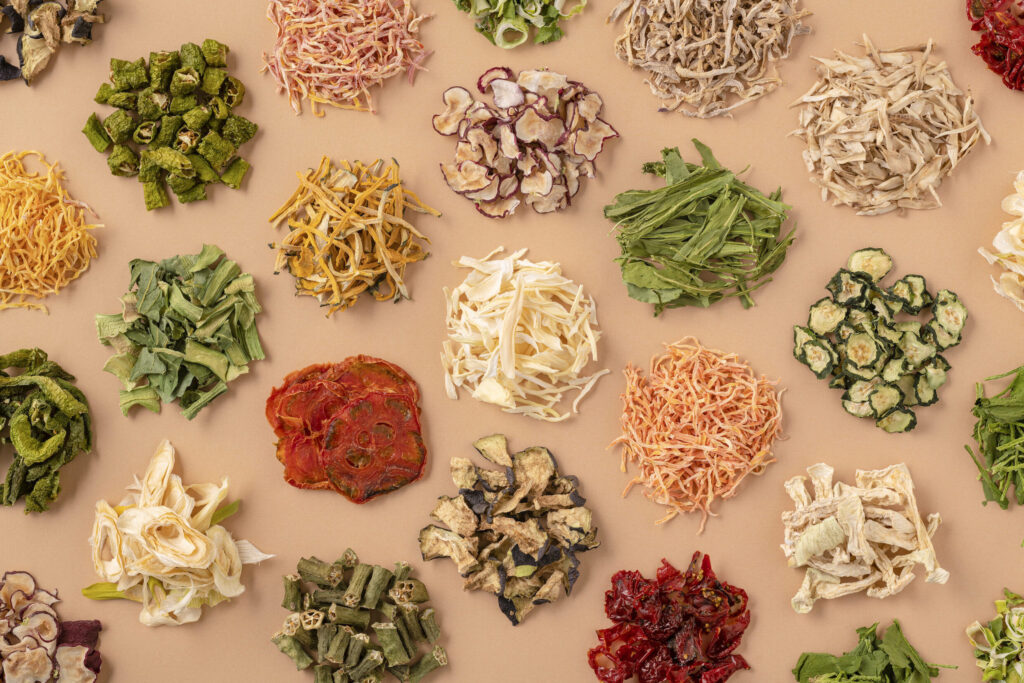
- Available for purchase in small lots from 1 kg
- We handle heirloom vegetables from across Japan
- Dried fruit and herbs also supported
FOR BUSINESS
乾燥野菜を業務用でお探しですか
国産の野菜・果物を乾燥し、必要に応じて粉砕してお出ししています。扱っている品目は100種前後で、規格は 乾燥品の一覧・パウダーの一覧 に掲載しています。
少量でのご購入は、姉妹ブランドの通販サイト OYAOYA で承っています。
Characteristics and cooking methods of 7 representative heirloom vegetables of Miyazaki
Sadowara Eggplant — a pale-purple long eggplant from Sadowara, Miyazaki City
| Season | April to November |
| Growing region | Sadowara, Miyazaki City; Saito City; Shintomi Town |
| Well-suited dishes | Grilled eggplant, dengaku, agebitashi, simmered dishes |
Sadowara eggplant is a pale-purple long eggplant grown in Sadowara (Miyazaki City), Saito City, and Shintomi Town, prized for a melt-in-the-mouth texture when grilled. Its long harvest window (April–November) is a distinctive trait, and it is a native variety distributed within Miyazaki Prefecture.
Its tender flesh shines in grilled eggplant, dengaku, and agebitashi. In season from April to November, it is sold at JA farm stands in Miyazaki City, Saito City, and Shintomi Town.
Heike Daikon — a pungent radish handed down in Shiiba Village (the Heike refugee legend)
| Season | November to January (Shiiba Village Tourism Association) |
| Growing region | Shiiba Village, Higashiusuki District |
| Well-suited dishes | Grated, pickled, simmered, or as a condiment |
Heike daikon is a native pungent radish handed down in Shiiba Village in the Kyushu Mountains, a local ingredient spoken of alongside the legend that Heike refugees who lost the Battle of Dan-no-ura (1185, the first year of the Bunji era) fled into the mountains of Shiiba. Most roots are white with a purple band, though purple and pink individual variants also occur, and a strong pungency is said to be its hallmark. Handed down through seed saved on-farm, it is now grown by only a very limited number of farmers (Shiiba Village Tourism Association and others).
It is used in Shiiba's local cooking, grated, pickled, simmered, or as a condiment. A winter vegetable harvested from November to January (Shiiba Village Tourism Association), its cultivation is currently limited to a very small area.
Itomaki Daikon — a radish from Nishimera Village with reddish-purple thread-like stripes
| Season | November to February |
| Growing region | Nishimera Village, Koyu District |
| Well-suited dishes | Salad, lightly pickled, simmered, grated |
Itomaki daikon is a native radish grown in Nishimera Village, distinguished by thread-like reddish-purple stripes on its skin. High in sugar with dense, tender flesh, it is versatile enough for eating raw, light pickling, and simmered dishes.
In season from November to February, it ships from farm stands within Nishimera Village.
Hyuga Kurokawa Pumpkin — Miyazaki Ikime's "kiku-kabocha" (chrysanthemum pumpkin)
| Season | December to June |
| Growing region | Ikime area, Miyazaki City, and others |
| Well-suited dishes | Simmered dishes, dengaku, soup, fukumeni |
Hyuga kurokawa pumpkin is a Japanese pumpkin grown in the Ikime area of Miyazaki City. Its black-green skin and grooved, rugged surface earn it the nickname "kiku-kabocha" (chrysanthemum pumpkin). It stores well and is distributed over a long period, from December through the following June.
It suits simmered dishes, dengaku, and soup. It is sold at JA farm stands in Miyazaki City.
Miyazaki White Eggplant — a white-skinned eggplant without anthocyanin
| Season | July–October |
| Growing region | Miyazaki City and others |
| Well-suited dishes | Salad, grilled eggplant, agebitashi, pickles |
Miyazaki white eggplant has pale-green to light-green skin. Because it belongs to a strain that does not accumulate anthocyanin pigment in its skin, it does not turn purple even when fully ripe. Its distinctive pale hue works well in salads, and it also suits grilled eggplant, agebitashi, and pickles.
In season from July to October, it is sold at JA farm stands in Miyazaki City.
Takenoko-imo — an edible parent-corm taro from Kobayashi, Kunitomi, and Saito
| Season | September to February |
| Growing region | Higashikata, Kobayashi City; Kunitomi Town; Saito City |
| Well-suited dishes | Simmered dishes, dengaku, fukumeni, imo soup |
Takenoko-imo is a type of taro grown in Higashikata (Kobayashi City), Kunitomi Town, and Saito City, eaten for its parent corm. Its cylindrical shape and floury texture that holds its shape when simmered make it shine in simmered dishes, dengaku, and fukumeni.
In season from September to February, it is sold at JA farm stands in Kobayashi, Kunitomi, and Saito.
Tsurukubi Pumpkin — a gourd-shaped Japanese pumpkin with good storage life
| Season | July–August |
| Growing region | Kobayashi and others |
| Well-suited dishes | Simmered dishes, dengaku, soup, tempura |
Tsurukubi pumpkin is a Japanese pumpkin with a long, slender gourd-like shape, and its flesh is smooth with more moisture than a floury type. Grown in Kobayashi City and elsewhere, it shows its best in simmered dishes, dengaku, soup, and tempura.
Harvest is centered in summer (July–August), but the traditional practice is to store it for about a month after harvest to build sweetness, so it can also be found at farm stands in Kobayashi City from autumn into winter.
How to buy Miyazaki's heirloom vegetables
| Item | Main sources | Timing |
|---|---|---|
| Sadowara nasu | JA farm stands in Miyazaki City, Saito City, and Shintomi Town | April to November |
| Itomaki daikon | Farm stands in Nishimera Village | November to February |
| Heike daikon | Within Shiiba Village (distribution is extremely limited) | November to January |
| Hyuga kurokawa pumpkin | JA farm stands in Ikime, Miyazaki City | December to June |
| Miyazaki shironasu | JA farm stands in Miyazaki City | July–October |
| Takenoko-imo | JA farm stands in Kobayashi, Kunitomi, and Saito | September to February |
| Tsurukubi kabocha | JA farm stands in Kobayashi City | July–August (stored autumn–winter) |
A product catalog that shows around 100 items we handle
Agriture, flexibly handling everything from small lots to large lots
- Available for purchase in small lots from 1 kg
- We handle heirloom vegetables from across Japan
- Dried fruit and herbs also supported
FOR BUSINESS
乾燥野菜を業務用でお探しですか
国産の野菜・果物を乾燥し、必要に応じて粉砕してお出ししています。扱っている品目は100種前後で、規格は 乾燥品の一覧・パウダーの一覧 に掲載しています。
少量でのご購入は、姉妹ブランドの通販サイト OYAOYA で承っています。
FAQ
Other regional specialty varieties (3 heirloom fruits)
| Item | Category | Growing region | Features |
|---|---|---|---|
| Ningbo kumquat | Kumquat (citrus) | Miyazaki City (the former Takaoka Town and others — Japan's top producer), Kushima City, and others | Edible skin and all, richly sweet. Distributed under the prefectural brand "Kanjuku Kinkan Tamatama." Greenhouse November–January, open-field December–March, fully ripe January–March |
| Hyuganatsu | Citrus | Miyazaki City (originating as a chance seedling discovered at a private home in the former Akae area during the Bunsei era — per Miyazaki City official sources), Nichinan City, Aya Town, and several other districts in the prefecture | Vivid yellow. Distinctive flavor in which the inner side of the thick rind (albedo) is sweet. Greenhouse December–March, open-field March–May |
| Heibeizu (hebesu) | Acidic citrus | Hyuga City | Juice squeezed over grilled fish and sashimi. Greenhouse June–October, open-field August–October |
Summary
Miyazaki's heirloom vegetables comprise 12 items handed down across the prefecture — in Miyazaki City, Nishimera, Shiiba, Kobayashi, Saito, Misato, Nobeoka, Hyuga, Kushima, Aya, and elsewhere — plus 3 heirloom fruits (Ningbo kumquat, Hyuganatsu, and hebesu), for 15 items in all. From Itomaki daikon, Sadowara eggplant, Heike daikon, and Hyuga kurokawa pumpkin to Miyazaki white eggplant and takenoko-imo, each region from the mountains to the coast preserves its own distinctive strengths.
References / information sources
- Japan Heirloom Vegetable Promotion Association, "Miyazaki Prefecture"
- National Agriculture and Food Research Organization Genebank "Native Variety Database"
Related articles
- Heirloom vegetables of Japan
- Heirloom vegetables of Oita
- Heirloom vegetables of Kumamoto (Higo vegetables)
- Heirloom vegetables of Fukuoka
Download the product catalog
We will send the materials to your email address based on the information you provide.
- What are Oita’s heirloom vegetables? Features, season, and ways to eat the 16 items organized by the association (Sorin kabocha, Kuju takana, Yaso seri) explained
- What are Kagoshima’s heirloom vegetables? Features, season, and ways to eat the 24 items organized by the association (Sakurajima daikon, Anno sweet potato, handama) explained
Author of this article
Related articles
-
 Okinawa island vegetables: individualistic vegetables nurtured by a subtropical climate
 -
 Kaga vegetables: Kanazawa brand vegetables where tradition lives on
 -
 The appeal of Kansai heirloom vegetables | Specialties of Naniwa, Kyoto, and Yamato thoroughly explained
 -
 Kyoto heirloom vegetables: Kyoto specialties with a long history
 -
 A list of heirloom vegetables of the 8 prefectures of Kyushu and Okinawa|A thorough introduction to characteristics, growing regions, and seasons
 -
 Know the heirloom vegetables of Edo Tokyo | The city’s vanishing food culture
 -
 They'll make you smile! The fun names of heirloom vegetables and their origins
 -
 5 cases and strategies that succeeded in branding heirloom vegetables