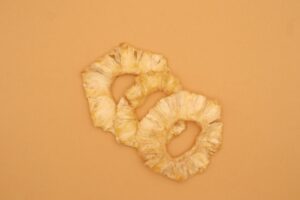
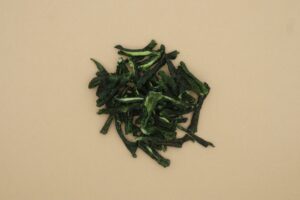
Dried Kujo green onion


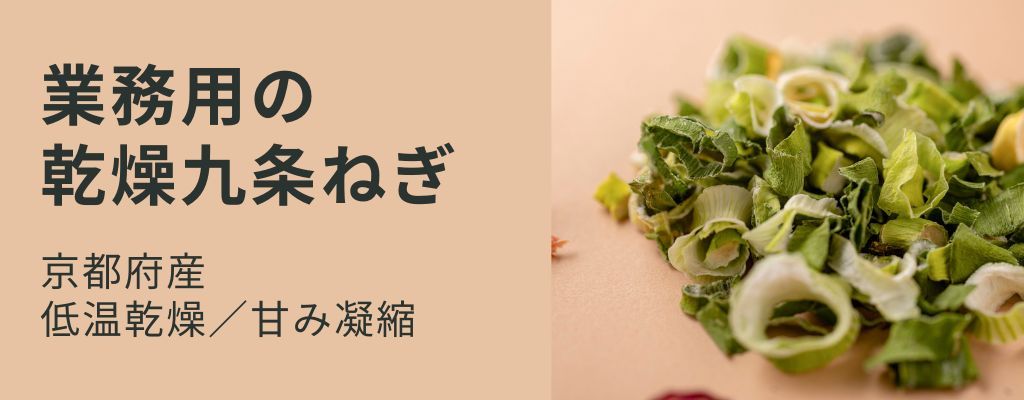
This is a commercial dried vegetable made using Kujo green onion, known as a Kyoto heirloom vegetable, sliced and dried at our own plant. The onion's inherent high fragrance and sweetness are concentrated, and a crisp texture remains even after rehydration. It suits commercial use, and is often used especially as an ingredient in Japanese prepared dishes, soups, and toppings; it is a specification easy to handle in processing and cooking settings.
TOC
Agriture's dried Kujo green onion, three points of care
01 The oldest Kyoto vegetable brand, dating from the Nara period
Kujo green onion is a green onion said to have been cultivated since the Nara period, boasting the oldest history among Kyoto vegetables. Its leaves are soft, its flavor full, and it is plenty sweet. In winter, when it comes into season, the leaves thicken and it becomes even sweeter. As a representative branded Kyoto vegetable, it is a high-value-added raw material that lets you differentiate simply by messaging "made with Kujo green onion" on the product packaging.
02 A cutting method that keeps the texture
We adopt a cutting method that does not become too fine even after drying, so you can enjoy the onion's texture. Unlike common powdered onion or finely chopped dried onion, a crisp presence remains even after rehydration, so it can be used as an ingredient, which is highly valued by commercial users. It is a raw material that can be used as the star of prepared dishes and soups.
03 Additive-free, coloring-free, natural finish
By drying the ingredient just as it is, without any glucose coating or additives, we achieve an additive-free, coloring-free, natural finish. Processing at our own plant Kujo green onion grown by partner farms lets us also issue a Kyoto-origin proof for the raw material, so it can be adopted with confidence as a raw material for branded products.
Product catalog showing the items we handle
Flexible support from small lots to large lots
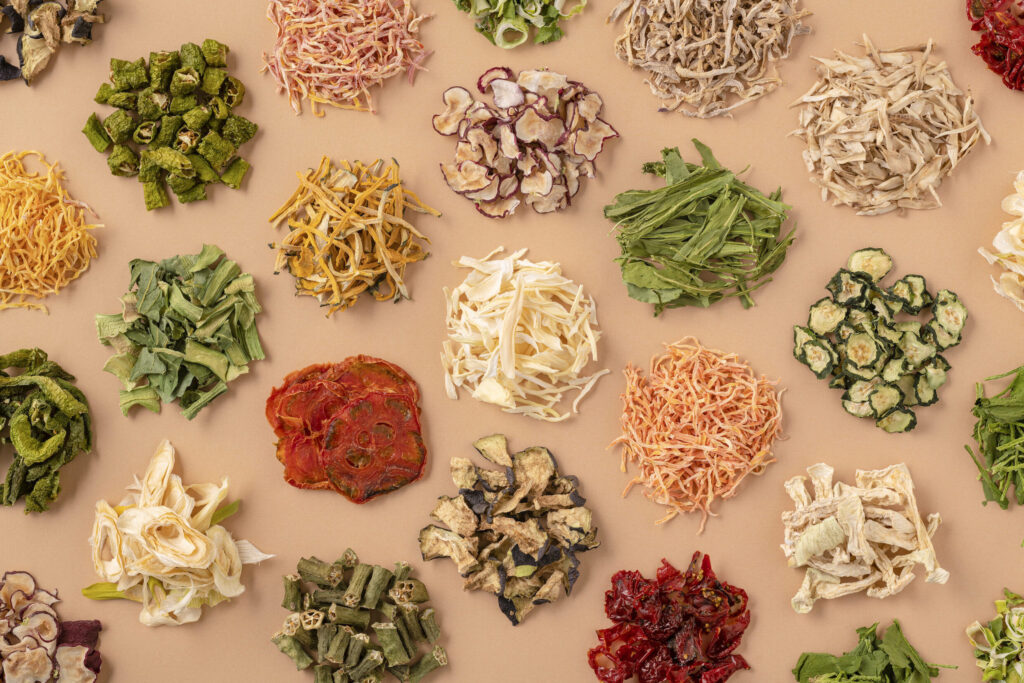
- Sold in small lots from 1 kg
- Handling heirloom vegetables from across Japan
- Dried fruits and herbs also supported
Characteristics of commercial dried Kujo green onion
A leading Kyoto vegetable
Cultivated since the Nara period, Kujo green onion is a branded vegetable boasting the oldest history even among Kyoto vegetables. It is chosen as a high-value-added raw material that lets you message the Kyoto vegetable brand on product packaging.
Almost none of the pungency characteristic of onion
Compared with common green onion, Kujo green onion has almost no pungency, and you can savor its sweet umami as you chew. It is a universally appealing aromatic-vegetable ingredient, easy to accept even for those who dislike pungency.
A grilled-corn-like aroma
It softens when heated, and another charm is that you can enjoy a corn-like flavor not found in raw Kujo green onion. It gives off a distinctive presence in aroma-focused menu items such as bakery and ramen soup.
Crisp even after rehydration
With a cut that does not become too fine even after drying, it keeps a crisp texture after rehydration. It is a specification you can use with confidence even in dishes where you want to retain its presence as an ingredient.
Additive-free and coloring-free
Dried just as it is without glucose or additives, it has an additive-free, coloring-free, natural finish. It can be adopted as is for products where you want to keep the ingredient list simple.
Powder available
We also handle a fine-powder type, and can propose specifications suited to applications where you want to blend it evenly into soup bases, furikake, and seasonings.
Product specifications
Item | Details |
|---|---|
Raw material growing region | Kyoto Prefecture (partner farmers) |
Specification | Small round-cut slices |
Storage method | Room temperature (store away from high heat and humidity) |
Best-before date | 6 months from the shipping date |
Minimum lot | From 10 bags / 100 g |
Powder | Available |
Manufacturing period | Except in summer |
Customization support
At Agriture, cooperation with partner farms and our own processing facility achieve a stable raw material supply and high-quality manufacturing. We can flexibly handle OEM manufacturing and welcome consultations on specification changes and packaging. Custom-size handling (cut-thickness change, shape adjustment) is available for consultation from orders of 10 kg or more, and for large-lot manufacturing please consult us three months before the manufacturing period.
POWDER
We also offer Kujo green onion powder
We supply Kujo green onion powder, made by finely milling dried Kujo green onion, as a commercial raw material. It is a raw material that broadens ideas for powder use, such as kneading into rice-cracker dough, flavored oils, furikake, and flavor seasonings. Please inquire for details and unit price.
Commitments to variety, grower, and growing region
The raw material used in dried Kujo green onion is Kujo green onion grown by a partner farm in Kyotango, Kyoto Prefecture. A leading Kyoto vegetable dating from the Nara period, it is the variety with the oldest history as a green onion. In cooperation with the producer partner farm, we cultivate and harvest in a planned way during periods other than summer.
BRAND
Variety: Kujo green onion. A Kyoto heirloom vegetable, it is the oldest variety of green onion, cultivated since the Nara period. Its leaves are soft and plenty sweet. In winter, when it comes into season, the leaves thicken and the sweetness stands out even more.
PRODUCER
Producer: A partner farm. Aiming for agriculture kind to the environment and to people, it is a farm that grows crops using homemade compost. As an Agriture partner farm, we have built a structure that can supply stable-quality Kujo green onion in a planned way.
REGION
Growing region: Kyotango City, Kyoto Prefecture. Making use of the characteristics of a Sea-of-Japan-side climate, we harvest during the period when the winter cold makes the leaves thick. It is a high-value-added growing region that allows brand messaging as Kyoto-grown Kujo green onion.
CULTIVATION
Cultivation method: Environmentally conscious cultivation using homemade compost. With a cultivation policy that holds down the use of chemical fertilizers and pesticides, it draws out Kujo green onion's inherent sweetness and aroma. Cooperation with producers who know the local soil and climate intimately achieves both quality and quantity.
*Reference: OYAOYA product page
Low-temperature drying technology and quality control
Aromatic vegetables like Kujo green onion pose the difficulty that their aroma components are heat-sensitive, and high-temperature drying drives off the distinctive aroma. At Agriture we operate a low-temperature drying program dedicated to aromatic vegetables, pulling moisture out over time to finish it into a raw material that retains Kujo green onion's sweetness and aroma to the greatest extent. The small round-cut slices are the optimal size that keeps an appropriate texture even after drying.
💡 TIPS | Drying-processing trivia
For aromatic vegetables containing sticky components, like Kujo green onion, sugars and viscosity intertwine during drying, so mishandling the temperature control makes the surface sticky or the color darken. At Agriture we set drying conditions dedicated to viscous vegetables and achieve processing that keeps a clean green color.
Use cases and adoption examples
As furikake and topping ingredients
As a secondary raw material for furikake manufacturers and Japanese-style seasonings and soups, it is an ingredient that can stably supply the sweetness and aroma unique to Kujo green onion. Raw Kujo green onion's incoming volume readily fluctuates with harvest timing and weather, and the prep, washing, and cutting steps burden the site, but the dried product can be stored at room temperature and used year-round, and blend amounts are easy to control. It can be provided for OEM product development that makes use of the branded Kyoto vegetable's labeling value, and in shapes to suit the application, such as flakes or powder.
As a product raw material (rice crackers and Kyoto souvenirs)
This is a scene with a track record of adoption by rice-cracker and baked-goods manufacturers and confectionery OEM firms handling Kyoto souvenirs. Raw Kujo green onion has high moisture content and is difficult to disperse evenly into dough, but the powder specification stabilizes weighing and dosing and readily keeps flavor and a vivid green color even after baking, which is well received on-site. Because the brand messaging as a Kyoto-grown raw material can also be used in packaging labeling, it can be considered as a secondary raw material for premium souvenir lines that emphasize origin differentiation.
As a topping ingredient for restaurants
This is a use whose adoption benefits stand out at fast-turnover formats such as ramen specialty shops, set-meal chains, and gyudon and curry fast food. With raw Kujo green onion, disposal risk from misjudging purchase volume or from temperature changes is unavoidable, but the dried product can be used up only as needed as room-temperature stock, directly cutting loss cost. You can consider it in specifications to suit the menu served and the seat turnover rate, such as a freeze-cut type that can be topped as is without rehydration, or a slice type used after rehydration.
Product development with powder
As a secondary raw material for powder-based processed foods such as furikake, seasoning powders, flavored oils, and soup mixes, it has a track record of adoption by food manufacturers and EC brands. Raw Kujo green onion is difficult to homogenize in flavor and to grind, and yield control also takes labor, but a powder raw material stores at room temperature and is easy to blend by fixed amount, greatly lowering the barrier to introduction on the manufacturing line. Because messaging "made with Kyoto-grown Kujo green onion" directly links to packaging differentiation, it can also be used in product development that wants to foreground an origin brand, such as gift furikake and souvenir seasonings.
For instant noodles and instant foods
For instant noodle and instant soup manufacturers, it becomes a strong option when considering ingredient quality differentiation. Compared with common dried green onion, the sweetness and aroma unique to Kujo green onion readily persist even after rehydration in hot water, and it has a track record of adoption in premium lines and health-conscious brands. Because long-term room-temperature storage and fixed-amount use are possible, labor control at line dosing is easy, and we also handle prototype consideration from small lots.
Commercial usage and rehydration
The easiest way to use dried Kujo green onion is to sprinkle it as a condiment directly onto miso soup, soup, or ramen without rehydration. It is also excellent as a condiment for instant noodles, rehydrating just by pouring hot water and spreading the aroma of Kujo green onion. Adding it to dashimaki tamago or using it as an ingredient for negiyaki is also recommended.
When rehydration is needed, it rehydrates in about 5 minutes. When using it in prepared dishes or aemono, lightly drain the water after rehydration and then dress it with seasonings so the flavor does not become muddled. The powdered version can be mixed into flavored salt, seasoned oil, and furikake for product development with a uniform aroma.
Related cases and articles
- A Guide to All of Japan's Negi Varieties | The Difference Between Green Negi, White Negi, Kujo Negi, Shimonita Negi, and Wakegi, and Commercial Uses (OEM article)
- How to choose commercial Kujo green onion raw material: recommendations from a dried-frozen-fresh comparison (OEM article)
- A Collection of Ideas for Using Dried Kujo Green Onion Powder | What Is a Food OEM Material That Makes Use of Natural Green Color and Aroma?(OEM article)
Product catalog showing the items we handle
Flexible support from small lots to large lots
- Sold in small lots from 1 kg
- Handling heirloom vegetables from across Japan
- Dried fruits and herbs also supported
Frequently asked questions
Q. What is the minimum lot and prototype handling?
A. Orders are possible from 10 bags (in 100 g units). OEM prototyping is available for consultation from 10 kg or more, and cut, packaging, and blend-ratio customization is also possible. We also handle simultaneous prototyping of multiple specifications, such as Kujo green onion powder and sliced products.
Q. What is the price range?
A. Because it uses Kyoto-grown Kujo green onion, the unit price is on the higher side compared with common dried green onion. However, it carries the added value of a branded Kyoto vegetable and is a raw material that makes it easy to raise the product's unit price. For a detailed quote, please consult us via the inquiry form.
Q. What is the lead time?
A. In-stock items can be shipped 1 to 2 weeks after order. The manufacturing period for Kujo green onion is outside summer, and we carry out planned processing timed to the autumn-to-spring harvest. For large lots, consulting us three months before the manufacturing period lets us respond in a planned way.
Q. Can you issue a raw-material origin certificate?
A. We can issue a raw-material origin certificate for Kyotango-grown material in Kyoto Prefecture. We can also handle cases where the product packaging states "made with Kyoto-grown Kujo green onion" or "made with a Kyoto vegetable." We can meet the requirements for raw-material origin labeling under the Food Labeling Act.
Q. Can you submit pesticide residue results or analysis tables?
A. We can submit quality reports such as microbiological testing and general composition analysis. The partner farm works on cultivation that holds down chemical pesticide use, and we can meet the high quality requirements demanded in OEM projects.
Q. Can you handle HACCP and export?
A. Our own plant handles submission of HACCP-compliant documents. Export projects are on a case-by-case basis, but there are also cases of developing Kujo green onion as a Kyoto vegetable for overseas Japanese-food markets. Please also consult us on developing for Japanese-ingredient stores serving Asia and Europe and the Americas.
Q. Please tell me the OEM consultation flow
A. The flow is inquiry, then concept hearing, then sample sending, then paid prototyping, then specification finalization, then main manufacturing. For Kyoto-vegetable branded product development, we provide hands-on support including story design, packaging concept, and flavor evaluation.
RETAIL
For those looking to purchase in small packs
For prototype use or personal consumption, small-quantity packs can also be purchased at the online shop of our sister brand OYAOYA. It is recommended for those who want to check the flavor and texture with a small quantity before commercial use.
Yakuzen-style effects (in the case of raw green onion)
In the world of yakuzen, green onion is positioned as an "ingredient that warms the body." It is said to help ease discomfort caused by cold, and has long been enjoyed as an ingredient that promotes perspiration and is good for the early symptoms of a cold. Added to hot pots and soups, its natural sweetness spreads and it is said to warm the body from the core. Grilling the onion brings out its sweetness and roastiness, and it also plays a role in heightening a dish's appeal.
Winter Japanese leek gains sweetness and is characterized by a soft, melting texture. Adding it to hot pots and soups lets that sweetness enhance the whole dish and bring warmth. Cooked as grilled leek, its roastiness and sweetness stand out even more, adding color to the table. Fresh leek has a strong aroma and finishes dishes richly, a winter staple ingredient.
💡 TIPS | Yakuzen trivia
In yakuzen, green onion is said to have a "pungent, warm" nature and to be an ingredient that warms the body and promotes perspiration. Warming the body with a hot dish using green onion when you feel cold or have early cold symptoms is one of the basic ideas of yakuzen. It is an ingredient easy to incorporate as a material for warming menu items.
Unlike raw green onion, dried Kujo green onion can be stored at room temperature, so it is handy as a warming ingredient you can use right away even when you are not feeling well. As a secondary raw material for commercial warming soups and yakuzen hot pots, we can also handle consultations on menu development that incorporates a yakuzen perspective.
YAKUZEN
For those who want to know more about green onion from a yakuzen perspective
On our sister site Yasai Yakuzen, which introduces recommended ingredients by constitution and yakuzen recipes, we explain the effects of green onion and how to incorporate it in more detail. We also introduce ways to eat it by season and tips for combinations.
Recommended reading
- A Guide to All of Japan's Negi Varieties | The Difference Between Green Negi, White Negi, Kujo Negi, Shimonita Negi, and Wakegi, and Commercial Uses (OEM article)
- How to choose commercial Kujo green onion raw material: recommendations from a dried-frozen-fresh comparison (OEM article)
- A Collection of Ideas for Using Dried Kujo Green Onion Powder | What Is a Food OEM Material That Makes Use of Natural Green Color and Aroma?(OEM article)
- Kujo green onion powder
Download the product catalog
We will send the materials to your email address based on the information you provide.