Dried ginger


Made with new ginger so fragrant that a refreshing coolness envelops you the moment it is dug up. Drying keeps that sharp, crisp pungency intact while the aroma remains alive. Beyond use as a raw material, powdering it also allows use as a secret ingredient in a variety of products.
Dried ginger (shoga): three points of care
Agriture's dried ginger is rigorously designed for quality so it can be adopted as a commercial raw material. Here we introduce three perspectives we treat as particular strengths.
01 Kyotango open-field grown, preserving just-dug aroma
New ginger grown in Kyotango, Kyoto, which comes into season in autumn, is given primary processing right after harvest. To avoid losing the refreshing aroma that rises the moment it is dug up, we slowly draw out only the moisture with low-temperature hot-air drying.
02 A drying design that does not destroy the pungency and aroma components
Because ginger's pungent components gingerol and shogaol are heat-sensitive, we finely control temperature and airflow. We achieve a finish that keeps both the fresh pungency before processing and the refreshing aroma.
03 A clean label with no glucose or preservatives
Because we add no sugars, preservatives, or bleaching agents during processing, the ingredient labeling is simple. It can be adopted straight into product development that emphasizes the ingredient list, such as functional foods, medicinal-food teas, and craft gin.
Product catalog showing the items we handle
Flexible support from small lots to large lots
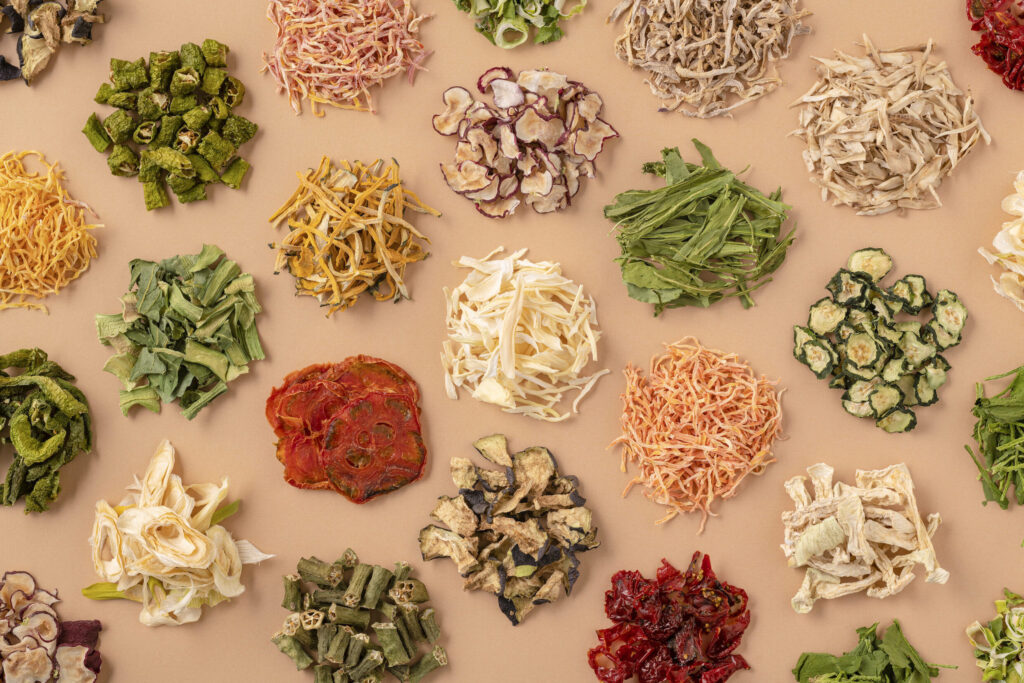
- Sold in small lots from 1 kg
- Handling heirloom vegetables from across Japan
- Dried fruits and herbs also supported
TOC
Characteristics as a commercial raw material
We summarize, from six perspectives, the advantages of choosing dried ginger as an OEM raw material. Use it as a reference for both replacing existing raw materials and developing new products.
Strong ginger aroma
Just adding a small amount to black tea, craft gin, or ginger tea imparts a commanding aroma. Ideal for brands that want to convey the "just-dug freshness" hard to reproduce with flavorings in their products.
Julienne easy to handle for beverage and confectionery materials
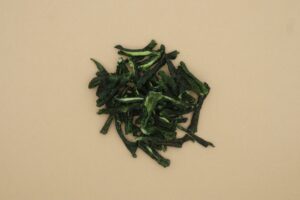
The standard specification is a julienne type. It is a shape easy to add straight as a raw material, such as for tea packs, syrup extraction, kneading into baked-goods, and highball garnishes.
Easy long-term storage and inventory planning
Room-temperature storage with a 6-month best-before date. Being able to procure new ginger, whose supply-demand is hard to predict, in a planned way and build it into year-round supply is a strength unique to dry processing.
Powdering expands recipe possibilities
Fine-powder processing is available upon request. Because drink solubility and kneading suitability improve, the range of applications expands to protein bars, gummies, roux, retort noodle broths, and more.
Kyoto-grown brand story
The raw-material origin is Kyotango, Kyoto. Because we use ginger with a visible face from our partner farmers, it is a material that makes it easy to appeal to the "Kyoto-grown" origin on the product package.
One-stop from prototype to volume production
From small-lot prototyping to full-production spec design, packaging, and label consultation—all end-to-end on our own line in Kyoto. Even if fine changes arise for a brand or for export, we can respond flexibly by rolling back.
Product specifications (commercial)
The product's basic specs are as follows. Cut specifications and packaging specs can be individually adjusted on a contract basis, so please consult us to match your OEM requirements. We have organized raw-material origin, best-before date, production method, and minimum lot so they can be checked at a glance.
Item | Details |
|---|---|
Raw material growing region | Kyoto Prefecture (partner farm) |
Specification | Fine-cut |
Storage method | Room temperature (store away from high heat and humidity) |
Best-before date | 6 months from the shipping date |
Minimum lot | From 10 bags / 100 g |
Powder | Available |
Manufacturing period | October |
Customization support
For each OEM project, we respond flexibly to changes in cut shape, powdering, small-lot prototyping, blending, and packaging specs. In addition to the response table below, please consult us about individual adjustments to match your requirements.
POWDER
We also offer powder products
Beyond commercial use, you can refer to the ginger powder sold under our retail brand "OYAOYA." Please look at commercialization examples such as medicinal-food teas, drink mixes, and confectionery materials.
Variety, grower, and origin information
Agriture's dried ginger keeps quality stable through procurement from partner farmers and contracted growing regions. Please refer to it when you want to make use of origin information at the product-planning stage.
BRAND
Variety: Open-field-grown new ginger that comes into season in autumn. We select varieties with strong pungency and aroma that can assert presence even from a single piece.
PRODUCER
Producer: Partner farmers (Kyotango, Kyoto). Partner farmers who use homemade compost and aim for cultivation kind to the environment and people.
REGION
Growing region: Kyotango, Kyoto. A land with deep snow in winter and large temperature swings, known as a growing area for aromatic new ginger.
CULTIVATION
Cultivation method: Open-field cultivation. Grown in fields where the nutrients and microbial balance of the soil are kept in order through soil-building that makes the most of homemade compost.
*Reference: OYAOYA product page
Low-temperature drying to protect the ingredient's natural flavor
At Agriture, to protect ginger's aroma, color, and umami, we use low-temperature hot-air drying with finely controlled temperature and airflow. A strength is that we preserve the components easily lost in high-heat drying through a process designed to match the ingredient's nature.
Because we take in the raw material at our own processing facility in Kyoto and manage the whole flow in one place—sorting, cutting, drying, and inspection—we can hold quality variation between lots to a minimum. Combining procurement from partner farmers and contracted regions, we can start the drying process while the raw material is still fresh, which ties directly to finished quality.
💡 TIPS | Drying-processing trivia
Ginger's pungent component gingerol partly changes into shogaol through drying and heating, turning into a warmer pungency. Because low-temperature drying retains the aromatic components while advancing this pungency change gently, it improves affinity with beverages and warming-oriented products.
Commercial use cases
Because dried ginger has ample aroma, texture, and umami even on its own, a single ingredient can be developed into multi-use product development. Here we introduce five representative use cases.
Craft drinks and bar businesses
As a botanical raw material for craft cola, ginger ale, highballs, craft gin, and the like, it is adopted by beverage makers and bar / hotel-lounge businesses. Fresh ginger tends to vary in pungency and aroma by purchase lot and its prep man-hours are a burden, but the dried raw material allows room-temperature bulk storage and stable procurement of quality. It handles slice, coarse-cut, and powder shapes, and can be discussed in specs matched to extraction methods such as simmering and cold infusion.
Tea and herbal-tea raw material
Adopted by tea-blend makers and health-food brands as a herbal-tea raw material for "warming" and "chill-measure" appeal. Fresh ginger has high moisture content, making stable lot procurement difficult, and requires pre-treatment on the production line, but dried slices allow room-temperature stable storage and fixed-quantity blending, leading to stable production with suppressed quality variation. Because the blend ratio with wakoucha, hojicha, and rooibos tea can be discussed to match the application, it also handles adoption in OEM blends and gift-oriented individually-packaged tea bags.
Health foods and functional foods
As a base raw material for functionality-appeal brands—warming supplements, chill-measure foods, medicinal-food blended teas, and the like. Because it retains ginger's characteristic pungent components while being finished additive-free, it pairs well with clean-label, additive-free EC health-food brands and pharmacy-oriented OEM products. Because it can be provided in processing shapes to your request—ground, sliced, coarse-minced—raw-material procurement matched to the process is possible, from capsule filling to tea-bag filling.
Commercial usage and case examples
For commercial use, we handle everything from 100g small lots to large-lot production in 10kg units. We flexibly cover from the prototype stage of new products to ongoing supply of volume products and custom sizes for restaurants. In past cases, it has been adopted as an OEM raw material across many fields—tea, beverages, confectionery, retort, craft gin, and more.
At Agriture, we provide end-to-end support on our own line in Kyoto, from raw-material selection and primary processing to cutting, powdering, blending, and small-portion packaging. Because we can adjust specifications to match an OEM client's spec sheet and design recipes for launching new brands, you can entrust everything with confidence from the prototype stage through volume production and ongoing supply.
We welcome first-time inquiries and considerations of switching from existing raw materials. For sample provision, quotes, and technical questions about the production process, feel free to reach out via the inquiry form.
Related case examples and reference articles:
- Solve picky eating too! 3 ideas for commercializing vegetable powder you can keep up every day
- Know the heirloom vegetables of Edo Tokyo | The city’s vanishing food culture
Product catalog showing the items we handle
Flexible support from small lots to large lots
- Sold in small lots from 1 kg
- Handling heirloom vegetables from across Japan
- Dried fruits and herbs also supported
FAQ (OEM and commercial dried ginger)
We have compiled frequently asked questions about OEM and commercial dried ginger. Please use them as decision-making material before contracting.
Q. About what are the minimum lot and unit price?
A. We prepare prototype samples from 100g. Volume production is 10kg and up as a guide, and the unit price varies with lot and processing details. Please request a detailed quote via the inquiry form.
Q. When is the price / unit price determined?
A. It is quoted each time depending on raw-material market prices, processing specification, and packaging specs. The common form is deciding the following year's contract volume to coincide with the new-ginger harvest season (around October), and there are many cases where we present an annual unit price.
Q. About how long are the delivery time and lead time?
A. When stock is available, it can ship in 1 to 2 weeks. For full production, 3 to 6 weeks is a guide, covering raw-material securing, processing, and inspection. Prototyping of new specifications may take an additional 1 to 2 weeks.
Q. Can you provide raw-material origin certification or origin information?
A. We can prepare origin information certifying it is Kyotango, Kyoto-grown, and a sheet stating the partner farmer's name. It can also be used for export compliance and document preparation for major clients. If there are specified items or an inspection body designated, please consult us in advance (this will be billed separately at actual cost).
Q. Can you handle HACCP and export requirements?
A. Our production line complies with HACCP. We can also support the preparation of English-language documents, hygiene certificates, and component tables for export. We have handled overseas OEM projects in the past as well.
Q. What is the flow for an OEM consultation?
A. It proceeds in the flow: ① inquiry → ② interview (application, quantity, desired specification) → ③ sample provision → ④ quote and contract → ⑤ prototyping → ⑥ full production → ⑦ delivery.
RETAIL
For those looking to purchase in small packs
Beyond commercial use, for those looking for small household packs, we sell retail packs of ginger at our dried-vegetable specialty brand "OYAOYA." Please use them for home cooking and tasting.
Medicinal-food properties (in the case of fresh ginger)
From the medicinal-food perspective, ginger has long been used as an ingredient that warms the body and eases troubles caused by cold and chill.
Because it is expected to work to care for the throat and stomach and support appetite, it has been used in combination with soups, simmered dishes, and warm drinks. In product development too, it is a material that pairs well with branding built around "warming" and "chill measures."
💡 TIPS | Yakuzen trivia
Ginger's warming effect switches, when heated, to being mainly shogaol, which warms "deep in the body," and, when raw, to being mainly gingerol, which warms "the body's surface." The point is to design the recipe's heating step around which one you want to make the lead.
Because Agriture's dried ginger is low-temperature dried, it can be used as a raw material that comfortably retains both components—for warming products, medicinal-food teas, chill-measure soups, and more.
YAKUZEN
For those who want to learn more about ginger from a medicinal-food perspective
Yasai Yakuzen explains the medicinal-food workings of vegetables including ginger, along with recommended ways to eat them by constitution and season. Please use it as a hint for product development as well.
Recommended reading
- Solve picky eating too! 3 ideas for commercializing vegetable powder you can keep up every day
- Know the heirloom vegetables of Edo Tokyo | The city’s vanishing food culture
- Ginger powder
Download the product catalog
We will send the materials to your email address based on the information you provide.