
How to Choose Commercial Kujo Negi: Comparing Fresh, Frozen, and Dried
Raw materials & ingredients
Dried vegetables
Kyoto vegetables
Heirloom vegetables
Raw material sales
Food OEM
Commercial ingredients

Summary of this article
The complete guide to commercial Kujo negi. We organize the varieties, growing regions, and Kyoto Prefecture certification rules of the Kyoto-born heirloom vegetable "Kujo negi"; a comparison of the three forms—fresh, frozen, and dried (taste, texture, best-before date, storage, price, yield, business-type suitability); a quick-reference table for choosing by business type such as ramen shops, izakaya, boxed-lunch factories, instant-noodle makers, and furikake makers; how to use each dried particle size (chopped, minced, powder, flake); five procurement points—growing region, best-before date, shipping lot, delivery lead time, and certification; the differences among Kujo negi, banno negi, and konegi; Kyoto-style product development ideas such as furikake, senbei, shichimi, potato chips, and bread; and the characteristics of Agriture's Kyoto-grown dried Kujo negi (prototypes from 100 g, low-temperature drying at 45°C).
Commercial Kujo green oniondistributes "Kujo negi," one of Kyoto's representative heirloom vegetables, in three types—fresh, frozen, and dried—as a raw material for ramen shops, food manufacturers, boxed-lunch factories, and others to use stably. The iron rule for making the most of its distinctive sweetness and aroma and deep green color is to choose the optimal form for each application.
In this article, From the varieties, growing regions, and Kyoto Prefecture certification rules of Kujo negi, the comparison of the three commercial forms (fresh, frozen, dried), the quick-reference guide for choosing by business type and by particle size, the five points for not failing at commercial procurement, and Kyoto-style Kujo negi product development ideas (furikake, senbei, shichimi, etc.), we compile all the information worth knowing if you use Kujo negi commercially.
What you'll learn in this article
- Varieties, growing regions, and Kyoto Prefecture certification rules of Kujo negi
- A comparison of the three commercial Kujo negi forms (fresh, frozen, dried)
- A quick-reference guide to using by business type and by particle size
- Five points for not failing at commercial procurement
- Product development ideas using Kujo negi (furikake, senbei)

We have materials available to help you understand dried processing OEM
Agriture OEM, flexibly handling everything from small lots to large lots
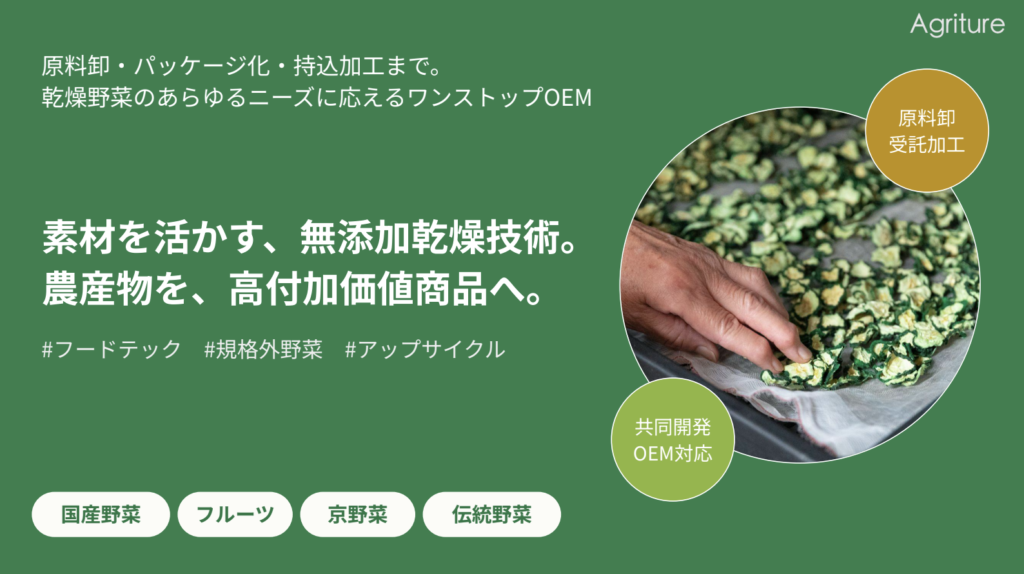
- OEM available from small lots of 10 kg
- Drying of brought-in raw materials also possible
- Support from processing to filling in one place
TOC
What is Kujo negi|varieties, growing regions, certification
Kujo green onion (Kujo negi, English: Kujo negi) is a type of green onion long cultivated in Kyoto. Originating in the Kujo area of Minami Ward, Kyoto City, it is now produced across the whole of Kyoto Prefecture, including Kyoto City, Kyotango, Ayabe, and Nantan. It is distinguished by tender leaves, a characteristic sliminess, deep sweetness, and a deep green color, and in the Kansai region it has established itself as the representative condiment onion. Agriture's commercial dried Kujo negi offers Kyoto-grown Kujo negi as a product available in chip, chopped, and powder forms.
| Item | Details |
|---|---|
| Category | Amaryllidaceae, genus Allium / green onion type / leaf onion |
| Place of origin | Kujo area, Minami Ward, Kyoto City (origin) |
| Main growing region | Kyoto City, Kyotango, Ayabe, Nantan |
| Season | November–February (winter is the peak of sweetness) |
| Certification | A certified item of "Kyoto Heirloom Vegetables" and "Kyoto Brand Produce" |
| Features | Thick, tender leaf flesh / high in slimy components / deep green / strong sweetness |
Note: Among products distributed as "Kujo negi," there are also similar varieties produced outside Kyoto Prefecture. If you want to use genuine Kujo negi certified by Kyoto Prefecture, the Kyoto Brand Produce seal is the surest thing to check for.
A comparison of the three commercial Kujo negi forms
Commercial Kujo negi is distributed in three forms: fresh, frozen, and dried. The basic approach is to choose among them based on four factors: work efficiency at the cooking site, storage conditions, cost, and best-before date.
| Comparison item | Fresh | Frozen | Dried |
|---|---|---|---|
| Taste and aroma | ◎ Best | ○ | ○ |
| Texture | ◎ Crisp | ○ Slightly soft | △ Requires rehydration |
| Best-before date | 3–5 days | 6–12 months | 6–12 months |
| Storage condition | Refrigeration required | -18°C or below | Room temperature, dry |
| Cooking effort | Cutting required | Thaw → use as is | Sprinkle / rehydrate |
| Yield | 70〜80% | 100% | 100% |
| Price (per 100 g guide) | 60–120 yen | 150–250 yen | 2,000–4,000 yen |
| Suitable business types | Ryotei / izakaya | Ramen shops / boxed lunches | Instant noodles / furikake |
💡 POINT|Using the three forms
Fresh if you prioritize freshness; frozen for work efficiency and storability; dried for processed foods and shelf-stable products. Since the optimal form differs by business type, the iron rule is to choose by working backward from your purpose and inventory-management setup.
FOR BUSINESS
乾燥九条ねぎを、原料としてお探しですか
国産の九条ねぎを乾燥・粉砕してお出ししています。カット形状や粒度の指定、継続してのお取引もご相談ください。規格は Dried Kujo green onion・Kujo green onion powder に掲載しています。
少量でのご購入は、姉妹ブランドの通販サイト OYAOYA で承っています。
Quick-reference guide by business type
The recommended Kujo negi form differs clearly by the business type of restaurants and food manufacturers. Because the lead time from order to delivery, shipping lots, and best-before date requirements also differ by business type, check the quick-reference table below.
| Business type | Recommended form | Reason for choosing |
|---|---|---|
| Ramen shops / udon shops | Frozen or dried | Reduced prep, avoided waste loss, stable year-round supply |
| Izakaya / Japanese restaurants | Fresh | Freshness and texture are vital as a condiment and garnish for sashimi |
| Ryotei / high-end restaurants | Fresh (direct from contracted farms) | Fixing the variety and growing region, appealing to Kyoto Brand Produce |
| Boxed-lunch / prepared-food factories | Frozen | Mass processing, 100% yield, work efficiency |
| Instant-noodle makers | Dried (kayaku) | Long shelf-stable storage, lightweight, meets instant-noodle specs |
| Furikake / powdered soup | Dried (powder) | Zero moisture, easy formulation design, long best-before date |
| Frozen-food makers | Frozen (IQF) | Individual quick freezing makes it easy to separate |
Using dried Kujo negi by particle size
With dried Kujo negi, the products you can make change with the particle size (cut shape). By specifying the particle size when ordering, we can deliver a raw material that fits your product design.
| Particle size | Size guide | Main use |
|---|---|---|
| Chopped (cut) | 3〜5mm | Instant-noodle kayaku, soup ingredients, toppings |
| Minced | 1〜3mm | Furikake, gyoza filling, hamburger steak |
| Powder | 100–200 mesh | Senbei, potato chips, seasonings, dressings |
| Flake | Irregular shape | Adding color and aroma to processed foods |
Five points for not failing at commercial procurement
To avoid failing at commercial Kujo negi procurement, the basic approach is to check not just price but the five items: growing region, best-before date, shipping lot, delivery lead time, and certification.
| Item to confirm | What to check |
|---|---|
| Growing region / domestic confirmation | Confirm whether it is Kyoto-grown or domestic. Overseas or other-prefecture products are sometimes labeled "Kujo negi" |
| Best-before date | As a guide, fresh 3–5 days / frozen 6–12 months / dried 6–12 months. Also confirm whether it is based on the production date |
| Shipping lot / minimum unit | Whether small lots (from 1 kg) are supported, or only large orders (10 kg or more) |
| Order lead time | Fresh 1–2 times a week; frozen and dried same day to a few days depending on stock. Large fluctuations in season |
| Certification / documents | Confirm the Kyoto Brand Produce seal, residual pesticide test results, and HACCP compliance |
Differences from similar onions (banno negi, ao negi, konegi)
There are several green-onion-type varieties easily confused with "Kujo negi." To avoid trouble in product labeling and raw material specs, you need to understand the differences.
| Variety | Main growing region | Features |
|---|---|---|
| Kujo green onion | Kyoto Prefecture | Thick leaves and strong sweetness / high sliminess / deep green / Kyoto Prefecture certified |
| Banno negi | Asakura City, Fukuoka Prefecture (JA Town registered trademark) | Slender with mild pungency / a selected line of Kujo negi |
| Yakko negi | Kochi Prefecture | Young-harvested green onion / slender and tender |
| Konegi | Various regions | A general term for green onion / slender and young-harvested |
| Leaf onion (general) | Nationwide | A classification name for green onions in general |
If you want to use "genuine Kyoto-grown Kujo negi,"Kyoto Brand Produce—specifying lots with the seal is the surest way.
We have materials available to help you understand dried processing OEM
Agriture OEM, flexibly handling everything from small lots to large lots
- OEM available from small lots of 10 kg
- Drying of brought-in raw materials also possible
- Support from processing to filling in one place
Product development ideas using Kujo negi
Kujo negi is a rare raw material that combines all four elements: Kyoto character, sense of the ingredient, color, and aroma. Beyond a mere condiment, it can be used in product development that appeals to the Kyoto brand. In particular, dried and powder forms make it easier to design sales channels thanks to ambient distribution and a long best-before date.
Kyoto-style Kujo negi product ideas
| Category | Product idea | Recommended raw material |
|---|---|---|
| Furikake / mixed-rice seasoning | Kujo negi salt furikake / Kujo negi × chirimen / Kujo negi and egg soboro furikake | Dried minced / powder |
| Senbei / rice crackers | Kujo negi salt senbei / Kujo negi soy-sauce okaki / fried mochi Kujo negi flavor | Powder / flake |
| Potato chips / snacks | Kujo negi salt potato chips / Kujo negi × bonito-flavored snack | Powder |
| Shichimi / condiment seasonings | Kyoto shichimi (with Kujo negi) / Kujo negi salt / Kujo negi dressing | Powder / minced |
| Instant soup / instant noodles | Kujo negi clear soup / Kujo negi soup / Kujo negi ramen | Dried cut |
| Bread / baked goods | Kujo negi bread / Kujo negi salt roll / Kujo negi crackers | Powder |
| Kyoto souvenirs / gifts | Kyoto condiment set / Kujo negi tsukudani / Kujo negi × matcha granola | Dried / powder |
In particular, "furikake," "senbei," and "shichimi" are categories where the aroma and color of dried Kujo negi translate directly into product value. If you can clearly state "made with Kyoto-grown Kujo negi" on the package, you can also expand into high-value channels such as Kyoto souvenirs, tourism products, and furusato tax donations.
💡 Product development POINT
To differentiate with Kujo negi products, it is effective to appeal with numbers—"made with ○○ g of Kyoto-grown"—and to use Kyoto-style packaging (Japanese patterns, Kyoto place names, artisanal typefaces). Since the dried Kujo negi raw material can be prototyped in 100 g units, it is a category where market testing via small-lot OEM is easy.
Agriture's dried Kujo negi
At Agriture, we handle Kyoto-grown Kujo negi processed by low-temperature drying at 45°C Dried Kujo green onion We offer. Particle size can be chosen from chopped, minced, powder, and flake, and we also support small-lot prototyping from 100 g. We process Kujo negi sourced from our contracted farm Echie Nosan at our manufacturing base in Kyotango.
| Item | Details |
|---|---|
| Growing region | Kyoto Prefecture (direct from contracted farms) |
| Processing conditions | Low-temperature drying at 45°C (preserves color and aroma) |
| Particle size | Chopped / minced / powder / flake |
| Minimum lot | Prototyping supported from 100 g |
| Best-before date | 6–12 months from the production date |
| Applicable projects | Instant noodles, furikake, soup, senbei, gift products, and more |
If you are looking for genuine Kyoto-grown Kujo negi raw material, Agriture's wholesale / OEM information.
FOR BUSINESS
乾燥九条ねぎを、原料としてお探しですか
国産の九条ねぎを乾燥・粉砕してお出ししています。カット形状や粒度の指定、継続してのお取引もご相談ください。規格は Dried Kujo green onion・Kujo green onion powder に掲載しています。
少量でのご購入は、姉妹ブランドの通販サイト OYAOYA で承っています。
FAQ about commercial Kujo negi
How do Kujo negi and banno negi differ?
Kujo negi is a heirloom vegetable originating in Kyoto Prefecture, distinguished by thick leaves and strong sweetness and sliminess. Banno negi is a registered trademark of Asakura City, Fukuoka Prefecture, a slender variety selected from Kujo negi. Both are green-onion types, but their texture and flavor differ.
What is the minimum commercial lot?
Fresh from 1 kg, frozen from 5 kg, and some suppliers can prototype dried from 100 g. Agriture's dried Kujo negi is supported from 100 g.
Are "Kyoto-grown" and "Kujo negi" synonymous?
Strictly speaking, they are different. Kujo negi is the variety name; Kyoto-grown is the growing region. Since the Kujo negi variety can be cultivated outside Kyoto Prefecture too, confirming the growing region is important. Items certified as "Kyoto Brand Produce" meet the condition of being Kyoto-grown.
What are the conditions for writing "made with Kyoto-grown Kujo negi" on the product package?
If you use Kyoto-grown Kujo negi as a raw material, labeling based on the fact of use is possible. However, if you claim "Kyoto Brand Produce" certification, you must meet Kyoto Prefecture's standards.
Where is Agriture's dried Kujo negi product page?
Agriture's commercial dried Kujo negi can be viewed on the commercial dried Kujo negi product page. It is Kyoto-grown, supports small-lot prototyping from 100 g, is available in chip/chopped/powder forms, and supports catalog downloads.
Summary|Choose commercial Kujo negi by working backward from your purpose
Three-line summary
- Choose among the three forms—fresh, frozen, and dried—by business type, work efficiency, and storability
- Dried and powder are best for Kyoto-style product development such as furikake, senbei, and shichimi
- If you claim Kyoto-grown, Kyoto Brand Produce certification and growing-region confirmation are essential
Commercial Kujo negi is distributed in three forms: The optimal form changes depending on whether you use it in cooking or incorporate it into processed foods. The dried form stores at room temperature for 6–12 months and can be used in Kyoto-style product development such as furikake, senbei, and shichimi. Agriture's commercial dried Kujo negi is Kyoto-grown and low-temperature dried, and a product catalog is also available. Agriture's dried Kujo negi is Kyoto-grown, low-temperature dried, and prototyped from 100 g, supporting everything from product development to mass production.
Download the OEM contract processing materials
We will send the materials to your email address based on the information you provide.
Recommended reading
→ Commercial dried Kujo negi|Agriture's product page
→ Creating a regional brand with a Kyoto-vegetable OEM | The complete flow from planning to sales
→ Heirloom vegetable OEM | A commercialization case guide using Kyoto vegetables and local ingredients
→ Kyoto ingredient processing OEM | How to make the most of Kyoto vegetables and quality control
→ Kyoto-style food development | Gift-oriented product development OEM using Kyoto vegetables
If you are considering product development with off-spec or your own farm's vegetables:From planning to processing, materials, package printing and novelties, you can consult us through a single point of contact. → Learn more about one-stop product development
- Dried Kujo green onion powder | Usage ideas and how to choose it as a food OEM raw material
- How to source commercial vegetable powder in small lots, and how to use it
Author of this article
Related articles
-
 Original coffee marketing strategy | Ways to grow sales
 -
 ベジタリアンとは?国の規格が分けている4つの区分と食べられないもの
 -
 長ねぎと白ねぎは同じもの?ねぎの種類と呼び名を国の資料で確かめる
 -
 柚子の種類は何種類あるのか、公の資料で名前が残る系統を数えた
 -
 ゆずの時期は年に二度、青ゆずは7月から黄ゆずは10月から
 -
 ゆずの産地は高知が半分を占め、二位は徳島から愛媛に変わった
 -
 Preventing Food OEM Failures: Common Failure Cases and Countermeasures for Success
 -
 How to find a food OEM | How to efficiently find the best manufacturing partner