
Kyoto-style food development | Gift-oriented product development OEM using Kyoto vegetables
Tea
Gifts & novelties
Novelties
Kyoto vegetables
Heirloom vegetables
Food OEM
Product development
Non-standard vegetables

Summary of this article
A practical guide to Kyoto-style food-product-development OEM. It organizes how to create gift products that make use of Kyoto vegetables—Kujo negi, Shogoin daikon, Kamo eggplant, Manganji chili—plus the pickles, tsukudani, Kyoto sweets, and dashi that Kyoto's food culture has nurtured. It covers seven categories, product variations by 10 kinds of Kyoto vegetables, gift design by occasion (Ochugen, Oseibo, celebrations, tourist souvenirs, corporate, overseas), packaging that evokes Kyoto using washi, mizuhiki, foil stamping, and brush lettering, use of Kyoto brand certifications, and leading Kyoto OEM companies.
Gift-food OEM using Kyoto ingredients is a field where you can add to a product the "Kyoto brand" value that product development elsewhere can't deliver. Kujo green onion・Shogoin daikon・Kamo eggplant・Manganji togarashi Alongside Kyoto vegetables such as pickles, tsukudani, Kyoto sweets, and dashi—all nurtured by Kyoto's food culture—the combinations of ingredient and processing let you create endless variations.
In this article, We organize the practical side of developing gift products that make use of Kyoto ingredients: the seven categories of Kyoto gift-food OEM, Kyoto vegetables product variations by type, gift design by occasion, packaging that evokes Kyoto, Kyoto brand certifications, and leading Kyoto OEM companies. It is information you can also use for catalog gifts, ryokan tea sweets, tourist souvenirs, and product planning for specialty shops.
What you'll learn in this article
- The seven categories of Kyoto gift-food OEM (pickles / tsukudani / Kyoto sweets / dashi, etc.)
- Concrete product variations by 10 kinds of Kyoto vegetables
- Gift design by occasion (Ochugen / Oseibo / tourism / overseas)
- Packaging that evokes Kyoto (washi, mizuhiki, foil)
- How to use Kyoto brand certifications
- Leading Kyoto OEM companies

We have materials available to help you understand dried processing OEM
Agriture OEM, flexibly handling everything from small lots to large lots
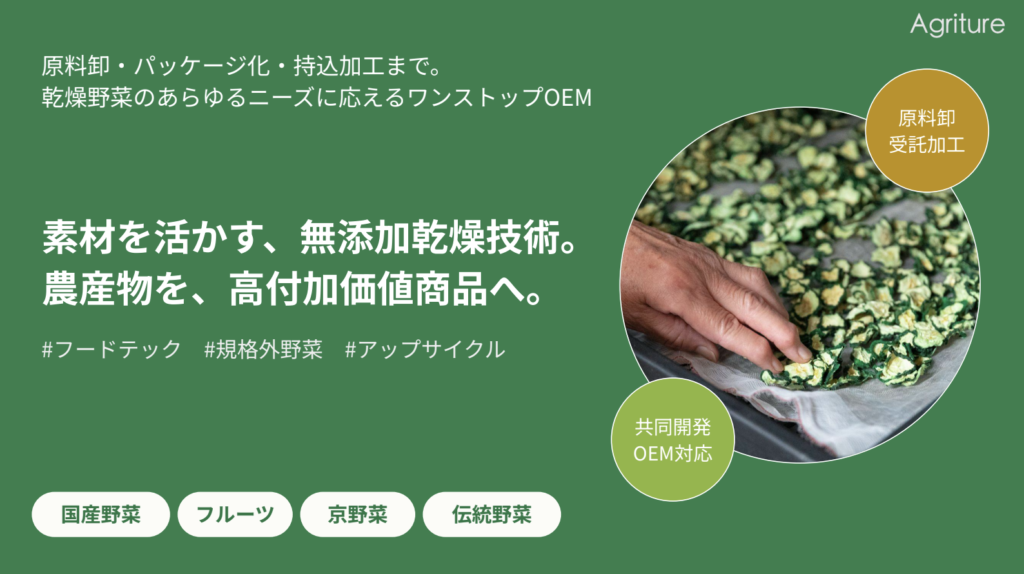
- OEM available from small lots of 10 kg
- Drying of brought-in raw materials also possible
- Support from processing to filling in one place
TOC
The seven categories of Kyoto gift foods
Gift foods using Kyoto ingredients can be developed mainly across seven categories. Pickles, tsukudani, Kyoto sweets, and dashi are staples of Kyoto food gifts, with steady demand for catalog gifts and products for ryokan and specialty shops. Dried vegetables, furikake, and rice crackers are areas that have grown in recent years.
| Category | Product example | Best-before date | Suited sales channel |
|---|---|---|---|
| Pickles | Senmaizuke / shibazuke / suguki / Kyoto-vegetable pickles | 1 to 3 months (refrigeration required) | Kyoto gift staple, department stores |
| Tsukudani / chirimen | Chirimen sansho / Manganji chili tsukudani / Kamo eggplant dengaku | 4 to 6 months | Premium gifts, corporate, ryokan |
| Kyoto sweets / wagashi | Yatsuhashi / kintoki-carrot wagashi / beetroot yokan / Kyoto-vegetable cookies | 1–3 months | Tourist souvenirs, gift specialty shops |
| Dashi and seasonings | Kyoto dashi / ponzu / Kyoto-vegetable dressing / ichimi | 6–12 months | Catalog gifts, EC |
| Furikake / ochazuke | Kyoto-vegetable furikake / mizuna ochazuke / chirimen mixed-rice base | 6–12 months | Room-temperature gifts, EC |
| Rice crackers / snacks | Kujo negi rice crackers / Manganji chili chips / Kyoto-vegetable arare | 4 to 6 months | Tourist souvenirs, tea sweets |
| Dried vegetables, powder | Kyoto-vegetable dried mix / Kujo negi powder / Shogoin powder | 12–18 months | Commercial, culinary gifts |
Product variations by Kyoto vegetable
Kyoto vegetables have different character by variety, so you can design gift products that make the most of each one's features. We have organized representative product examples for 10 main kinds.
| Kyoto vegetables | Features | Product example |
|---|---|---|
| Kujo green onion | Aroma, sweetness, and the green of its color | Kujo-negi rice crackers / Kyoto ramen / negi miso / negi-powder cookies |
| Shogoin daikon | Faint sweetness, fine-grained flesh | Shogoin daikon jam / pickles / soup / dried chips |
| Kamo eggplant | Round, meaty, and holds up to simmering | Kamo eggplant dengaku / jam / curry / frozen prepared dishes |
| Manganji togarashi | Large, sweet, with no pungency | Tsukudani / chips / rice topping / dressing |
| Kintoki carrot | Deep red color, sweetness | Carrot cake / jam / juice / smoothie ingredient |
| Mizuna (Mibuna) | Crisp texture | Mizuna furikake / ochazuke / dried vegetables |
| Kyoto bamboo shoots | Tender, refined flavor | Bamboo-shoot tsukudani / clear soup / takikomi-gohan base |
| Fushimi togarashi | Long and slender, no pungency, aromatic | Sesame-oil pickle / tsukudani / ichimi chili |
| Ebi-imo | Rich, sticky texture | Croquettes / sweets ingredient / frozen prepared dishes |
| Shishigatani kabocha | Gourd-shaped, fluffy and starchy | Kabocha pudding / soup / pound cake |
For example, Kujo green onion is characterized by aroma, sweetness, and a vivid green, and can be developed into a wide range of products—rice crackers, ramen, powder cookies, and more. Manganji togarashi has no pungency and is sweet, making a gift that children and adults alike can enjoy as tsukudani or a rice topping. Kamo eggplant makes the most of its meaty flesh that holds up to simmering, finishing as a high-value-added gift as a jam or dengaku ingredient.
FOR BUSINESS
乾燥野菜のOEM・受託加工を承ります
国産の野菜・果物の乾燥、100メッシュ相当までの粉砕、10g以上の小袋充填までをお受けしています。小ロットの試作から量産までご相談ください。寄せられた相談の実例は OEM・卸のご相談 に掲載しています。
乾燥品の賞味期限は、出荷日から6ヶ月程度を目安にご案内しています。
Gift design by occasion
For Kyoto-vegetable gifts, the best product changes with the gifting occasion. Ochugen calls for refreshing summer vegetables, Oseibo for warming winter vegetables, and tourist souvenirs for long-keeping rice-cracker types—sorting products by season and use makes repeat purchases more likely.
| Scenario | Recommended products | Price-range guide |
|---|---|---|
| Ochugen, summer | Manganji chili tsukudani / mizuna ochazuke / Kyoto-vegetable pickles | ¥3,000–5,000 |
| Oseibo, winter | Shogoin daikon jam / Kyoto-vegetable bouillon / Shishigatani kabocha pudding | 4,000–8,000 yen |
| Celebration gifts, happy occasions | Kyoto-vegetable furikake assortment / Kujo negi cookie box | 2,000–4,000 yen |
| Tourist souvenir | Kujo negi rice crackers / kintoki-carrot chips / Fushimi chili sesame oil | 800 to 2,000 yen |
| Corporate, anniversary | Kyoto-vegetable gift set (assortment of 3 to 5 kinds) | 5,000–15,000 yen |
| Overseas gifts | Dried-vegetable pack / Kyoto-vegetable powder | 3,000 to 8,000 yen |
Packaging that evokes Kyoto
For Kyoto-vegetable gifts, Evoking Kyoto in the packaging can multiply the value of the contents. Using traditional Kyoto motifs—washi, mizuhiki, foil stamping, brush lettering—makes a product more likely to be chosen for gifting.
| Element | Presentation method | Budget guide |
|---|---|---|
| Washi label | Handmade washi, hand-dyed label | 50 to 200 yen per sheet |
| Mizuhiki | Red-and-white, gold-and-silver, colored | 50 to 300 yen per cord |
| Foil stamping | Text or family crest in gold or silver foil | Plate cost 50,000 to 150,000 yen + per-lot |
| Brush lettering | Handwritten style, calligrapher-supervised | Plate cost 30,000 to 100,000 yen |
| Wooden box / paulownia box | For premium gifts | 500 to 3,000 yen each |
| Furoshiki wrapping | Traditional pattern, original dye | 500 to 2,000 yen per cloth |
For small lots, washi label + mizuhiki is the most cost-efficient combination, expressing a Kyoto feel even for petit gifts. For premium gifts, wooden box, foil stamping, and furoshiki wrapping can be combined to design a product that feels right even above the 10,000-yen price range.
We have materials available to help you understand dried processing OEM
Agriture OEM, flexibly handling everything from small lots to large lots
- OEM available from small lots of 10 kg
- Drying of brought-in raw materials also possible
- Support from processing to filling in one place
Using Kyoto brand certifications
For products using Kyoto vegetables, Kyoto brand certifications greatly boost credibility and pricing appeal. Because the conditions and application steps differ by certification, checking whether you can obtain it at the planning stage widens your sales channels.
| Certification | Audience | Overview |
|---|---|---|
| Kyoto Heirloom Vegetables | 41 heirloom vegetable varieties | A certification system set by Kyoto Prefecture |
| Kyoto Brand Produce | Items designated by Kyoto Prefecture and Kyoto City | Prefectural brand-strategy certification |
| Traditional Kyoto foods | Pickles, tofu, yuba, nama-fu, etc. | Traditional foods registered by Kyoto Prefecture |
| Kyoto-grown ingredient labeling | Uses Kyoto-Prefecture-grown ingredients | Ensuring ingredient traceability |
Obtaining certification the origin, variety, and use ratio of the ingredients requires proof of these. Because using Kyoto-grown ingredients above a certain ratio is a condition, it is practical to check whether an OEM maker has "a track record of sourcing Kyoto-grown ingredients" when selecting one.
The flow of Kyoto-vegetable OEM
The basic flow of Kyoto-vegetable gift OEM is the four stages of concept → ingredients → prototype → production. Because some Kyoto vegetables have a limited season, aligning the order timing with the harvest period matters.
| Step | Main work | Period guide |
|---|---|---|
| Concept design | Selecting the Kyoto vegetable, target, and price range | 2–3 weeks |
| Securing ingredients | Securing a sourcing route for Kyoto-grown ingredients | 1–2 months |
| Prototyping and adjustment | Verifying taste, color, texture, and best-before date | 1–2 months |
| Package design | Washi, mizuhiki, foil, brush lettering | 1–2 months |
| Production and delivery | Manufacturing, inspection, shipping | 1–2 months |
When using seasonal Kyoto vegetables, start product planning half a year before the harvest period to be safe. Kujo negi is in season in winter (November to March), Manganji chili in summer (June to September), and Kamo eggplant in summer (July to September); outside the season, you fall back on substitute ingredients from other regions and risk no longer being able to call them "Kyoto vegetables."
Leading Kyoto OEM companies
As places to consult about food OEM using Kyoto vegetables, we introduce Food OEM Directory the Kyoto and Kansai-area companies listed. Compare and consider companies that fit your concept, based on their track record of sourcing Kyoto-grown ingredients, small-lot capability, and certification support.
| Company name | Area of strength |
|---|---|
| Agriture Inc. | Dried vegetables, Kyoto-vegetable powder, Kyotango |
| Kyoto Katsuobushi Co., Ltd. | Kyoto dashi, kyo-dashi, dried goods |
| Kyotango City Food Processing Support Center | Kyotango-grown ingredients, processing support |
| Nikka Foods Co., Ltd. | Kyoto vegetables, tsukudani, prepared dishes |
| Eguchi Seika Co., Ltd. | Kyoto confectionery, cookies, baked sweets |
| Genten Honten Co., Ltd. | Kyoto sweets, wagashi |
All Kansai-area OEM companies are on the Food OEM Portal "Kansai" list.
FOR BUSINESS
乾燥野菜のOEM・受託加工を承ります
国産の野菜・果物の乾燥、100メッシュ相当までの粉砕、10g以上の小袋充填までをお受けしています。小ロットの試作から量産までご相談ください。寄せられた相談の実例は OEM・卸のご相談 に掲載しています。
乾燥品の賞味期限は、出荷日から6ヶ月程度を目安にご案内しています。
Kyoto-vegetable gift OEM summary
Food OEM using Kyoto vegetables lets you create endless variations with combinations of 6 categories x 10 kinds of Kyoto vegetables. As with Kujo-negi rice crackers, Shogoin daikon jam, Kamo eggplant dengaku, and kintoki-carrot cake, just putting the variety's character in the product name establishes differentiation.
Line up the best products by occasion, and with Kyoto brand certification plus washi, mizuhiki, and foil packaging evoke a Kyoto feel to add value that gift OEM from other regions can't offer. When using seasonal Kyoto vegetables, start planning half a year before the harvest period and choose an OEM maker with a track record of sourcing Kyoto-grown ingredients—that is the practical approach.
Download the OEM contract processing materials
We will send the materials to your email address based on the information you provide.
Recommended reading
Kyoto ingredient-processing OEM
Kyoto-vegetable commercialization OEM
If you are considering product development with off-spec or your own farm's vegetables:From planning to processing, materials, package printing and novelties, you can consult us through a single point of contact. → Learn more about one-stop product development
- 柚子の種類は何種類あるのか、公の資料で名前が残る系統を数えた
- Creating a regional brand with a Kyoto-vegetable OEM | The complete flow from planning to sales
Author of this article
Related articles
-
 Original coffee marketing strategy | Ways to grow sales
 -
 ベジタリアンとは?国の規格が分けている4つの区分と食べられないもの
 -
 長ねぎと白ねぎは同じもの?ねぎの種類と呼び名を国の資料で確かめる
 -
 柚子の種類は何種類あるのか、公の資料で名前が残る系統を数えた
 -
 ゆずの時期は年に二度、青ゆずは7月から黄ゆずは10月から
 -
 ゆずの産地は高知が半分を占め、二位は徳島から愛媛に変わった
 -
 Preventing Food OEM Failures: Common Failure Cases and Countermeasures for Success
 -
 How to find a food OEM | How to efficiently find the best manufacturing partner