
Are naga-negi and shiro-negi the same thing? Checking the kinds and names of negi against national records

Summary of this article
Naganegi, shironegi, and fukanegi all refer to the same thing; konegi is negi harvested young, and only wakegi stands as a separate crop. Using the pesticide-registration crop classification table, the Standard Tables of Food Composition in Japan, and the variety registration database, we organized the names of negi, and compiled the three lineages—the Senju group, the Kaga group, and the Kujo group—the backing of brand negi including 3 GI registrations, and the growing regions and seasons of availability.
At the negi aisle you'll find naganegi, shiro-negi, nebuka-negi, ao-negi, ha-negi, ko-negi, banno-negi, Wakegi, and asatsuki—only the names keep multiplying. That's because words pointing to the same thing and words pointing to an entirely different crop sit side by side on the same shelf.
This article sorts out the names using public materials, not guesswork. What it uses are the crop classification table used in pesticide registration, crop classification table, and the Ministry of Education, Culture, Sports, Science and Technology's Standard Tables of Food Composition in Japan, the Ministry of Agriculture, Forestry and Fisheries'variety registration database、Crop Statistics Survey and Survey on the Production of Local Specialty Vegetables, and the list of products registered as geographical indications (GI). Once you see that each system draws the line for "negi" differently, the discrepancies among the store names untangle as well.
In the second half, we cover what backs up branded negi, growing regions and availability, how to choose by dish, and—for commercial use—Dried product the judgment of when to use it.
TOC
Do naganegi, shironegi, and fukanegi refer to the same negi?
To state the conclusion first, these three are names for the same vegetable. What differs is only the setting in which each word is used, not a botanical distinction.
In the national food classification, "fukanegi" is the formal name
The Standard Tables of Food Composition in Japan, published by the Ministry of Education, Culture, Sports, Science and Technology, places a category called 'negi group' within vegetables. Listed there are 'nebuka-negi, leaf, blanched,' 'ha-negi, leaf,' 'Kujo green onion leaf,' 'konegi, leaf,' 'menegi, leaf'—five in all.
In other words, the way the state writes it when organizing it as food is fukanegi and hanegi, not naganegi or shironegi. The food names "naganegi," "shironegi," and "aonegi" do not appear even once in this table. The fact that the words you see most often in stores are words that do not exist in the official classification is the starting point of the confusion.
The "fuka" in fukanegi does not mean that the roots are deep; it comes from the way the whitened part is buried deep in the soil. The white part you eat is not the root but the leaf sheath (yosho), formed by many leaves wrapped and layered together. The negi's roots spread out like whiskers below it.
Why "naganegi" and "shironegi" are used differently in stores
"Naganegi" is a store word that simply describes how it looks when bundled. The form—leaves trimmed off and the white part left long—is literally long, hence the name.
"Shironegi" is a word that names it on the premise of eating that white part. In western Japan, aonegi is the everyday choice, so there was a need to call this one shironegi to distinguish it. Conversely, in eastern Japan, where negi usually means fukanegi, it gets by as simply "negi" or "naganegi" without bothering to add "shiro."
The same product is labeled shiro-negi at shops in its growing region, naganegi at mass retailers in Tokyo, Specification sheet and sometimes written nebuka-negi in it. When specifications don't match in back-and-forth, it's settled faster by checking the 'length of the blanched section' and 'where the leaves are cut' rather than the name.
Aonegi, hanegi, and konegi also refer to a single crop
Negi whose green leaves are also eaten are written "hanegi" in the composition tables. In stores they are called aonegi, and in the Kansai region this is the default for negi. Those harvested while thin and young are "konegi," which are also placed within the negi group of the composition tables.
Those picked at the stage when the seed has just sprouted are "menegi," used as sushi toppings and as a garnish for soups. The composition tables also list this menegi as a member of the negi group.
All the names up to this point are differences in how the same single crop is grown and when it is harvested. When you are unsure from appearance, there are just three places to check: whether the base is swollen, how many stalks the plant splits into, and whether the leaf cross-section is a hollow round tube. Fukanegi and hanegi both have a base that does not swell, and their leaf cross-section is a hollow tube. If the base is swollen like a small bulb, it is likely not negi but wakegi or asatsuki.
The following table lays out where the everyday names are positioned within the public materials.
| Name | In the food composition tables Positioning | crop classification table how it is treated | Main situations where it is used |
|---|---|---|---|
| Long negi | Not listed | Falls under “negi” | Retail sales floor Everyday term in eastern Japan |
| white green onion, | Not listed | Falls under “negi” | Sales floors in western Japan Common name in growing regions |
| fukanegi | Listed in the 〈negi group〉 | Falls under “negi” | Spec sheets and statistics School education |
| Green scallion | Not listed | Falls under “negi” | Sales floors in western Japan Restaurants |
| hanegi | Listed in the 〈negi group〉 | Falls under “negi” | Spec sheets and growing regions |
| Konegi (ko-negi) | In the 〈negi group〉, listed as “ko-negi” | No separate category | Retail as a condiment Commercial/foodservice spec |
| Thin negi | Not listed | No separate category | Retail sales floor |
| Banno negi | Not listed | No separate category | Of a growing-region brand Product name |
| Me-negi | Listed in the 〈negi group〉 | No separate category | Sushi and Japanese cuisine |
| Wakegi | Listed separately | As “wakegi” A different crop | Sales floors in western Japan Especially Hiroshima |
| Wakenegi | Not listed | Example of an alternate name for “negi” explicitly stated in | Growing regions and seeds/seedlings |
| Asatsuki | Listed separately | As “asatsuki” A different crop | Wild vegetables and condiments |
| Chives | Not listed | As “chives” A different crop | Herb section |
| Leek | Listed separately | Example of an alternate name for “negi” explicitly stated in | Western cuisine and imported goods |
How negi with long white sections are grown
The white part of white negi is not white because it is a white variety. It is the result of mounding soil during cultivation so that light does not reach it. Even when grown from the same seed, it becomes a green leaf negi if no soil is mounded.
Blanching cultivation that mounds soil to block out light
Seedlings are planted in furrows, and soil is mounded repeatedly as they grow. Because light does not reach the leaf sheaths buried in the soil, no chlorophyll is produced and they grow up white. This work is called blanching (nanpaku), and the term “blanched section” is also used in the descriptions of negi registered as geographical indications.
With soil mounding, piling on too much at once stops growth, while too little keeps the white section from lengthening. How many times to divide the work and to what height to mound has become region-specific expertise, and the differences in the length and thickness of the blanched section arise from this.
Why bent negi are bent
According to the official website of Miyagi Prefecture, Sendai's bent negi is said to have first been cultivated in the Amarume district of Iwakiri, Miyagino Ward, Sendai City. Because this area along the Nanakita River had a high groundwater table and poor drainage, it was land where deep-planted negi, which are planted deep, easily suffered root rot.
So in 1909, at the end of the Meiji era, Mr. Hajime Nagano of the Amarume district devised a method called “yatoi.” In it, partly grown negi are pulled up once, laid down and replanted in a diagonally dug furrow, and covered with soil. Because the roots do not extend deep, root rot can be avoided, and because the negi try to rise toward the sun, they take on a bow-like shape.
Niisato negi and Akutsu bent negi, which are registered as geographical indications, also register the curved shape of the blanched section as a characteristic. The bend is not a failure but the form left behind by a cultivation method adapted to local conditions.
Even in the same field, changing the harvest timing produces a different product. Leaf negi are shipped as small negi (ko-negi) when harvested young, and shipped as leaf negi when left to grow as they are. Sprout negi (me-negi) is an even earlier stage. From the buyer's side these are different products, but as a crop they are simply the same thing stopped partway.
Because this “where to stop” has become the spec, the spec sheets for ko-negi describe length and number of stalks in detail. When they are sent for drying or freezing as well, the finished appearance is influenced more by harvest timing than by variety.
Are wakegi, asatsuki, and leek different crops from negi?
This is where naming conventions diverge most. Depending on the source, explanations vary—“wakegi is a hybrid of negi and onion,” “asatsuki is a type of negi”—but the national systems each draw a clear line in their own way.
In the crop classification for pesticide registration, “negi,” “wakegi,” and “asatsuki” stand separately
To decide which crops a pesticide may be used on, the Food and Agricultural Materials Inspection Center publishes a crop classification table. In the April 1, 2024 edition of this table, within the vegetable category there is a mid-level category called bulb crops, and further a sub-category called bulb crops (leafy) is placed within it.
Lined up in that sub-category are asatsuki, gyoja garlic, chives, nira (garlic chives), negi, and wakegi. Asatsuki, chives, and wakegi stand as crop names separate from negi。Even within the same bulb crops, rakkyo, garlic, and onion are placed under bulb crops (root), divided by the part that is harvested.
The way the remarks column is written also differs. For negi it is “harvested for stems and leaves,” and for wakegi it is “harvested for leaves and bulbs.” This means wakegi is defined on the premise that even the swollen base part is eaten.
“Wakenegi” is included in negi, not in wakegi
In the same table, the examples given as alternative names for 'negi' are Kujo-negi, Kaga-futo-negi, Senju-negi, yagura-negi, Shimonita negi, leek, and Wakenegi, contained in burdock and cocoa.
Wakegi and wakenegi differ by only one character, but their treatment is the exact opposite. Wakegi is set up as an independent crop name, while wakenegi is treated as an alternate name for negi. Whether something labeled “wakegi” on the sales floor is really wakegi, or a leaf negi that splits into many shoots, changes with this single character.
The clue for telling them apart is the base. Wakegi swells into a small ball-like shape at the base and multiplies its clumps with this bulb. Wakenegi is a member of the leaf negi family that multiplies by seed, so its base does not swell and extends straight down.
National statistics also count “wakegi” with “wakenegi” excluded
The Ministry of Agriculture, Forestry and Fisheries' survey on the production of regional specialty vegetables is a survey that, once every two years, has prefectures nationwide report planted area and harvest volume. The “wakegi” column of this questionnaire carries a clear note. It states that “wakegi” excludes “wakenegi.”
Because the two get mixed up even in the field where statistics are gathered, a note is deliberately placed to draw the line. From this one line, you can read that the confusion of names is not a consumer misunderstanding but an old problem that the system side, too, has felt it necessary to address.
In the world of plant variety registration, the “negi species” and the “wakegi species” are different types
In the Ministry of Agriculture, Forestry and Fisheries' plant variety registration database, you select the “type of agricultural/forestry plant” when applying. Japanese names and scientific names are registered here in pairs: the negi species is Allium fistulosum L., and the wakegi species is Allium x proliferum. The registration framework itself is divided as different types。
Looking at the actual registrations, there are not many varieties registered as the wakegi species. They are Saga Prefecture's “Saga Otome,” the “Hiroshima No. 12” and “Hiroshima No. 13” jointly registered by Hiroshima Prefecture and the National Federation of Agricultural Cooperative Associations, and “NB304,” registered by a seed company in May 2026. In addition, Saga Prefecture's “Sagayutaka” is registered as a variety crossing the wakegi species with the negi species. The wakegi species and the negi species are close enough for crossing to succeed, yet under the system they sit in separate frameworks.
On the other hand, not a single variety registered under the Japanese name “asatsuki” can be found in the database. Even though asatsuki is treated independently in both the crop classification table and the composition table, in the world of variety registration it is a crop with no registered varieties.
Leek is sometimes “negi” and sometimes a separate item depending on the system
Leek (poro-negi, Western negi) are listed in the crop classification table as examples of alternative names for 'negi.' For deciding how pesticides are used, this means they are treated in the same category as negi.
In the Standard Tables of Food Composition in Japan, however, leek is listed independently outside the 〈negi group〉 as “leek, bulb and leaf.” The judgment is that counting it as a separate food better matches reality.
Even for the same plant, a discrepancy arises: grouped together in pesticide registration, separated in food tabulation. When creating raw material labels and spec sheets, it is safer to first confirm which system's terms you are using.
| Crop | Pesticide registration crop classification table | Standard Tables of Food Composition in Japan | Plant variety registration “Type” |
|---|---|---|---|
| Green onion | Crop name “negi” Harvested for stems and leaves | In the 〈negi group〉, Deep-planted, leaf, Kujo Ko-negi, me-negi | Negi species Allium fistulosum L. |
| Wakegi | Crop name “wakegi” Harvested for leaves and bulbs | Listed separately | Wakegi species Allium x proliferum |
| Wakenegi | Of “negi,” an example alternate name | Not listed | Included in the negi species |
| Asatsuki | Crop name “asatsuki” | Listed separately | Registered varieties cannot be found |
| Chives | Crop name “chives” | Not listed | Registered varieties cannot be found |
| Leek | Of “negi,” an example alternate name | Listed separately | Ampeloprasum species only one registration |
| Yagura-negi | Of “negi,” an example alternate name | Not listed | Included in the negi species |
FOR BUSINESS
Looking for dried vegetables for commercial use?
We dry domestically grown vegetables and fruits, grinding them as needed, to supply them. We handle around 100 items, and specifications are List of dried products・List of powders listed at.
Small-quantity purchases are available through our sister brand's online store, OYAOYA.
We have materials available to help you understand dried processing OEM
Agriture OEM, flexibly handling everything from small lots to large lots
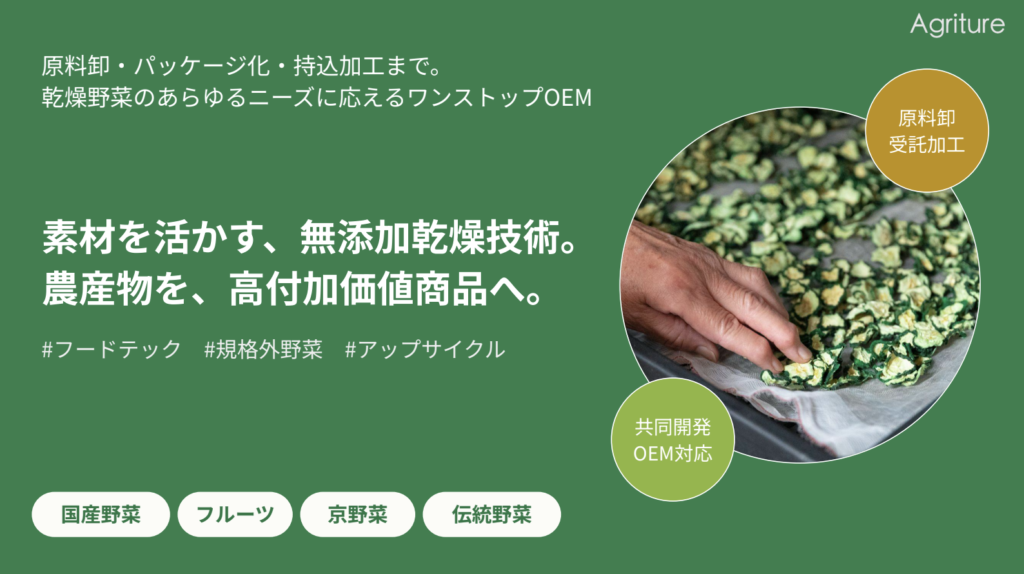
- OEM available from small lots of 10 kg
- Drying of brought-in raw materials also possible
- Support from processing to filling in one place
Which negi does “ko-negi” refer to?
“The difference between wakegi and ko-negi,” which often lines up in searches, splits into two forms of answer. That is because the relationship is asymmetric: wakegi is a separate crop, while ko-negi is a difference in how negi is grown.
There is no “ko-negi” category in the crop classification table for pesticide registration
Searching through the crop classification table, the crop name “ko-negi” does not appear. It is not even listed as an example of an alternate name for “negi.” The same goes for leaf negi and deep-planted negi; all that appears in the table is the single word “negi.”
This does not mean that ko-negi does not exist; rather, it is judged that there is no need to separate it from negi in deciding how pesticides are used—that is the point. This is decisively different from wakegi, which is given separate treatment as a crop.
In food classification, “ko-negi” is placed within the negi group
The Standard Tables of Food Composition in Japan list “ko-negi, leaf, raw,” placed in the same 〈negi group〉 as deep-planted negi and leaf negi. When counted as a food, it is treated as one form of negi.
Here too, wakegi is placed independently outside the 〈negi group〉. In the world of food tabulation as well, the line is drawn with ko-negi inside negi and wakegi outside.
“Banno negi” appears in neither the crop classification table nor the composition table. This is because it is the product name of a brand grown in a particular region, not the name of a crop or a food classification. What is lined up as banno negi on the sales floor corresponds, in classification terms, to leaf negi or ko-negi.
Where to look when telling wakegi and ko-negi apart
You cannot tell them apart by their look alone—thin and green. The three points you can check by picking them up are the following.
- If the base swells into a ball shape it is wakegi; if it is straight it is negi
- If many stalks branch out from a single clump, it is likely wakegi
- A strong sliminess when cut is common in the leaf-negi family
When shipped with the roots cut off at the store, the shape of the base cannot be seen. Look at the origin label—if it is grown in Hiroshima Prefecture, the chance that it is genuine wakegi rises. Statistically, the planted area of wakegi is heavily concentrated in Hiroshima Prefecture.
Negi divides into three groups: the Senju group, the Kaga group, and the Kujo group
Apart from the names used at stores, there is a way of dividing lineages that has been used in cultivation. The Ministry of Agriculture, Forestry and Fisheries' consumer consultation responses also explain that negi broadly divides into three groups: the Senju group, the Kaga group, and the Kujo group.
The Senju group accounts for much of the white negi on sales floors
It is cultivated widely from Hokkaido to Kyushu, and the Ministry explains that most of the white negi and long negi sold are of the Senju group. It keeps growing slowly through winter, splits into few clumps, and has thick, well-extending leaf sheaths.
The name comes from the Senju greengrocer market in Edo. The history of Fukaya negi published by Fukaya City also records that it began around 1897 (Meiji 30) when Senju red-stem negi were introduced from the Kashiwa area of Chiba Prefecture. The deep-planted negi growing regions of Kanto spread on the basis of this lineage.
The Kaga group is strong against cold and snow, and Shimonita negi is also in this family
It is a lineage suited to cultivation in cold and snowy places. As winter approaches, it stores nutrients in its underground stems and roots, and in spring it vigorously extends new leaves. In the Ministry's reply, it is clearly stated that Shimonita negi is a type of the Kaga group.
Many in the Kaga group are of a thick, short type that becomes meltingly soft when heated. As for Shimonita negi, the explainer article on Shimonita negi covers its growing region and ways to eat it in detail.
The Kujo group has many tillers and soft leaves
It is said to have come to be called the Kujo group because it was cultivated mainly in Kyoto Prefecture, and it is now grown mostly in western Japan. It splits into many clumps, has thin, soft leaves, and little pungency, so it is eaten as leaf negi.
The Standard Tables of Food Composition in Japan list “Kujo negi” as an independent food within the 〈negi group〉. There are not many examples where a regional variety name is set up as an item in food classification. For the history and lineage of Kujo negi, see the explainer article on Kujo negi.
Lineage and sales-floor names do not correspond one-to-one
It does not become a simple correspondence of Senju group = white negi, Kujo group = green negi. Asago City, Hyogo Prefecture, explains that Iwatsu negi is an intermediate type right between the deep-planted negi / Senju negi of Kanto and the Kujo-type negi of Kansai. Aichi Prefecture also introduces Koshizu negi as an intermediate type combining the characteristics of both thick negi with much white and leaf negi with much green.
Lineage is a matter of breeding and cultivation; white negi and green negi are a matter of how they are eaten and their shipping form. Because these are classifications on different layers, overlaying them always produces a contradiction somewhere.
What backs up brand negi?
The term 'branded negi' mixes at least four kinds of backing: geographical indication registration, trademarks obtained by municipalities, varieties selected by prefectures, Heirloom vegetables, and regional collective names. Which one applies completely changes the scope of what can bear the name.
Only three negi are registered as geographical indications
The geographical indication (GI) protection system is a mechanism in which the state registers and protects quality tied to a growing region. Checking through the list of registered products, the registered products whose names include negi are the following three.
- No. 35 Niisato negi (Niisato-machi, Utsunomiya City, Tochigi Prefecture / registered May 26, 2017)
- No. 59 Mito no Yawaraka negi (Mito City, Ibaraki Prefecture and others / registered February 7, 2018)
- No. 113 Akutsu bent negi (Koriyama City, Fukushima Prefecture / registered February 3, 2022)
The well-known Kujo negi, Shimonita negi, Fukaya negi, and Iwatsu negi are none of them registered as GIs. Fame and GI registration are separate matters.
The three that are registered are all deep-planted negi, and Niisato negi and Akutsu bent negi are bent negi whose blanched section curves. The registration information for Niisato negi states that it has been cultivated for over 100 years since the end of the Edo period without changing its variety or cultivation method.
There are negi whose trademarks are held by a municipality
Asago City, Hyogo Prefecture, has announced that the city obtained the trademark rights to “Iwatsu negi.” Two registration numbers are shown as standard-character trademarks, and it is explained that use of the trademark is free but requires an application. It is a form in which the city holds and manages the name of the growing region.
Asago City also sets a sales-release date and a shipping-end date. The release date is November 23, and shipping ends on March 21. By managing both the name and the time it is on the market, it is clear the city is trying to curb variation in quality.
Furthermore, on January 24, 2025, the “resource-recycling agricultural system centered on Iwatsu negi” was certified as a Japan Agricultural Heritage. It is an example where not the negi itself but the agricultural system built around the negi was recognized.
Negi included in the heirloom vegetables selected by prefectures
The definition of Kyoto heirloom vegetables published by Kyoto City was set by the Kyoto Prefecture Department of Agriculture, Forestry and Fisheries in March 1988, with five items: introduced before the Meiji era; covering the whole of Kyoto Prefecture; including bamboo shoots; excluding mushrooms and ferns; and including both varieties that are cultivated or preserved and those that have gone extinct. The only negi that falls within this framework is Kujo negi.
Aichi Prefecture selects 37 items as Aichi heirloom vegetables. There are four conditions for selection: having been cultivated around 1955 (Showa 30); originating in Aichi Prefecture, such as bearing a place name or a person's name; still having seeds or seedlings today; and being able to obtain the seeds or produce. Two negi are included: Koshizu negi and Hosshoji negi.
Koshizu negi is said to have originated in the former Koshizu area of Kamori Village, Ama District—present-day Koshizu-cho, Tsushima City—and Aichi Prefecture introduces that it was treated as a tribute item in the era of Iemitsu, the third Tokugawa shogun. For the full picture of the 37 Aichi heirloom vegetables, see the explainer article on Aichi heirloom vegetables for more.
Fukaya negi is not a variety name but a regional collective name
Fukaya City clearly states that Fukaya negi is not a variety name but a collective name for negi cultivated in the Fukaya area. It is also written that it belongs to the deep-planted negi / Senju group, and that many varieties exist. There is even a description made public that negi cultivated in the Tone River basin outside Fukaya City are also sold under the name “Fukaya negi.”
The origin of the name is also clear. When the market price of negi fell in the Taisho era, a leader of Yatsumoto Village consulted the owner of a dried-goods store, and when shipping to Shinshu, Hokuriku, Hokkaido, and Tohoku from Fukaya Station, took the station name and attached the trademark “Fukaya negi.” It is an example of a regional brand born from a railway station name.
These three—GI registration, a municipal trademark, and selection as an heirloom vegetable—differ in the conditions required and the scope they protect. In purchasing situations, it works better in practice to look at which kind of backing supports a name than at the strength of the name.
| Name | Growing region | Official backing | Features |
|---|---|---|---|
| Nissato negi | Tochigi Prefecture Nissato, Utsunomiya | GI No. 35 | Its blanched section bends into a bow shape—a bent negi |
| Mito no Yawaraka negi | Mito City, Ibaraki Prefecture Shirosato-machi and Ibaraki-machi | GI No. 59 | The blanched section is long and has little bend |
| Akutsu magari-negi | Koriyama City, Fukushima Prefecture | GI No. 113 | Since the early Showa era, cultivated in the Akutsu district |
| Iwatsu negi | Asago City, Hyogo Prefecture | Registered trademark of Asago City Japan Agricultural Heritage | Between deep-planted and the Kujo lineage, an intermediate type |
| Kujo green onion | Kyoto Prefecture | Kyoto Heirloom Vegetables Listed in the composition table | Has many tillers and soft leaves |
| Shimonita negi | Shimonita, Gunma | Listed in the crop classification table Listed as an alternate name | A type of the Kaga group Thick and short |
| Koshizu negi | Tsushima City, Aichi Prefecture Ama City and others | Aichi's heirloom vegetables | An intermediate of thick negi and leaf negi an intermediate type |
| Hosshoji negi | Okazaki City, Aichi Prefecture | Aichi's heirloom vegetables | In Owari and Mikawa, a surviving native negi |
| Fukaya green onion | Fukaya City, Saitama Prefecture Tone River basin | Fukaya City states it is a collective name | Not a variety name but a regional collective name |
| Sendai magari-negi | Sendai City, Miyagi Prefecture Iwakiri and others | Introduced by Miyagi Prefecture as an heirloom vegetable | By the yatoi method, grown into a bow shape |
| Taihaku thick negi | Sendai City, Miyagi Prefecture Taihaku Ward | Taihaku Ward publishes a definition | Taihaku Ippon Futo-negi and similar ones |
| Senju negi | All over the Kanto region | Listed in the crop classification table Listed as an alternate name | The core of the Senju group Much of the white negi on the market |
| Kaga futo-negi (thick leek) | Hokuriku | Listed in the crop classification table Listed as an alternate name | Kaga group Suited to cold regions |
We have materials available to help you understand dried processing OEM
Agriture OEM, flexibly handling everything from small lots to large lots
- OEM available from small lots of 10 kg
- Drying of brought-in raw materials also possible
- Support from processing to filling in one place
Which leek varieties do the prefectures grow?
Behind the branded leeks, another lineage is at work. These are leeks bred by prefectural experiment stations and public research institutes and submitted for variety registration. The names are plain, but a growing region's real strength shows here.
Number of leek-species registrations visible in the variety registration database
When you export the entire Ministry of Agriculture, Forestry and Fisheries variety registration database and pull out those whose agricultural/forestry plant type is the leek species, 52 are registered. Of these, 25 still have breeder's rights in force, while the rest have passed their term of protection and can be used by anyone.
Looking at other Allium crops in the same database, the onion species has the most registrations, with the leek species next. After that come the Chinese chive species and the rakkyo species. The number of registrations shows that the leek has long been a target of variety improvement.
Registered varieties bearing prefecture or place names line up
Among the breeders, prefectures and their experimental research institutes stand out. Examples include Chiba Prefecture's "Ashinaga Bijin," Kanagawa Prefecture's "Shonan Ippon," Ibaraki Prefecture's "Hitachi Benikko," Toyama Prefecture's "Ecchu Natsu Komachi" and "Ecchu Fuyu Komachi," Yamaguchi Prefecture's "YSG No. 1" and "Yamahiko," "Tokyo Komachi" bred by a Tokyo Metropolitan affiliated body, Akita Prefecture's "Akita Harukko," and Hyogo Prefecture's "Hyogo N-1."
Ibaraki Prefecture's "Hitachi Benikko" is a thick-leek variety whose registration records the exterior color of the leaf sheath as reddish. Some of what is sold as red leek at the store corresponds to such prefecture-bred registered varieties.
From public research institutes, varieties such as Negi Chukan Bohon No. 1, Yume-warabe, Fuyu-warabe, Koi-warabe, Suzu-warabe, and Natsu-moeka are registered. Those with "bohon" (parent line) in the name are registered not to be grown as is, but on the premise of being used as parents to create the next variety.
Kujo leek and Shimonita leek are not registered varieties
Even searching the entire database for the characters "Kujo," "Shimonita," "Iwatsu," "Fukaya," "Senju," and "Kaga," not a single registered Allium variety comes up. These are heirloom lineages, not registered varieties protected by breeder's rights.
Heirloom lineages are maintained by continuing to save seed in the growing region. That is exactly why subtle differences remain from region to region, and even the same Kujo leek varies slightly in thickness and color depending on the seed supplier or the farmer. Instead of the uniform shape of a registered variety, an heirloom lineage shows the character of its growing region directly.
| Variety name | Registrant | Year of registration | Notes |
|---|---|---|---|
| Ashinaga Bijin | Chiba Prefecture | 2007 | Does not bolt For thick leeks |
| Shonan Ippon | Kanagawa Prefecture and others | 2007 | For deep-rooted (white) leeks |
| Hitachi Benikko | Ibaraki Prefecture | 2007 | The exterior of the leaf sheath is For reddish thick leeks |
| Ecchu Natsu Komachi | Toyama Prefecture | 2010 | For summer harvest |
| Ecchu Fuyu Komachi | Toyama Prefecture | 2010 | For winter harvest |
| Negi Chukan Bohon No. 1 | Public research institute | 2014 | As a breeding parent Parent line to use |
| YSG No. 1 | Yamaguchi Prefecture and others | 2015 | Jointly bred by the prefecture and the agricultural cooperative |
| Tokyo Komachi | Tokyo Metropolitan affiliated body | 2017 | Clump-forming type Extremely high tillering |
| Akita Harukko | Akita Prefecture | 2018 | For spring harvest |
| Hyogo N-1 | Hyogo Prefecture | 2024 | A new prefecture-bred registered variety |
| Yamahiko | Yamaguchi Prefecture and others | 2025 | The prefecture and a seed company's and the agricultural cooperative |
| NB304 | Seed company | 2026 | As a Welsh-onion (wakegi) species Registered |
Where does leek production concentrate, and when does it come to market?
The leek is one of the 14 designated vegetables for which the government works to stabilize prices. It sits in the same category as daikon, cabbage, and onion, and proper statistics are compiled every year.
The national statistics count three cropping seasons: spring, summer, and autumn-winter
In the vegetable survey of the Crop Statistics Survey, leeks are tallied in three groups: spring, summer, and autumn-winter. There are no statistics that separate deep-rooted (white) leeks from leaf leeks, and there is no "small leek" category. What the government tracks is the seasonal movement of a single item, "leek."
For the 2024 (Reiwa 6) crop, the planted area nationwide was 21,200 hectares, the harvest was 399,200 tons, and shipments were 333,000 tons. By cropping season, autumn-winter was the largest at 13,200 hectares and 242,200 tons, followed by spring at 3,350 hectares and 74,100 tons, and summer at 4,720 hectares and 82,900 tons. About 60% of the harvest concentrates in autumn-winter.
The reason leeks get cheaper in hot-pot season is this skew. Conversely, from early summer through midsummer, the volume coming to market tightens and prices move more easily.
Prefectures with high shipments, and the skew in use
In the 2024 (Reiwa 6) crop shipments by prefecture, Ibaraki Prefecture was the highest at 44,100 tons, followed by Chiba Prefecture at 39,200 tons and Saitama Prefecture at 39,000 tons. The three Kanto prefectures account for more than a third of the national total. After them come Hokkaido and Oita Prefecture at 19,000 tons each, Gunma Prefecture at 14,200 tons, Akita Prefecture at 11,600 tons, and Nagano Prefecture at 11,100 tons.
By use, of the national shipments of 333,000 tons, 314,000 tons were for fresh consumption, 12,000 tons for processing, and 7,010 tons for foodservice. This means the leek is still overwhelmingly distributed fresh.
Some growing regions have a high share of processing use
While processing use is small overall, Kagawa, Tokushima, and Ehime Prefectures stand out for the high share of processing use in their shipments. Shikoku is an unusual region with several prefectures where processing use exceeds fresh consumption.
Ibaraki Prefecture has the largest actual volume of processing use in the country, and Kyoto Prefecture, too, has a high share of processing and foodservice use relative to its shipment scale. Whether a processing outlet is near the growing region changes how even the same leeks flow.
| Prefecture | Total shipments | Of which, for processing | Of which, for foodservice |
|---|---|---|---|
| Ibaraki | 44,100 t | 2,840 t | 1,760 t |
| Chiba | 39,200 t | 47 t | 56 t |
| Saitama | 39,000 t | 15 t | 347 t |
| Hokkaido | 19,000 t | 87 t | 182 t |
| Oita | 19,000 t | 201 t | 460 t |
| Gunma | 14,200 t | 367 t | 79 t |
| Akita | 11,600 t | 239 t | 373 t |
| Nagano | 11,100 t | 20 t | 960 t |
| Tochigi | 9,440 t | 7 t | 4 t |
| Aomori | 8,470 t | 135 t | 10 t |
| Tottori | 7,360 t | 126 t | – |
| Shizuoka | 7,020 t | 329 t | 801 t |
| Kyoto | 6,500 t | 855 t | 711 t |
| Kagawa | 3,470 t | 1,490 t | 104 t |
| Tokushima | 2,490 t | 1,320 t | 3 t |
Wakegi production is heavily concentrated in Hiroshima Prefecture
Because wakegi is not a designated vegetable, it is counted in the Survey of Production of Regional Specialty Vegetables conducted every two years. For the 2024 (Reiwa 6) crop, the nationwide planted area was 35 hectares, the harvest 396 tons, and shipments 372 tons.
Of this, Hiroshima Prefecture accounts for 22 hectares and 200 tons. More than 60% of the nation's planted area and more than half the harvest is concentrated in Hiroshima Prefecture That is the picture. Next come Aichi Prefecture and Osaka Prefecture at 2 hectares each, and Fukuoka and Kanagawa Prefectures at 1 hectare each.
While leek shipments exceed 330,000 tons, wakegi does not reach 400 tons. The difference in how often you see them at the store is exactly the difference in production volume. The reason it is hard to procure wakegi steadily year-round lies in this small scale.
Which leek to choose for your dish
Rather than memorizing variety names, it is easier to choose if you first decide whether you will cook it or use it raw. A leek's character shows most strongly in how it changes when heated.
When you want heat to bring out thickness and sweetness
Deep-rooted (white) leeks with a thick blanched section are suited to this. Kaga-group lineages, such as Shimonita leek and Iwatsu leek, are the thick, short type that softens when heated. Asago City also describes Iwatsu leek as essential for winter hot pots like crab-suki and duck-suki.
For grilled leek, cut the blanched section into tubes about 4 cm long, brown the surface over fairly strong heat, then lower to low heat. Once heated through, the layers loosen apart and the texture changes.
When you want to bring up aroma as a condiment
Leaf leeks and small leeks are suited to this. The finer you cut, the more cut surfaces there are and the more the aroma rises, so thin rings are used for condiments. Lineages with sliminess on the inside of the leaf, like Kujo leek, hold together well when chopped and have the advantage of not scattering even when placed atop noodles.
To tame the pungency, cut and then let it rest a little, or rinse it briefly in water. Rinsing too much strips the aroma as well, so use it right after cutting, or if you let it rest, keep it to a few minutes to stay manageable.
When you want it as the star in a hot pot or sukiyaki
Cut thick leeks thickly on the diagonal and they hold their shape while soaking up the broth. Intermediate varieties where you can eat both the white part and the green leaves, like the Kozu leek that Aichi Prefecture introduces, give two textures from a single stalk, so they suit hot pots.
If you use leaf leeks in a hot pot, add them just before turning off the heat. Long simmering dulls the color and drives off the aroma, so it finishes cleaner if you don't add them at the same time as the white part.
How to keep them after buying also splits between those eaten for the white part and those eaten for the leaves. The basic method for deep-rooted (white) leeks is to wrap them, soil and all, in newspaper and stand them upright. Laid on their side, they try to right themselves and use up nutrients, so they spoil faster. If you have ground you can bury them in, burying them keeps them even longer.
Leaf leeks and small leeks dry out easily, so chopping and freezing them makes them easier to handle. You can drop them into soups straight from frozen, which suits home use where you use a little at a time.
We have materials available to help you understand dried processing OEM
Agriture OEM, flexibly handling everything from small lots to large lots
- OEM available from small lots of 10 kg
- Drying of brought-in raw materials also possible
- Support from processing to filling in one place
What to decide when using leeks commercially
In commercial use, before taste preference, the question is whether you can supply the same form and the same quantity year-round. Because the leek is a crop with a large seasonal skew, the choice of form directly affects stable supply.
If you try to cover the whole year with fresh product, you take the full brunt of the supply waves that concentrate in autumn-winter. Since the autumn-winter harvest accounts for 60% of the total, summer procurement means either crossing growing regions or changing the form. The figures of 12,000 tons for processing use and 7,010 tons for foodservice use are a very small flow compared with the 314,000 tons for fresh consumption, and the processing outlet is still not large. Conditions change depending on whether you secure the quantity in advance.
Storage and effort change with fresh, frozen, and dried
Each has its strengths and weaknesses. Refrigerated fresh product is closest in flavor but has a short storage life; frozen holds color and aroma more easily but requires storage equipment; dried can be kept at room temperature and is light, but the texture once rehydrated is different from fresh.
| Form | Refrigerator needed | Effort before use | Suited use |
|---|---|---|---|
| Fresh | Refrigerated Short shelf life | Washing and cutting are needed every time | Finishing condiment Hot-pot ingredient |
| Frozen | A freezer is needed Cannot be left at room temperature | Straight from frozen can be added | Soups Stir-fry |
| Dried | Stored at room temperature Takes up little space | Scatter as is, or rehydrate in hot water | Instant noodles Furikake Seasoning |
| Powder | Stored at room temperature Watch for moisture absorption | Just mix in | Dashi Soup Seasoning |
Cut size to decide when making dried leek
What you decide before sending it to drying is, first, the cut. Whether to cut into thin rings, how wide to make the rings, whether to use only the white part or include the leaves—these change how the finished product looks.
For uses like instant noodles and cup soup where you pour in hot water to rehydrate, thinner and smaller cuts rehydrate faster. Conversely, when you want to keep presence as an ingredient, cut thicker and allow a longer rehydration time.
The white part and the green leaves show color differently after drying. Deciding at the outset whether to mix or separate them removes any need to backtrack.
The range of processing we can handle
At Agriture, we handle processing that hot-air dries domestically grown vegetables and fruits and, as needed, grinds them to the equivalent of 100 mesh. Small-pack filling of dried products and powder is available from 10 grams and up. The best-before date for dried products is set at roughly 6 months from the shipping date as a guide.
We do not handle freeze-drying, roasting, chips, or retort. For a project that needs these four, you will need to find a factory with separate equipment.
For a dried-leek inquiry, the first three things we ask are which part to use, how to cut it, and how many grams to pack into what kind of bag. Once these are set, the amount of raw material and the process needed come into view.
FOR BUSINESS
Looking for dried vegetables for commercial use?
We dry domestically grown vegetables and fruits, grinding them as needed, to supply them. We handle around 100 items, and specifications are List of dried products・List of powders listed at.
Small-quantity purchases are available through our sister brand's online store, OYAOYA.
FAQ
Summary
The reason leek names look tangled is that each system draws the lines differently. In the crop classification table for pesticide registration, leek, wakegi, asatsuki, and chive stand as separate crop names, while leek (leek in English), wakenegi, and yagura-negi fall under alternate names for "leek." In the Standard Tables of Food Composition in Japan, deep-rooted leek, leaf leek, Kujo leek, konegi, and menegi are grouped under the , while wakegi, asatsuki, and leek (leek) are placed outside. In the world of variety registration, the leek species and the wakegi species stand as separate types.
Naga-negi, shiro-negi, and ne-fuka-negi are different names for the same thing, and a small leek is a young-harvested leek. Only wakegi is a separate crop, while wakenegi, despite the similar name, falls on the leek side. The reason the national statistics go out of their way to note that "wakegi" excludes "wakenegi" is that this mix-up occurs in the field too.
When looking at branded leeks, look at the kind of backing rather than the strength of the name. Only three leeks are registered as geographical indications—Niisato leek, Mito no Yawaraka Negi, and Akutsu Magari Negi; Iwatsu leek is a municipal trademark; Kujo leek and Kozu leek are prefectural traditional vegetables; and for Fukaya leek the growing region itself states that it is a general name. Kujo leek and Shimonita leek are not registered varieties but heirloom lineages whose seed has continued to be saved in the growing region.
Production is heavily skewed to autumn-winter, with autumn-winter harvest accounting for 60% of the 2024 (Reiwa 6) crop harvest of 399,200 tons. For commercial use where you want the same form year-round, how to absorb this skew is the starting point of your design. Drying and powdering are one of those options.
Recommended reading
Download the OEM contract processing materials
We will send the materials to your email address based on the information you provide.
- How to source commercial vegetable powder in small lots, and how to use it
- Heirloom vegetable OEM | A commercialization case guide using Kyoto vegetables and local ingredients
Author of this article
Related articles
-
 Kansai Food OEM: 6 Steps to Making a New Product and Subsidies
-
 How to choose commercial vegetable dashi: comparing across three axes of ingredient, format, and scope
-
 A guide to preparing for a trade show | Schedule, costs, and checklist
-
 How to source commercial vegetable powder in small lots, and how to use it
-
 The complete guide to powder-processing OEM in Kansai | Strengths by area and how to choose small-lot-friendly manufacturers
-
 A complete explanation of the coffee OEM flow! All steps from order to delivery
-
 5 Points for Selecting Packaging Materials | The Best Fit for Your Filling Method and Product Characteristics
-
 Flavored Tea Development: Differentiating Aroma with 3 Elements × 4 Axes