Dried wakegi

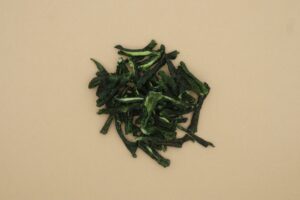
Wakegi is a cross between negi and onion, a garnish vegetable characterized by tender leaves and a mild flavor. Dried wakegi is made by carefully drying domestic fresh produce at low temperatures, retaining an aroma milder and less pungent than green onion in dried form. It is an ingredient we are frequently asked about for commercial foods where you want to add a gentle negi-family flavor — okonomiyaki, soups, garnishes, egg-dish toppings, and more. For consultations on dried vegetable and powder OEM here and let us know your intended use and desired cut form.
TOC
Three points of dedication in Agriture's dried wakegi
01 Preserving a mild flavor with low-temperature drying
Among negi-family vegetables, wakegi has gentle pungency and grows sweeter when heated. Because high-temperature drying drives off its delicate flavor, at Agriture we draw off the moisture slowly by low-temperature hot-air drying, using a drying design that keeps a mild aroma and faint sweetness in the dried leaf.
02 Making the most of tender leaves in the cut shape
A feature of wakegi is that its leaves are thinner and more tender than green onion. To make the most of this texture, we process it in shapes suited to the application — small-cut, minced, longer-cut, and so on. Longer cuts for okonomiyaki, small cuts for soup garnishes — you can choose the shape to match the product design.
03 Integrated support from small-lot prototyping to mass production
At Agriture we handle small-lot prototyping from 1 kg, and can even ship samples with different cut shapes and drying temperatures in parallel. You can compare finishes by sensory evaluation before commercialization, with one-stop support from early PB/OEM development through to volume production.
Product catalog showing the items we handle
Flexible support from small lots to large lots
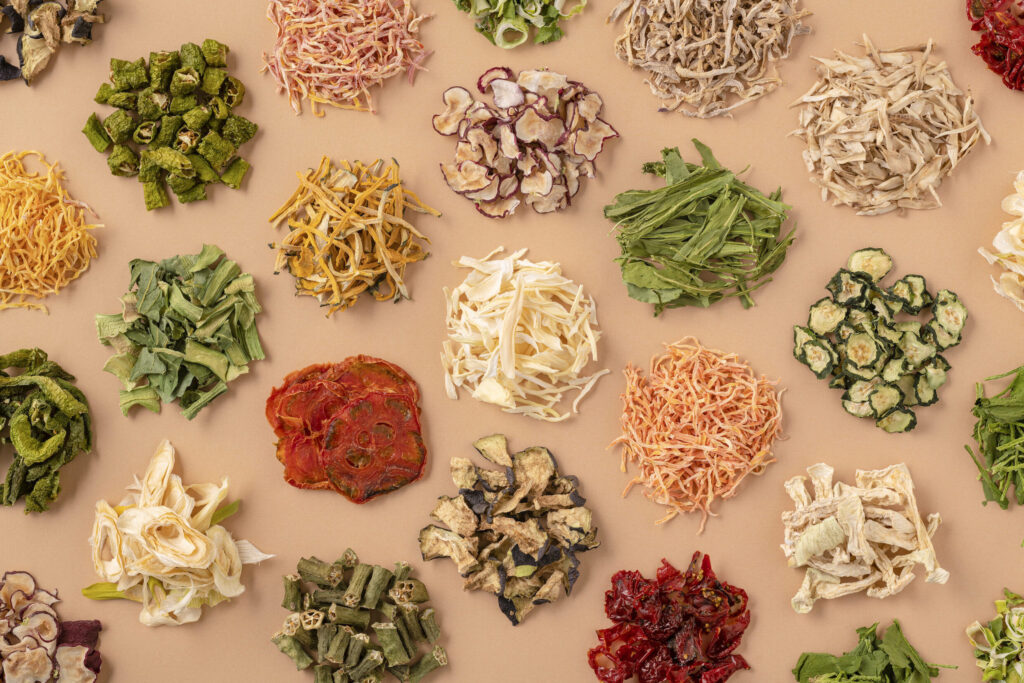
- Sold in small lots from 1 kg
- Handling heirloom vegetables from across Japan
- Dried fruits and herbs also supported
Features of commercial dried wakegi
A mild, refined flavor
Wakegi, a cross between negi and onion, has gentle pungency without green onion's characteristic sharpness and carries a mellow sweetness closer to onion. With little sharpness, it is a garnish ingredient easy to match to a wide range of dishes.
Tender leaves and good rehydration
Wakegi has thinner, more pliable leaves than green onion, rehydrating quickly from its dried state in water or hot water. Added to soups, it returns to a soft texture fast, making it an easy-to-use dried vegetable.
Vivid green color
Low-temperature drying suppresses chlorophyll fading and maintains a vivid green. Scattered as a topping on okonomiyaki or soups, it also works as a color accent.
Year-round supply with room-temperature storage
Fresh wakegi has a limited season, but the dried product keeps at room temperature for about six months and enables stable year-round supply. It can be stocked without worrying about disposal loss, easing the management load as a commercial raw material.
Additive-free, domestic ingredients
It is finished with wakegi leaves alone, using no coloring, preservatives, or flavorings. This spec pairs well with clean-label product designs that want to keep the ingredient list simple.
Blending and formulation support
We also handle pre-blending with other dried negi-family vegetables and dried vegetables. Blend designs combining multiple ingredients — miso-soup ingredient sets, okonomiyaki mixes, and the like — can also be discussed.
Product specifications (commercial)
Item | Details |
|---|---|
Raw material | Wakegi (domestic) |
Shape | Small-cut / minced / longer-cut (chosen by application) |
Production method | Low-temperature hot-air drying |
Best-before date | About 6 months from the shipping date |
Processing plant | Our own processing plant within Kyoto Prefecture |
Shipping unit | 100g〜 |
Minimum-lot OEM | Prototype from 1kg / full production from 10kg |
Customization support
Item | Available | Details |
|---|---|---|
Cut form changes | ◎ | Selectable from small-cut, minced, and longer-cut |
Powdering | ◎ | Fine-milling into wakegi powder available |
Small-lot OEM prototyping | ◎ | Prototyping available from 1kg |
Mixed materials and blends | ◎ | Blending with dried negi, tempura bits, wakame, etc. available |
Packaging changes | ◎ | Both commercial and small-portion individual packaging are available |
POWDER
A powder type is also available
We also offer "wakegi powder," a further fine-milled form of dried wakegi. It suits even blending into dressings, soup bases, and seasoning mixes.
Commitments to variety, grower, and growing region
The raw material used in our dried wakegi is domestic wakegi sourced directly from partner farms in Japan. Wakegi is a cross between negi (Allium fistulosum) and onion (Allium cepa), with a habit of dividing into tillers to multiply the clump, and its name derives from "wake-negi" (dividing negi). It is grown widely in western Japan, centered on Hiroshima Prefecture, and its tender leaves and mild flavor depend on the region's climate conditions.
BRAND
Variety: Wakegi (Amaryllidaceae, genus Allium, Allium × wakegi). A cross between negi and onion, a perennial that propagates by bulbs. Its leaves are thinner and more tender than green onion, with gentle pungency and a low-key, mild flavor as its features.
PRODUCER
Producer: We source from partner farms tied to domestic wakegi growing regions. To limit the loss of freshness after harvest, we run operations that shorten the lead time from harvest to processing.
REGION
Growing region: We procure processing material from wakegi growing regions in western Japan centered on Hiroshima Prefecture. Wakegi raised in the warm climate tends to have thick leaves and increased sweetness, which also has a good effect on the flavor after drying.
CULTIVATION
Cultivation method: Under managed cultivation with reduced pesticide use, we have arranged a record-keeping system that can also meet the raw-material origin certification food manufacturers require.
Low-temperature drying technology and quality control
Because wakegi has thinner, more delicate leaves than green onion, a slight difference in drying conditions greatly affects the color and flavor of the finish. Dried rapidly at high heat, the leaves brown and the sweet, onion-like aroma turns into a scorched nuance. At Agriture we adopt a low-temperature hot-air method with finely controlled temperature and airflow, running a drying program that maintains wakegi's inherent mild flavor and vivid green.
Manufacturing is managed in an integrated way at our own processing facility in Kyoto Prefecture, securing traceability from raw-material receiving to shipment. We have standardized the process of packing after a foreign-matter removal step, and we also accommodate the issuance of analysis reports and raw-material origin certificates required for OEM projects.
TIPS | Wakegi drying know-how
Wakegi and green onion look similar, but their characteristics during drying differ. Because wakegi has thin leaves, drying time is short and it easily becomes over-dried. At Agriture we use temperature and time settings dedicated to wakegi even among negi-family vegetables, adjusting so the thin leaves finish pliable without cracking.
Use cases and adoption examples
A topping ingredient for okonomiyaki and takoyaki
Dried wakegi is an application we are frequently asked about as a topping for okonomiyaki and takoyaki. Because it is milder and sweeter than green onion, it pairs well with sauce and mayonnaise, and scattered as a finish it becomes a color and flavor accent. Longer cuts give it more presence, while small cuts scatter evenly.
A garnish for soups, miso soup, and broths
It can be added straight as a garnish for miso soup, clear soup, and Chinese soups, rehydrating quickly in hot water to a soft texture. With less sharpness than green onion, it draws interest in commercial Japanese-style soups as a garnish that does not spoil the delicate flavor of the dashi.
An ingredient to knead into egg dishes and jeon
Add wakegi to dashimaki tamago, jeon, or scrambled eggs and it lends a tender texture and mild negi flavor. With fresh wakegi, cutting at prep time is laborious, but the dried product needs only measuring and adding, raising production efficiency at prepared-food plants.
An ingredient for nuta and su-miso dressed dishes
Dried wakegi can also be used as an ingredient in nuta and su-miso dressed dishes, classic wakegi dishes. Simply dress rehydrated wakegi with su-miso to offer a nuta menu year-round, so there are cases where stable supply is sought as a raw material for the standard side dish of izakaya and catered bento.
Dried-vegetable mixes and hot-pot-broth ingredient sets
It can also be used as one ingredient in miso-soup sets combined with dried wakame, dried fried tofu, and dried tofu, or in dried-vegetable mixes for hot-pot broth. List of dried vegetables we can also discuss blends combined with other ingredients.
Commercial usage and rehydration
Dried wakegi rehydrates in roughly 1–2 minutes when added straight to hot water or soup. Used as a garnish or topping, it can be scattered as-is with no rehydration needed. For stir-fries or kneading applications, soak it in room-temperature water for about 5–10 minutes to half-rehydrate before adding, for a better balance of texture and flavor.
For storage, sealed storage away from high heat and humidity is best. After opening, use it up promptly or reduce air contact with a zip bag to keep the vivid green and flavor longer.
Related cases and articles
- Welsh onion powder (powder-version product page)
- List of dried-vegetable and herb products
- For consultations on dried vegetable and powder OEM here
Product catalog showing the items we handle
Flexible support from small lots to large lots
- Sold in small lots from 1 kg
- Handling heirloom vegetables from across Japan
- Dried fruits and herbs also supported
Frequently asked questions
Q. What is the minimum lot and prototype handling?
A. Prototyping is from 1 kg and full production from 10 kg. Simultaneous prototyping of multiple shapes — small-cut, minced, longer-cut — is also possible. Send us a concept sheet and we will propose the fastest route to sample shipment.
Q. How does the flavor differ from green onion?
A. Because wakegi is a cross between negi and onion, it has gentler pungency than green onion and a mellow sweetness closer to onion. Its impact as a garnish is more restrained, but its refined aroma that does not interfere with the flavor of dashi is favored in Japanese-style applications.
Q. What is the lead time?
A. Stock items can ship 1–2 weeks after order. New processing to customized specs takes 1–2 weeks for prototyping and 3–4 weeks for full production as a guide. We can also discuss bringing production forward to align with the wakegi harvest season (spring and autumn).
Q. Can you issue a raw-material origin certificate?
A. We can issue a certificate of origin proving the wakegi is domestic. Microbiological test certificates can also be arranged and issued case by case upon consultation.
Q. How does it differ from freeze-dried?
A. Agriture's dried wakegi is finished by low-temperature hot-air drying. Compared with freeze-dried products, rehydration takes somewhat longer, but it gives a superior finish in the pliability of the leaves and retention of sweetness. If a freeze-dried product is required, please consult us separately.
Q. Can it be blended with other dried vegetables?
A. We handle pre-blending with dried wakame, dried fried tofu, dried tofu, dried negi, and the like. We can discuss blend designs combining multiple ingredients, such as miso-soup ingredient sets and hot-pot broth mixes.
Q. Please tell me the OEM consultation flow
A. The flow is: consult via the inquiry form → concept hearing → sample delivery → paid prototyping → spec finalization → full production. Because fine adjustment of the cut shape governs the finish, we can compare multiple patterns at the prototyping stage.
Recommended reading
- Welsh onion powder (details of the powder version)
- List of dried-vegetable and herb products
- For consultations on dried vegetable and powder OEM here
- We Prototyped "Dried Wakegi and Wakegi Powder" Using Domestically Grown Wakegi
Download the product catalog
We will send the materials to your email address based on the information you provide.