Dried kintoki carrot

Dried kintoki carrot is a commercial material that turns "kintoki carrot (Kyoto carrot)," an East-Asian-type carrot, into raw material in julienne strips. Compared with ordinary Western carrots, it is characterized by a more vivid crimson color and gentle sweetness, and that color and flavor are sealed in by low-temperature drying. At Agriture, we run it alongside kintoki carrot powder made by finely milling the same kintoki carrot (made to order), proposing a division of use: dried kintoki carrot for applications where you want to keep the julienne shape and color, and powder for coloring sauces, doughs, and powders.
Compared with other carrots such as Western carrots, orange carrots, and Kyo-kurenai carrots, kintoki carrot differentiates itself by its "vivid crimson containing lycopene," "staple status in osechi and ozoni," and "presence as color in Japanese cuisine." It is a material we get many prototype inquiries for, as a raw material for osechi nishime, ozoni, Japanese prepared dishes, colorful rice dishes, confectionery coloring, and potages.
TOC
Agriture's dried kintoki carrot: three points of care
1. Low-temperature drying that makes the most of the crimson color
Kintoki carrot's appeal is a vivid crimson color containing lycopene. At Agriture, we hold down the drying temperature and design the process to remove moisture in a short time, keeping the crimson color in the finished product as much as possible. Having the crimson rise when rehydrated is a factor that shapes the appearance of osechi, Japanese prepared dishes, and colorful rice dishes.
2. A julienne shape easy to rehydrate
Kintoki carrot is shaped into julienne strips before drying. Because julienne has a large surface area and rehydrates easily in water or dashi, it can be used straight in nishime, kinpira, mixed rice, and colorful prepared dishes. Length and thickness can be adjusted to match the application, so you can select to match the finished product's look and texture.
3. Selecting domestic (Kyoto-grown) kintoki carrot for the raw material
At Agriture, we use kintoki carrot from domestic growing regions, led by Kyoto, assessing the depth of the crimson color, sweetness, and size to make the raw material. Raw material with visible origin makes traceability easy to design, and is one reason it is chosen in prototypes by osechi, Japanese-prepared-dish, and confectionery makers.
Product catalog showing the items we handle
Flexible support from small lots to large lots
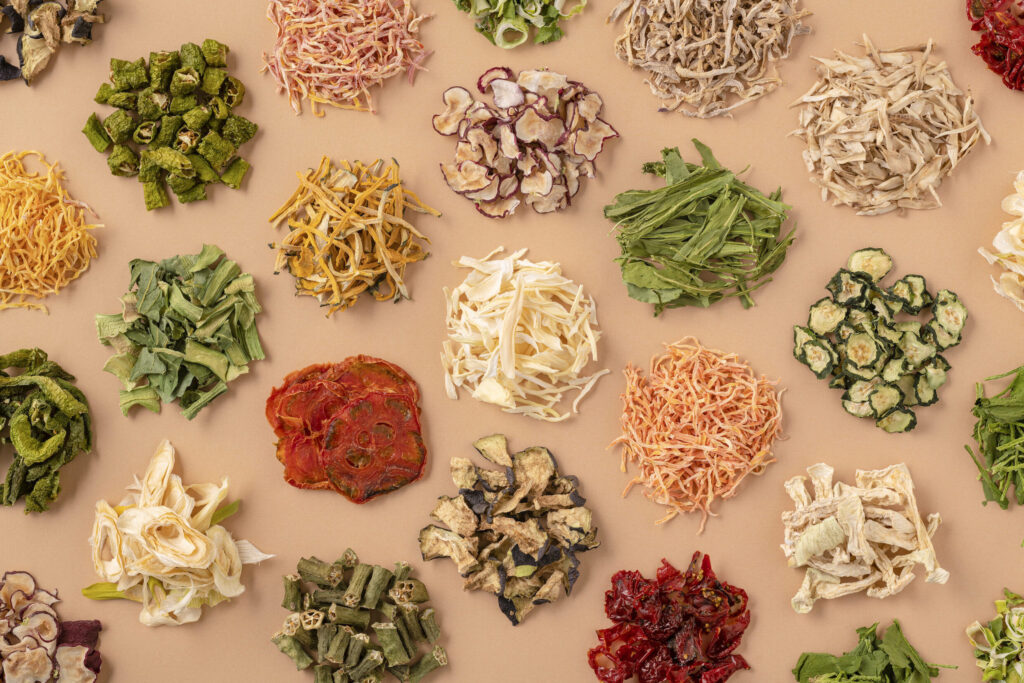
- Sold in small lots from 1 kg
- Handling heirloom vegetables from across Japan
- Dried fruits and herbs also supported
Features of commercial dried kintoki carrot
Even among carrot dried raw materials, kintoki carrot holds a unique position with its crimson color, sweetness, and presence in Japanese cuisine. We organize, from six perspectives, its strengths that assume a julienne shape.
Vivid crimson containing lycopene
Kintoki carrot's crimson color involves lycopene, the pigment also found in tomatoes. A deep crimson different from the orange of Western carrots, it gives an accent to the appearance of osechi, Japanese prepared dishes, and colorful rice dishes.
Easy-to-rehydrate julienne shape
Julienne is a shape with a large surface area that rehydrates easily in water or dashi. It can be used straight in nishime, kinpira, and mixed rice, keeping the rehydration time short.
Staple status in Japanese food and osechi
A material long used as color for New Year and Japanese cuisine—osechi nishime, ozoni, namasu, and more. A dried product that stores at room temperature lets you bring kintoki carrot's color into the finished product regardless of season.
Soft sweetness
Kintoki carrot has little of the grassy note characteristic of carrots, with a gentle sweetness as its forte. It suits recipe designs that want to make the most of sweetness and color—simmered dishes, potages, Western sweets, and more.
Suitability as a confectionery and coloring material
Making the most of the crimson color, it can be used as a coloring material for baked goods, steamed sweets, potages, and breads. It suits accents for product designs that highlight a vegetable-derived color.
Use in combination with powder
Used together with finely milled kintoki carrot powder (made to order), it enables recipe designs that balance ingredient texture (julienne) with coloring of sauces and doughs (powder).
Product specifications (commercial)
Basic specifications at the prototype stage are as follows. Purchase lot, lead time, and packaging format are worked out through individual consultation.
| Item | Details |
|---|---|
| Product name | Dried kintoki carrot |
| Raw material | Kintoki carrot (domestically grown) |
| Shape | Julienne. Length and thickness adjusted to match the application |
| Appearance | Vivid crimson julienne strips |
| Aroma | A gentle, carrot-like sweet aroma |
| Net content | Individual quote according to use and lot |
| Best-before date | About 6 months from the shipping date |
| Storage method | Avoid high temperature, high humidity, and direct sunlight; after opening, seal and store in a cool, dark place |
| Minimum prototype lot | From 1 kg of raw material |
Customization support
You can consult us from the prototype stage about shape, cut size, packaging, and final commercialization. Because we nail down the recipe while keeping records, it is a setup where specifications don't drift between prototype and mass production.
| Item | Available | Details |
|---|---|---|
| Shape adjustment | Julienne / dice / slice | Design length, thickness, and slice thickness to match the finished product's look and texture |
| Powdering | Fine powder (made to order) | For coloring confectionery, sauces, and drinks, and powder blending |
| Blend design | Combining with other root and other vegetables | Japanese-prepared-dish mix with burdock, lotus root, and other carrots |
| Packaging form | Commercial bulk / small bag / individual wrapping | From prepared-dish bulk to packs for confectionery raw material |
| OEM productization | End-to-end support through the finished product | From concept to production for osechi prepared dishes, mixed-rice bases, and confectionery raw materials |
For those considering the fine-powder type
For applications where you want to spread kintoki carrot's crimson color and flavor evenly, such as coloring confectionery, sauces, and drinks, or powder blending, our finely milled Kintoki Carrot Powder (made to order) is well suited. Please also see the list of powder raw materials.
Commitments to variety, grower, and growing region
Kintoki carrot is an East-Asian-type carrot in the Apiaceae family, also called "Kyoto carrot," one of the Kyoto vegetables long loved as color in Japanese cuisine. At Agriture, we base our raw-material design on origin, harvest timing, and the depth of the crimson color.
BRAND | Where kintoki carrot fits as a raw material
Kintoki carrot is an East-Asian carrot long used as color in Japanese cuisine—osechi nishime, ozoni, namasu, kinpira, mixed rice, and more. At Agriture, we translate this coloring and sweetness into a commercial raw material that works across a wide range of finished products, from osechi prepared dishes and confectionery to veggie-based products.
PRODUCER | Basic policy for sourcing and coordination
We select lots directly with growing regions, matching on the depth of the crimson color, sweetness, and uniform shape. At the prototype stage we order small quantities from multiple suppliers, evaluating crimson-color retention during drying and ease of rehydration, then build the supply line for volume lots.
REGION | Characteristics of the main growing region
Kintoki carrot has its representative growing area in the sandy zones of Sakaide and Kanonji in Kagawa, accounting for much of domestic distribution. It is also grown in various regions, including Kyoto, and appears heavily in winter for New Year demand. At Agriture, centered on Kyoto-grown, we assess lots with crimson color and sweetness suited to drying and turn them into raw material.
CULTIVATION | Harvest timing and crimson color
Kintoki carrot comes into season in winter (around November to December), appearing in time for New Year osechi demand. Those from the cold season tend to have deeper crimson color and increased sweetness. At Agriture, we select in-season produce carrying color and sweetness and turn it into raw material.
Low-temperature drying technology and quality control
Prompt drying after cutting
After kintoki carrot is julienned, the surface dries over time and the color tends to dull. By moving promptly from cutting to drying, we finish it under conditions that balance crimson color and sweetness.
Crimson-color retention through low-temperature drying
High-heat drying dulls the crimson color and tends to let the sweet aroma escape. By drawing out moisture slowly at low temperatures, we finish it so the crimson remains even when rehydrated. As an ingredient for osechi and Japanese prepared dishes, we aim for a raw material whose kintoki-carrot character comes through in appearance. For nishime, simmering the rehydrated julienne in dashi to absorb the flavor lets the flavor penetrate while keeping the crimson color. For mixed rice, cooking it in with the rice as-is without rehydrating transfers color and sweetness along with the rehydrating liquid.
Use cases
We organize the applications customers bring to us for prototyping into six categories. All are examples of recipe design that make the most of kintoki carrot's crimson color, sweetness, and julienne shape.
1. Osechi and New Year prepared dishes
Usable as a color material for New Year prepared dishes such as osechi nishime, ozoni, and namasu. Rehydrated and simmered in dashi to absorb the flavor, the crimson remains and tightens up the coloring of the jubako. It can be held as room-temperature stock, and being able to curb prep man-hours during the busy season is also valued in commercial use.
2. Japanese prepared dishes and simmered dishes
Usable as a color material for Japanese prepared dishes such as kinpira, chikuzenni, gomokuni, and shiraae. Julienne rehydrates quickly, and simmering it in dashi or broth brings the sweetness and crimson color to life. Being pre-prepped also ties into cutting prepared-dish production man-hours.
3. Mixed rice and seasoned rice
Usable as an ingredient in mixed rice, seasoned rice, and kamameshi. Cooked in with the rice as-is without rehydrating, color and sweetness transfer to the rice along with the rehydrating liquid, finishing it richly colorful. It can also be developed into instant mixed-rice bases and onigiri fillings.
4. Confectionery and bakery
Usable as coloring and an ingredient for baked goods, steamed sweets, and breads. Making the most of the crimson color and sweetness, it can be developed into confectionery and bakery products that highlight vegetable-derived color, such as carrot cake, scones, and steamed buns.
5. Retort, frozen foods, and prepared dishes
Can be built into retort and frozen prepared dishes and meal kits as a colorful vegetable. It can be stably secured as room-temperature stock, and being pre-prepped cuts production-line man-hours. It also suits products where rehydration time is short, such as soups, simmered dishes, and mixed-rice bases.
6. Soups, potages, and veggie-based products
Usable as a vegetable source for potages, consommé soups, and veggie-based meals. Because kintoki carrot has a gentle sweetness and crimson color, it suits accents for soup and veggie designs that want to bring out vegetable sweetness and color. Combined with powder, it can balance coloring with ingredient texture.
Commercial usage and rehydration
Rehydration basics
- For Japanese prepared dishes: rehydrate in water for 8 to 12 minutes, or in hot water for 4 to 6 minutes. For kinpira and simmered dishes
- For flavor-absorbing simmering: rehydrate and then cook in dashi or broth to let the flavor penetrate while keeping the crimson color
- For mixed rice: without rehydrating, cook it together with the rice. Color and sweetness transfer along with the rehydrating liquid
- Because the rehydrating liquid carries kintoki carrot's color and sweetness, it is good to use it straight in broths and mixed-rice dishes
Blending guide
- Nishime: 8 to 12g of dried rehydrated per 100g of finished dish
- Kinpira: 10 to 15g of dried rehydrated per 100g of finished dish
- Mixed rice: add about 6 to 10g of dried per 2 cups (go) of rice as a guide
- Potage: rehydrate and use 5 to 8g of dried per serving (200ml)
How to store
- Before opening: store in a cool, dark place at room temperature, away from heat, humidity, and direct sunlight
- After opening: transfer to a zip bag or airtight container and use up within 1 to 2 months
- The best-before date is about 6 months from the shipping date. Note that light and moisture absorption change the crimson color
- Refrigerated storage is possible. Because condensation forms right after taking it out, return it to room temperature before opening
Related cases and articles
- What Is Kintoki Carrot – Explaining Its Features as a Kyoto Vegetable
- Dried Carrot – a Western-carrot raw material
- Dried Kyo-kurenai Carrot – a Kyoto-vegetable carrot
- List of dried vegetable raw materials
- Consult us on food OEM and raw material supply
Product catalog showing the items we handle
Flexible support from small lots to large lots
- Sold in small lots from 1 kg
- Handling heirloom vegetables from across Japan
- Dried fruits and herbs also supported
Frequently asked questions
What is the difference from Western carrots?
Kintoki carrot is an East-Asian-type variety, also called "Kyoto carrot," characterized by a vivid crimson color containing lycopene and a long, slender shape, versus the orange of Western carrots. With little grassy note and a gentle sweetness, it has long been used as color in Japanese cuisine—osechi, nishime, Japanese prepared dishes. You can use it separately from Western carrot (dried carrot) by color and application.
How much of the crimson color remains?
By moving promptly from cutting to low-temperature drying, we give a finish that keeps the crimson color. Even after rehydrating, you can confirm the crimson as color for nishime, mixed rice, and Japanese prepared dishes. Because it fades easily with high-heat cooking or long-term storage and moisture absorption, care is needed with the finished product's heating conditions and storage design.
Can it be used for mixed rice?
This is one of the applications we get many inquiries about. Julienne can be cooked in together with the rice as-is without rehydrating, and color and sweetness transfer to the rice along with the rehydrating liquid. It can be used broadly in rice dishes where you want to add color—instant mixed-rice bases, kamameshi ingredients, onigiri fillings, and more.
How do I choose between it and kintoki carrot powder?
The division is that dried kintoki carrot suits "applications where you want to keep the julienne ingredient texture and color," while powder suits "coloring confectionery, sauces, and drinks, and powder blending." Nishime, kinpira, and mixed rice call for the dried product; coloring carrot cake, soups, and steamed buns calls for powder. Using both together enables recipe designs that balance ingredient texture with even coloring.
What is the minimum prototype lot?
Prototypes are accepted from 1kg of raw material. You can run prototypes in parallel across multiple conditions, such as comparing julienne length and thickness, or simmered-dish versus confectionery specifications. Full production is from 10kg and up, and you can consult us all the way through to OEM finished-product development. After hearing the specifications, lot, and schedule for your intended finished product, we propose individual quotes and delivery times.
Please tell me the best-before date and how to store it.
The best-before date is about 6 months from the shipping date. Unopened, store in a cool, dark place at room temperature, away from heat, humidity, and direct sunlight. Because kintoki carrot's crimson color fades easily with light and moisture absorption, we recommend transferring it to a zip-lock bag or light-blocking container after opening and using it up within 1 to 2 months as a guide. Refrigerated storage is also possible, but beware of condensation right after removing it—let it return to room temperature before opening.
Recommended reading
- What Is Kintoki Carrot – a Kyoto-vegetable explainer
- Dried Carrot – Western carrot
- Dried Kyo-kurenai Carrot – a Kyoto-vegetable carrot
- List of dried vegetables
- List of powders
Download the product catalog
We will send the materials to your email address based on the information you provide.