Dried goya

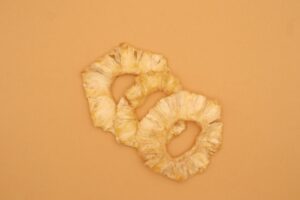
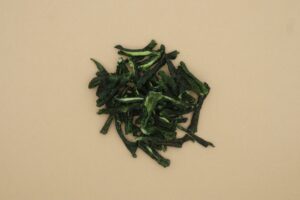
Dried goya is a commercial ingredient made from goya (bitter melon), Okinawa's signature summer vegetable, processed into ring-cut (sliced) form. The flesh, with the seeds and pith removed, is finished by low-temperature drying while preserving the distinctive bitterness and the green of the rind. At Agriture, we run it alongside goya powder, in which the same goya is fine-milled (made to order), proposing dried goya for uses that want to keep the ring shape and sense of the ingredient, and powder for health teas, powder blending, and uniform dispersion of bitterness.
Compared with cucumber, zucchini, and other cucurbit summer vegetables, goya can be differentiated by its "distinctive momordicin-derived bitterness," its "striking ring shape," and its "standard use in goya chanpuru and goya tea." It is an ingredient that draws many prototyping consultations as a raw material for goya chanpuru prepared dishes, goya tea, tsukudani, tempura, health-tea blends, and vegetable chips.
TOC
Three points of care in Agriture's dried goya
1. Low-temperature drying that preserves the bitterness and green color
The character of bitter melon (goya) lies in the momordicin-derived bitterness and the vivid green of its skin. At Agriture, we use a design that keeps the drying temperature low and removes moisture in a short time, retaining as much of the bitterness and green color as possible in the finished product. When rehydrated, the way the goya-like bitterness and color come through is a factor that determines the quality of champuru side dishes and goya tea.
2. Seed and pith removal and ring shape
Bitter melon is halved lengthwise, the seeds and pith are removed, and it is trimmed into rounds (rings) before drying. Varying the thickness of the rings lets you adjust how the bitterness comes through and the texture after rehydration. Thin slices suit goya tea, furikake, and chips, while slightly thicker rings suit champuru side dishes and tempura.
3. Using domestic bitter melon as raw material
At Agriture, we use bitter melon from Kyoto and other domestic growing regions, assessing flesh thickness, skin green color, and freshness to turn it into raw material. Raw material with a visible origin makes traceability easier to design, which is one reason it is chosen for prototyping by makers of health teas and prepared foods.
Product catalog showing the items we handle
Flexible support from small lots to large lots
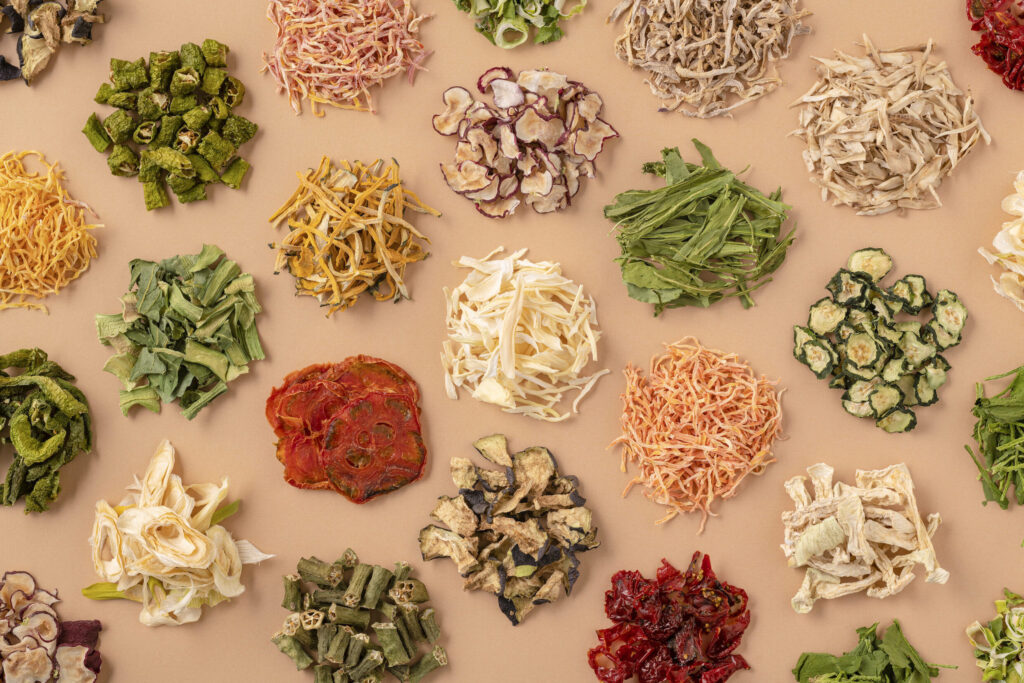
- Sold in small lots from 1 kg
- Handling heirloom vegetables from across Japan
- Dried fruits and herbs also supported
Features of commercial dried bitter melon
Among dried raw materials in the gourd (Cucurbitaceae) family, bitter melon holds a distinctive position for its bitterness, appearance, and suitability for health tea. Here we organize its strengths, based on the ring shape, from six perspectives.
Momordicin-derived bitterness
We make the most of momordicin, the bitter compound unique to bitter melon, through low-temperature drying. Because the bitterness itself can become a product's character, it suits designs that want to feature bitterness, such as goya tea, health teas, and snacks for adults.
The look of the ring shape
The ring-shaped rounds with a hollow center are a striking form instantly recognizable as bitter melon. They come into their own in uses such as champuru side dishes, tempura, and toppings, where you want the appearance to convey a sense of goya.
Suitability for goya tea and health teas
Dried bitter melon can be used as the main ingredient in goya tea, brewed on its own or in blends. Finished so as to retain bitterness and a roasted aroma, it can be developed as a core ingredient for health teas and blended teas.
Low-temperature drying that preserves green color
High-temperature drying tends to dull the green of bitter melon's skin, so we dry it slowly in a low-temperature range to preserve the color. The green remains even after rehydration, adding to the color of champuru side dishes and toppings.
Pairing with Okinawan cuisine and champuru
It is an ingredient that can take the leading role in Okinawan cuisine, starting with goya champuru. It can be used as a raw material that supplies pre-prepped bitter melon reliably for retort and frozen champuru side dishes and meal kits.
Use in combination with powder
Used together with finely milled bitter melon powder (available to order), it enables recipe design that achieves both a sense of substance as an ingredient (dried product) and even dispersion of bitterness into beverages and powders (powder).
Product specifications (commercial)
Basic specifications at the prototype stage are as follows. Purchase lot, lead time, and packaging format are worked out through individual consultation.
| Item | Details |
|---|---|
| Product name | Dried goya |
| Raw material | Bitter melon (domestically grown) |
| Shape | Rounds (rings). Thickness adjusted to suit the application |
| Appearance | Ring-shaped with a hollow center; skin is green |
| Aroma | A green, bitter aroma characteristic of goya; the flavor of a summer vegetable emerges when rehydrated |
| Net content | Individual quote according to use and lot |
| Best-before date | About 6 months from the shipping date |
| Storage method | Avoid high temperature, high humidity, and direct sunlight; after opening, seal and store in a cool, dark place |
| Minimum prototype lot | From 1 kg of raw material |
Customization support
You can consult with us from the prototype stage through shape, seed and pith removal, packaging, and final product development. Because we keep records while refining the recipe, the specifications stay consistent between prototyping and mass production.
| Item | Available | Details |
|---|---|---|
| Shape adjustment | Thin-cut rings / thick-cut rings | Thickness designed to match the texture and bitterness profile of the final product |
| Powdering | Fine powder (made to order) | For powder blends in goya tea, beverages, and health foods |
| Blend design | Combining with other ingredients | Blended tea design with adlay, brown rice, dokudami, and more |
| Packaging form | Commercial bulk / small bag / individual wrapping | From bulk for tea bags to packs for prepared foods |
| OEM productization | End-to-end support through the finished product | From planning to production of goya tea, champuru side dishes, and snacks |
For those considering the fine-powder type
For uses where you want to spread bitter melon's bitterness and components evenly, such as blending into goya tea or beverages or designing powders for health foods, finely milled bitter melon powder (available to order) is suitable. For details, please see the bitter melon powder page.
Commitments to variety, grower, and growing region
Bitter melon is a summer vegetable of the genus Momordica in the gourd family, a food plant widely eaten in hot regions such as Okinawa, the Nansei Islands, Southeast Asia, and South Asia. At Agriture, we base our raw-material design on growing region, harvest timing, and the condition of the flesh.
BRAND | The position of bitter melon as a raw material
Bitter melon is a summer vegetable usable across Japanese cuisine, Okinawan cuisine, and health teas, including goya champuru, goya tea, tsukudani, and tempura. At Agriture, we translate this versatility into commercial raw material, offering it as an ingredient usable in a wide range of final products, from health teas and prepared foods to snacks.
PRODUCER | Basic policy for sourcing and coordination
We select lots with consistent skin green intensity, flesh thickness, and size, aligning directly with growing regions. At the prototype stage, we source small quantities from several suppliers, evaluate green retention and bitterness during drying, and then set up the supply line for mass-production lots.
REGION | Characteristics of the main growing region
Okinawa, Miyazaki, and Kagoshima are the main domestic growing regions, and it is a vegetable that appears mainly in summer. Okinawan produce is available nearly year-round, while Honshu produce is centered on summer and autumn crops. At Agriture, we assess bitter melon from Kyoto and other domestic regions by the flesh thickness and green color suited to drying, and turn it into raw material.
CULTIVATION | Harvest timing and bitterness
Bitter melon harvested in season (summer) tends to have a deeper green and firmer bitterness. As it fully ripens, the skin turns yellow and the bitterness softens, so at Agriture we select in-season green bitter melon as raw material for uses that make the most of bitterness.
Low-temperature drying technology and quality control
Prompt drying after removing seeds and pith
Bitter melon is halved lengthwise, the seeds and pith removed, and then sliced into rounds. After cutting, moisture readily escapes from the flesh, and color and aroma fade over time, so we move quickly from cutting to drying and finish it under conditions that balance green color and bitterness.
Preserving color and bitterness through low-temperature drying
High-temperature drying dulls the green of the skin and lets the aroma escape more easily. By removing moisture slowly in a low-temperature range, we achieve a finish where the green and the goya-like bitterness remain even after rehydration. When used for goya tea, lightly roasting it before brewing adds a roasted note and rounds off the sharp edge of the bitterness, making it easier to drink. In champuru side dishes, stir-frying the rehydrated rings in oil brings up a texture and green color close to fresh bitter melon.
Use cases
Here we organize the uses customers consult us about at the prototype stage into six categories. All are examples of recipe design that make the most of bitter melon's bitterness, green color, and ring shape.
1. Goya tea and health teas
Dried bitter melon can be used as the main ingredient in goya tea, brewed on its own or in blends. Lightly roasting it before filling tea bags brings out a roasted note, and it can be developed into blended tea designs with adlay, brown rice, dokudami, and more. It is a use we are often consulted about as a health tea for adults that retains bitterness.
2. Champuru and Okinawan prepared foods
It can be used as a raw material for Okinawan prepared foods, starting with goya champuru. Rehydrated in water and stir-fried in oil, it takes on a texture close to fresh bitter melon and can be developed into ingredients for retort and frozen champuru side dishes and meal kits. Because it can be stored at room temperature, it is also valued in commercial use for cutting prep labor and reducing waste loss.
3. Tsukudani and Japanese prepared foods
It can be used as a raw material for Japanese prepared foods that make the most of bitterness, such as bitter melon tsukudani, kinpira, and dressed dishes. Rehydrated and simmered in a sweet-savory sauce, it becomes a dish suited to a rice accompaniment or a bento side. Being pre-prepped, it also helps cut labor in prepared-food manufacturing.
4. Snacks and vegetable chips
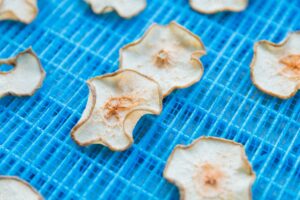
It can be used as an ingredient for vegetable chips and snacks for adults that make the most of the ring shape. By featuring the bitterness and ring-shaped appearance, you can differentiate from other vegetable chips. With a design of plain frying or seasoning, it can also be developed into bar-snack products.
5. Retort, frozen foods, and prepared dishes
It can be incorporated as a summer-vegetable ingredient in retort and frozen prepared foods and meal kits. It can be secured reliably as room-temperature stock, and because the seeds and pith are already removed, it cuts labor on the production line. It also suits products such as microwave meals that require a short rehydration time and quick preparation.
6. Health foods and vegetable-based products
It can be used as a vegetable source in vegan and vegetarian meals and health-conscious products. Because bitter melon has the distinctive character of bitterness, it suits being an accent in vegetable-based designs where you want to bring out definition in flavor. It can also be developed into raw material for health-oriented products that feature bitterness, such as goya tea and powder blends.
Commercial usage and rehydration
Rehydration basics
- For stir-frying: rehydrate in water for 10-15 minutes, or in hot water for 5-7 minutes, then stir-fry in oil. For champuru side dishes
- For simmered dishes and tsukudani: rehydrate in hot water for 10-15 minutes, then simmer in a sweet-savory sauce. For Japanese prepared foods
- For goya tea: without rehydrating, lightly roast and then brew. Makes the most of the bitterness and roasted aroma
- The rehydration liquid carries the aroma and bitterness of bitter melon, so use it or replace it according to the application
Blending guide
- Goya tea: brew 3-5 g of dried product per 1 liter of hot water
- Champuru side dishes: 8-12 g of dried product rehydrated per 60 g of bitter melon for one serving
- Tsukudani: 12-15 g of dried product rehydrated per 100 g of finished product
- Blended tea: blend dried bitter melon at roughly 10-30% of the whole
How to store
- Before opening: store in a cool, dark place at room temperature, away from heat, humidity, and direct sunlight
- After opening: transfer to a zip bag or airtight container and use up within 1 to 2 months
- The best-before date is about 6 months from the shipping date. Note that the green color changes with light and moisture absorption
- Refrigerated storage is possible. Because condensation forms right after taking it out, return it to room temperature before opening
Related cases and articles
- Dried cucumber – a raw material in the same gourd family
- Dried winter melon – a summer gourd-family vegetable
- List of dried vegetable raw materials
- List of powder raw materials
- Consult us on food OEM and raw material supply
Product catalog showing the items we handle
Flexible support from small lots to large lots
- Sold in small lots from 1 kg
- Handling heirloom vegetables from across Japan
- Dried fruits and herbs also supported
Frequently asked questions
Can it be used as a raw material for goya tea?
This is one of the uses we are often consulted about. Lightly roasting dried bitter melon before brewing adds a roasted note to the bitterness, making it easier to drink. Besides goya tea on its own, it can also be used as a core ingredient in blended teas with adlay, brown rice, dokudami, and more. The cut size for tea bags and the blend ratio can also be adjusted during prototyping.
How much of the green color remains?
By moving promptly to low-temperature drying after removing the seeds and pith, we achieve a finish that retains the green of the skin. Even after rehydration, you can see the green color adding to the appearance of champuru side dishes and toppings. Because color fades easily with high-temperature drying and prolonged storage or moisture absorption, care is needed in the storage design of the final product.
How should it be used differently from bitter melon powder?
Dried bitter melon is for uses where you want to retain the ring shape, a sense of substance, and appearance, while powder is for even dispersion of bitterness into beverages and powders. Champuru side dishes, tsukudani, and snacks suit the dried product, while instant powder for goya tea and powder blends for health foods suit the powder. Using them together makes it possible to design recipes that achieve both a sense of substance and even bitterness.
Are the seeds and pith removed?
In the standard specification, it is halved lengthwise and the seeds and pith removed before slicing into rounds. Because it is dried with the pith, a source of bitterness and harshness, removed, it can be used directly in cooking after rehydration. If you have specific requests about how the seeds and pith are processed, please consult us at the prototype stage.
What is the minimum prototype lot?
We accept prototyping from 1 kg of raw material. You can run multiple conditions in parallel, such as comparing ring thicknesses or comparing specifications for goya tea and for champuru. Main production is from 10 kg, and you can consult us including final product development for OEM. After hearing the specifications, lot sizes, and schedule you envision for the final product, we propose an individual quotation and delivery time.
Please tell me the best-before date and how to store it.
The best-before date is about six months from the shipping date. While unopened, avoid high temperature, high humidity, and direct sunlight, and store in a cool, dark place at room temperature. Because bitter melon fades easily in color with light and moisture absorption, after opening we recommend transferring it to a zip bag or light-blocking container and using it up within one to two months as a guide. Refrigerated storage is also possible, but watch for condensation right after taking it out, and let it return to room temperature before opening.
Recommended reading
- Dried cucumber – a raw material in the same gourd family
- Dried winter melon – a summer gourd-family vegetable
- Dried zucchini – a summer vegetable for Western cuisine
- List of dried vegetables
- List of powders
Download the product catalog
We will send the materials to your email address based on the information you provide.