Dried Maca

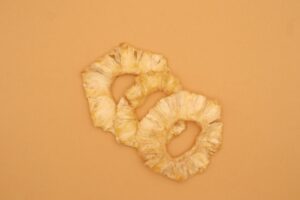
Dried maca is a commercial ingredient made from maca (scientific name: Lepidium meyenii), a functional plant of the Brassicaceae family, in two shapes: julienned/chipped root and coarsely ground (cut) leaf. Known as native to the Peruvian Andes highlands, maca has also spread in domestic cultivation and has drawn attention as a nutrient-rich plant containing amino acids and minerals such as iron, zinc, and calcium, as well as glucosinolate compounds. At Agriture we run it in parallel with a finely milled Maca powder proposing dried maca for applications where you want to keep texture and shape, and the powder for even blending into liquid and powder products.
Compared with functional plants such as moringa, ashitaba, and kale, maca holds a distinctive position in its "amino-acid- and mineral-based composition centered on the root," its "Andes-native brand story," and its "room for differentiation through domestic cultivation." It is an ingredient we are frequently asked to prototype as a raw material for health-food OEM, supplements, blended teas, and confectionery.
TOC
Three points of dedication in Agriture's dried maca
Maca is an ingredient whose root and leaf differ greatly in character, requiring separate designs for drying conditions, pretreatment, and finishing. At Agriture we manage everything from raw-material intake to packaging in-house at our processing facility in Kyoto Prefecture, aiming for a finish that brings out the strengths of both root and leaf.
1. Separate drying designs for root and leaf
The root is washed with the skin on, undergoes careful pretreatment, then is dried at low temperature and finished julienned or chipped. The leaf is dried under conditions that keep its green aroma and color, using the same drying profile as ordinary leafy vegetables. Separating the design by part shapes the raw material to draw on the characteristic components and flavor of each.
2. Flexible development across two shapes and two parts
The root handles both julienne (for decoctions and health teas) and further-ground powder (for health foods and beverages). The leaf, coarsely ground to cut, suits blended teas and furikake. Because you can prototype multiple shapes from the same raw material in parallel, it is a design that makes it easy to broaden a product line.
3. Domestic maca as an axis of differentiation
Maca carries a strong image as an imported ingredient, but with the advance of domestic cultivation, room for differentiation has emerged — "a raw material with a visible growing region" and "traceability you can design." At Agriture, we provide hands-on support for brand design and finished-product storytelling built on domestic maca.
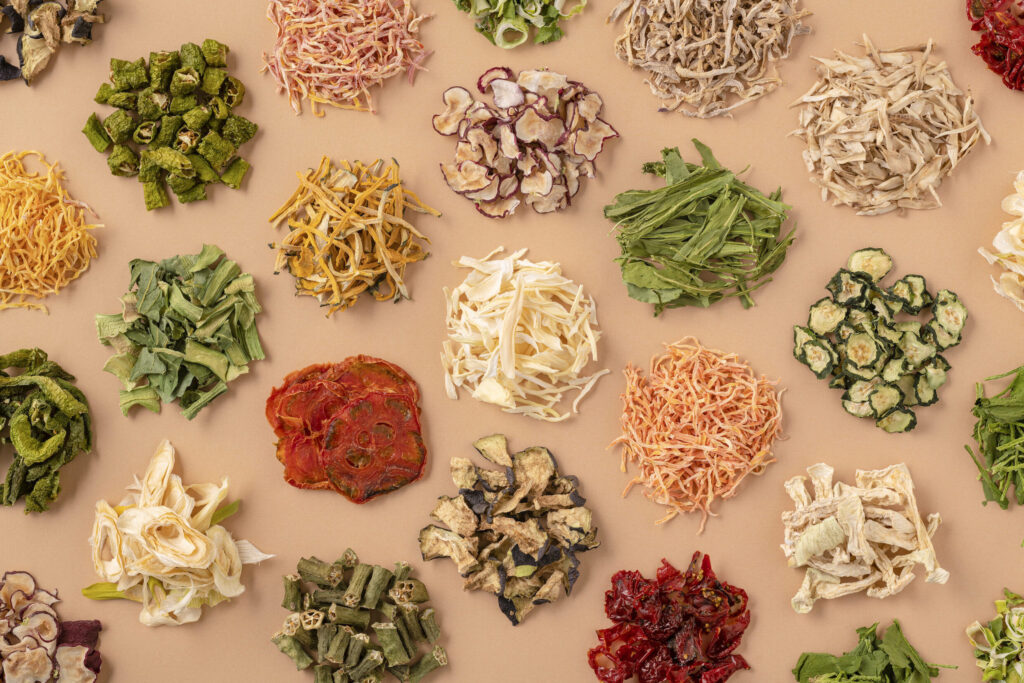
Product catalog showing the items we handle
Flexible support from small lots to large lots
- Sold in small lots from 1 kg
- Handling heirloom vegetables from across Japan
- Dried fruits and herbs also supported
Features of commercial dried maca
Even among functional plants, maca stands apart from moringa, ashitaba, and kale in that the root can be made the lead. Here we organize the strengths unique to dried maca, which lets you use both root and leaf, across six angles.
Minerals and amino acids in the root
Representatively, minerals such as iron, zinc, and calcium and multiple amino acids are the points of focus. Component values vary by condition, but it is positioned as easy to use as a main ingredient for health foods and supplements — a plant that has drawn attention.
Glucosinolate compounds
An ingredient containing glucosinolate compounds common to Brassicaceae plants, the source of maca's characteristic mild bitterness and pungency. As a compound family drawing interest as a component of focus, it is easy to use in designing product concepts.
Versatility across two parts and two shapes
You can combine four spec families from the same raw material: julienned/chipped root, and coarsely ground/cut leaf. It is an ingredient that can broaden a product line by using the root as the main ingredient and the leaf as a blend ingredient for tea bags.
Use in combination with powder
Finely milled Maca powder Used together with the , you can brand-develop both a "dried product that keeps texture" and a "powder for even blending into liquids and powders" from a single ingredient. It is an ingredient that readily adds depth to a product line.
An Andes-native brand story
Carrying the story of a traditional food of the Peruvian Andes highlands, it is an ingredient easy to appeal to conceptually in the brand design of health foods, supplements, and smoothies. Domestic cultivation also adds the appeal axis of "raising an Andes-derived ingredient on Japanese soil."
Blend design with other ingredients
It pairs well with plant ingredients such as moringa, ashitaba, kale, and yomogi, enabling blend designs combining multiple ingredients. As a main ingredient for green-juice drinks, protein drinks, health teas, and supplements, it is easy to commercialize by cross-blending the individuality of ingredients.
Product specifications (commercial)
Basic specifications at the prototype stage are as follows. Purchase lot, lead time, and packaging format are worked out through individual consultation.
| Item | Details |
|---|---|
| Product name | Dried Maca |
| Raw material | Maca (domestic, root and leaf) |
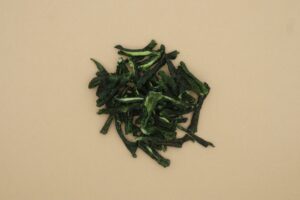
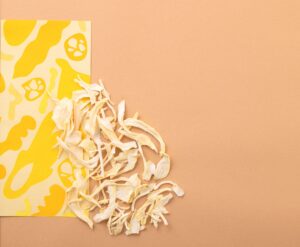
| Shape | Two shapes: root — julienne/chip / leaf — coarsely ground (cut) |
| Appearance | Root: pale yellowish-white to yellow-brown / leaf: green (turns somewhat deep green after drying) |
| Aroma | The mild bitterness characteristic of Brassicaceae and a root-vegetable richness; the leaf has a fresh green aroma |
| Net content | Individual quote according to use and lot |
| Best-before date | About 6 months from the shipping date |
| Storage method | Avoid high temperature, high humidity, and direct sunlight; after opening, seal and store in a cool, dark place |
| Processing plant | Our own processing plant within Kyoto Prefecture |
| Minimum prototype lot | From 1 kg of raw material |
| Main production lot | From 10 kg (by consultation) |
Customization support
Because we record shape and conditions as we finalize, the specs are unlikely to drift between prototyping and volume production.
| Item | Available | Details |
|---|---|---|
| Shape adjustment | Root: julienne / chip; leaf: coarsely ground to cut | Designed to suit health teas, tea bags, decoctions, and blend ingredients |
| Part specification | Root only / leaf only / both | Choose the part to match its positioning as the main ingredient |
| Cut particle size | Coarse / standard / fine | Adjusted to suit tea-bag extractability and blend compatibility |
| Blend design | Combination with other plant ingredients | Blended-tea design with moringa, ashitaba, yomogi, etc. |
| Packaging form | Commercial bulk / tea bags / small packs | From light-blocking aluminum bags and triangular tea bags to supplement bulk |
| OEM productization | End-to-end support through the finished product | From planning to production of health teas, supplements, beverages, and health foods |
For those looking for a finely milled type
For applications such as green-juice drinks, smoothies, protein drinks, supplements, and confectionery, where you want to spread maca's components evenly, use the finely milled Maca powder is suitable.
Commitments to variety, grower, and growing region
Maca is an annual to biennial of the genus Lepidium in the Brassicaceae family, known as native to the Peruvian Andes highlands, though domestic cultivation has now also spread. At Agriture, we consider the growing region, harvest timing, and
BRAND | Where maca stands as a raw material
Carrying the background of a traditional food of the Peruvian Andes highlands, maca has built a distinctive position in the world of health foods and supplements. At Agriture, we translate the raw-material concept of domestic maca into a commercial ingredient, offering it as an ingredient usable across a wide range of finished products, from health foods and blended teas to beverages and confectionery.
PRODUCER | Basic policy for sourcing and coordination
We select lots with consistent root shape and size and sound leaves by coordinating directly with the growing region. During prototyping we source small quantities from multiple suppliers, evaluate them for color retention, flavor stability, and component reproducibility during drying, then set up the supply line for volume lots.
REGION | Characteristics of the main growing region
The native Peruvian Andes are highlands at around 4,000 m elevation, where the climate with large temperature swings and volcanic soil are said to suit maca cultivation. In domestic growing areas, attempts are spreading centered on highland zones such as Nagano and Yamanashi Prefectures, and root size, flavor, and color differ by region. At Agriture we use different growing regions by application, selecting raw material balanced for flavor and components.
CULTIVATION | Harvest timing and flavor
Maca has a long cultivation period from sowing to harvest, and the root's firmness, sugar content, and amount of glucosinolate components change with harvest timing. Young roots are tender with a strong green aroma, while mature roots tend toward deeper richness and pungency. At Agriture we use component-focused lots for health-food applications and flavor-focused lots for blended teas and confectionery.
Low-temperature drying technology and quality control
Root pretreatment and low-temperature drying
The root is washed with the skin on, undergoes careful pretreatment, then moves to cutting. Because glucosinolate compounds and minerals include components that change easily with heat, we finish under conditions that keep temperature bands down to preserve both components and color. For either the julienne or chip spec, we aim for a design where cut-surface discoloration is unlikely to appear.
Drying that keeps the green aroma of the leaf
The maca leaf is a tender leafy vegetable resembling mizuna, dried under conditions that keep its fresh green aroma and green color. Because prolonged drying causes aroma loss and fading, we optimize drying time to the moisture content and leaf thickness, aiming for a finish easy to use as an ingredient for blended teas and furikake. Used as a base for blended tea, combined with fragrant tea leaves such as rooibos, hojicha, or tochu tea, maca's pungency softens for an easy-to-drink finish. The leaf pairs well with moringa, ashitaba, and herbs and can be designed as the lead of a blended tea. For health-food and supplement uses, further grinding into powder raises compatibility with capsules, tablets, and powdered beverages. For confectionery, a 1–3% powder addition to flour lends madeleines, cookies, and pound cakes a distinctive richness and flavor.
Use cases and adoption examples
Here we organize the applications customers bring to us for prototyping into six categories. Each is an example of recipe design that draws on the individual character of maca's root and leaf.
1. Health teas and blended teas
It can be used as a raw material for decoction health teas using julienned maca root, or for herbal and yakuzen-style blended teas centered on maca leaf. It extends to health-oriented tea products, such as blended teas with moringa or ashitaba, or blends with rooibos or hojicha.
2. Supplement and health-food ingredient
It can be used in tablets and capsules containing maca root powder, or as a base ingredient for health foods. It is easy to fit into powder and granule formulation processes and suits use as a blend ingredient for wellness supplements.
3. Protein drinks and sports beverages
It can be used as an ingredient in protein drinks or plant-protein mixes containing maca root powder. It can be built into distinctive beverage designs, such as post-workout drinks or as a core ingredient for health-oriented smoothie brands.
4. Confectionery and bakery
It can be used as an ingredient to knead into baked goods — madeleines, pound cakes, cookies, and the like — using maca powder. It extends to value-added products such as function-oriented breads and scones, or granola and health snacks using maca chips.
5. Furikake and Japanese-style toppings
It can be used as an ingredient for functional furikake using maca leaf, or for a health-oriented "friend of rice" series. Blended with salt or Japanese-style seasoning, it also extends to health-appeal seasonings and toppings for granola and cereal.
6. Gift and wellness-brand ingredient
It can be used as a main ingredient for health-oriented gift sets or wellness brands. Powdered, it extends easily to drinks and supplements, and can also be adopted as a raw material for hotel and ryokan amenity health teas or original wellness brands.
Commercial usage and rehydration
Extraction and basic use
- Root, julienne: decoct 5–7 minutes in water at 90–95°C. Suits extraction in health teas and tea bags
- Root, chip: as a soup or dashi ingredient, add straight to simmered dishes
- Leaf, coarsely ground: fill into a tea bag and extract at around 90°C for 3–5 minutes, or use as furikake or a soup ingredient
- Kneading into dishes: grind further and blend 1–2% into bread or pasta dough
Blending guide
- Single-ingredient health tea: 2–4 g of dried maca (root) per 300 ml of hot water
- Blended tea: ratio to other tea leaves — 20–40% for a lead role, 5–15% for a supporting role
- Tea-bag fill: 1.5–3 g per bag is standard
- Supplement tablets: grind and blend to match the functional labeling and daily intake guideline
How to store
- Before opening: store in a cool, dark place at room temperature, away from heat, humidity, and direct sunlight
- After opening: transfer to a zip bag or light-blocking container and use up within about one to two months
- The best-before date is roughly six months from the shipping date. Note that components and color change with light and heat
- Store apart from other strongly aromatic ingredients to prevent aroma transfer
Related cases and articles
- Dried moringa – functional plant ingredient
- Dried ashitaba – a chalcone-containing functional plant
- Maca powder – fine powder for health foods and beverages
- List of dried vegetable raw materials
- Consult us on food OEM and raw material supply
Product catalog showing the items we handle
Flexible support from small lots to large lots
- Sold in small lots from 1 kg
- Handling heirloom vegetables from across Japan
- Dried fruits and herbs also supported
Frequently asked questions
How do you decide between the root and the leaf?
The root, julienned or chipped, suits decoctions, health teas, and soup ingredients, and further-ground maca powder can be used as a main ingredient for health foods, supplements, and beverages. The leaf, resembling mizuna, is coarsely ground to cut and suits blended teas, furikake, and soup ingredients. It is often designed with the root playing the lead in health foods and the leaf in a supporting role adding flavor and function. We also handle combined orders for both parts in a single lot.
How much of the components (minerals, amino acids) does it contain?
It is an ingredient containing minerals such as iron, zinc, and calcium, several kinds of amino acids, and glucosinolate compounds, but the specific content varies with growing region, harvest timing, part, and drying conditions. The components are a guide as "representative points of focus," and on the understanding that they vary by condition, please consult us individually if external analysis is needed during prototyping. If you apply for foods with function claims, we support you from the design stage of a standardized raw material.
How do you decide between it and maca powder?
Dried maca is for applications where you want to keep texture and shape with julienned/chipped root or coarsely ground leaf, while the powder is for even blending into health foods, supplements, beverages, and confectionery. Decoction teas, tea bags, and soup ingredients suit the dried product; blending into liquid and powder products suits the powder. There are also cases where both are developed in parallel to line up a health-tea brand and a supplement brand.
Is it caffeine-free?
Maca is a Brassicaceae plant and inherently contains no caffeine. It is an ingredient easy to use in designs that want to avoid caffeine, such as nighttime health teas, blends for pregnant and nursing women, and herbal teas for seniors. If blending with caffeinated tea leaves such as green tea, black tea, or oolong, consider the caffeine-content labeling of the finished product at the design stage.
Are there points to note regarding the Pharmaceutical and Medical Device Act and function claims?
Maca has long been used in the health-food and supplement market, but making definitive claims of specific benefits (fatigue recovery, boosting stamina, beauty effects, restorative and tonic effects, etc.) should be avoided under the Pharmaceutical and Medical Device Act. We recommend designing the product concept with ingredient-based appeal, such as "a nutrient-rich plant containing amino acids and minerals" or "an Andes-native functional plant." If you apply for a food with function claims, we can support you from the evidence design of the notification materials.
What is the minimum prototype lot?
We accept prototyping from 1 kg of raw material. Root only, leaf only, or both together, and any of the julienne / chip / coarsely ground specs — you can test multiple conditions in parallel from small quantities. Full production is from 10 kg, and we can discuss everything through to OEM finished products. After hearing the intended finished-product specification, lot, and schedule, we propose an individual quote and lead time.
Please tell me the best-before date and how to store it.
The best-before date is roughly six months from the shipping date. While unopened, avoid high heat and humidity and direct sunlight, and store in a cool, dark place at room temperature. Because maca's components and color change easily with light and heat, after opening we recommend transferring it to a light-blocking container or zip bag and using it up within about one to two months. Store it apart from other strongly aromatic tea leaves and spices.
Recommended reading
- Maca powder – fine-powder type
- Dried moringa – functional plant ingredient
- Dried ashitaba – a chalcone-containing functional plant
- List of dried vegetables
- List of powders
- We prototyped “dried maca” using domestic maca
Download the product catalog
We will send the materials to your email address based on the information you provide.