
The Work of "Subtraction" That Makes the Most of Kyoto Vegetables

Summary of this article
A column in which chef Yu Yoneyama — who earned a Michelin Bib Gourmand at “Potsura Potsura” and “Utsura Utsura” in Shinsen, Tokyo — talks about the “subtractive” cooking that brings out Kyoto vegetables. He introduces seven Kyoto vegetables that draw out the ingredient's own flavor and points for practicing at home: Kamo eggplant charcoal-grilled in rounds with no oil at a charcoal surface temperature of 250–300°C; Kujo negi simmered at 70–80°C for 20–30 minutes; and Manganji togarashi grilled quickly over high heat and served with yuzu.
—No salt, no oil: what the ingredient teaches—
A column written by Tamotsu Yoneyama, a chef who runs "Potsura Potsura" and "Utsura Utsura" in Shinsen, Tokyo, and earned a Michelin Bib Gourmand at both stores. Tamotsu Yoneyama writes this column. Facing a Kyoto vegetable, he talks about the work of “subtraction” that a chef should choose.
TOC
An Encounter with the Deliciousness of Doing Nothing
As a child, do you remember biting into a bright-red tomato right there in the field, the moment you picked it?
The grassy scent, the sweet-tart juice, the summer fragrance filling the whole mouth. With no seasoning at all, I laughed in surprise: “It's this delicious.” For me, that experience was the starting point of cooking.
Years passed, and after becoming a chef, I finally came to remember it.
“Ah, that taste back then was the ‘deliciousness of doing nothing,’ wasn't it.”
A Child's Palate and the Science of “The Ingredient As-Is”
There's a scientific reason the field tomato I bit into as a child stays unforgettable. A tomato just after harvest has a sugar content of 6–8 degrees, with lycopene and glutamic acid at their most active. As it passes through distribution, the aroma compound hexanal is said to halve, so the flavor eaten in the field is quite literally a once-in-a-lifetime encounter.
On Kyoto farms, “morning-picked direct delivery” — harvesting Kyoto vegetables at around 5 a.m. and delivering them to restaurants that same day — has taken root. The idea that freshness decides flavor is deeply connected to subtractive cooking.
What Kamo Eggplant Teaches Us
Kyoto vegetables have that “deliciousness of doing nothing.”
Take Kamo eggplant. Cut into rounds, placed on a grill with no oil, and slowly charcoal-grilled, the flesh swells plump inside the skin and becomes so tender it melts.
Cut it with a knife, and the juice seeps out. In a single bite, it gives an umami and fragrance like fine steak. Nothing added, not even salt. All you need is the ingredient's sweetness and the power of the fire.
At such times, I find myself wanting to stop my hand.
“I mustn't add anything more than this.”
Kamo Eggplant Charcoal-Grilled | Temperature and Time Guidelines
Kamo eggplant When charcoal-grilling
, a charcoal surface temperature of 250–300°C is ideal. For 2 cm-thick rounds, grill 4–5 minutes per side, and when the center temperature reaches 85°C it finishes with a melting texture. If you're not using oil, lightly salting the grill mesh keeps the skin from sticking.
FOR BUSINESS
乾燥野菜を業務用でお探しですか
国産の野菜・果物を乾燥し、必要に応じて粉砕してお出ししています。扱っている品目は100種前後で、規格は 乾燥品の一覧・パウダーの一覧 に掲載しています。
少量でのご購入は、姉妹ブランドの通販サイト OYAOYA で承っています。
Kamo eggplant is in season from late June to early September. Kamigamo in Kita Ward, Kyoto City, and Kameoka City are the main growing regions, and those 10 cm or more in diameter and around 300 g in weight are considered the finest.
Not Technique, but the Courage to Subtract
Culinary technique, the more you accumulate it, tends to move “in the direction of adding.” Layering umami, layering fragrance, layering texture to enrich a single plate.
But facing Kyoto vegetables, on the contrary, you come to need the “courage to strip away.” Seasoning, effort, garnish — how far can you reduce them? I even feel as if that's what's being tested.
With Manganji togarashi, take one picked on a midsummer day, grill it quickly over high heat to lightly char the surface — that's all. Add a shaving of yuzu. With just that, a dish is complete. Not adding anything unnecessary, in turn, gives the dish depth.
That's not throwing away technique. Rather, subtraction is itself technique, and I think it's the proof of experience.
The “Dialogue with the Ingredient” Kujo Negi Teaches
For instance, gently simmer Kujo negi in water over very low heat, and within its viscosity sweetness and umami dissolve out, making a thick, mellow soup.
Add dashi here and it may indeed become a “dish.”
But I deliberately don't add it.
Drawing out the flavor the ingredient inherently has.
Receiving it just as it is.
This is harder than technique, and it's work that tests a chef's “stance.”
Cooking, I think, is an act of dialogue with the ingredient.
“How does it want to be used today?” “How does it want to be tasted?” — asking such questions, strangely, the unnecessary seasoning fades away.
Kujo green onion Tips for Heating to Draw Out Kujo Negi's Sweetness
When simmering
FOR BUSINESS
乾燥野菜を業務用でお探しですか
国産の野菜・果物を乾燥し、必要に応じて粉砕してお出ししています。扱っている品目は100種前後で、規格は 乾燥品の一覧・パウダーの一覧 に掲載しています。
少量でのご購入は、姉妹ブランドの通販サイト OYAOYA で承っています。
over very low heat, a water temperature of 70–80°C is ideal. Bringing it to a boil breaks down the viscous component (fructan) and halves the sweetness. Passing heat through slowly over 20–30 minutes draws out the negi's natural sugar content to the fullest.
Kujo negi originated in Kujo, Minami Ward, Kyoto City. In winter (December–February), frost-touched negi exceeds 8 degrees in sugar content — sweet enough to taste even raw. There are two lines, asagi (shallow) and fukagi (deep), used differently depending on the dish.
Subtraction Is Respect for the Ingredient
“Subtraction” might sometimes sound like cutting corners.
But I want to say it loud and clear.
“Subtraction” is the highest respect for the ingredient.
Rather than the chef showing off his skill, letting the ingredient speak.
Powerful vegetables like Kyoto vegetables truly have that quiet way of speaking.
So today too, I face the fire quietly, so as not to add unnecessary touches, and listen to the vegetable's voice. Shogoin kabura 7 Kyoto Vegetables That Come Alive in Subtractive Cooking Shogoin daikon Here are the Kyoto vegetables where the subtractive approach especially shines: Kamo eggplant (charcoal-grilled), Manganji togarashi (direct-flame seared), Kujo negi (simmered over low heat),
(braised), Kyoto vegetable calendar (lightly seasoned fukumeni). In all of them, keeping seasoning to a minimum makes the ingredient's outline emerge clearly.
For these Kyoto vegetables, checking the season with
and buying accordingly makes subtractive cooking come alive even more.
Dried vegetables Points for Practicing “Subtraction” at Home
Kyoto vegetable columns to read together
Subtractive cooking can be practiced at home too. First, choose seasonal Kyoto vegetables. Next, decide the flavor by the “subtractive method” — start with a pinch of salt and add a little at a time if it's lacking. Using a fish grill or grilling on a mesh rather than a frying pan gives a fragrant finish even without oil. How to build a seasonal course Using, the moisture drawn out concentrates the vegetable's umami, so you can enjoy a deep flavor without adding anything. They keep well too, making them a recommended way to enjoy seasonal Kyoto vegetables year-round. For those who want to deepen subtractive cooking further, the following articles are also recommended. sustainable food explains how to compose seasonal Kyoto vegetables into a course. Also,
We have materials available to help you understand dried processing OEM
Agriture OEM, flexibly handling everything from small lots to large lots
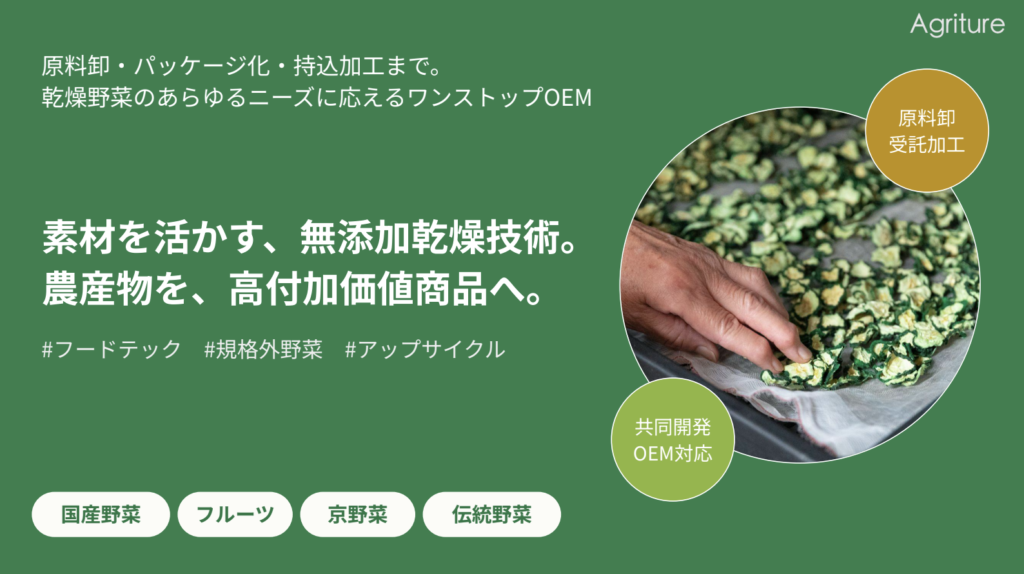
- OEM available from small lots of 10 kg
- Drying of brought-in raw materials also possible
- Support from processing to filling in one place
Download the OEM contract processing materials
We will send the materials to your email address based on the information you provide.
Author of this article
Related articles
-
 京野菜は何品目あるのか、読み方の一覧と認定の枠組みから確かめる
 -
 Drying Is Another Kind of Cooking
 -
 The Technology to Lock In the Season. The Seasonal Story Dried Vegetables Connect.
 -
 The Cut Face of a Vegetable. The Difference the Cut Makes.
 -
 Tasting Kyoto Vegetables by Aroma. The Pleasure of Cooking That Begins at the Tip of the Nose
 -
 Vessels and Kyoto Vegetables. Creating the Scenery of Plating.
 -
 Vegetables and Heat Control. Between High and Low Flame
 -
 Kyoto Vegetables and Sake. The Happy Relationship of a Dish and a Cup.