
How to Build a Seasonal Course Woven with Kyoto Vegetables

Summary of this article
Dried Kamo Nasu →
Michelin Bib Gourmand chef Yu Yoneyama explains the idea of building a seasonal course from summer Kyoto vegetables. It introduces the flow—beginning with a chilled purée of Kyo tomato and Kamogawa eggplant, moving to Fushimi togarashi and shira-yaki hamo, August Kamo nasu grilled over charcoal, and an ohitashi of water eggplant and sweet-long chili—plus a quick-reference pairing chart of Kyoto vegetables and sake such as Koshu pétillant and junmai ginjo, the three principles of temperature, texture, and sour-sweet-bitter, and a three-dish mini course to enjoy at home.
A column written by Tamotsu Yoneyama, a chef who runs "Potsura Potsura" and "Utsura Utsura" in Shinsen, Tokyo, and earned a Michelin Bib Gourmand at both stores. Tamotsu Yoneyama—Sealing summer's life, cool and clear, into a single plate—
TOC
is a column penned by . Here I convey the ideas and commitments behind how to build summer Kyoto vegetables into a course.
Summer Kyoto Vegetables Are Something Special
Summer Kyoto vegetables are, somehow, something special.
Grown lush under the blazing sun, their forms are all powerful, and yet somewhere cool.
The moment you pick one up, they carry an air as if the season's atmosphere flows softly in.
I want to set the season on the plate.
When I think that, Kyoto vegetables become a most reliable partner.
Adding "Coolness" to the Course's Beginning
When I think about a summer course, the word that first comes to mind is "coolness."
For instance, the first dish.
I serve a chilled purée of Kyo tomato and Kamogawa eggplant.
A fully ripe Kyo tomato, with just a touch of salt, has its flavor rise up astonishingly.
Add lightly seared Kamogawa eggplant and sweetness and savoriness join in, leaving a quiet aftertaste.
In a thoroughly chilled vessel, served cold.
With the first bite, the heat drains softly from deep within the body.
FOR BUSINESS
乾燥野菜を業務用でお探しですか
国産の野菜・果物を乾燥し、必要に応じて粉砕してお出ししています。扱っている品目は100種前後で、規格は 乾燥品の一覧・パウダーの一覧 に掲載しています。
少量でのご購入は、姉妹ブランドの通販サイト OYAOYA で承っています。
Wanting to make it a dish like that, I've cherished this combination every year.
Connecting the Flow with Lightness and Acidity
For the next dish, I change the tempo a little.
I bring together Fushimi togarashi and shira-yaki hamo, tied up refreshingly with sudachi and plum paste.
Fushimi togarashi has an aroma and flavor unique to this season.
Grilled slowly, its sweetness increases and it blends well with the fat of the hamo.
In building this stretch, how you use acidity is the key point.
Refreshing, yet not lacking.
Since appetite tends to flag in summer, I make a point of creating a light flow with aroma and temperature.
Fushimi togarashi How to Heat Fushimi Togarashi and Pair It with Acidity
Deep-fried plain in 170°C oil for about 30 seconds, the skin turns crisp while the inside stays juicy. Rather than squeezing the sudachi, shaving and adding the peel makes the aroma last longer.
Using a small amount of plum paste at around 15% salt concentration tightens the hamo's fat and the sweetness of the Fushimi togarashi, while staging a summery refreshment.
Kamo Nasu, Coloring the Main Course
For the main, of course, Kamo nasu.
A representative of summer Kyoto vegetables, its flavor changes depending on when it grew, which is another fascinating part.
August Kamo nasu especially has a rich aroma and a melting tenderness as its charm.
I grill it whole over charcoal, peel it, and take out just the soft interior.
Then I add a little Kujo green onion dressed in soy-koji oil, perched on top.
Though I use neither meat nor fish, it takes on the presence of a "star."
When a plate like this comes together, I'm delighted to feel I've been taught by the ingredient.
Kamo Nasu Grilled over Charcoal | From Prep to Serving
When grilling Kamo nasu whole, making a few cuts on the surface helps it cook through evenly. Grill over charcoal for about 20 minutes, turning it occasionally; it's done when a bamboo skewer slides through smoothly. When peeling, don't rinse it under water—peel it gently by hand so the aroma doesn't escape. Kujo green onion For the Kujo-green-onion soy-koji oil, dress finely sliced , soy-koji, and refined sesame oil at a ratio of 1:1:2 and let it rest for 30 minutes to stabilize the flavor.
A Closing Dish That Leaves an Aftertaste
For the finish, an ohitashi of water eggplant and sweet-long chili.
By deliberately returning to something like an appetizer, I calm the body's heat once more.
At summer's end, as a wind chime softly rings and a breeze slips quietly through.
I want to leave an aftertaste like that in the cooking too.
Pairing with Sake
Pairing with sake is, of course, an important element too.
For the chilled Kyo tomato and eggplant, for instance, a faintly sparkling Koshu pétillant.
When gentle acidity and bubbles layer over the tomato's sweetness and the eggplant's savoriness, it becomes wonderfully cool.
For the Fushimi togarashi and hamo, a chilled junmai ginjo namazake is perfect.
In harmony with the plum and sudachi, it cleanly settles the mouth.
For the charcoal-grilled Kamo nasu, a slightly aged Chardonnay or a rich yamahai junmai.
It's a presence that quietly draws close to the eggplant's viscosity and aroma.
A Quick-Reference Pairing Chart for Summer Kyoto Vegetables
Chilled Kyo tomato + eggplant → Koshu pétillant (sparkling, slightly dry). Fushimi togarashi + hamo → junmai ginjo namazake (chilled). Charcoal-grilled Kamo nasu → aged Chardonnay or yamahai junmai. Water eggplant + sweet-long chili → rosé wine or summer sake (low-alcohol sake).
Pairing Kyoto vegetables with sake Do also look at the article explaining in more detail.
FOR BUSINESS
乾燥野菜を業務用でお探しですか
国産の野菜・果物を乾燥し、必要に応じて粉砕してお出ししています。扱っている品目は100種前後で、規格は 乾燥品の一覧・パウダーの一覧 に掲載しています。
少量でのご購入は、姉妹ブランドの通販サイト OYAOYA で承っています。
Facing Summer Kyoto Vegetables
Summer Kyoto vegetables are all brimming with vitality, yet never pushy.
Straight, honest, with a clarity to them.
That's precisely why we cooks use them without pulling too hard, drawing close to them.
"Cool, and energizing."
Aiming for a summer course like that, I face the vegetables day after day.
Three Basic Principles for Building a Seasonal Course
There are three principles I keep in mind in composing a course. First, "a rise and fall in temperature." Begin cold, build with a hot dish, and close again with a cold plate, and a rhythm is born in the sensation. Second, "changes in texture." Slipping a crisp Fushimi togarashi in after a melting Kamo nasu—not letting texture grow tiresome is important.
Third, "a balance of sour, sweet, and bitter." Apportioning the course so acidity, sweetness, and bitterness don't skew, and creating timing where the guest's palate is reset. staging aroma Adding finishes it into a course that appeals to all five senses.
A Summer Kyoto-Vegetable Mini Course to Enjoy at Home
At home too, you can enjoy a small three-dish course. A chilled Kyo tomato suri-nagashi as the appetizer, and chicken breast with grilled over an open flame as the main, Manganji togarashi and a closing dish of Shogoin kabura light-pickled dressed with ponzu. Total cooking time is about 30 minutes.
Dried Kyoto vegetables Keep on hand and you can recreate the aftertaste of a summer Kyoto-vegetable course even in winter.
Kyoto vegetable columns to read together
For those who want to know Kyoto-vegetable course cuisine more deeply, we also introduce Subtractive cooking methods and the idea of vessels and plating please be sure to see this as well. It also touches on the relationship between and its relationship to Kyoto vegetables.
We have materials available to help you understand dried processing OEM
Agriture OEM, flexibly handling everything from small lots to large lots
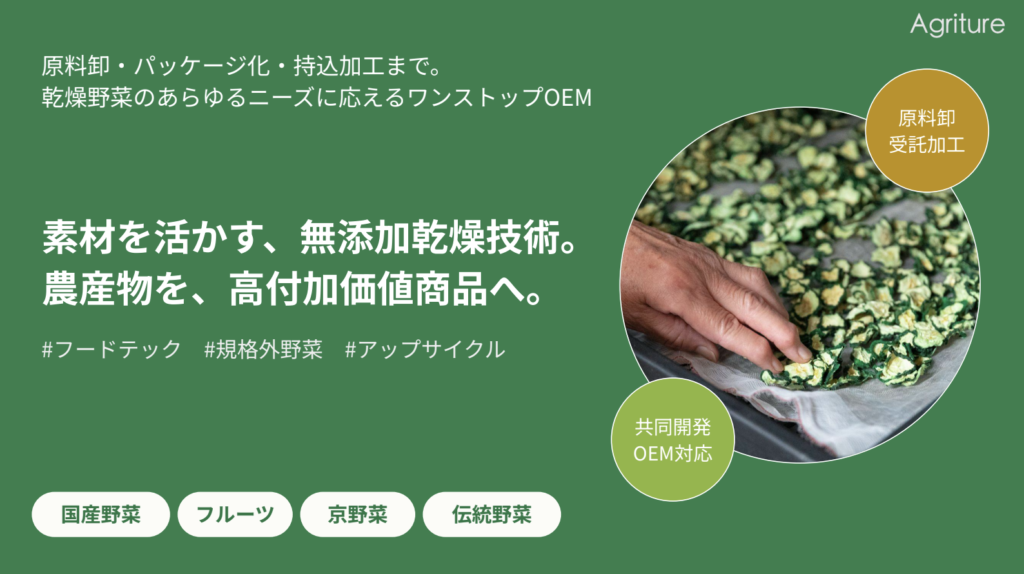
- OEM available from small lots of 10 kg
- Drying of brought-in raw materials also possible
- Support from processing to filling in one place
Download the OEM contract processing materials
We will send the materials to your email address based on the information you provide.
- Why Are Kyoto Vegetables Expensive? History, Brand Power, and Producers' Commitment Explained
- 京野菜は何品目あるのか、読み方の一覧と認定の枠組みから確かめる
Author of this article
Related articles
-
 京野菜は何品目あるのか、読み方の一覧と認定の枠組みから確かめる
 -
 Drying Is Another Kind of Cooking
 -
 The Technology to Lock In the Season. The Seasonal Story Dried Vegetables Connect.
 -
 The Cut Face of a Vegetable. The Difference the Cut Makes.
 -
 Tasting Kyoto Vegetables by Aroma. The Pleasure of Cooking That Begins at the Tip of the Nose
 -
 Vessels and Kyoto Vegetables. Creating the Scenery of Plating.
 -
 Vegetables and Heat Control. Between High and Low Flame
 -
 Kyoto Vegetables and Sake. The Happy Relationship of a Dish and a Cup.