
Tasting Kyoto Vegetables by Aroma. The Pleasure of Cooking That Begins at the Tip of the Nose

Summary of this article
A column by chef Yu Yoneyama on the joy of savoring Kyoto vegetables through aroma. He introduces the mechanism by which Kujo negi's allyl sulfide (allicin) and hexanal change into propyl mercaptan above 60°C, turning into a sweet aroma; grilling-time guidelines for shishito and Manganji chili pepper; steam-simmering technique for Shogoin kabura; the earthy aroma of Horikawa gobo; storage methods; a shopping guide that chooses by aroma for kintoki carrot and Shishigatani kabocha; and a list of Kyoto-vegetable cultivars.
Cooking, it's often thought, is something you savor by putting it in your mouth. In fact, it starts much earlier. The green scent that rises when you put a knife in, the sweet aroma that drifts up the moment you put it over the flame. That aroma reaching your nose is the first signal for the cook and the entrance for the eater.
TOC
Kujo negi | aroma tells you "raw" and "ripe"
Handling Kyoto vegetables, you're struck by the richness of their aromas.
For example, Kujo green onion. Chopped on the cutting board, a fresh green scent spreads. Even without bringing your nose close, it dissolves right into the air, enough to make you pause the knife in your hand. Raw, it carries a slight pungency, but heat it and it turns to sweetness. That shift in aroma lets you feel negi's two faces, "raw" and "ripe."
Kujo negi's aroma components and temperature change
Kujo green onion's green scent is really volatile components like allyl sulfide (allicin) and hexanal. In the raw state it's a stimulating aroma with pungency, but heated above 60°C the allyl sulfide changes into propyl mercaptan and turns into a sweet aroma.
Knowing this "aroma turning point" makes it easier to judge whether to use it raw or apply heat. When using Kujo negi as a condiment, plating it within 30 seconds of chopping makes the aroma stand up most.
Shishito | the scent of char signals it's grilled
When grilling shishito, too, you meet the magic of aroma.
Grilled sizzling on the grill, at first a green scent drifts, and before long the slight bitterness of char mixes in. In that moment it's as if the vegetable itself is saying "take me off soon," and as a cook you gauge the heat by straining to listen to the aroma. Served before the guest, first the toastiness tickles the nose, and that alone hurries the first bite. Aroma awakens the appetite.
Grilling-time guidelines for shishito and Manganji chili pepper
Shishito over a high-heat grill for 30 seconds to 1 minute per side. When faint char marks appear on the surface and it crackles, that's the sign to turn it. Manganji togarashi is thick-fleshed, so 1.5–2 minutes per side is appropriate.
Grill too long and the aroma components fly off, leaving only bitterness. "The moment the toasty aroma is strongest" is the best timing to pull it off.
FOR BUSINESS
乾燥野菜を業務用でお探しですか
国産の野菜・果物を乾燥し、必要に応じて粉砕してお出ししています。扱っている品目は100種前後で、規格は 乾燥品の一覧・パウダーの一覧 に掲載しています。
少量でのご購入は、姉妹ブランドの通販サイト OYAOYA で承っています。
Shogoin kabura | gentleness dissolving into the steam
Winter is large at 15–20cm in diameter, so choosing a deep plate or shallow bowl 18cm or more across allows for a roomy plating. Shogoin kabura, too, has a truly gentle aroma when heated.
Retaining a faint earthy scent, a tender sweetness rises up as steam with the dashi. Just smelling that aroma, your body naturally eases and feels wrapped in warmth. It makes you feel "this is a gentle dish" even before tasting. Aroma has the power to unwind the eater's heart, I think.
How to lock in aroma by steam-simmering Shogoin kabura
Shogoin kabura To make the most of 's aroma, steam-simmering is recommended. Add about 2cm of water to the pot, put in the kabura cut into quarters, cover, and simmer over low heat for 20–25 minutes. With little moisture, the kabura's own aroma fills the pot, and the moment you lift the lid, sweet steam rises up.
Shogoin kabura originated in Shogoin, Sakyo Ward, Kyoto City. A large cultivar 15–20cm in diameter weighing 1–3kg, its season is November–February. It's also known as the raw material for senmaizuke.
Horikawa gobo | the depth of the root, told through aroma
Horikawa gobo has an even deeper aroma.
The earthy scent drifting the moment you peel it, and the sweet, rich aroma rising as you simmer it through. Chasing that change at your nose, you're made to feel "gobo tells the depth of its root through aroma." Texture and flavor are appealing too, of course, but the memory of aroma lingers longer. Even after eating the simmered dish, a soft afterglow stays deep in your nose for a while.
Aroma is the signal of "done"
For the cook, aroma also serves as a "guideline for doneness."
When quickly stir-frying Kujo negi in oil, stop the heat as soon as the aroma stands up. Fry beyond that and sweetness increases, but the aroma flies off. When deep-frying Manganji chili pepper plain, the aroma bursting in the oil is the signal. Pulling it out before the aroma escapes preserves the vividness when it hits your mouth. Before you can measure the flavor, aroma already tells you it's "finished."
Aroma as the memory of a season
Aroma is also tied to the memory of a season.
A summer morning, the green scent of cucumber picked in the field. At the end of autumn, the deep earthy scent when you cut Horikawa gobo. A winter night, the steam of a pot with Shogoin kabura soaked in. Facing aroma day after day as a cook, aromas pile up like a season's notebook. That's why, delivering that aroma at the table, guests too tell me they "feel they're eating the season."
The joy of aroma for the cook
The fun of savoring through aroma is a great joy not only for the eater but for the maker too.
The scent when the knife goes in, the steam when heat is applied. Because the cooking process itself is full of aroma, I think that while cooking you've already "savored the dish" once. And that joy carries into plating, ultimately uniting aroma and scenery on the plate. Cooking begins before it's carried to the mouth, and continues long afterward along with the memory of aroma.
FOR BUSINESS
乾燥野菜を業務用でお探しですか
国産の野菜・果物を乾燥し、必要に応じて粉砕してお出ししています。扱っている品目は100種前後で、規格は 乾燥品の一覧・パウダーの一覧 に掲載しています。
少量でのご購入は、姉妹ブランドの通販サイト OYAOYA で承っています。
In closing | listening to the voice of aroma
When I cook, I always think about "how to bring out the voice of aroma."
Because aroma vanishes in an instant, I want to catch that fleetingness and carry it into the dish. The greenness of Kujo negi, the toastiness of shishito, the gentleness of Shogoin kabura, the depth of Horikawa gobo. How to resonate each aroma and how to deliver it to the guest—that is a great joy for the cook and an endless pursuit.
Kyoto-vegetable storage techniques that don't let aroma escape
Kyoto vegetables' aroma is lost rapidly along with freshness. After buying, wrap them in newspaper and store them standing up in the vegetable drawer as a rule. Wrapping Kujo negi's root end in dampened paper towel keeps the aroma for about 3 days.
dry processing Kyoto vegetables that have been retain concentrated aroma from the loss of moisture. Used in simmered dishes and soups, you can enjoy a deep aroma different from the raw state. List of Kyoto vegetable varieties.
A Kyoto-vegetable shopping guide that chooses by aroma
At farm stands and marches, we recommend picking them up and checking the aroma before buying. Kintoki carrot the deeper the cross-section color, the stronger the aroma, and Shishigatani kabocha a sweet aroma when you smell around the calyx is proof of full ripeness.
Kyoto vegetable calendar Checking the season together with makes it easier to obtain Kyoto vegetables at their most aromatic state.
Kyoto vegetable columns to read together
Alongside aroma, do also see the world of the equally important "heat control," and how to heighten the presentation of aroma with "vessels and plating."Sustainable food culture We also touch on the role aroma plays in Kyoto vegetables within.
We have materials available to help you understand dried processing OEM
Agriture OEM, flexibly handling everything from small lots to large lots
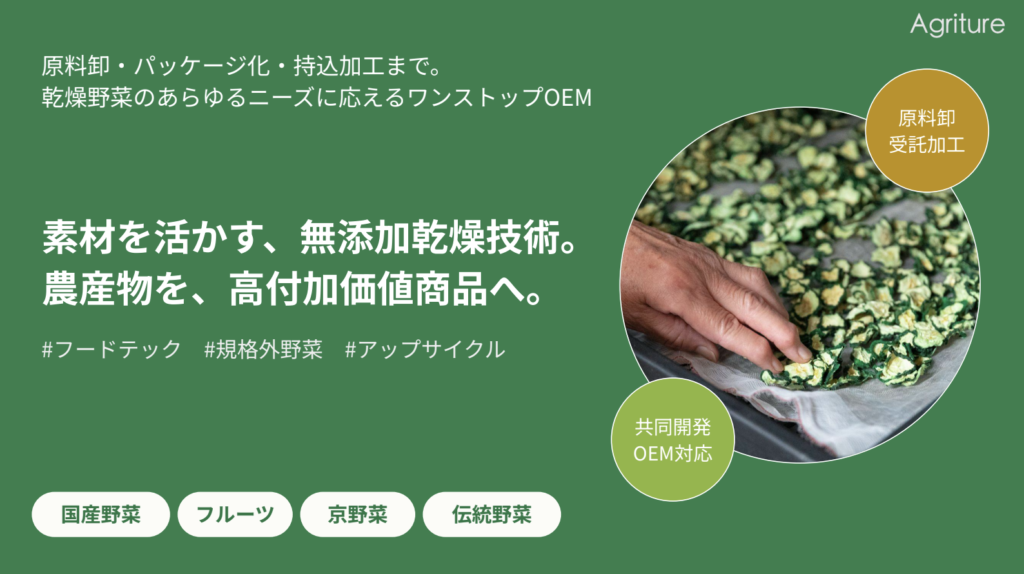
- OEM available from small lots of 10 kg
- Drying of brought-in raw materials also possible
- Support from processing to filling in one place
Download the OEM contract processing materials
We will send the materials to your email address based on the information you provide.
- Vessels and Kyoto Vegetables. Creating the Scenery of Plating.
- The Cut Face of a Vegetable. The Difference the Cut Makes.
Author of this article
Related articles
-
 京野菜は何品目あるのか、読み方の一覧と認定の枠組みから確かめる
 -
 Drying Is Another Kind of Cooking
 -
 The Technology to Lock In the Season. The Seasonal Story Dried Vegetables Connect.
 -
 The Cut Face of a Vegetable. The Difference the Cut Makes.
 -
 Vessels and Kyoto Vegetables. Creating the Scenery of Plating.
 -
 Vegetables and Heat Control. Between High and Low Flame
 -
 Kyoto Vegetables and Sake. The Happy Relationship of a Dish and a Cup.
 -
 Kyoto Vegetables and Dashi —The Resonance Between the Ingredient's Voice and the Dashi—