
The Technology to Lock In the Season. The Seasonal Story Dried Vegetables Connect.

Summary of this article
Michelin Bib Gourmand chef Yu Yoneyama talks about how to lock in the season of Kyoto vegetables with drying technology. He introduces practical drying methods that connect the seasons -- the technique of cutting August Manganji peppers from Maizuru, Kyoto lengthwise in half and sun-drying them for 3 to 5 days, drying Kamo eggplant in 5 mm slices, making leek salt with dried Kujo green onion at 1 part leek to 2 parts salt, and drying shaved Horikawa burdock -- along with applications such as a simmered dish of Shogoin turnip and dried Manganji, and Kamo eggplant simmered in dried-burdock dashi.
Working as a chef, you're constantly faced with the question of how to handle seasonal ingredients. Vegetables are living things. Their most beautiful moment arrives for only a brief span, and a single shift in temperature or rainfall can utterly change their face. That's exactly why how to deliver a "taste of only now" to guests always troubles my mind and, at the same time, is a challenge that excites me.
Among all that, what I hold dear is the technique of "drying."
Drying isn't just for preservation; I think of it as "another cooking method" for delivering the season into the future.
TOC
Manganji pepper | Carrying the memory of summer into winter
The finest sweetness of a midsummer Manganji
For example, the Manganji togarashi harvested in midsummer. Those picked at the height of August have thick flesh, strong sweetness, and a rich aroma. The Manganji grown in the Maizuru region of Kyoto has a meatiness not found in other pepper varieties, and you can taste ample sweetness even eaten raw.
The memory of summer concentrated by drying
Dry that same form as-is, and it becomes not just a pepper but a "concentrated memory of summer." On a cold winter night, add a little to a simmered dish, and the sweetness and aroma that gently return from the dried Manganji spread out, a flavor that seems to call back the air of summer. There, the technique of "drying" shows its power to transcend time and connect the seasons.
The method suited to drying Manganji
To dry Manganji peppers, first cut them lengthwise in half and remove the seeds, then sun-dry them in a well-ventilated spot. Because the flesh is thick, it takes about 3 to 5 days to dry completely. Manganji dried thoroughly can be stored in an airtight container for several months, and with commercial dry processing even longer quality maintenance is possible.
FOR BUSINESS
乾燥野菜を業務用でお探しですか
国産の野菜・果物を乾燥し、必要に応じて粉砕してお出ししています。扱っている品目は100種前後で、規格は 乾燥品の一覧・パウダーの一覧 に掲載しています。
少量でのご購入は、姉妹ブランドの通販サイト OYAOYA で承っています。
Kamo eggplant | A new dignity born of drying
The technique of slicing thin and sun-drying
Kamo eggplant is another vegetable that shows a different face when dried.
Slice its plump flesh thin and set it in the sun, and the excess moisture escapes while the umami concentrates tightly. Because Kamo eggplant is especially high in moisture among Kyoto vegetables, slicing it to about 5 mm is the key to successful drying.
How to use dried Kamo eggplant
Use it in mixed rice, and a nourishing sweetness rises up, different from when it soaks up oil. In contrast to the freshness of new Kamo eggplant, "dried Kamo eggplant" holds a settled umami, lending a dignity fitting for a winter kitchen. It also pairs superbly with the traditional Kyoto cooking method of simmering in Saikyo miso.
Kujo green onion | A new voice born of drying
Aroma and sweetness that change with sun-drying
Kujo green onion, too, changes its impression when dried.
Chop it and set it in the sun, and the fresh green aroma softens somewhat while the sweetness grows stronger instead. The mucilaginous component distinctive to Kujo green onion changes during drying, and it's an interesting feature that a unique thickness emerges when rehydrated.
How to make the all-purpose seasoning "leek salt"
Powder dried Kujo green onion and combine it with salt for a versatile "leek salt" that supports your cooking year-round. The ratio guide is 1 part dried onion to 2 parts salt. Kujo green onion wears a different face each season, but by going through the process of drying, it gains yet another new voice. Seasonal calendar of Kyoto vegetables Looking at
, though Kujo green onion is available year-round, drying winter onion brings out the strongest sweetness.
Horikawa burdock | The wisdom of locking in roastiness
Aroma heightened by thin-slice drying Horikawa gobo。
And what must not be forgotten is Horikawa gobo the finely grown
slice it thin and dry it slowly, and its roastiness stands out all the more. The aroma that rises when rehydrating with water has the strength of burdock grilled by a winter hearthside. Because Horikawa burdock is thicker in diameter than ordinary burdock and hollow at the center, slicing it thin lets it dry evenly.
Applying dried burdock to dashi Use it as the base of a simmered dish or dashi, and it lends depth to the whole dish. Dried burdock also keeps well and has long been a "wise ally" supporting Kyoto kitchens. In shojin cuisine there's a tradition of using the soaking liquid of dried burdock as a dashi base, an ingredient deeply rooted in the food culture of Kyoto vegetables
Drying is another "cooking with heat"
The changes born of moisture leaving
The fascination of dried vegetables lies not in mere preservation but in giving rise to a "new expression."
As moisture leaves, the fibers' texture changes, the aroma concentrates, and at times a different flavor even rises up. In other words, drying is another "cooking with heat." Rather than drawing out umami all at once with fire, the sun and wind finish the vegetable slowly. There, work by nature beyond a chef's hands is involved, and that, I think, is exactly why a depth is born.
The changes in nutrients that drying brings
When moisture leaves in the drying process, umami, sweetness, and aroma concentrate tightly. With sun-drying, because it dries slowly over time, the texture when rehydrated finishes naturally too, and you can enjoy a deeper flavor different from when fresh. A sustainable diet In considering it too, dried vegetables are drawing attention.
A dish that transcends the season
A simmered dish of Shogoin turnip and dried Manganji
In fact, among the dishes I serve to guests in winter, dried vegetables show great power.
For example, Shogoin kabura A simmered dish of
and dried Manganji. The turnip's gentle sweetness and the dried Manganji's concentrated aroma melt together into a heartfelt flavor.
Kamo eggplant in dried-burdock dashi Shogoin daikon Or, Kamo eggplant simmered in a dashi enriched with dried burdock. The moment it enters your mouth, the roastiness of burdock and the melting texture of Kamo eggplant resonate, completing a dish that transcends the season.
Add julienned dried
, and a contrast of textures is born too, making it a luxurious dish where several seasons coexist in a single plate.
Delivering the season into the future
The meaning of the technique of locking in the season
A chef's joy lies in bringing "the vegetable of this very moment" to life, but at the same time it lies in layering ingenuity to "deliver the season into the next season too."
The technique of drying grants both. It locks in the season and spreads it before guests across time. When the memory of the season packed into that plate gently warms the heart of the one who eats it -- when I can be present at such a scene, I find myself thinking anew, "I'm glad I cook."
FOR BUSINESS
乾燥野菜を業務用でお探しですか
国産の野菜・果物を乾燥し、必要に応じて粉砕してお出ししています。扱っている品目は100種前後で、規格は 乾燥品の一覧・パウダーの一覧 に掲載しています。
少量でのご購入は、姉妹ブランドの通販サイト OYAOYA で承っています。
Food-loss reduction and drying technology
As awareness of food loss grows, drying technology is taking on new meaning. By drying Kyoto vegetables harvested in large quantities in season, you can turn them into ingredients usable year-round while reducing waste. Off-spec vegetables that can't go to market also become fine products once dry-processed. A traditional preservation technique is contributing to solving the challenges of the modern food system, too.
In closing | A small boat carrying the season
Dried vegetables are like small boats carrying the season to the tables of the future.
Related articles
- How are commercial dried vegetables made?
- For commercial use, low-temperature dryers and freeze-drying technology are used. Low-temperature drying uses warm air of about 40 to 60C to dry slowly, holding down loss of color and nutrients. Freeze-drying is a technique that freezes and then sublimates the moisture under vacuum; it has high reconstitution, letting you rehydrate close to the original shape and flavor.
- Kyoto vegetable calendar — check the seasons of the four seasons at a glance
Recommended reading
List of Kyoto vegetable varieties / Kyoto vegetable calendar / Commercial dried vegetables / Kamo Eggplant: A Kyoto Vegetable Prized for Its Round Shape and Rich Flavor / The Real Reason Chefs Use Kyoto Vegetables
We have materials available to help you understand dried processing OEM
Agriture OEM, flexibly handling everything from small lots to large lots
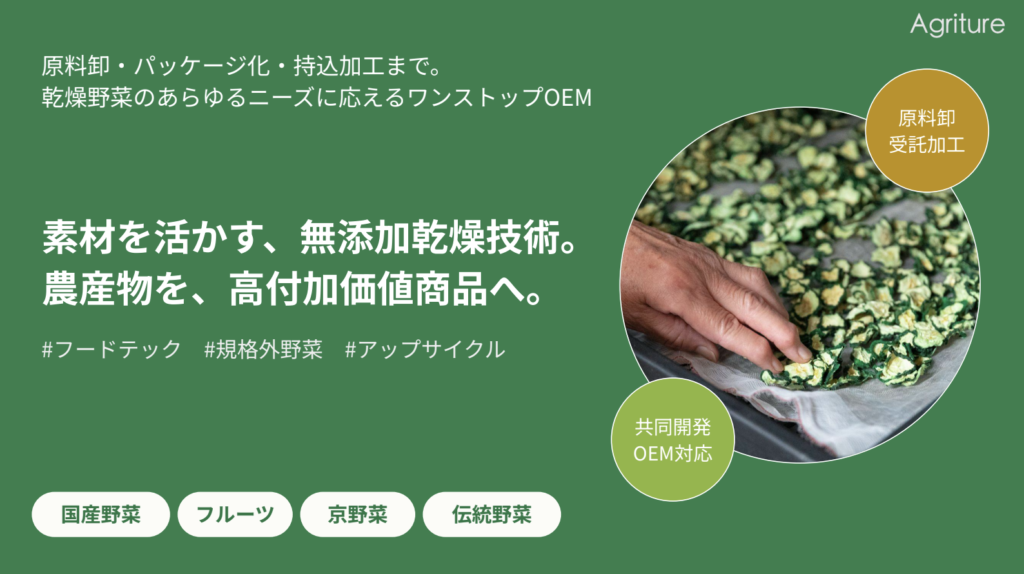
- OEM available from small lots of 10 kg
- Drying of brought-in raw materials also possible
- Support from processing to filling in one place
Download the OEM contract processing materials
We will send the materials to your email address based on the information you provide.
Author of this article
Related articles
-
 京野菜は何品目あるのか、読み方の一覧と認定の枠組みから確かめる
 -
 Drying Is Another Kind of Cooking
 -
 The Cut Face of a Vegetable. The Difference the Cut Makes.
 -
 Tasting Kyoto Vegetables by Aroma. The Pleasure of Cooking That Begins at the Tip of the Nose
 -
 Vessels and Kyoto Vegetables. Creating the Scenery of Plating.
 -
 Vegetables and Heat Control. Between High and Low Flame
 -
 Kyoto Vegetables and Sake. The Happy Relationship of a Dish and a Cup.
 -
 Kyoto Vegetables and Dashi —The Resonance Between the Ingredient's Voice and the Dashi—