
How do you dry chili peppers? Days to dry them and how to store them without mold

Summary of this article
Drying chili peppers does not end with sun-drying alone. We have brought together why growing-region reports make a finishing forced-drying step essential and the 40°C temperature ceiling, the drying end point you confirm by snapping a pepper, how to seal them so mold does not form, how to use room-temperature, refrigerated and frozen storage and their best-before periods, why you should not handle them with bare hands, how to use up a large quantity, and the fact that national statistics count chili peppers by dried weight.
The chili peppers in your garden turn bright red, you spread them on a basket and set it under the eaves. After about a week they are bone-dry, so you put them in a jar. A month later you open the lid and find something like white fuzz on them. This is not a rare story.
Here is the conclusion first. Sun-drying alone does not finish the drying. A report compiled by Kagawa Prefecture's Agricultural Extension Center states plainly that "even with sun-drying, a subsequent finishing forced-drying step is essential." A reason is given too. No clear benchmark for the drying end point has been established, and mold incidents during storage caused by insufficient drying are common, and that's the main reason.
Articles and videos aimed at home use say "two weeks if clear weather holds" or "about a month," but there is no official standard setting a number of drying days. The extension center that guides growing regions itself writes that "no benchmark for the drying end point has been established." For shipping from growing regions, there are cases where drying alone takes two months. The number of days depends entirely on conditions, and what you should rely on is not the day count but "how to confirm whether it has dried."
In this article, going back to statistics from the Ministry of Agriculture, Forestry and Fisheries and to growing-region reports, we lay out in order how to dry, how to finish, how to tell when it is done, and how to store. From the standpoint of drying domestically grown vegetables and supplying them for commercial use, we have also written in the hands-on sense of a side that removes moisture every day at the factory.
TOC
Drying chili peppers does not end with sun-drying alone
The drying work itself has two stages. The first half is drying by sun or airflow, the second half is a finishing step that applies heat to drive out the remaining moisture. After that come cooling and storage. Failures at home almost always happen when the second half is skipped.
Growing-region reports state that "a finishing forced-drying step is essential"
In a report compiled by the Seisan Agricultural Extension Center of Kagawa Prefecture on building up the growing region for the heirloom variety "Kagawa Hontaka," the following appears as a challenge in drying technology.
Furthermore, the same applies to the drying temperature of the fruit. Even with sun-drying, a subsequent finishing forced-drying step is essential. The forced-drying temperature is capped at 40°C, from the standpoint of preserving flavor based on experience, but because no benchmark for the drying end point has been established, mold incidents during storage caused by insufficient drying are also common, and an easy-to-understand benchmark for the drying end point is under consideration.
Seisan Agricultural Extension Center, Kagawa Prefecture, "Island and town revitalization drawing on the storytelling appeal of the attractive chili pepper 'Kagawa Hontaka'" (Tokusan Shubyo No. 20) / wording as in the original
A public institution in the position of guiding growing regions writes, as a challenge of its own, that "mold incidents from insufficient drying are common." What's more, it cites the lack of an established benchmark as a challenge so the right way to read the day counts that appear in home-use articles is as rough guides.
The reason for capping at 40°C is to retain aroma and flavor
The same report states that the finishing heat is capped at 40°C. The reason is to "preserve flavor." Raising the temperature dries them faster, but the aroma goes first. At our factory, too, we set the temperature for each type of vegetable, and the more an ingredient sells on its aroma, the lower we keep the temperature and the more time we take.
When you use an oven at home, it is not unusual for even the lowest setting to exceed 100°C. As a heat source this is too strong, so you need to make adjustments such as leaving the door slightly open, running it for short periods, or using only the residual heat. We cover the details in the section on finishing indoors.
Whether drying is sufficient is decided by the state of the peppers, not the number of days
Even starting to dry in the same October, moisture leaves very differently in a region along the Seto Inland Sea where clear days continue than in a region on the Sea of Japan side where cloudy weather is frequent. It also changes between varieties with thick flesh and those with thin flesh. The number of days is only a rough guide; you judge by feel and by how it snaps。
| Process | What to do | Where things tend to go wrong |
|---|---|---|
| First half: sun- and air-drying | Spread on a basket or net, or hang on a string | Piling them up, so the underside does not dry |
| Second half: finishing drying | Apply heat to drive out the remaining moisture | Skipping this and moving straight to storage |
| Cooling | Bring to room temperature | Sealing while still hot, so condensation forms inside |
| Storage | Seal and keep out of light | Taking on moisture again with no desiccant |
Fresh peppers can only be kept for a few days
The window between harvesting and drying is not long either. The Kagawa report mentioned above says that fresh fruit "loses its commercial value within a few days of harvest due to mold." It is a sentence written in the context of explaining that this is a crop hard to distribute through the market.
In other words, a plan to put red chili peppers you were given into the refrigerator still in their bag and leave them until the weekend is unworkable. Spread them out the same day or the next day you receive them is the baseline.
Which pepper does "red chili" in a recipe mean?
Before drying, let's sort out the names just once. A recipe says "red chili," and what you have at home is "takanotsume." You get stuck on whether it means the dried or the fresh form.
"Red chili" is a name for the degree of ripeness, not a variety name
The fruit of chili peppers changes color from green to red. "Green chili" and "red chili" are differences in ripeness of the same fruit, not different crops. "Red chili" in a recipe means one that has ripened red; it does not specify a variety.
This distinction decides whether to dry them. Red is for drying, green is for using fresh. We will explain later that rather than forcing green ones to dry, you get better results by turning them to processing that makes use of their fresh moisture.
"One red chili" in a recipe means one dried takanotsume
Takanotsume is an heirloom variety long used in Japan, bearing small, slender fruit. When a recipe says "one red chili," what it assumes is the size of a dried takanotsume.
In other words, using one large-fruited pepper like Kagawa Hontaka makes it hotter than the recipe assumes. If the size differs, change the number too is how to think about it. The relationship between varieties and names is唐辛子と鷹の爪とししとうの違いcovered in detail in.
| Name | What it refers to | Whether to dry |
|---|---|---|
| Green chili | Green fruit before ripening | Used fresh, not dried |
| Red chili | Fruit ripened red not a variety name | Dried for storage |
| Takanotsume | Small, slender heirloom variety | Distributed as a dried product |
| Shishito / Fushimi amanaga manganji | Mild sweet varieties | Drying them does not make a condiment |
When you dry sweet varieties, the purpose changes
Shishito, Fushimi amanaga and Manganji togarashi are mild sweet varieties. Drying and grinding them does not make ichimi (chili powder).
They are, however, worth drying as a vegetable, and we handle Kyoto's Dried Manganji pepper and Dried Fushimi togarashi. It is drying aimed at retaining sweetness and aroma, a different aim from drying hot varieties.
Which chili peppers to dry, and when
Half the result is decided by sorting before drying. If fruit with high moisture, damaged fruit, or fruit that has not fully colored gets mixed in, mold spreads from there.
Dry only the fully red-ripened ones
Chili peppers change color from green to red. While green, the flesh holds a lot of moisture and dries slowly, so what you dry is ones that have fully turned red on the branch. Letting them fully ripen while still on the plant also gives a deeper color.
After turning red, some fruit begins to dry on the branch and wrinkle. These finish quickly if you harvest and dry them as is. But exclude any that are darkened, split, or have insect holes.
Harvest by picking the red ones first, in order
The fruit on a single plant does not all turn red at once. Pick the red ones in order and leave the green ones is the basic approach. Picking makes the plant channel its energy to the next fruit, so the harvest period also lengthens.
When you pick, cut with scissors, taking the branch above the stem cap. Tearing by hand pulls off the stem cap or splits the fruit, and spoilage sets in from there.
- Check for red ones every week
- Decide on any that remain green before the frost comes
- If you pull up the whole plant and hang it upside down, some will turn red on the branch
- If you get a large amount at once, spread them out the same day
As autumn deepens and temperatures fall, green ones turn red no further. Frost damages the fruit, so before that the common method is to pull up the whole plant and hang it upside down in a well-ventilated spot. The nutrients left in the branch can bring on color, and you remove the red ones in order.
For any that still end up green, give up on drying and use them fresh. Uses include chopping and mixing with salt, pickling in soy sauce, or kneading with yuzu peel.
Better to use green chili fresh than to dry it
To answer first, you can dry it, but it is not suited to it. While green, the flesh holds a lot of moisture and dries more slowly than red fruit, so it tends to tip toward spoiling before it dries through. Growing regions, too, do not send green ones to drying.
The study group handling Aomori Prefecture's heirloom variety "Shimizumori Namba" sells the immature green chili among its collected peppers fresh, for fresh-produce and processing use, and dries and then mills the red chili into chili powder. It separates the outlets for green and red.
What green chili suits is processing that makes use of its fresh moisture. Yuzu kosho is the prime example, and in a trial to select varieties for raw material, the Kumamoto Prefectural Agricultural Research Center made yuzu kosho from green fruit and compared quality across varieties. If you have green ones on hand, chopping them and combining with salt and yuzu peel brings out their character better than drying. The blend guideline is given in the section on using them up.
How easily they dry and how they finish vary by variety
The hot varieties grown in Japan are a mix of heirloom varieties such as "takanotsume" and "hontaka" and varieties developed by food makers and prefectures. How easily they dry changes with the thickness and size of the flesh, so checking which the peppers you were given are closest to makes it easier to plan.
| Variety / lineage | Fruit form | Ease of drying |
|---|---|---|
| Takanotsume | Small and slender | Thin flesh, dries quickly |
| Tochigi Kairyo Santaka | Uniform in shape | Picking, drying and similar work is reported to be easy |
| Kagawa hontaka | 4–5 times the size of takanotsume, about 12 cm Fruits upward | Flesh slightly thicker than takanotsume and correspondingly harder to dry |
| Shimizumori Namba | Long type with broad shoulders | In growing regions, red fruit is dried and milled into powder |
| Shima togarashi | Small and very hot | Small, dries quickly |
| purple chili pepper | Colors purple | Dried slowly at low temperature to retain color |
"Tochigi Kairyo Santaka" is a variety that Genshiro Yoshioka, who moved to Otawara City, Tochigi Prefecture, succeeded in breeding and named in 1955 (Showa 30). In the council's report, it is strongly hot, good in color, uniform in shape, high-yielding, easy to work with for picking, drying and the like, and keeps well—six characteristics are cited. That ease of drying becomes a selling point of a variety shows how heavy a step drying is for this crop.
Dry them with the stem cap left on, not removed
If you remove the stem cap before drying, that becomes an opening and air and moisture get inside the flesh. When hanging, the stem cap serves as the knot, so it is all the more necessary.
Removing the stem cap is done after drying. Growing regions follow the same order; in Tochigi, after the drying is finished, there is a step of "plucking" the fruit and stem cap apart by hand. We cover the burden of this work in detail in the section on handling precautions.
FOR BUSINESS
Looking for dried chili peppers as a raw material?
We handle the drying and milling of domestically grown chili peppers. We do not carry common hot varieties such as takanotsume as standard items; we offer Okinawa's Dried island chili pepper, Yamato vegetables' Dried purple chili pepper, and Kyoto's Dried Fushimi togarashi . For the specifications of the items we handle, List of dried products・List of powders listed at.
We give a best-before guideline of around six months from the shipping date for dried products. For small-quantity purchases, our sister brand's online store OYAOYA handles orders.
Steps for sun-drying, and how many days it takes
From here are the actual steps. For equipment, a drying basket or a laundry net dryer is enough.
The time to dry is late September to early November
Chili peppers turn red in autumn. If you sun-dry, a period when clear days continue and humidity drops is what you aim for. In practice you can act from around late September to early November; any later and the temperature and sunlight are not enough.
What you must not do is dry them outdoors during the rainy season or the long autumn rains. When humidity is high, the moisture that leaves during the day is taken back overnight, and no number of days makes progress. In a week of continuous rain, finish indoors and by machine from the start is the faster decision.
Conditions also differ by region. Along the Seto Inland Sea and the Pacific side, clear weather tends to continue before winter, while on the Sea of Japan side and in mountainous areas, cloud and rain increase. The same steps progress differently, so there is little point comparing day counts with others.
The equipment can be a basket or a drying net
- Flat basket: the easiest to handle. Enough room to lay them out without overlapping is all you need
- Hanging drying net: keeps insects and birds away. Multi-tier ones suit a large number
- Reed screen or slatted board: air passes through from below. A substitute when you have no basket
- Directly on newspaper: the paper holds moisture, so it is not suitable
- Metal tray: moisture collects underneath, so it is not suitable
There is a single criterion for choosing, whether air passes through from below. If you choose something with a mesh and place them spaced so the fruit does not touch, the difference between tools barely shows.
Whether to wash depends on where you dry
If dirt or dust bothers you, rinse quickly with water and then wipe off the moisture completely with a cloth. If you pile them up with water left on the surface, that becomes the starting point for mold.
If you dry outdoors, there is also the option of drying without washing and wiping with a dry cloth at the end. The longer they sit outdoors, the more something settles on the surface。乾燥に2か月かける産地でも、乾燥中にほこりが付くことは避けられない前提で扱われています。
重ねずに並べ、1日1回は転がす

- ざるや平らな網に、果実が触れ合わない間隔で並べる
- 風が抜ける場所に置く。当社の工場でも、温度より風量のほうが乾き方を変えます
- 朝置いて夕方に取り込む。夜露に当てると水分が戻ります
- 1日1回、手で転がして向きを変える
- 表面がしぼんで、指で押すとへこまなくなったら次の段階へ
雨に当てると乾きの進みが戻るだけでなく、半乾きのまま濡れることで内側から傷みます。天気予報を見て、降る日は屋内に入れる。これだけで失敗の多くは防げます。
日数は数日から2か月まで幅がある
乾燥にかかる日数は、果実の大きさ・置き場所・天候で大きく変わります。下の表は条件ごとの目安で、当社が野菜を乾燥している経験から見た範囲です。日数を定めた公的な基準は見当たらないので、保証する数字として読まないでください。
| 干し方・条件 | 前半にかかる目安 | Notes |
|---|---|---|
| 小ぶりな果実・晴天が続く屋外 | 4日〜1週間 | 鷹の爪サイズ。表面が縮むのが早い |
| 果肉が厚い大果・晴天が続く屋外 | 2–3 weeks | 中心まで乾きにくい |
| 室内で風を当てるだけ | 2週間〜1か月 | サーキュレーターがあると進む |
| 紐で吊るして軒下 | 3週間〜1か月以上 | 雨と夜露を避けられる場所が前提 |
| 産地の出荷(栃木の例) | 約2か月 | 乾燥だけで2か月 この後にもぎりと選別 |
表のどの条件でも、前半が終わった段階で「まだ中心に水分が残っている」状態です。ここから仕上げに入ります。
途中で雨に降られたときの立て直し
半乾きのまま濡れたら、まず水気を拭いて広げ、風を当てて表面を乾かします。そのうえで、その日のうちに熱をかけて仕上げるところまで進めてしまうのが安全です。一度濡れたものを、また屋外に出して日数をかけるのは避けます。
黒く変色した果実、ぬめりが出た果実は、この時点で捨てます。1個が残ると、乾いたあとの瓶の中で周りに広がります。
紐で吊るして干す方法
ざるを置く場所がないときは、吊るして干せます。産地では昔からこの形で、青森県の清水森では唐辛子を縄で編んで干す風景が昭和の写真に残っています。
ヘタを紐に編み込んでいく
- 麻紐やタコ糸を用意する。5cm間隔で20本なら1.5〜2mみておく
- 唐辛子のヘタの部分に紐を回して、ひと結びで固定する
- 同じ紐に5cmほど間隔をあけて次の果実を結んでいく
- 10〜20本をひと連にして、両端を輪にする
- 雨のかからない軒下や室内の高い位置に吊るす
- 落ちたときに拾えるよう、下にざるか新聞紙を敷いておく
針と糸でヘタを貫いて数珠つなぎにする方法もありますが、果肉に穴が開くと傷みの入口になります。ヘタだけを通し、果実には針を刺さないのがこつです。
乾き始めると果実が縮んで、ヘタに回した結び目が緩みます。2〜3日目に一度、全部の結び目を締め直すと落下が減ります。
吊るす場所は「雨がかからない」より「風が通る」を優先する
軒下は雨をしのげますが、壁際で空気が動かない場所だと乾きません。風が抜ける方向に吊るします。室内なら、階段の吹き抜けや廊下のように空気が動く場所が向きます。
台所は避けたほうがいいです。調理のたびに湯気が上がる場所なので、乾かしたい相手を湿気の中に置くことになります。
吊るし干しが向く場合と、向かない場合
- 向く:本数が少ない、置き場所がない、見た目も楽しみたい
- 向く:小ぶりで果肉の薄い品種
- 向かない:果肉が厚い大果。中心が乾くまでに表面が傷むことがある
- 向かない:湿度の高い時期。梅雨や秋の長雨の時期は室内でも進まない
- 向かない:大量にある場合。編む手間が本数に比例します
吊るし干しも、前半の乾燥にあたります。吊るしたままで保存に入るのではなく、下ろしてから仕上げ乾燥に回します。台所に吊るしたままにすると、湿気を吸って風味が落ちます。
室内と機械で乾かす・仕上げる
天候に左右されず、仕上げまで一気に進めたいときは熱を使います。温度の上限は、香川の報告にある40℃を基準に考えると失敗が減ります。
食品乾燥機があるなら一番確実
家庭用の食品乾燥機は40〜70℃あたりで温度を設定できる機種が多く、唐辛子なら低めに振って長く回すのが向きます。風が循環するので、ざるで干すよりむらが出ません。
当社の工場も原理は同じで、温風を当てて水分を飛ばします。品目ごとに温度と時間を決めていて、色や香りを売りにする素材は温度を下げて時間を延ばします。紫色に色づくDried purple chili pepperは、色を残すために低い温度で時間をかけて乾かしています。
仕上げ乾燥は何時間かければ終わるのか
産地でも終点の目安が確立されていないので、時間だけで決め打ちはできません。時間の目安と、終点の確かめ方をセットで持つのが実際のやり方です。当社が乾燥品を扱うなかでの運用に置き換えると、次のようになります。
- 前半の天日や風干しで、表面がしぼんで指で押してもへこまない状態まで進める
- 食品乾燥機なら40〜50℃で回す。前半の進み具合によって4〜8時間が目安
- 1〜2時間ごとに、いちばん大きい果実を1本取り出して折る
- 断面の白い部分に湿り気が残っていたら、そのまま続ける
- 折るとパキッと音がして、断面が乾いていたら終了
ここで大事なのは、時計ではなく折った断面で終わりを決めることです。4時間で終わることもあれば、果肉の厚い品種で雨続きのあとなら8時間かけても足りないことがあります。
オーブンや電子レンジを使う場合も、確かめ方は同じです。加熱を止めるたびに1本折って断面を見る。この繰り返しで、乾きすぎと乾燥不足のどちらも避けられます。
オーブンは温度が高すぎるので使い方に注意する
家庭用オーブンは機種によりますが、最低設定が100℃前後で40℃まで下げられないものが多いです。40℃の目安からは大きく外れるので、そのまま長時間入れると焦げるか香りが飛びます。使うなら次の順で考えます。
- 発酵機能があれば40℃前後に設定できるので、これがいちばん目安に近い
- 予熱後に電源を切り、余熱だけで30分ほど置く。これを何回か繰り返す
- 100℃設定で扉を少し開けたまま、20〜30分ごとに様子を見る
3番目の100℃で扉を開ける方法は、庫内の温度が下がることを当てにした妥協策です。40℃という上限は香りを残すための数字なので、100℃で乾かせば香りは落ちます。乾かしきることを優先して、香りは諦めるという選び方になります。
焦げ色が付いたら、そこは苦味に変わります。色が黒ずむ前に取り出してください。
電子レンジは短時間だけ、様子を見ながら
電子レンジは水分の多い部分から加熱が進むので、半乾きの唐辛子だと一部だけ焦げます。使うなら、すでに前半の乾燥が進んだものに対して30秒ずつ、間に冷ましながらが限度です。煙が出たら止めます。
レンジで一気に仕上げようとすると、内部で蒸気が膨らんで果実が破裂します。飛び散った粉が目に入ると相当に痛いので、手間はかかりますが低温で時間をかけるほうが安全です。
フライパンでの空煎りは仕上げには向かない
フライパンで乾煎りすると香ばしさは出ますが、それは乾燥ではなく焙煎です。保存のための水分を抜く工程としては温度が高すぎ、色も香りも変わります。焙煎したものは、その日から数日で使い切る前提で考えます。
乾いたかどうかを見分ける
産地の課題として「乾燥終点の目安が確立されていない」と書かれているとおり、終点を測る基準は普及センターでも定まっていません。そのぶん、確かめ方をいくつも重ねます。
折ってみて、音がして砕けるかどうか
もっとも分かりやすい方法です。1本を手に取って曲げます。
| State | 曲げたときの反応 | 判断 |
|---|---|---|
| 生乾き | しなって曲がる Back | まだ水分が残る。保存すればカビる |
| もう少し | 曲がるが 戻りが鈍い | 仕上げ乾燥を続ける |
| 乾いた | パキッと折れる 断面が乾いている | 保存に回せる |
| 乾きすぎ | 触ると粉になる | 粉に挽く用途なら問題ない |
注意点は、1本だけで判断しないことです。大きい果実、内側にあった果実、厚みのある果実を選んで折ります。いちばん乾きにくかったものが乾いていれば、全体が乾いています。
振ってカラカラと音がするか
中の種が動いて音を立てるのは、果肉と種の間に隙間ができた証拠です。水分があると種が張り付いて音がしません。ただし小さい品種では音が分かりにくいので、折る確認と組み合わせます。
重さの減り方で見る
干す前に全体の重さを量っておくと、進み具合が数字で分かります。当社で乾燥品を扱ってきた実感では、生の唐辛子から水分が抜けると重さはおおよそ5分の1から6分の1あたりまで落ちます。品種と果肉の厚さで変わるので幅を持たせて見ます。
換算しておくと段取りが立てやすくなります。生1kgなら、仕上がりは160〜200gあたり。500gなら80〜100gです。この範囲に入るまで続ける、という使い方ができます。
この比率が体感的にわかると、あとどれくらい残っているかの見当が付きます。台所のはかりで足ります。
断面を見て、白い部分が湿っていないか
1本を切って中を見ます。種を包む白い部分に湿り気が残っていれば、まだ足りません。ここがいちばん最後に乾きます。表面がカラカラでも中が湿っていることは珍しくないので、仕上げの判断はこの断面で行います。
乾燥唐辛子がカビるのは、ほぼ乾燥不足が原因
乾燥唐辛子が保存中にカビる原因は、ほぼ1つに集約されます。乾燥不足です。産地の報告が「乾燥不足による保存中のカビ発生の事故も多く」と書いているとおりで、保存方法を工夫しても、乾いていないものは持ちません。
乾燥不足のまま密閉するのがいちばん危ない
密閉容器は、外から湿気を入れない代わりに中の水分も外へ逃がしません。半乾きのまま入れると、容器の中で水分が果実と空気を行き来し、いちばん湿った場所からカビが出ます。
ジッパー袋も同じです。透明なので中が見えるぶん気づきやすいですが、気づいた時点ではもう広がっています。
熱いまま密閉すると内側が結露する
仕上げ乾燥を終えた直後の唐辛子は温まっています。そのまま容器に入れてふたを閉めると、冷える過程で容器の内壁に水滴が付きます。完全に室温まで戻してから詰める。この一手間を飛ばして失敗するのは、家庭でも工場でも同じです。
カビが出たら、その1本を取れば済む話ではない
目に見える白や青緑のカビは、表面に出てきた一部です。同じ容器のほかの果実にも胞子は回っています。1個でも出ていたら、その容器の中身は使わないのが安全な判断です。
見えているのは表面に出た部分だけで、内側までどれだけ入り込んでいるかは見ただけでは分かりません。洗って乾かし直せば元に戻るという性質のものではないので、惜しくても処分します。
白い粉のようなものは、カビとは別のこともある
乾燥した果実の表面に白っぽいものが浮くことがあります。カビなのか、そうでないのか迷う場面です。見分ける手がかりを並べますが、確実に判別できるわけではないので、迷ったら使わない判断を優先してください。
- ふわふわと立体的に盛り上がっている、緑や黒が混じる、かび臭い → カビとみて処分する
- 粉状で平たく、指でこすると取れ、においが変わらない → カビではない可能性がある
- 袋の中の一部だけに出ている → その袋全体を疑う
- 判断に迷う → 使わない。1袋を惜しんで体調を崩すほうが高くつきます
乾燥唐辛子の保存方法
乾いたあとは、光・湿気・空気の3つから守ります。冷蔵と冷凍にはそれぞれ向く場面があり、使い分けで風味の持ちが変わります。
常温・冷蔵・冷凍のどれを選ぶか
| Storage place | Suitable situations | 注意する点 |
|---|---|---|
| 常温(暗所) | 2〜3か月で使い切る量 | 夏の室温は高すぎる 色が抜けやすい |
| Refrigerated | 半年ほどかけて使う量 | 出し入れのたびに結露する |
| Frozen | 1年近く置く量 大量にできたとき | 使う直前に出さない |
| 粉にして保存 | 薬味として毎日使う | 湿気を吸って固まりやすい |
冷蔵と冷凍は「結露させない」ことがすべて
冷蔵庫や冷凍庫から出した容器は冷えています。室温の空気が触れると、容器の内側と唐辛子の表面に水滴が付きます。これを繰り返すと、乾かしたものをわざわざ湿らせることになります。
対策は単純です。小分けにして、使う分の容器だけを出し、常温に戻してから開ける。1回で使う量ずつジッパー袋に分けておくと、開け閉めの回数が減ります。
容器と乾燥剤の選び方

- ガラス瓶:においが移らず中が見える。光を通すので暗い場所に置く
- 金属缶:光を通さない。ふたの密閉度を確認する
- ジッパー袋:省スペース。空気を抜いて口をしっかり閉じる
- 乾燥剤:海苔や菓子に入っているシリカゲルを再利用できる。湿気を吸ったら交換する
- 脱酸素剤:色の退色を抑える。乾燥剤とは役割が違うので混同しない
保存容器の選択より、入れる前に乾いているかどうかが結果を左右します。容器で乾燥不足を補うことはできません。
色が黒ずみ、香りが抜けていく速さ
乾燥唐辛子は腐るより先に、色と香りが落ちます。香川の報告には、乾燥果実の貯蔵について次の記述があります。
生果に比べて、確実に乾いた乾燥果実の貯蔵性は良い。しかし、室温での保存では半年程経過すると、深紅の赤色が退色し、黒味を増した赤色となる他、芳ばしい香りと風味が減退する。
香川県西讃農業改良普及センター「魅力的なトウガラシ『香川本鷹』のストーリー性を生かした島おこしと町おこし」(特産種苗 第20号)
産地の実感として、室温なら半年で色と香りが落ちると書かれています。つまり「食べられるか」と「おいしいか」は別の話です。この記事で示す期間は、すべて色と香りが保てる目安is the approach we take. Once it is fully dried, it keeps at room temperature for six months to a year, but by then it has darkened and lost its aroma.
Color fading also progresses with light exposure. Setting a clear glass jar next to the stove is the fastest way to lose color. In a commercial setting, the thinking is Best-before dates and storage of commercial dried vegetables.
How long is the best-before date
The situation differs between store-bought and homemade. We treat items with a printed date separately from ones you dried yourself.
For store-bought dried chili, follow the label
The best-before date printed on the bag is set as the period during which quality holds under that packaging and filling condition. Once opened, that no longer applies, and After opening, seal it and use it up within a few months is the basic rule.
The dried products we supply for commercial use are offered with a guideline of about six months from the shipping date. Ground products have a larger surface area, so they lose aroma and absorb moisture faster.
For homemade, write down "when it was dried"
Items you dried yourself have no label, so write the date on the container. Without it, within six months you can no longer tell whether it is from last year or this year.
- Room temperature, dark place: use up within 2 to 3 months as a guide
- Refrigerated: about six months
- Frozen: close to a year
- When ground: aroma fades quickly, so grind only the amount you will use in 1 to 2 months
Judging whether it is still edible
Whether to use something past its date, check in the following order.
- Is mold visible. If so, discard it container and all
- Does it smell musty, damp, or of rancid oil
- Touch it by hand: is it damp. If it bends, it has taken on moisture
- Is it darkened and without aroma. Even if edible, you cannot expect flavor
When in doubt, do not use it. Chili works in small amounts, so it is not something worth forcing yourself to consume.
Avoiding pain and injury when handling
The most overlooked part of working with dried chili is right here. Reading reports from growing regions, the reality described is far harsher than you might imagine.
Removing the stems bare-handed leaves pain lingering up to the wrist
A council in Otawara City, Tochigi Prefecture, summarizing the workload on producing farms, lists the following three points (point ③ is summarized).
- Irritation and pain to the skin from touching with bare hands. The pain reaches up near the wrist, severe enough to keep you from sleeping at night
- Irritation and pain to the throat's mucous membranes from pungent components rising as dust
- The "cold" of doing the picking work outdoors in winter to avoid the smell and dust
These are cited by the growing region as reasons it cannot expand cultivation area. The report also states that a "picking machine" is being developed to reduce this burden. Enough of a burden from manual work to motivate the development of machinery On that premise, it is better to plan your household work as well.
Gloves and a mask are not "nice to have" but necessary
Removing dried chili from the stem, chopping it, or grinding it into powder sends dust into the air.
- Wear rubber or vinyl gloves. Cloth gloves let the components soak through, so they are unsuitable
- Wear a mask. This is especially necessary when grinding to a powder
- Wash your hands with soap after working. Do not touch your eyes or nose before washing
- If you wear contact lenses, do not touch them while working
- Wash the counter and cutting board after working. They carry over to the next ingredient you cut
If it gets in your eyes, rinse with running water. If the pain does not subside, consult a medical facility. On your hands, it is hard to remove with water alone, so use soap.
When grinding to a powder, do it in a place without a draft
Grinding dried chili in a mill or mortar sends fine powder into the air. Working under a range hood can spread the powder with the airflow. Grind in a mill with a lid, and let it settle for a while before opening.
At our factory too, the grinding step is isolated, and workers wear protective gear. Even grinding just a few dozen at home will make you cough once you try it.
A product catalog that shows around 100 items we handle
Agriture, flexibly handling everything from small lots to large lots
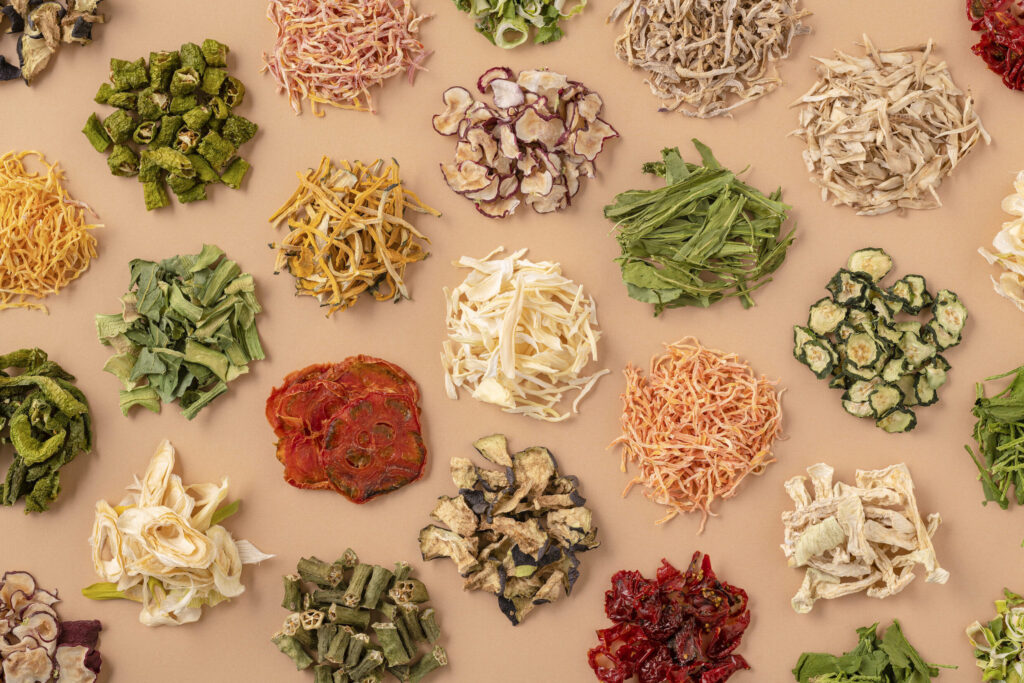
- Available for purchase in small lots from 1 kg
- We handle heirloom vegetables from across Japan
- Dried fruit and herbs also supported
How to rehydrate and cut
Dried chili has situations where you use it without rehydrating and situations where you rehydrate it. We separate them by use.
Situations where you can use it as is, without rehydrating
In dishes with liquid, or dishes that infuse aroma into oil, there is no need to rehydrate.
- Peperoncino: heat whole or sliced chili from cold oil to draw out the aroma
- Simmered dishes and hot pot: drop in whole, and it rehydrates in the broth's moisture while releasing heat
- Soup and curry: it rehydrates during the simmering time
- Pickles and nukadoko: add whole
Steps for Rehydrating in Water
- Soak in lukewarm water for 10 to 15 minutes. In cold water, about 30 minutes
- Once softened, cut off the stem
- Open it lengthwise and remove the seeds and the white part
- Chop it, or crush it with the flat of the knife into a paste
Rehydrated chili is handled the same as fresh. Once rehydrated, refrigerate it and use it up that day or the next. The soaking liquid carries some of the heat, so you can add it to a dish, but note that it becomes harder to adjust the spiciness.
How you handle the seeds and white part changes the spiciness
It is often said that "the seeds are spicy," but that is not accurate. What creates the heat is not the seeds themselves, but the white part that encloses the seeds (the placenta) A research group led by Professor Yoshiyuki Tanaka of Kyoto University, in a study published in 2023 in the academic journal The Plant Journal, also showed that genes involved in synthesizing the pungent compound work specifically in the placenta.
In other words, if you want to reduce the heat, discarding only the seeds is not enough; you need to scrape off the white part. Conversely, if you want it spicier, leave the white part and chop.
Choosing between slices, chopped, and powder
| Form | How it releases | Well-suited dishes |
|---|---|---|
| Whole | Releases slowly Can be removed | Simmered dishes, hot pot, pickles, oil |
| Rounds | Medium Visual accent | Stir-fries, pasta, condiments |
| Coarsely chopped | Releases quickly and strongly | Stir-fries, sauces |
| 粉 | Distributes evenly throughout | Ichimi, seasoning, batter |
When grinding to a powder, What is ichimi togarashi is worth reading alongside this. It lays out what differs between store-bought ichimi and homemade.
Getting the spiciness exactly as you intend
Even using the same dried chili, how the heat releases changes with the dish. And even within the same variety, the heat changes with the conditions it was grown in.
Even the same variety does not have a fixed spiciness
A report compiled by a researcher at Shinshu University shows, from multiple trials, that chili heat is affected by the fertilizer components in the soil. In a trial growing "Takanotsume" and "Santaka" in pots filled with soil from four locations in Nagano Prefecture, a tendency for fruit heat to weaken when there is more phosphate in the soil was observed.
In other words, It is not fixed that "because it is Takanotsume, it has this heat"is the point. If the heat of chili you were given differs from last year, that simply happens. The heat does not change with drying, so biting into one before drying to check its strength makes it easier to decide the number to use in a dish. For the relationship between the range of heat and the variety,唐辛子と鷹の爪とししとうの違い, which covers this in detail.
How to bring out stronger heat, and how to tone it down
| What you want to do | How to | Reason |
|---|---|---|
| Bring out more | Chop or crush Leave the white part | More cut surfaces make it release more easily |
| Bring out more | Heat in oil | The pungent compound transfers readily to oil |
| Tone it down | Add whole and remove partway | You can stop the amount released by timing |
| Tone it down | Remove the seeds and white part | Remove the part that creates the heat |
| Tone it down | Rehydrate in water before using | Some of it goes into the soaking liquid |
Recovering when it is too spicy
- Add dairy: a small amount of milk, cream, or yogurt
- Add fat: butter or sesame oil. The heat disperses
- Add sweetness and acidity: sugar, mirin, vinegar
- Increase the volume: add tofu, potato, or rice to dilute
- Remove it: if you added it whole, pull it out right away
Whether you can remove the chili you added changes how easy it is to recover. When you are unsure about the heat, whole rather than chopped is the sure way to add it.
How to Use Up a Large Amount
Chili from a home garden yields several dozen peppers even from a single plant. What troubles people searching for "using up dried chili in bulk" the most is that the amount used as a condiment is limited. To work through a sizable quantity, changing the form is the quickest route.
Grind it into powder to make ichimi
This is what reduces the volume the most. Even grinding several dozen peppers fits into a single small jar. The prep and tools are summarized in the next section.
Store-bought ichimi togarashi is chili alone ground to a powder, and as a commercial raw material it is called "chili powder" or "ground chili." Coarse grinds retain texture and appearance, while fine grinds mix evenly into dishes. For details, How chili powder is made and how to choose it.
注意点は、once ground, the aroma fades quickly is the point. Grinding only the amount you will use in 1 to 2 months and keeping the rest whole makes it last longer.
Tools for grinding to a powder, and what to do before grinding
- Tear off and remove the stem of the dried chili. Put on gloves first
- Open it lengthwise and remove the seeds and white part. If you want to keep the heat, leave the white part
- Grind with a mill, coffee grinder, or mortar
- For a coarse grind, run it briefly and stop. For a fine grind, run it longer
- Let it sit for about a minute before opening the lid to let the airborne powder settle
Using a coffee grinder transfers the aroma, so it is better to keep one separate for chili. A mortar takes time but lets you decide the coarseness yourself. A food processor has large blades, so with a small amount it just spins without catching.
Before grinding, check the dryness once more do not forget this. If moisture remains, it will not turn to powder and will clump like dough. Clumping is evidence of insufficient drying, so dry it again at a low temperature while still in powder form.
Making it into shichimi
Combining chili with sansho, sesame, chinpi (dried mandarin peel), hemp seeds, aonori, poppy seeds, and the like makes shichimi. A review compiled by the Secretariat of the Agriculture, Forestry and Fisheries Research Council of the Ministry of Agriculture, Forestry and Fisheries explains that, prompted by the introduction of shichimi togarashi in the early Edo period, it came to be widely used as a condiment for soba and udon.
You may build it from what you have at home. Even just drying mandarin peel and adding it changes the layers of aroma. Being able to decide the blend yourself is the advantage of homemade.
Making oil-preserved or soy-sauce-preserved chili
Steeping chopped dried chili in oil or soy sauce gives you a seasoning ready to use right away. However, since the approach to storage changes, we write this part carefully.
- When steeping only dried chili in oil: because the moisture is low, it can be kept in a relatively stable state
- When adding raw garlic or raw vegetables together: moisture enters, so refrigerate and use it up quickly
- Wash the jar with boiling water and dry it completely before use
- Do not leave it at room temperature; store it in the refrigerator
Regarding homemade bottling, Tokyo's food-hygiene guidance states this. Because Clostridium botulinum spores are widely distributed in soil, preventing contamination of raw materials is difficult, and when making canned goods, vacuum packs, or bottled goods at home, it is dangerous unless you thoroughly wash the raw materials and pay close attention to the heat-sterilization temperature and the storage method it says. It also notes that the spores are not completely killed without heating at 120°C for 4 minutes or longer.
An ordinary household pot does not reach that temperature. Not aiming for long-term storage, but using it up in a short period under refrigeration making it on that premise is the safe approach. The same guidance states that the toxin itself is inactivated by heating at 80°C for 30 minutes, so it is safer to use it in dishes that are heated before eating.
Making chili oil (rayu)
- Put ground chili into a heatproof vessel. As a guide, 2 tablespoons of powder to 100 ml of oil
- Combine sesame oil and vegetable oil half and half, and heat until just before thin smoke begins to rise
- Take it off the heat and let it sit for about 30 seconds to bring the temperature down before pouring it over the powder
- Pouring it all at once scorches it and brings out bitterness, so pour in three batches
- Once cooled, transfer it to a jar and refrigerate
Frying green onion or ginger in the oil first to infuse the aroma adds layers of flavor. If the oil temperature is too high, the powder scorches and turns bitter, so take it off the heat and wait a little before pouring. This is where the result is decided.
If some remain green, turn them into yuzu kosho
If fruit that did not turn red remains, rather than drying it, chop it and combine it with salt and yuzu peel. In a trial by the Kuma Agricultural Research Institute of the Kumamoto Prefectural Agricultural Research Center comparing raw-material varieties, 100 g of the fresh fruit was put through a blender, and 20 g of yuzu peel and 12 g of salt were added to make a prototype. As a ratio for making it at home, starting from here makes it easy to adjust.
Quick reference for using it up
| Method | Amount reduced | Storage | Effort |
|---|---|---|---|
| Grind into powder | Several dozen peppers into one small jar | 1 to 2 months | Easy if you have a mill |
| Make shichimi | Same as powder | 1 to 2 months | The effort of gathering the ingredients |
| Oil-packed | 10 to 20 peppers | 2–3 weeks refrigerated | Preparing a jar |
| Soy-pickling | 10 to 20 peppers | 2–3 weeks refrigerated | Done quickly |
| Chili oil (rayu) | A few tablespoons of powder | About a month refrigerated | Managing the oil temperature |
| Store whole | Does not reduce | 2 to 3 months at room temperature Six months refrigerated | The least effort of all |
The unexpectedly effective choice is the last one, "do not reduce it."Kept whole and dry, it holds its color and aroma for 2 to 3 months at room temperature and six months refrigerated. Rather than forcing it into a steeped preparation and shortening its shelf life, storing it dry and using it a portion at a time means you can use it over a longer period in the end.
How many dried chili peppers to add, and how to use them by dish
Apart from how to use it up, let us lay out what it can actually be used for in the first place. From dishes where you just drop it in whole to ones you grind into powder first, in order of least effort.
Peperoncino starts from cold oil
Pasta with only chili and garlic lets the aroma of the dried chili become the dish itself. The trick is put the chili and garlic into cold olive oil, then turn on the heat If you add them to already-heated oil, they scorch and turn bitter in seconds.
- Put olive oil, thinly sliced garlic, and seeded chili into the pan
- Set it over low heat and warm it slowly until the garlic takes on a faint color
- Add the cooked pasta and some cooking water, and emulsify
- When you want to add heat, chop the chili and add it at the end
If you leave the chili in whole, you can remove it once the heat gets too strong. Slicing makes it release faster, so when you want to control it, start with it whole.
For kinpira and simmered dishes, drop it in whole
For dishes like kinpira gobo, simmered kiriboshi daikon, and chikuzenni, dropping in just one whole pepper is enough. It rehydrates in the broth's moisture while releasing heat little by little.
Leaving the chili in to the very end makes it too spicy, so remove it once the seasoning is set. Remembering that you added it is the only thing to watch for.
For nukadoko and pickles, 2 to 3 whole peppers
Adding dried chili to a nukadoko pickling bed, umeboshi, or takuan is a long-standing practice. The aim is to tighten the flavor, so 2 to 3 whole peppers are buried in. It is also said to help keep insects away, but that is not something you can verify at home, so it is safest to think of it as being for the flavor.
Build kimchi and yangnyeom with powder
Powdered chili is used for kimchi. The common approach is to blend two types: coarsely ground for color and texture, and finely ground to spread the heat throughout. If you make it yourself, prepare the ground pepper in two levels of coarseness.
Combine it with garlic, ginger, fish sauce, and sugar to make yangnyeom, and you can use it not only on napa cabbage but also on cucumber and daikon. Refrigerate the yangnyeom you make and use it up quickly.
Keep it on hand as chili miso
Knead chopped dried chili with miso, mirin, and sugar and you get chili miso. It goes well with rice and with grilled meat.
For the amount to mix into the miso, start at around 3 tablespoons of miso per 1 teaspoon of chopped chili, then add more as you check the heat. It keeps for about a month in the refrigerator.
Use it in quantity in tsukudani and stir-fried jako
Simmer-frying chirimen jako and dried chili in soy sauce and mirin makes a side dish for rice. You can use a generous amount of chopped chili, so it suits times when you want to work through a quantity.
If you have sansho, add it together. The heat of chili and the aroma of sansho are the same combination as sansho being included in shichimi.
Chili is counted by dried weight even in the national statistics
We have written out the drying procedure up to this point, but chili as a crop is premised on drying from the very way its statistics are taken.
"For kanpyo and chili, dried weight was used"
The Ministry of Agriculture, Forestry and Fisheries' Survey on the Production Status of Local Specialty Vegetables states the following as the definition of yield. "The measurement form of yield was the weight by shipping form, in relation to shipment. For example, for kanpyo and chili, dried weight was used." While other vegetables are counted by fresh weight, chili, alongside kanpyo, is tallied by dried weight is how it is handled.
Just as the national side writes "weight by shipping form,"chili is a crop shipped in a dried state the statistics are built on that premise. Drying is not a post-process but the shipping form itself, and the reason growing regions cite establishing drying technology as a challenge is that this is what determines the quality of the shipped product. Note that this survey is conducted every two years, and the latest, for the 2024 crop year, was published on June 30, 2026.
The figures for the 2024 crop year are a planted area of 68 ha, a yield of 227 tons, and a shipment volume of 212 tons. For the distribution by growing region and how it compares with other items,唐辛子と鷹の爪とししとうの違いfor more.
Of the chili consumed domestically, only about 1% is domestically grown
The fact that much of the dried chili sold in stores is not domestically grown is clear from the figures. A review compiled in 2015 by the Secretariat of the Agriculture, Forestry and Fisheries Research Council of the Ministry of Agriculture, Forestry and Fisheries states the following.
The overwhelming majority of chili currently consumed domestically is imported, and domestic production is about 1% of total consumption. For that reason, heirloom varieties long protected in local areas are increasingly no longer being cultivated.
Secretariat of the Agriculture, Forestry and Fisheries Research Council, Ministry of Agriculture, Forestry and Fisheries, "The Current State of Research on Chili and Wasabi" (Specialty Seeds and Seedlings No. 20, 2015)
As of the same review, domestic production of pungent varieties was stated to be about 140 tons, and the 2024 crop year is 227 tons. The volume itself has recovered somewhat, but seen as a ratio to consumption, domestic production is extremely thin that relationship has not changed. The few dozen peppers you dried yourself fall on that 1% side.
Around 1963 there were roughly 7,000 tons
The reason domestically grown dried chili is hard to obtain is that the volume has fallen this far. A report by the Otawara Chili Hometown Development Promotion Council contains the following description.
Chili was once cultivated vigorously in Japan. At its peak, around 1963, there was annual domestic production of roughly 7,000 t, and it was even exported overseas. Supporting that peak was Otawara City, Tochigi Prefecture, which at the time was a leading chili-growing region, boasting the No.1 production volume in the country.
Otawara Chili Hometown Development Promotion Council, "The Otawara Revival and Town-Revitalization Project for 'Tochigi Takanotsume Chili' in Otawara City, Tochigi Prefecture" (Specialty Seeds and Seedlings No. 20)
The peak was roughly 7,000 tons, and the 2024 crop year is 227 tons. The council's report states that "chili cultivation declined from around 1975 onward," and a report from Kagawa Prefecture also carries the expression that "after the late 1970s, once imported chili became dominant, domestic chili became a phantom."
The era when there were export standards for dried chili
The Kagawa Prefecture report states that, as materials dating up to the late 1960s, records of sales to major domestic spice manufacturers, as well as Ministry of International Trade and Industry and Ministry of Agriculture and Forestry ordinances and dried chili export standards from the time when it was exported to Europe as a pickling ingredient, are preserved. The ones who kept them were a family that ran a chili wholesale business locally.
It switched from being the side that exports to the side that relies on imports is what happened. The few dozen peppers dried at home now fall into a rare category as domestically grown dried chili. Drying them yourself carries that much meaning.
Procuring dried chili as a processing raw material
From here on is for those looking for dried chili for product development. What you need to consider is completely different from home drying.
Why it is hard to assemble volume domestically
The figures in the previous section are the answer as they stand. The domestic shipment volume of pungent varieties is 212 tons a year (2024 crop year, dried weight) and moreover the growing regions are scattered a few hectares at a time across each prefecture. If a single company tries to secure several tons, that alone becomes a substantial share of the domestic shipment volume.
The growing region's circumstances are also written in official reports. The Kagawa Prefecture report, treating chili as a crop unsuited to market distribution, cites the seasonality of the harvest period, the lack of keeping quality in fresh fruit, and the fact that whether fresh or dried product is demanded changes with processing needs, and states that full-volume buyback through contract production is an essential condition is how it is put. If you want to use domestic product reliably, an arrangement before planting, not a one-off order, is the premise.
The drying conditions dictate the finish
Variation in color and aroma from lot to lot comes from both the variety of the raw material and the drying conditions. The reason the growing region's report sets 40°C as the upper limit is to retain the flavor; raising the temperature increases throughput but the aroma drops.
At our company we set the temperature and time by item, and for materials where we want to retain the color we take time at a low temperature. Heat generation must be kept down at the grinding stage as well, because when heat is applied the aroma flies off.
Start with Prototyping in Small Lots
At our company we accept the drying and grinding of domestically grown vegetables and fruit. We also handle the arrangement of you bringing in the raw material, and we take inquiries such as wanting to grind chili you grow yourself into powder, or wanting to retain the character of its color. How particle size and specifications are decided is How chili powder is made and how to choose it for a summary.
In a case where we handled a variety that colors purple, we dried it at a low temperature with the aim of retaining the color and finished it into a fine powder. The finish is Purple chili pepper powder and Dried purple chili pepper is posted on. We also handled an Okinawan variety, Dried island chili pepper which exists as well.
FOR BUSINESS
Looking for dried chili peppers as a raw material?
We handle the drying and milling of domestically grown chili peppers. We do not carry common hot varieties such as takanotsume as standard items; we offer Okinawa's Dried island chili pepper, Yamato vegetables' Dried purple chili pepper, and Kyoto's Dried Fushimi togarashi . For the specifications of the items we handle, List of dried products・List of powders listed at.
We give a best-before guideline of around six months from the shipping date for dried products. For small-quantity purchases, our sister brand's online store OYAOYA handles orders.
Frequently asked questions
How many days does drying chili take?
It ranges from a few days to two months depending on the conditions. With small fruit and continued clear weather, the surface dries in 4 days to a week, while with thick-fleshed varieties it takes 2 to 3 weeks. In growing regions there are cases of spending 2 months on drying alone. there seems to be no official standard that sets the number of drying days so judge not by the number of days but by the method of snapping it to check.
Can it be preserved just by sun-drying?
In the growing region's official reports, finishing forced drying after sun-drying is treated as essential. The reason is that if drying is insufficient, mold appears during storage. After the surface dries in the sun, apply heat at an upper limit of 40°C to drive out the remaining moisture before moving it to storage.
How long do dried chili peppers keep?
For commercial products, follow the bag's labeling. For homemade, a guide is 2 to 3 months in a dark place at room temperature, about six months refrigerated, and close to a year frozen. This is the period over which color and aroma can be retained; as long as it is thoroughly dried, it is edible at room temperature for six months to a year. However, the Kagawa Prefecture report states that under room-temperature storage the color darkens in about six months and the aroma and flavor decline.
Can dried chili be frozen?
Yes. If you are going to keep it for close to a year, freezing is suitable. The point to watch is condensation: if you open it right after taking it out of the freezer, water droplets form. Divide it into portions of the amount you use at once, and open it after returning it to room temperature.
Can green chili also be dried?
Drying itself is possible, but it has a lot of moisture and dries poorly, so it is not suited to it. In growing regions in Aomori Prefecture, green unripe fruit is sent as-is, fresh, for produce and processing use, and the ripe red ones are dried and ground into powder. If you have green ones on hand, a process that uses the moisture of the fresh fruit, like yuzu kosho, brings out their character better.
Do dried chili peppers need to be rehydrated before use?
For dishes with broth or dishes that transfer aroma into oil, there is no need to rehydrate. The heat comes out as it rehydrates within the simmering liquid or oil. When you want to chop it into a paste, or want to eat it with a soft texture, rehydrate it in lukewarm water for about 10 to 15 minutes. Once rehydrated it is treated the same as fresh, so refrigerate it and use it up quickly.
Is removing the seeds enough to reduce the heat?
The seeds alone are not enough. What creates the heat is not the seeds themselves but the white part that wraps them. A study announced in 2023 by a Kyoto University research group also showed that a gene involved in synthesizing the pungent component works specifically in this part. If you want to lower the heat, split it lengthwise and scrape off the white part.
What can I do with a large amount of dried chili peppers?
What reduces the volume most is grinding it into powder, with a few dozen peppers fitting into a single small jar. Combine it with sansho, sesame, and dried mandarin peel and it becomes shichimi. You can also make oil-pickled, soy-pickled, or chili oil versions, but adding fresh ingredients shortens the shelf life, so refrigerate and use up quickly. Not forcing processing, and instead storing it dried and using only as much as you need, is also a realistic choice.
Summary
Here are the points worth keeping in mind about drying chili.
- It doesn't end with just sun-drying. The growing region's official reports treat finishing forced drying as essential
- Consider 40°C the upper limit for the finishing temperature. The aroma flies off first
- There seems to be no official standard that sets the number of drying days. Judge by whether it snaps with a crack and crumbles
- Dry only the ripe red ones. Leave the still-green ones for yuzu kosho and the like
- Remove the stem after it dries. Taking it off before drying makes an entry point for moisture
- Do not seal it while hot. Put it in the container after returning it to room temperature
- At room temperature the color and aroma decline in about six months. If keeping it long, refrigerate or freeze it in portions
- Do not handle it with bare hands. The growing region's report records pain "so bad you can't sleep at night"
- The heat is not in the seeds but in the white part that wraps them
- The domestic yield of pungent varieties is 227 tons by dried weight (2024 crop year). It has fallen greatly from the peak of roughly 7,000 tons
Dried chili is a low-maintenance material once it is thoroughly dried. Failures occur almost always when the final push is skipped. Dry it to the point where it snaps with a sound, and seal it after returning it to room temperature. With these two, you'll have no trouble for a winter.
Recommended reading
- We checked the difference between chili pepper, takanotsume, and shishito against the national crop classification
- What is ichimi togarashi? How it differs from shichimi, its ingredients, uses, and how to choose
- What is chili powder? Production methods, how to choose commercial-grade, and OEM / small-lot manufacturing
- How to start a shichimi OEM | Domestically grown chili and local shichimi
- Best-before dates and storage of commercial dried vegetables
Download the product catalog
We will send the materials to your email address based on the information you provide.
- A Guide to Using and Rehydrating Dried Mushrooms: Characteristics by Type and Recipes Using Mixes
- The way to rehydrate dried shiitake is in 5°C cold water: 5 hours for koshin, 10 hours for donko
Author of this article
Related articles
-
 Preventing vegetable shortfall while dieting | Add dietary fiber with dried vegetables
-
 Aojiru vs. vegetable juice vs. dried vegetables, thoroughly compared | Which method truly works for beating vegetable deficiency?
-
 What is yakuzen? Its meaning, the difference from kampo, and the basics of starting with familiar ingredients explained
-
 What's the Difference Between Yakuzen and Kampo? A Gentle Look at Food vs. Crude Drugs, Purpose, and Philosophy
-
 Assembling domestically grown yakuzen ingredients: the difference between familiar vegetables and imported crude drugs
-
 Complete guide to using dried mugwort | From rehydrating to popular recipes and storage tips
-
 We checked how to make and use yuzu shichimi against long-established makers' blend charts and ingredient labels
-
How to make yomogi mochi with dried mugwort | Ingredients, amounts, and foolproof tips explained