
What Is Chili Powder? Manufacturing Methods, How to Choose for Commercial Use, and OEM and Small-Lot Production Explained

Summary of this article
A dried-vegetable maker explains chili powder production and the tricks to preserving heat and color, the checkpoints for commercial buying (particle size, origin, heat stability, moisture absorption, color), applications such as ichimi, kimchi, soup, and snacks, the difference between domestic raw material and Korean or imported goods, and how to proceed with OEM and small-lot production.
Chili powder, made by drying chili peppers and grinding them, is a handy ingredient that adds heat, color, and aroma without water. Its uses are wide — from ichimi and kimchi to soups and snack seasoning — and we are seeing more inquiries like "we want to use domestic chili powder in small lots" or "we're looking for a powder with stable heat and color."
On this page, we organize the characteristics and production of chili powder, the tricks to preserving heat and color, the checkpoints for commercial buying, applications, the strengths of domestic raw material, and how to proceed with small-lot OEM and production — from the perspective of a maker engaged in dried vegetables and powder processing. For the dried chili peppers that serve as the raw material, how to make and use dried chili peppers and for the difference between varieties, an explanation of the kinds of chili pepper.
TOC
What is chili powder
Chili powder is a processed ingredient made by grinding dried red chili peppers into powder. Heat, color, and aroma vary with particle size and the variety of the raw material. Because it adds heat and color without adding liquid, you can adjust the heat without upsetting the formulation of a dough or sauce.
The relationship with ichimi togarashi
"Ichimi togarashi" is a household product name for chili alone ground into powder, and its contents are the same as chili powder. As a commercial raw material it is called "chili powder" or "ground chili," and it is procured by specifying particle size and heat. Sansho Combined with sansho, sesame, chinpi, and the like, it becomes shichimi, and chili powder can serve as that base as well.
The difference between coarse and fine grinds
Chili powder comes in coarse and fine grinds. Choosing the particle size to match the application governs the finish.
| Particle size | Character | Suited use |
|---|---|---|
| Coarse grind | Leaves an accent of texture and appearance | Kimchi, noodle garnish, toppings |
| Fine grind | Blends uniformly into dishes | Seasoning base, soups, blending into doughs |
Advantages of using it as powder
Unlike whole dried chili, powder is easy to measure and spreads the heat evenly through the whole dish. It can also draw on the color to add visual appeal, and on the production floor the benefit is greater reproducibility in formulation. Because you can bring out heat with a small amount, it raises the flexibility of seasoning design.
FOR BUSINESS
乾燥野菜のOEM・受託加工を承ります
国産の野菜・果物の乾燥、100メッシュ相当までの粉砕、10g以上の小袋充填までをお受けしています。小ロットの試作から量産までご相談ください。寄せられた相談の実例は OEM・卸のご相談 に掲載しています。
乾燥品の賞味期限は、出荷日から6ヶ月程度を目安にご案内しています。
Chili powder production and the tricks to preserving heat and color
Chili powder is made through the steps of drying and grinding. Managing each step determines the finish of heat, color, and aroma.
The flow from drying to grinding
Ripe red chili peppers are washed and dried, and after the moisture is thoroughly removed, they are ground into powder with a grinder. If drying is insufficient, they are hard to grind and deteriorate easily during storage. At the grinding stage, the particle size is made uniform and finished to the fineness suited to the application.
Tricks to preserving heat and aroma
If too much heat is applied during grinding, the aroma escapes and the quality of the heat changes. Grinding while keeping heat generation down is the key to preserving aroma and heat. The choice of raw-material variety also matters, and varieties are used differently — strong-heat types, aromatic types — to match the target flavor.
To keep a vivid color
The vivid red of chili powder greatly influences the look of a dish. Because color fades with light, oxygen, and moisture, storage that blocks light and seals out air is essential. Choosing a variety with an inherently deep red is also effective in drawing on the color. Using a variety that colors purple lets you Purple chili pepper powder make the color itself a distinctive feature.
Checkpoints for commercial selection
Commercial chili powder is chosen from a different angle than household goods, which reduces failures. Because reproducibility of the finish and lot-to-lot stability are at stake, check the following items.
- Whether the particle size (coarse or fine grind) suits the application and production process
- Whether the variation in heat (lot differences) is within tolerance
- Whether the color is stable and measures against fading are in place
- Whether the packaging and storage conditions resist moisture absorption
- Whether the growing region and variety can be identified and traced
- Whether the needed quantity can be secured from a small lot
Stability of particle size and heat
Particle size governs texture, appearance, and how it blends into the dish. Because heat varies by variety and lot, in products that require stable heat, consistency of raw-material variety and sourcing is important. Confirming heat and particle size with a sample before adoption gives peace of mind.
Moisture absorption, storage, and hygiene
Powder readily absorbs moisture, leading to clumping, fading, and loss of aroma. Packaging that prevents moisture absorption, such as aluminum bags and oxygen absorbers, is a key point of selection. Confirming the hygiene management system and the best-before date and storage conditions in advance also makes it easier to maintain quality after delivery. For commercial best-before dates and storage, Best-before dates and storage of commercial dried vegetables.
Applications of chili powder
Chili powder is an ingredient used across a wide range, from seasonings to processed foods. We have compiled representative applications into a list.
| Use | How to use | Suitable particle size |
|---|---|---|
| Ichimi / garnish | Sprinkle on as-is to add heat | Fine grind |
| Kimchi / Korean cuisine | Mix into marinades and yangnyeom | Coarse + fine grind |
| Soups / noodles | As a base for soups and spicy sauces | Fine grind |
| Snacks / seasoning | For seasoning or kneading into dough | Fine grind |
| Sauces / dips | As a seasoning that adds heat and color | Fine grind |
As ichimi and seasoning
The most familiar use is as ichimi. Sprinkle it on udon, soups, and stir-fries to add heat. Combined with salt and dashi, it also becomes an original spicy seasoning. Using aromatic domestic raw material makes it easier to set your product apart from commercial goods.
For kimchi, Korean cuisine, and soups
In Korean dishes such as kimchi and soups, chili powder is the deciding factor in flavor. It is common to use particle sizes differently — coarse grind for texture and color, fine grind for heat and richness. It is also used as a base for the spicy sauce of hot pots and soups, giving dishes a deep, layered heat.
For seasoning snacks and processed foods
Chili powder is indispensable in seasoning processed foods, too — snack and prepared-food seasoning, kneading into noodles, and more. Powder is easy to blend and adds heat and color consistently. Combined with spices, it lets you bring out the individuality of each product.
We have materials available to help you understand dried processing OEM
Agriture OEM, flexibly handling everything from small lots to large lots
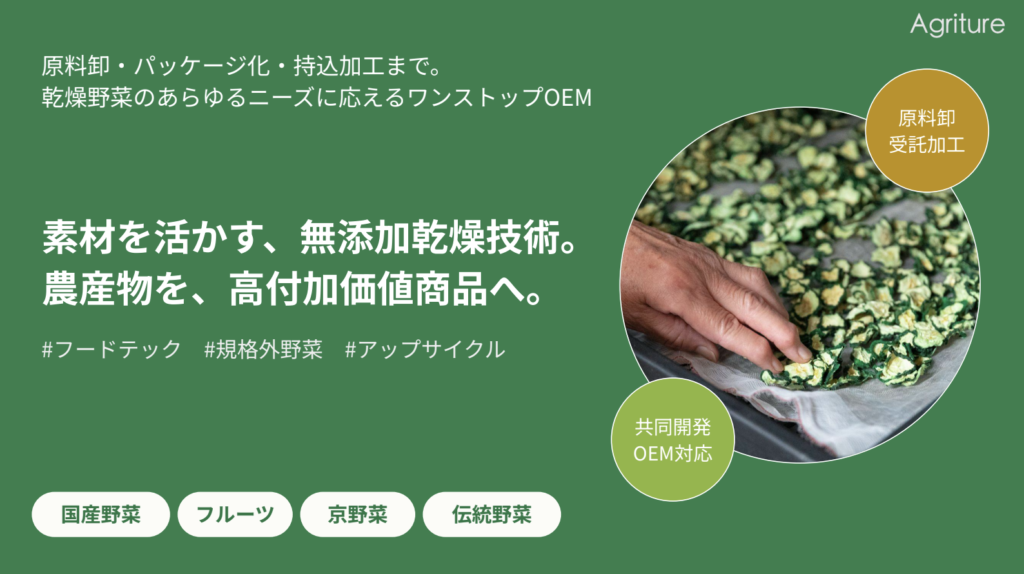
- OEM available from small lots of 10 kg
- Drying of brought-in raw materials also possible
- Support from processing to filling in one place
The difference between domestic chili powder and imported goods
The chili powder on the market also includes many imported goods such as Korean and Chinese. Lining up the difference from domestic goods on the same axes makes it easier to choose the raw material suited to the application.
| Axis of comparison | Domestically grown | Korean / imported goods |
|---|---|---|
| How the heat comes through | Easy to adjust by choosing the variety | Many are the mild, sweet type |
| Color | Adjustable to red, purple, etc. by variety choice | Centered on a vivid red suited to kimchi |
| Lot stability | Easy to manage | Lot-to-lot variation can occur |
| Ease of tracing history | Origin and variety easy to trace | Confirmation can be labor-intensive at times |
| small-lot support | Easy to select from small quantities | Tends to be centered on large lots |
| Price and volume security | Can be pricier than imported goods | Easy to secure volume and advantageous on price |
Characteristics of Korean and imported goods
Widely used for kimchi, Korean goods have mild heat, sweetness, and a vivid color as their strengths. Because volume is easy to secure and they are advantageous on price, they are a strong option when the heat and color tendencies suit the application. On the other hand, lot-to-lot variation in heat and color, and tracing the raw material's history, can take extra effort.
The strengths of domestic chili powder
Domestic chili powder's strength is that the raw material's origin and variety are easy to trace and flavor and heat are easy to manage. Highlighting domestic material and domestic production can be tied to added value and reassurance for the product. Being able to choose the variety and use it from small quantities is also a major advantage in product development.
Agriture's chili powder
At Agriture, we dry and grind domestic chili peppers and supply them as raw material. Being able to choose the variety is a distinctive feature.
Domestic raw material you can choose by variety
Besides red hot chili, you can choose by variety, including color-rich Purple chili pepper powder and heat-free Manganji pepper powder and more. It suits cases where you want to bring out a product's individuality not just with heat but with color and flavor.
The response only a dried-vegetable maker can offer
From our position handling everything from drying to powder processing, we can respond to consultations on particle size and finish. Seasoning designs that combine vegetable powders other than chili are also possible. For commercial use of vegetable powder, Ways to use vegetable powder commercially.
To make chili powder by OEM in small lots
If you want to make chili powder, or a seasoning using it, as your own product, small-lot OEM production is an option. Here we lay out how it proceeds.
The advantages of starting with small lots
With small lots, you first prototype and gauge the market response before moving to volume production. Because you can decide while testing the raw-material variety, particle size, and heat, you can hold down the risk of carrying inventory. It also suits small-batch production for test sales, gifts, and novelties.
The flow from consultation to delivery
It begins with your sharing the application, desired heat, particle size, and quantity. After selecting the raw material and prototyping, we adjust particle size and heat, decide the packaging, and move to production. Whether to finish it as ichimi, or Shichimi or spice, sharing the finished image early on makes it easier to proceed.
FOR BUSINESS
乾燥野菜のOEM・受託加工を承ります
国産の野菜・果物の乾燥、100メッシュ相当までの粉砕、10g以上の小袋充填までをお受けしています。小ロットの試作から量産までご相談ください。寄せられた相談の実例は OEM・卸のご相談 に掲載しています。
乾燥品の賞味期限は、出荷日から6ヶ月程度を目安にご案内しています。
Frequently asked questions
Download the OEM contract processing materials
We will send the materials to your email address based on the information you provide.
Summary: choose chili powder by particle size and raw material
Chili powder is an ingredient made by powdering dried red chili, usable across a wide range from ichimi and kimchi to soups and snack seasoning. For commercial use, check particle size, heat stability, color, moisture-absorption measures, and origin history, and choosing the particle size suited to the application governs the finish. Domestic raw material is easy to trace by history and ties into a product's added value.
At Agriture, we choose domestic chili by variety, dry and grind it, and handle production from small lots. If you are considering developing ichimi, shichimi, or an original seasoning, tell us your application and desired heat and particle size. For choosing the raw-material variety, an explanation of the kinds of chili pepper.
If you are considering product development with off-spec or your own farm's vegetables:From planning to processing, materials, package printing and novelties, you can consult us through a single point of contact. → Learn more about one-stop product development
- Commercial mushroom OEM and drying & powdering processing guide | Domestically grown, small-lot support
- Edible flower OEM | Commercial and wholesale, product development, and development into tea
Author of this article
Related articles
-
 Original coffee marketing strategy | Ways to grow sales
 -
 ベジタリアンとは?国の規格が分けている4つの区分と食べられないもの
 -
 長ねぎと白ねぎは同じもの?ねぎの種類と呼び名を国の資料で確かめる
 -
 柚子の種類は何種類あるのか、公の資料で名前が残る系統を数えた
 -
 ゆずの時期は年に二度、青ゆずは7月から黄ゆずは10月から
 -
 ゆずの産地は高知が半分を占め、二位は徳島から愛媛に変わった
 -
 Preventing Food OEM Failures: Common Failure Cases and Countermeasures for Success
 -
 How to find a food OEM | How to efficiently find the best manufacturing partner