
Edible flower OEM | Commercial and wholesale, product development, and development into tea

Summary of this article
A dried-vegetable maker explains commercial and OEM use of edible flowers. We’ve put together the fresh, dried, and powder forms; product development for sweets, drinks, tea, and gifts; the difference from ornamental flowers and their safety; and the flow of small-lot contract manufacturing.
Edible flowers add a gorgeous touch to dishes and sweets. Their use in café desserts, gifts, drinks, and tea is spreading, and we’re getting more inquiries from people who want to bring them into their own products. At the same time, they’re a raw material with many questions specific to commercial use: “In what form do we source them?” “How do they differ from ornamental flowers?” “Can we develop products in small lots?”
This page sums up the basics of commercial and OEM use of edible flowers from a dried-vegetable maker’s perspective. We explain the fresh, dried, and powder forms; examples of product development for sweets, drinks, and tea; the difference between food-grade and ornamental flowers; and the ordering flow for wholesale and contract processing.
TOC
What Is Edible Flower OEM?
OEM and commercial use of edible flowers means sourcing flowers grown under food-safe management as a raw material and using them in your own brand’s products or in-store menus. Beyond using them fresh, you can process them into dried or powder forms and roll them out into baked goods, drinks, tea, and more. Taking the form of contract processing (OEM), where you prototype from a small amount and progress to commercialization, lets you start while keeping inventory risk down.
- Source flowers managed for food use as a raw material
- Can be processed into forms such as dried and powder, in addition to fresh
- Easy to roll out into sweets, drinks, tea, gifts, and more
- Can consult from small-lot prototyping through commercialization
For the varieties of edible flowers themselves and how to eat them, see What Are Edible Flowers. For domestic edible roses, see the dried rose (edible rose) product page.
Edible Flower Forms and How to Choose Between Them
You can choose the form of edible flowers to match the use. Whether you want to show off color or transfer aroma and flavor changes which form is best.
The Difference Between Fresh, Dried, and Powder
Fresh edible flowers suit scenes where you want to show the flower’s shape and color as-is, such as salad or cake toppings. Dried edible flowers keep well and become easy to use as toppings for baked goods or as a blend ingredient for tea. Powder suits kneading into batter or cream when you want to distribute color and flavor evenly. Combining multiple forms lets you design both appearance and flavor.
| Form | Features | Suitable products |
|---|---|---|
| Fresh | Show the flower’s shape and color as-is | Toppings for salads and cakes |
| Dried | Keeps well and easy to handle | Baked goods, blended tea, gifts |
| Powder | Kneads in color and flavor evenly | Batter, cream, drinks |
Choose by “showing” use versus “extraction/flavor” use
How edible flowers are used broadly divides into “showing” use and “extraction/flavor” use. For toppings and gifts where the flower’s shape and color take center stage, fresh or dried—which keep their shape—suit best. For extraction/flavor use, where you transfer aroma and color to tea or batter, dried—which blends easily—or powder—which distributes evenly—suit best. Which you aim for changes the variety of flower and the form you choose.
- Rose: Strong aroma, easy to use in both toppings and blended tea
- Chamomile, marigold: Suited to tea blends and adding color
- Pansy, viola: Distinct shape and color, suited to toppings
- For appearance, fresh or dried; to transfer flavor or color, powder
We have materials available to help you understand dried processing OEM
Agriture OEM, flexibly handling everything from small lots to large lots
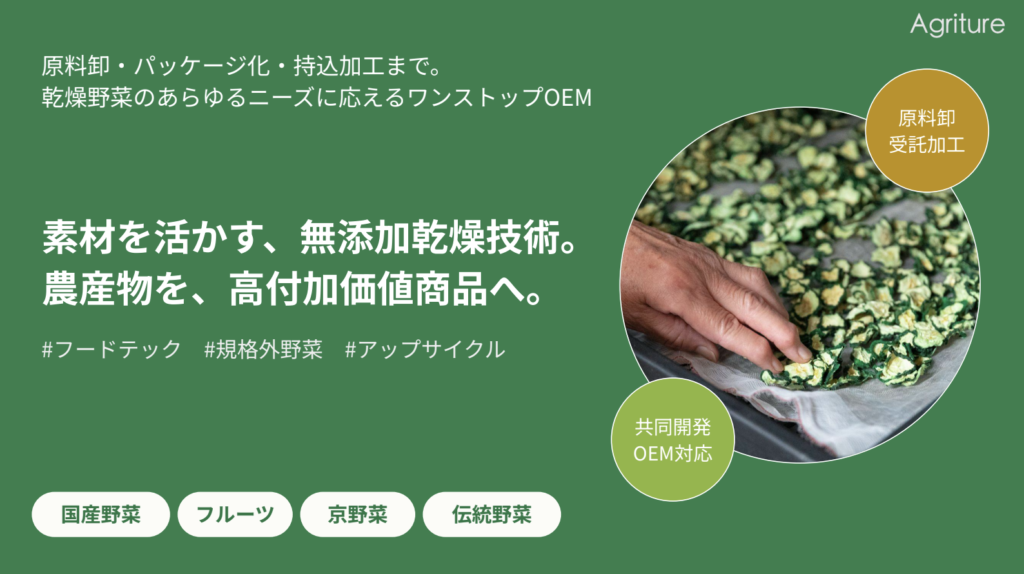
- OEM available from small lots of 10 kg
- Drying of brought-in raw materials also possible
- Support from processing to filling in one place
FOR BUSINESS
乾燥野菜のOEM・受託加工を承ります
国産の野菜・果物の乾燥、100メッシュ相当までの粉砕、10g以上の小袋充填までをお受けしています。小ロットの試作から量産までご相談ください。寄せられた相談の実例は OEM・卸のご相談 に掲載しています。
乾燥品の賞味期限は、出荷日から6ヶ月程度を目安にご案内しています。
Examples of Product Development Using Edible Flowers
Because edible flowers’ strength is their gorgeous appearance, they’re a raw material that pairs well with products designed for gifts and social-media appeal. Here we introduce some representative directions for product development.
Sweets, Baked Goods, Drinks
Placing dried flowers on cookies or pound cake, or floating them in jelly or drinks, gives a special look. For example, Dried Rose (Edible Rose) can be used in three directions—as a petal topping, blended with black tea, or made into powder and kneaded into batter. For color design combined with vegetable or fruit powders, see Vegetable Sweets OEM is also a helpful reference.
Gifts & novelties
Edible flowers are a material that pairs well with gift demand such as celebrations and seasonal presents. Bottling dried flowers, or setting them with tea or sweets, makes for products with a special feel. For contract processing of dried vegetables in general, see Dried vegetable OEM and contract processing.
Rolling Out into Tea
Edible flowers are also used to add color and aroma to tea and herbal tea. Blending in dried flowers makes a tea you can enjoy for the sight of the flowers opening in the cup and their soft aroma. For rolling out into tea, you can consult on contract terms including the design of shape and contents.
- Blend in dried flowers to add color and aroma
- Mix them into the contents of tea bags or pyramid tea bags
- Combine with herbs and fruit for an original blend
- Make them into a tea set for gifts
For tea OEM, we’ve prepared articles by purpose. To start with a small lot, see How to Start Herbal Tea OEM in Small Lots; to choose by shape, see Tea Bag OEM; for aroma design, see Flavored tea development; for the big picture, see How to request tea OEM manufacturing is a useful reference.
We have materials available to help you understand dried processing OEM
Agriture OEM, flexibly handling everything from small lots to large lots
- OEM available from small lots of 10 kg
- Drying of brought-in raw materials also possible
- Support from processing to filling in one place
The Difference Between Food-Grade and Ornamental Flowers and Their Safety
The most important thing when using edible flowers in a product is to “use flowers managed for food use.” Even if they look similar, ornamental flowers cannot be used for food.
Don’t Use Ornamental Dried Flowers for Food
Ornamental flowers sold at florists and garden shops, and the ornamental dried flowers made from them, are not grown or managed on the premise of being eaten, so they can’t be used in food or tea. When rolling out into tea or sweets, always use flowers grown for food as the raw material. Confirming whether they’re food-grade at the very entrance to product development is the first step to safety.
- Use only flowers managed and grown for food as raw materials
- Don’t use ornamental flowers or ornamental dried flowers in food
- Always confirm whether they’re food-grade when sourcing
- Choose a supplier where you can see the raw material’s origin and management
The Flow of Wholesale and OEM Ordering
For commercial and OEM use of edible flowers, the general flow is to consult on use and quantity, then progress to commercialization through prototyping. First, whether it’s “wholesale, where you source the raw material and use it yourself” or “OEM, where you entrust the work through to commercialization” changes what you’ll discuss.
| Type of Request | Suitable situations | Main Discussion Items | Form of Delivery |
|---|---|---|---|
| Wholesale (raw material sourcing) | You have the recipe and production in-house | Flower variety, form, quantity, timing | Raw material in fresh, dried, or powder form |
| OEM (contract processing) | You want to entrust through to commercialization | Use, concept, form design, prototyping | Processed goods, final products |
Being able to start from a small lot makes it easier to take on even a first product development.
- Discuss the flower variety, form, and use you want
- Confirm color, flavor, and finish with samples or prototypes
- Decide quantity and form, then move to quote and order
- After commercialization, consult on stable supply and additional processing
At Agriture, we’ve worked on drying and processing domestic raw materials, including prototyping edible roses. For how contract processing of dried vegetables in general works, see Domestic Dried Vegetable OEM Manufacturing Guide. You can consult on domestic raw materials from a small lot, with a setup that’s easy to use from the prototype stage.
FOR BUSINESS
乾燥野菜のOEM・受託加工を承ります
国産の野菜・果物の乾燥、100メッシュ相当までの粉砕、10g以上の小袋充填までをお受けしています。小ロットの試作から量産までご相談ください。寄せられた相談の実例は OEM・卸のご相談 に掲載しています。
乾燥品の賞味期限は、出荷日から6ヶ月程度を目安にご案内しています。
Frequently asked questions
Summary: For Edible Flowers, Form and Food-Grade Status Are the Keys to OEM
For edible flower OEM, using the fresh, dried, and powder forms selectively lets you roll out broadly into sweets, drinks, tea, and gifts. The number-one premise of product development is to use flowers managed for food use, not ornamental ones. Starting from a small-lot prototype lets you take on a new product while keeping inventory risk down.
If you’re considering product development using edible flowers or rolling out into tea or gifts, please also consult us about contract processing of domestic raw materials. We can handle everything from form design to prototyping.
Download the OEM contract processing materials
We will send the materials to your email address based on the information you provide.
If you are considering product development with off-spec or your own farm's vegetables:From planning to processing, materials, package printing and novelties, you can consult us through a single point of contact. → Learn more about one-stop product development
- What Is Chili Powder? Manufacturing Methods, How to Choose for Commercial Use, and OEM and Small-Lot Production Explained
- What is sansho powder? Its production method, how to choose commercial grade, and OEM and small-lot production explained
Author of this article
Related articles
-
 Original coffee marketing strategy | Ways to grow sales
 -
 ベジタリアンとは?国の規格が分けている4つの区分と食べられないもの
 -
 長ねぎと白ねぎは同じもの?ねぎの種類と呼び名を国の資料で確かめる
 -
 柚子の種類は何種類あるのか、公の資料で名前が残る系統を数えた
 -
 ゆずの時期は年に二度、青ゆずは7月から黄ゆずは10月から
 -
 ゆずの産地は高知が半分を占め、二位は徳島から愛媛に変わった
 -
 Preventing Food OEM Failures: Common Failure Cases and Countermeasures for Success
 -
 How to find a food OEM | How to efficiently find the best manufacturing partner