
Vegetable sweets OEM | The complete guide to designing color, flavor, and nutrition with vegetable powder

Summary of this article
In the flow of future health and natural orientation, domestically grown dried fruit becomes a solid element of differentiation. Why not start ingredient-focused manufacturing together with Agriture?
Using vegetable powder in sweets lets you add natural colors and flavors, such as kabocha, purple sweet potato, and beets,・Spinach,・Carrot, without synthetic colorings or food dye. Because you can create a "vegetable-containing" appeal for homemade cookies, cakes, bread, macarons, and ice cream simply by mixing it with cake flour, milk, and eggs, it is a raw material with wide uses, from home baking to commercial OEM, such as premium confectionery brands, sweets for children, gifts, and baby food.
This article compiles the basics of using vegetable powder in sweets, blend amounts and preparation by category, the design of color, flavor, and nutrition, the design flow, and how to organize information when consulting on OEM. Agriture processes over 30 kinds of dried vegetables and vegetable powders with low-temperature drying at 45C, and handles consultations on confectionery and sweets OEM. Related articles: Vegetable powder, natural coloring, additive-free/How to use fruit powder/Vegetable powder filling OEM。

TOC
A ranking of recommended ingredients for vegetable-sweets OEM (Agriture)
Vegetable powders adopted in sweets OEM are decided along four axes: color, flavor, blendability, and cost. We have organized the vegetable powders Agriture is chosen for in the confectionery OEM field in ranking form. Please use it as a reference for new product development of mail-order, in-store, and gift products, and for designing high-unit-price sweets using farm-direct ingredients. Ingredients sourced by the farm retain a fresh flavor and can express a depth that color-alone appeal cannot produce.
| Rank | Material | Suitable sweets | Agriture supply source |
|---|---|---|---|
| 1 | Kabocha squash powder | Pudding, pound cake, bread | Kyotango contract farm, Nagano farm |
| 2 | Purple sweet potato powder | Macaron, pudding, Japanese sweets | Contract farmers in Kyotango and Ehime |
| 3 | Beet powder | Macaron, ganache, latte | Etie Nosan (Kyotango), farm-direct |
| 4 | Spinach powder | Cookie, steamed bun, matcha-type | Partner farms in Mie and Nagano |
| 5 | Carrot powder | Carrot cake, baby sweets | Takii Shubyo PhytoRich line |
It also has a track record of adoption by brands supervised by vegetable sommeliers and registered dietitians, and we supply ingredients dried and processed in a fresh state from a contract-farmer network in Kyoto, Kyotango, Nagano, Mie, Ehime, and Okinawa by the bag (from 100 g). From seasonal ingredients, imperfect grades, and small prototypes to mass-production OEM, everything can proceed through the same window. For a detailed ingredient comparison, Vegetable powder recommendation ranking.
Why vegetable powder is chosen for sweets OEM
For sweets uses, vegetable powder is an ingredient that can add all three of "color, flavor, and nutrition" at once. Adding it to basic ingredients such as cake flour, milk, eggs, and sugar at a blend amount of 1 to 8% creates natural hues such as pink, yellow, green, purple, and orange, and a vegetable-derived flavor.
Three effects added at once
- Color: beet = pink / kabocha = deep yellow / spinach = deep green / purple sweet potato = purple / carrot = orange. Designable with ingredient-name labeling, without synthetic colorings or food dye
- Flavor: the higher the blend amount, the more the ingredient's sweetness and roastiness come forward. For the richness of premium confectionery and the natural sweetness for children
- Nutrition appeal: dietary fiber, vitamins, and polyphenols are added, used in vegetable-containing sweets for children lacking vegetables and health-conscious sweets
Scenes where it is readily adopted in sweets
- Ingredient appeal for premium confectionery brands (domestically grown, farmer partnership, upcycling out-of-spec vegetables)
- Health-conscious sweets lines claiming additive-free and coloring-free
- Vegetable-containing sweets for children and parent-child, homemade sets, and baby-food sweets
- Seasonal limited editions (spring cherry blossom x beet, autumn kabocha, winter purple sweet potato)
- Tourist souvenirs and regional brands (Japanese sweets with Kyoto vegetable powder)
FOR BUSINESS
乾燥野菜のOEM・受託加工を承ります
国産の野菜・果物の乾燥、100メッシュ相当までの粉砕、10g以上の小袋充填までをお受けしています。小ロットの試作から量産までご相談ください。寄せられた相談の実例は OEM・卸のご相談 に掲載しています。
乾燥品の賞味期限は、出荷日から6ヶ月程度を目安にご案内しています。
How to choose vegetable powder for sweets
Vegetable powders easy to use in sweets are chosen on four points: particle size, solubility, color stability, and flavor strength. The tip is to choose ones that do not stand out badly in sweet blends or fat-rich batters and that mix evenly with cake flour and milk.
Standard vegetable powders for sweets
We have organized vegetable powders easy to use in sweets by color direction. For all of them, the basic use is to sift them with cake flour and mix into the batter, or dissolve them in milk or fresh cream and then add to the base.
| Material | Color | Well-matched sweets |
|---|---|---|
| kabocha | Deep yellow, orange | Pudding, tart, pound cake, steamed bun |
| Purple sweet potato | Deep purple | Macaron, ice cream, Mont Blanc, yokan |
| beets, | Pink, magenta | Macaron, cream, sorbet, mousse |
| Carrot | Orange | Carrot cake, muffin, homemade bread |
| Spinach, | Deep green | Chiffon cake, madeleine, green bread |
| Dried tomato | Vermilion | Novelty macaron, chocolate, Italian confectionery |
Checkpoints for choosing
Even with the same "kabocha powder," the finish differs greatly by particle size and drying method. When choosing for sweets OEM, confirm the following four points.
- Particle size: a fine powder of 200 mesh or above is less likely to clump when sifted with cake flour
- Drying method: low-temperature drying (Agriture's standard is 45C) retains color and flavor more readily than high-temperature drying
- Vividness of color: obtain a sample and confirm the color after blending in a prototype
- Flavor strength: a restrained flavor suits sweet batters. For premium appeal, a stronger flavor brings out the ingredient character
Usage and preparation by sweets category
The suitable ingredient, blend amount, and blending step change by type of sweet. We organize by the representative categories of baked sweets, frozen sweets, fresh sweets, Japanese sweets, and homemade bread.
Baked sweets (madeleine, pound cake, muffin, cookie)
For baked sweets, the standard is to sift vegetable powder with the flour into a base of cake flour, egg, milk, and butter. Carotenoid types (kabocha, carrot, tomato) readily retain color through baking, while beet and spinach should be topped after baking or designed with a lower baking temperature.
- Suitable material: kabocha, carrot, dried tomato (heat-resistant carotenoid types)
- Blend amount: 3 to 8% relative to cake flour
- Preparation: sift with the flour at the same time for even dispersion, or dissolve first in liquid (milk, egg) to prevent clumping
- Points to note: because beet and purple sweet potato turn green with alkali (baking soda use), use them in neutral-to-acidic recipes
Frozen sweets (ice cream, sorbet, gelato)
Because there is no heating step, the strength of frozen sweets is that any coloring remains vivid. Mix vegetable powder little by little into the base milk, fresh cream, or fruit juice, then cool and freeze. Blending purple sweet potato, beet, and kabocha in a white base produces a sharp color contrast.
- Suitable material: all ingredients are stable. A color-coded line with pink = beet, purple = purple sweet potato, yellow = kabocha
- Blend amount: 0.5 to 3% relative to the base
- Preparation: dissolve little by little in milk or fresh cream, then cool and freeze
Fresh sweets (macaron, pudding, mousse, cream)
For macarons, the classic is to mix vegetable powder into powdered sugar and almond flour and bake at around 150C. Because pudding, mousse, and cream have a weak heating step, vivid coloring can be expected with any of beet, purple sweet potato, and kabocha.
- Suitable material: beet (pink macaron), purple sweet potato (purple macaron), kabocha (yellow pudding)
- Blend amount: 2 to 4% relative to macaron powder / 1 to 2% for mousse and cream
- Preparation: sift the powder little by little into the meringue or cream, taking care not to overmix
- Point: the macaron baking temperature of around 150C readily retains color
Japanese sweets (yokan, mizu-manju, mochi sweets)
For Japanese sweets, the basic preparation is to dissolve vegetable powder into agar liquid, bean paste, or mochi to add color and flavor. Using vegetable powders such as purple sweet potato, kabocha, and spinach balances the Japanese ingredient character with natural hues and appeal as tourist souvenirs and gifts.
- Suitable material: color variations with combinations of purple sweet potato, kabocha, spinach, and matcha
- Blend amount: 1 to 3% relative to bean paste / 0.5 to 2% for an agar base
- Preparation: dissolve into agar liquid or bean paste. Add heat-sensitive ingredients (purple sweet potato, beet) near finishing, or design toward frozen sweets
- Appeal: differentiate with a sense of season, Kyoto vegetables, tourist souvenirs, and gifts
Homemade bread and sweet bread
For sweeter breads such as shokupan, brioche, and Danish, the preparation of adding color and flavor with vegetable powder can also be used. It pairs well with batters containing milk, egg, and butter, and mixing 4 to 8% into cake flour produces a homemade-feel hue.
- Suitable material: kabocha, purple sweet potato, spinach, carrot
- Blend amount: 4 to 8% relative to flour
- Preparation: knead together with the flour. When using an alkaline-leaning sponge dough, avoid beet and purple sweet potato
- Use example: kabocha bread, purple sweet potato anpan, spinach focaccia, carrot brioche
The five steps of blend design
A design flow with little chance of failure in commercializing sweets is the five steps of concept, then color, then ingredient, then blend amount, then prototype. The shortcut is to first decide the color and flavor direction, then work backward to the ingredient and blend amount.
- ① Concept: target, price range, sales channel, season
- ② Color direction: pink / green / purple / yellow / orange, or a multicolor line
- ③ Ingredient selection: choose 1 to 2 kinds by color and flavor (bring out flavor depth with a blend)
- ④ Blend amount: more for color priority (5 to 8% relative to flour), less for restrained flavor (1 to 3%)
- ⑤ Prototype: vary the blend amount across 2 to 3 levels and evaluate coloring, flavor, texture, and color retention before and after baking
Points to watch in prototyping
- Color change before and after baking (carotenoids remain, while beet and spinach fade readily)
- Impact on texture (raising the blend amount makes the batter heavier)
- Discoloration during storage (ingredients that fade over time)
- Flavor balance (compatibility of sweetness and vegetable flavor)
How to treat vegetable powder in the cost design of sweets
In the cost design of sweets, the judgment criteria change depending on whether vegetable powder is positioned as a "main ingredient," "secondary ingredient," or "secondary material." We organize the perspective of reconciling it with the product's overall cost ratio.
Judgment axes by positioning
- Main-ingredient type: kabocha, purple sweet potato, and others are the star of the sweet (e.g., kabocha pudding). Because fluctuation in the raw-material unit price directly affects the selling price, prioritize contract unit price and stable sourcing
- Secondary-ingredient type: blended at a few percent for coloring or flavor reinforcement (e.g., pink coloring of macarons). The total raw-material cost is small, but lot freshness and color stability are important
- Secondary-material type: for topping and decoration. The usage is minimal, but it is the key to appearance appeal
How to think about the cost ratio
- Grasp the general cost-ratio range of the sweets industry, then estimate by how many percent it is pushed up by blending vegetable powder
- For the increase in raw-material cost from using domestically grown ingredients, a design that raises the selling price through "domestically grown" and "additive-free" appeal
- If the raw-material unit price is assumed to fall with mass production, the high unit price at the prototype stage is acceptable
- The higher the ratio of raw-material cost to the whole, the more readily the cost fluctuates with exchange rates and seasonal factors
Allergen management and the compatibility of vegetable powder
In the ingredient labeling of sweets, there is a labeling obligation for specified raw materials (allergens). Vegetable powder itself is generally not a specified raw material, but because contact with other ingredients can occur in the manufacturing process, there are points to confirm from an allergen management perspective.
Three items to confirm
- Items used on the same line: whether wheat, milk, egg, soy, etc., are handled on the drying line (cross-contamination risk)
- Allergen changeover cleaning procedure: whether cleaning and changeover records between lots are kept
- Management of allergen labeling: a structure to obtain allergen information from the raw-material supplier (Appended Table 14, etc.) and reflect it on the product label
Additional notes for children's and baby-food products
- For children's products, clearly stating allergen information is the foundation of brand trust
- For baby-food ingredients, confirm the suitability by age in months (ease of eating, allergy-onset risk) for each ingredient
- For school and nursery meals, there are specification-sheet conditions by local government, requiring individual handling
Designing color and ingredients for seasonal and season-limited plans
Sweets products move in sales with season- and event-limited plans. The color and flavor of vegetable powder pair well with seasonal plans, and tying them into an annual plan design makes it easy to build a product rotation.
Examples of season x color combinations
- Spring: pink (beet, strawberry), pale green (matcha, spinach). Cherry blossom, graduation, Mother's Day, Easter
- Summer: vivid green (matcha), purple (purple sweet potato), yellow (mango, kabocha). A cool impression, ice cream, gifts
- Autumn: orange (kabocha, carrot), brown (kinako). Halloween, autumn leaves, chestnut season
- Winter: deep purple (purple sweet potato), deep green (matcha), red (beet). Christmas, Valentine's, year-end gifts
Benefits of an annual rotation
- Limited-edition products are easy to make into a talking point, increasing exposure on SNS and in media
- Because the basic recipe can be reused, a design that changes only the color while holding down prototyping cost is possible
- It is easy to create new purchase motivation in stores and EC (a sense of season serves as a stimulus)
- The accuracy of forecasting annual order volume rises, making inventory management easier
About OEM consultation for vegetable powder
Agriture handles over 30 kinds of vegetable powders and dried vegetables, and handles consultations on ingredient supply and blend design for confectionery, bread, and sweets. Concrete application to sweets proceeds through individual design and prototyping according to the product concept, sales channel, and lot.
Information that is good to have at consultation
- The sweets category (baked sweets / frozen sweets / fresh sweets / Japanese sweets / bread)
- The color direction and flavor image you are aiming for (bring the sweetness forward, or keep it restrained)
- Sales channel, price range, and expected lot
- Whether there is additive-free appeal (coloring-free, etc.)
- Whether it is a season- or season-limited plan
Information needed when consulting on OEM
To make the quote and prototype concrete, organizing and sharing the following five pieces of information makes it proceed smoothly.
- The sweets category (baked sweets / frozen sweets / fresh sweets / Japanese sweets / bread)
- The color direction and flavor image you want (bring the sweetness forward, or keep it restrained)
- Whether there is additive-free appeal (coloring-free, food-dye-free, etc.)
- Sales channel and price range (premium / mid-price / mass production) and expected lot
- Whether it is season- or season-limited (spring cherry blossom, autumn kabocha, winter purple sweet potato, etc.)
We have materials available to help you understand dried processing OEM
Agriture OEM, flexibly handling everything from small lots to large lots
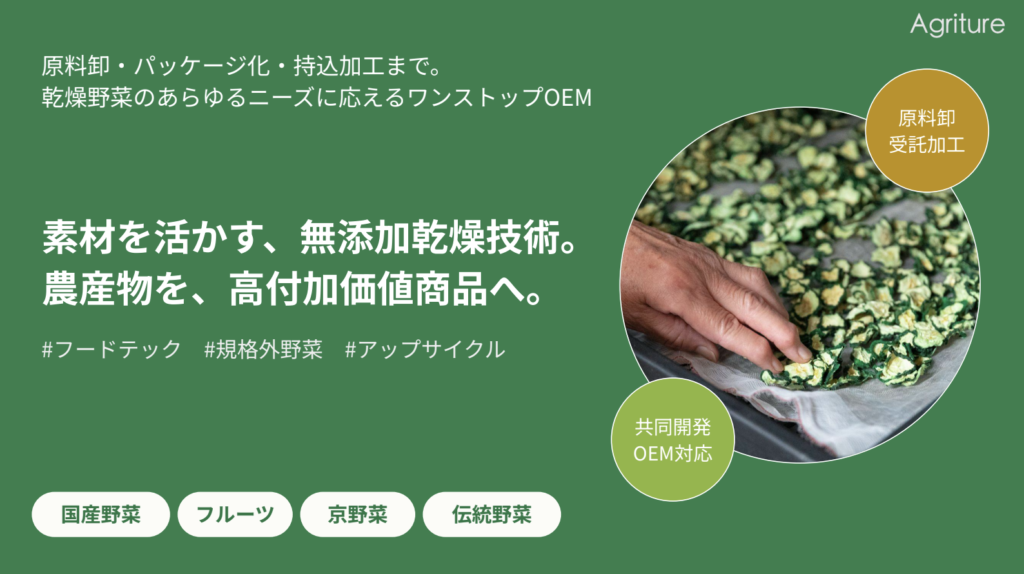
- OEM available from small lots of 10 kg
- Drying of brought-in raw materials also possible
- Support from processing to filling in one place
FOR BUSINESS
乾燥野菜のOEM・受託加工を承ります
国産の野菜・果物の乾燥、100メッシュ相当までの粉砕、10g以上の小袋充填までをお受けしています。小ロットの試作から量産までご相談ください。寄せられた相談の実例は OEM・卸のご相談 に掲載しています。
乾燥品の賞味期限は、出荷日から6ヶ月程度を目安にご案内しています。
Frequently asked questions before adopting vegetable-sweets OEM
Does adding vegetable powder change the flavor of sweets?
The higher the blend amount, the more the ingredient-derived flavor comes forward. For color priority with restrained flavor, 1 to 3% relative to flour is a guide, and for appealing to flavor too, 5 to 8%. Beet and purple sweet potato pair well with sweetness, and keeping the blend amount low is a failure-resistant way to use spinach and burdock types.
Does the color remain in baked sweets too?
Carotenoid types (kabocha, carrot, dried tomato) readily retain color even after baking and suit baked sweets. Because beet (betalain) and spinach (chlorophyll) fade readily with heat, holding the baking temperature to around 150C or turning them to post-baking decoration use retains the color.
I hear the color changes when combined with baking soda or egg white
The anthocyanin contained in purple sweet potato, purple cabbage, and red cabbage turns blue to green under alkalinity. Because cookies using baking soda and baked sweets using a lot of egg white readily turn green, it is safe to use it in a neutral-to-weakly-acidic recipe or in post-baking decoration.
Is the blend amount different for frozen and baked sweets?
Yes. Frozen sweets (ice cream, sorbet) have no heating step and retain vivid color, so 0.5 to 3% is enough, while baked sweets are generally designed higher at 3 to 8% to make up for the flavor and color weakening with heat. Read the percentage relative to flour on a powder basis (cake flour, almond flour).
Can I buy small amounts for home baking?
OYAOYA (Agriture's D2C brand) sells some ingredients in small packs of 10 g to 500 g. Before a large commercial OEM order, a flow of first testing a small amount at OYAOYA and then proceeding to the main order is also possible. For powdering and blend design, please consult us separately for commercial use.
Can I consult on sweets OEM?
Yes. Agriture lines up over 30 kinds of vegetable powders and dried vegetables, and can design blends to match the color, flavor, and sweets category you are aiming for. We have implementation cases such as pudding, macaron, sorbet, carrot cake, Japanese sweets, and homemade bread. Food OEM no Madoguchi (Agriture) Please consult us.
For the lineup of powders usable as raw materials for vegetable-sweets OEM, see Agriture's list of commercial vegetable powders available for viewing here.
Vegetable-sweets OEM: a summary of design and pre-order checks
Vegetable powder is an ingredient that can differentiate sweets through the three elements of color, flavor, and nutrition. With the basic preparation of mixing it with cake flour, milk, and eggs, it can be used widely from homemade cookies to commercial cakes, bread, macarons, ice cream, and Japanese sweets. Grasping the ingredient science that carotenoid types are heat-resistant and suit baked sweets, while anthocyanin types require pH attention, lets you design premium confectionery, sweets for children, and gift sweets without synthetic colorings or food dye.
Agriture processes over 30 kinds of dried vegetables and vegetable powders with low-temperature drying at 45C. For consultations on confectionery and sweets OEM, inquiring with the concept, category, sales channel, and lot together makes ingredient selection and prototyping proceed smoothly.
Related article: Vegetable powder, natural coloring, additive-free・How to use fruit powder・Vegetable powder filling OEM. For sweets OEM consultation, Food OEM no Madoguchi (Agriture).
Download the OEM contract processing materials
We will send the materials to your email address based on the information you provide.
If you are considering product development with off-spec or your own farm's vegetables:From planning to processing, materials, package printing and novelties, you can consult us through a single point of contact. → Learn more about one-stop product development
- The complete guide to succeeding at PB development with vegetable powder | Small lots supported
- Make Baby Food Easy with Vegetable Powder: Safe Uses and Recipes by Age
Author of this article
Related articles
-
 柚子の皮の使い道は干すと広がる、果汁と種まで使い切る手順
 -
 How to Use OEM Matching Sites: Efficiently Finding the Optimal Manufacturing Partner
 -
 How to proceed with hometown-tax product development | OEM techniques that make the most of local ingredients
 -
 Creating a regional brand with a Kyoto-vegetable OEM | The complete flow from planning to sales
 -
 How to source commercial vegetable powder in small lots, and how to use it
 -
 What Is Vegetable Powder? Features, Shelf Life, Uses and a Guide to OEM
 -
 What is vegetable paste? The difference from powder, dried vegetables, purée, and extract
 -
 Solve picky eating too! 3 ideas for commercializing vegetable powder you can keep up every day