
How to use commercial vegetable powder | Uses at restaurants and storage

Summary of this article
A practical guide to using commercial vegetable powder in restaurants, cafes, hotels, institutional catering, and confectionery. We've organized the difference between commercial and home-use, uses by business type (restaurant, cafe, hotel/inn, institutional/hospital meals, confectionery), the optimal particle size and when to add it by cooking method (soup, sauce, working in, topping, beverage), storage before and after opening, five common failure patterns at adoption, three sourcing routes (maker direct, food wholesaler, OEM operator), and Agriture's 11-item commercial powder lineup.
commercial vegetable powder is a raw material for handling the color, flavor, and nutrition of vegetables at room temperature, used in restaurants, cafes, hotels, institutional catering, and food makers. Compared with fresh vegetables, it's superior in shelf life, work efficiency, and yield, and cuts purchasing swings and disposal loss, so it's become a staple ingredient in commercial kitchens and workshops.
In this article, We lay out usable-on-the-ground perspectives, from the criteria restaurants and food operators use when choosing commercial vegetable powder, to uses by business type, storage and quality control, and common failures at adoption. Product development, PB, and OEM ordering are covered in separate articles (PB development/Small-lot sourcing/Filling OEM).
For restaurants and operators like these
- Struggling with purchasing swings and disposal loss for fresh vegetables
- Cafes and restaurants that want to add seasonal color to the menu
- Institutional and hospital meals that need measures for picky eaters
- Hotels and inns that want more color at the breakfast buffet
- Individual shops / small-scale food operators who want to try in 100g units
- Anyone who wants to know Agriture's specific commercial powder items

We have materials available to help you understand dried processing OEM
Agriture OEM, flexibly handling everything from small lots to large lots
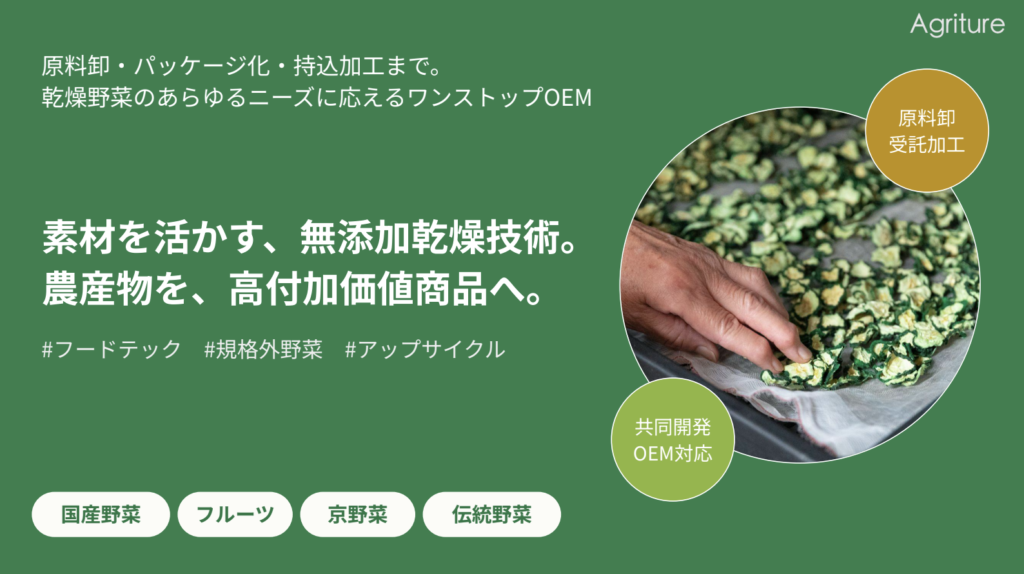
- OEM available from small lots of 10 kg
- Drying of brought-in raw materials also possible
- Support from processing to filling in one place
TOC
The difference between commercial and home-use
Commercial and home-use powders differ in packaging unit, unit price, particle-size specification, and quality assurance. The basic split is commercial for restaurants and food operators, home-use for home cooking. For the details of how to choose (method, origin, certification, additive-free), A complete guide to choosing vegetable powder.
| Item | Commercial | Household use |
|---|---|---|
| Packaging volume | 100g, 500g, 1kg, 5kg | 20-100 g small bags |
| Price (per kg) | Low to medium | High |
| Particle-size specification | Can be specified by use | Fixed specification |
| Quality assurance | Lot-managed, with a test report | Package labeling only |
💡 POINT | small restaurants should start from 100g
While your monthly usage is still unknown, starting from 100g or 200g small pouches is safest. Verify the color, flavor, and blend at your shop, then switch to 500g or 1kg units to match your usage.
Uses by business type
The uses for commercial vegetable powder change greatly by business type. restaurant, cafe, hotel, institutional catering, confectionery We've organized the frequently used items and cooking methods across these five business types. Use it as a base for deciding your direction of adoption by matching it against your own business type.
| Business type | Frequently used vegetable powders | Main uses |
|---|---|---|
| Restaurant (course) | Beet, kabocha, spinach | Coloring sauces, working into pasta, mousse |
| Cafes | Matcha, purple sweet potato, beet, spinach | Latte art, cakes, smoothies |
| Hotel / inn | Kyoto-vegetable types, burdock, lotus root | Kaiseki, breakfast, soups, Japanese-Western fusion dishes |
| Institutional / hospital meals | Carrot, spinach, kabocha | Nutritional fortification, measures for picky eaters, allergen consideration |
| Confectionery / bakery | Spinach, purple sweet potato, kabocha, matcha | Working into dough, ganache, macarons |
Uses at restaurants and cafes
At restaurants and cafes, vegetable powder shines for staging color and expressing the season. Pink pasta with beet powder, purple macarons with purple-sweet-potato powder, green touches with matcha or spinach powder, and more, it answers demand for seasonal menus and photogenic dishes. For particle size, a fine powder of 80-100 mesh or finer suits a smooth finish.
Uses at hotels and inns
At hotel and inn breakfast buffets and kaiseki meals, Kyoto-vegetable powder, burdock, lotus root and other heirloom-vegetable-type powders are often used. Since they store at room temperature, you can bring them into the menu without worrying about the purchasing lot, a strength of commercial powder. They're used as accents in Japanese-Western fusion dishes and to add character to breakfast omelet and smoothie corners.
FOR BUSINESS
乾燥野菜のOEM・受託加工を承ります
国産の野菜・果物の乾燥、100メッシュ相当までの粉砕、10g以上の小袋充填までをお受けしています。小ロットの試作から量産までご相談ください。寄せられた相談の実例は OEM・卸のご相談 に掲載しています。
乾燥品の賞味期限は、出荷日から6ヶ月程度を目安にご案内しています。
Uses in institutional and hospital meals
In institutional and hospital meals, the main aims are nutritional fortification and measures for picky eaters. Working carrot, spinach, and kabocha powder into curry, soup, or okonomiyaki-style pancakes lets people take in vegetables without changing the look. Choosing powder from a production line that handles allergens lets you use it with confidence in school and hospital meals too.
Choosing by cooking method
Even for the same powder, the optimal particle size and when to add it change with the cooking method. To get a stable finish commercially, mastering the split by cooking method is the basics. We've organized the recommended mesh, timing, and cautions for five cooking scenes.
| Cooking method | Recommended particle size | When to add it | Points to note |
|---|---|---|---|
| Soups and potages | 40–80 mesh | At the end of heating | Dissolve in a little water to prevent clumping |
| Sauces and dressings | 80–100 mesh | Mix with fat, then add water | Prevent separation and settling |
| Dough / working in | 80–100 mesh | Mix together with the flours | Increase the moisture by 5-10% |
| Topping, furikake | 40-60 mesh | To finish | At a temperature where color doesn't fade with heat |
| Beverages and smoothies | Over 100 mesh | Dissolve into the liquid by shaking | Check for remaining clumps |
Using in soups and potage
In soups and potage, kabocha, carrot, tomato, and spinach vegetable powders can deliver color and richness at once. Add the powder at the final stage of heating and dissolve it in a little water first before combining to avoid clumping. A medium particle size of 40-80 mesh is a guide that keeps a pleasant mouthfeel in soup while resisting settling. Try a blend amount from 1-3% of the liquid volume and increase it while watching the color and taste.
Using in sauces and dressings
In sauces and dressings, the basics are to mix with the fat first, then add the liquid. Beet, spinach, and basil powder reinforce the color and flavor of tomato sauce, genovese, and French dressing. Using a fine powder of 80-100 mesh gives a smooth finish and even color tone, and separation and settling over time are less likely to occur.
Working into dough
When working it into bread, pasta, cookie, or macaron dough, sift it together with the flours before adding the liquid to disperse it evenly. Because vegetable powder absorbs moisture, the basics are to Increase the moisture by 5-10% increase it over the usual recipe
. A blend amount of 3-8% of the flours is a guide, and since the color lightens after baking, designing it a bit darker at the dough stage balances out.
Using as a topping or furikake For topping uses where you sprinkle it on at the end of a dish,a somewhat coarse 40-60 mesh particle size finishes appetizingly in both texture and appearance. For salads, risotto, omelets, ochazuke, and so on. For heat-sensitive powders (spinach, beet),sprinkle after plating rather than right after heating
so the color doesn't fade.
Using in beverages and smoothies When using it in smoothies or lattes,a fine powder of 100 mesh or finer
We have materials available to help you understand dried processing OEM
Agriture OEM, flexibly handling everything from small lots to large lots
- OEM available from small lots of 10 kg
- Drying of brought-in raw materials also possible
- Support from processing to filling in one place
is essential. A coarse particle size clumps and worsens the mouthfeel. Any one of three methods, shaking in a shaker, mixing in a blender, or making it into a paste with a little liquid first before adding, gives a clump-free finish. Matcha, beet, and spinach powder are staple ingredients that stand out in cafe lattes and smoothie bowls.
Storage and quality control To keep the quality of commercial powder,the storage conditions before opening and the management after opening
matter. It hardens and loses flavor when it takes on moisture, so just getting the storage environment right changes the yield significantly. Especially with large-volume commercial 1kg and 5kg sizes, it takes time to use up once opened, so thorough storage practice is the key to maintaining quality. Beyond moisture,light, temperature, and oxygen
| State | Storage condition | Best-before guideline |
|---|---|---|
| are three factors that degrade quality. Powders with strong pigments in particular, like beet, purple sweet potato, and spinach, fade quickly with light and oxygen, so combining a light-blocking container with an oxygen absorber is the basics. The ideal storage spot is out of direct sunlight, with little temperature change (around 20°C, humidity 60% or less). | Unopened, room temperature | 12–18 months |
| No direct sunlight, humidity 60% or less | After opening, room temperature | 2–3 months |
| Airtight container, desiccant | After opening, refrigerated | Airtight to prevent condensation |
| 3-6 months (aroma-focused items) | After opening, frozen | Portion and freeze, thaw only what you use |
6-12 months (pigment and functional raw materials)
⚠️ Note | humidity control is the top priority The cause of quality decline in commercial powder is moisture
in most cases. In a kitchen or workshop, transfer it to an airtight container right after opening and store it with a desiccant. Take out only what you use, and return the rest to a cool, dark place.
Five failure patterns at adoption We've organized the failures restaurants and food operators using commercial vegetable powder for the first time tend to fall into. All are avoidable with information beforehand
| Failure | Symptom | Remedy |
|---|---|---|
| . | Order a lot and can't use it up | Quality decline and disposal after opening |
| Try in 100-200g → mass-buy once usage is clear | Wrong particle size | Hard to dissolve, clumps |
| Buy by specifying a mesh that suits the cooking method | Color fades | Discolors with heat |
| Sprinkle to finish / choose a low-temperature-processed product | Weak flavor | Simply doesn't taste of the vegetable |
| Consider FD or vacuum-dried products over hot-air-dried | Misjudging the blend amount | Flavor too strong or too weak |
Try from 5-10% of the dough, 1-3% of the liquid
Where to source commercial powder Commercial vegetable powder can be sourced via three routes:maker direct, food wholesaler, OEM operator
| Sourcing | Suitable orderer | . We've compiled the suited route by business type for first-time users. |
|---|---|---|
| Unit price and lot | Maker direct (e-commerce) | Individual restaurants, small cafes |
| 100g-1kg / higher unit price | Food wholesaler / distributor | Mid-size restaurant chains |
| 1-10kg / medium unit price, delivery-efficient ◎ | OEM operator | Confectionery and food makers |
10kg+ / low unit price, made-to-order For many restaurants, the practical flow is to buy from a maker's direct e-commerce in 100g units → switch to a wholesaler once usage is clear
.
Agriture's commercial powder lineup From its base in Kyoto, Agriture makes 100% domestic vegetables, sold from 100g, small-lot support
| Item | commercial vegetable powder. Items for restaurants and food makers, processed at contract farmers (Echie Farm and Taniyoshi Farm in Kyotango, etc.) and five production sites in Nagano, Mie, Ehime, and Okinawa. |
|---|---|
| Spinach powder | Characteristics and suited uses |
| Zucchini powder | Green color / confectionery, sauces, smoothies |
| Bell-pepper powder | Pale green, gentle flavor / pasta, pizza dough |
| Okra powder | Aroma of green vegetables / stir-fries, dressings |
| Nameko powder | Thickening, viscosity / soups, baby food |
| Yuzu powder (Kyoto-grown) | Umami, richness / Japanese-style soups, rice porridge |
| A Japanese aroma / wagashi, dressings | Moringa powder |
| Radish powder | Superfood / health foods, smoothies |
| Maca powder | Pink color, light spiciness / salads, color accents |
| Kamo eggplant powder | Functional ingredient / supplements, drinks |
| Mustard greens powder | Purple color, Kyoto vegetable / fine dining, Japanese sweets |
Light spiciness, a distinctive flavor / Japanese cuisine, dressings beets,・Kujo green onion・Shogoin daikon・burdock Besides these, kabocha, carrot, tomato, and more,nearly 100 dried vegetables and vegetable powders the product page for commercial vegetable powder are handled as contract-processing and commercial raw materials. For detailed items, specs, and prices, Wholesale and OEM information from here.
FOR BUSINESS
乾燥野菜のOEM・受託加工を承ります
国産の野菜・果物の乾燥、100メッシュ相当までの粉砕、10g以上の小袋充填までをお受けしています。小ロットの試作から量産までご相談ください。寄せられた相談の実例は OEM・卸のご相談 に掲載しています。
乾燥品の賞味期限は、出荷日から6ヶ月程度を目安にご案内しています。
, and for contract-processing inquiries,
Where to source commercial powder Summary of commercial use Choose on five criteria, raw material, particle size, flavor, volume, and shelf life,
and master the uses by business type when adopting it, and you can achieve both work efficiency in the kitchen and product quality. For a first adoption, try from 100g units and switch to a wholesaler or OEM once usage is clear, the low-risk way to proceed. If you're considering product development, PB, or OEM ordering, also see the、PB development guide、small-lot sourcing guide filling OEM guide
Download the OEM contract processing materials
We will send the materials to your email address based on the information you provide.
Recommended reading
If you are considering product development with off-spec or your own farm's vegetables:From planning to processing, materials, package printing and novelties, you can consult us through a single point of contact. → Learn more about one-stop product development
- Additive-free design with vegetable powder | How to choose natural colorants for use as coloring food
- The Secret to Vegetable Dashi Is Dried Vegetables! Tips for Drawing Out Umami
Author of this article
Related articles
-
 Original coffee marketing strategy | Ways to grow sales
 -
 ベジタリアンとは?国の規格が分けている4つの区分と食べられないもの
 -
 長ねぎと白ねぎは同じもの?ねぎの種類と呼び名を国の資料で確かめる
 -
 柚子の種類は何種類あるのか、公の資料で名前が残る系統を数えた
 -
 ゆずの時期は年に二度、青ゆずは7月から黄ゆずは10月から
 -
 ゆずの産地は高知が半分を占め、二位は徳島から愛媛に変わった
 -
 Preventing Food OEM Failures: Common Failure Cases and Countermeasures for Success
 -
 How to find a food OEM | How to efficiently find the best manufacturing partner