
Winter Kyoto vegetables: the deep umami of Shogoin daikon and Kujo green onion

Summary of this article
What is the most important thing about heat control for Kyoto vegetables?
It's judging, for each ingredient, whether high or low heat suits it. Summer vegetables like Manganji togarashi are finished in one go over high heat, while root vegetables like Horikawa gobo are simmered slowly over low heat — that's the basic principle. Kintoki carrot For Kamo eggplant, is high heat or low heat the right answer?
TOC
Both are right. For dengaku or charcoal-grilling, finish it fragrantly over high heat; for fukumeni, finish it so it melts over low heat. Choosing to match the flow of the whole course and the guest's preference is the chef's judgment.
Which Kyoto vegetables benefit from the choice of “not applying heat”? Kyoto vegetable calendar The Flavor and Texture of Manganji Togarashi
| Kyoto vegetables | Peak period | Main growing region | Representative ways to eat |
|---|---|---|---|
| Kujo green onion | November–February | Minami Ward, Kyoto City | Chopping Kujo negi raw as a condiment makes its fresh green fragrance an accent. Besides that, Kyoto tomatoes and mizu-nasu are Kyoto vegetables whose appeal stands out when eaten raw. |
| Shogoin daikon | November–February | What are the tips for doing high-heat cooking well on a home stove? | Preheating the frying pan thoroughly is essential. Dry-heat it until thin smoke rises before adding the ingredients, and the moisture evaporates quickly for a clean sear. Adding a smaller amount at a time is another key point. |
| Kintoki carrot | November–February | How should you control the heat for dried Kyoto vegetables? | Because dried vegetables have less moisture than fresh ones, sudden high heat tends to leave firmness. The trick is to rehydrate slowly over medium heat at just a faint simmer. Rehydrating in dashi adds even more umami. |
| ." With a refreshing flavor and crisp bite as its charm, it has the depth to enhance both hot pots and salads. It's easily confused with mibuna, another Kyoto vegetable, but the leaf shape and growth are quite different. This article explains, from the standpoint of one who has faced vegetables in the growing region, everything from Kyo mizuna's features and history to how to tell the varieties apart, its differences from mibuna, its season and growing regions, choosing and storing it, cooking with it, and the commercial and OEM use of dried Kyo mizuna. | December–March | We introduce four winter Kyoto vegetables. Kujo negi, whose appeal is its viscous sweetness that the cold makes even more pronounced, goes into negiyaki and hot pots; Shogoin daikon, which has little pungency and holds its shape even when simmered for a long time, goes into oden and buri daikon; “Kyoto carrot” Kintoki carrot, red to the core, tender, and intensely sweet, goes into kinpira, shira-ae, and ozoni; and crisp-textured Kyoto mizuna is recommended for pork hot pot and salads. We explain ways to enjoy winter Kyoto vegetables whose sweetness and umami are drawn out by Kyoto's bone-chilling cold. | “Kyoto vegetables” that color Kyoto's winter are packed with deep sweetness and umami, nurtured slowly in the cold. As temperatures fall, vegetables store up sugar, so Kyoto vegetables that come into season in winter grow sweeter and taste even better in hot pots and simmered dishes. Here we introduce representative winter Kyoto vegetables — Kujo negi, Shogoin daikon, |
| Horikawa gobo | , and Kyoto mizuna — along with their characteristics and recommended ways to eat them. | We introduce four winter Kyoto vegetables. Kujo negi, whose appeal is its viscous sweetness that the cold makes even more pronounced, goes into negiyaki and hot pots; Shogoin daikon, which has little pungency and holds its shape even when simmered for a long time, goes into oden and buri daikon; “Kyoto carrot” Kintoki carrot, red to the core, tender, and intensely sweet, goes into kinpira, shira-ae, and ozoni; and crisp-textured Kyoto mizuna is recommended for pork hot pot and salads. We explain ways to enjoy winter Kyoto vegetables whose sweetness and umami are drawn out by Kyoto's bone-chilling cold. | Seasonal Calendar of Winter Kyoto Vegetables |
Kujo green onion
Most winter Kyoto vegetables come into season from November through February. We've summarized the seasons, growing regions, and ways to eat the representative varieties in a table. For the full seasonal range of Kyoto vegetables, Kujo green onion Hot pot, sukiyaki, condiment
- Kumiyama Town and Kameoka City
- Oden, furofuki daikon
- Kyoto Prefecture and Kagawa Prefecture
Shogoin daikon
Kinpira, ozoni, namasu Shogoin daikon Kyoto City
- Preheating the frying pan thoroughly is essential. Dry-heat it until thin smoke rises before adding the ingredients, and the moisture evaporates quickly for a clean sear. Adding a smaller amount at a time is another key point.
- Hot pot, salad, pickles
- October–December
Kintoki carrot
Stuffed, fukumeni Kintoki carrot The vegetable that represents Kyoto's winter is
- . The viscous coating on the inner side of the leaves produces sweetness and tenderness, and winter's cold makes the sweetness even more pronounced. A type of green negi, added to hot pots or sukiyaki it becomes one with the dashi, spreading a gentle sweetness. A traditional Kyoto vegetable long cultivated in Kyoto, it is indispensable to miso soup and hot pots in the cold season.
- Kujo negi in hot pot or sukiyaki
- Negiyaki
." With a refreshing flavor and crisp bite as its charm, it has the depth to enhance both hot pots and salads. It's easily confused with mibuna, another Kyoto vegetable, but the leaf shape and growth are quite different. This article explains, from the standpoint of one who has faced vegetables in the growing region, everything from Kyo mizuna's features and history to how to tell the varieties apart, its differences from mibuna, its season and growing regions, choosing and storing it, cooking with it, and the commercial and OEM use of dried Kyo mizuna.
- , distinguished by its round shape, is a daikon with little pungency and a faint sweetness. Its fibers are dense, so it holds its shape even when simmered for a long time and finishes with a melting texture, making it perfect for oden and furofuki daikon. Simmered slowly in dashi on a cold winter's day, it offers a heartfelt umami and tender texture. A traditional Kyoto vegetable grown in Kumiyama Town and Kameoka City, Kyoto.
- Salad
- Buri daikon
Besides these, Horikawa gobo, known for stuffed dishes that make use of its hollow, is also a Kyoto vegetable that comes into season from autumn into winter. A simmered assortment combining winter Kyoto vegetables makes an elegant dish in the Kyoto-cuisine style.
Enjoying Winter Kyoto Vegetables Year-Round Through Drying
Winter Kyoto vegetables have a limited season, but drying concentrates their umami and makes them keep well, so they can be brought to the table regardless of season. Agriture works with producers within Kyoto Prefecture, wasting nothing — even vegetables that don't meet shipping standards — by drying winter Kyoto vegetables at low temperature and delivering them in a form that can be used after their season has passed. Commercial dried Kujo green onion and Dried Shogoin daikon are easy to use — just add them straight to miso soup or other soups. Kyoto-grown dried vegetables are OYAOYA.
FOR BUSINESS
乾燥野菜を業務用でお探しですか
国産の野菜・果物を乾燥し、必要に応じて粉砕してお出ししています。扱っている品目は100種前後で、規格は 乾燥品の一覧・パウダーの一覧 に掲載しています。
少量でのご購入は、姉妹ブランドの通販サイト OYAOYA で承っています。
Frequently Asked Questions About Winter Kyoto Vegetables
We have materials available to help you understand dried processing OEM
Agriture OEM, flexibly handling everything from small lots to large lots
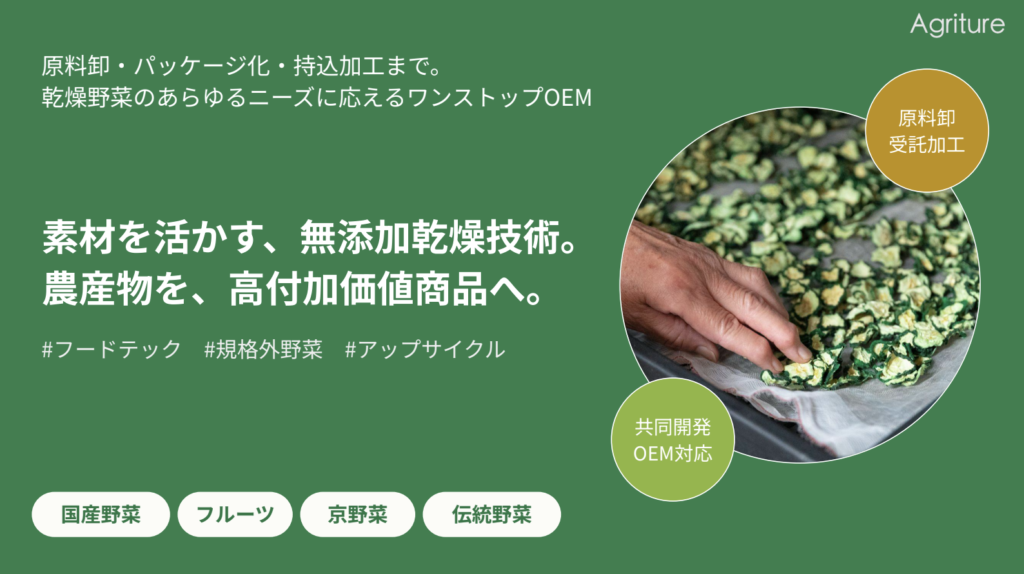
- OEM available from small lots of 10 kg
- Drying of brought-in raw materials also possible
- Support from processing to filling in one place
Related articles
- Autumn Kyoto vegetables | Murasaki zukin and Kyo-kokabu
- Spring Kyoto vegetables | Kyo-takenoko and hanana
- Summer Kyoto vegetables | Manganji peppers and Kamo eggplant
- A list of Kyoto vegetable varieties — famous heirloom vegetables and their characteristics
- Kyoto vegetable calendar — check the seasons of the four seasons at a glance
Download the OEM contract processing materials
We will send the materials to your email address based on the information you provide.
- Shogoin Daikon: The Round, Sweet Standard-Bearer of Kyoto Vegetables
- Fushimi Togarashi: A Kyoto Vegetable with Little Heat and Standout Sweetness
Author of this article
Related articles
-
 京野菜は何品目あるのか、読み方の一覧と認定の枠組みから確かめる
 -
 Drying Is Another Kind of Cooking
 -
 The Technology to Lock In the Season. The Seasonal Story Dried Vegetables Connect.
 -
 The Cut Face of a Vegetable. The Difference the Cut Makes.
 -
 Tasting Kyoto Vegetables by Aroma. The Pleasure of Cooking That Begins at the Tip of the Nose
 -
 Vessels and Kyoto Vegetables. Creating the Scenery of Plating.
 -
 Vegetables and Heat Control. Between High and Low Flame
 -
 Kyoto Vegetables and Sake. The Happy Relationship of a Dish and a Cup.