
[Kyoto Vegetable Calendar] Seasonal Kyoto Vegetables That Color the Four Seasons and Famous Kyoto Cuisine

Summary of this article
Through a Kyoto-vegetable calendar, we introduce the seasonal Kyoto vegetables that color the four seasons and their representative Kyoto dishes. In spring (March–May), Kyoto bamboo shoots, hanana, and Kyo-mibuna are used for wakatakeni and shiraae; in summer (June–August), Kamo eggplant, Manganji peppers, and Shishigatani pumpkin for dengaku and grilling; in autumn (September–November), ebi-imo, Horikawa burdock, and Tamba chestnut for imobo and chestnut rice; and in winter (December–February), Shogoin daikon, Kujo scallion, kuwai, and Kintoki carrot for osechi and senmaizuke — explaining the Kyoto food culture to be enjoyed.
The gentle ring of "Kyoto vegetables" is everyday life for the people of Kyoto, a longing for those who live outside Kyoto, and somehow evokes nostalgia. Tied to seasonal events and dishes, they have nurtured a distinctive food culture. In modern times, with advances in agricultural technology, more can be enjoyed year-round, but in Kyoto "the season" is still cherished above all.
This article compiles the Kyoto vegetables that come into season in spring, summer, autumn, and winter into a single calendar, introducing them together with representative Kyoto dishes and growing regions. For those who want to know the varieties comprehensively, see the comprehensive guide to Kyoto vegetables (What are Kyoto's heirloom vegetables).
TOC
[Kyoto-vegetable calendar] Seasonal Kyoto vegetables that color the four seasons
Kyoto vegetables, indispensable to Kyoto's food culture. Here are the seasons of the main Kyoto vegetables.
Spring Kyoto vegetables (March–May) | A season that feels the breath of life
Spring in Kyoto is a season packed with splendid events — the Doll Festival, Miyako Odori, and the cherry-blossom festival at Heian Shrine.
On the spring table appear Kyoto bamboo shoots that become wakatakeni, hanana made into shiraae and tempura, and Kyo-mibuna that becomes bubuzuke. Spring Kyoto vegetables are appealing for their faint sweetness and slight bitterness. Fitting for the season when life sprouts, they give off a fresh, pure aroma.
Kyoto bamboo shoots: a beautiful white form and a tenderness that lets you even eat them raw. Wakatakeni and bamboo-shoot rice are seasonal features of spring. They are also distinguished by little harshness or bitterness.
Hanana: a spring vegetable of gentle flavor for which the name "hanana" fits perfectly. With a crisp bite and a distinctive pungency, it adds color to pickles, mustard-dressed dishes, and clear soups.
Kyo-mibuna: with a refreshing aroma and a light pungency, it adds an accent to Kyoto cuisine. Besides being served alongside senmaizuke, it is an indispensable item in spring simmered and dressed dishes.
Vegetables | Representative dishes | Detail page |
|---|---|---|
Kyoto bamboo shoots | Wakatakeni | |
Hanana | Shiraae | |
Kyo-mibuna | Bubuzuke | |
Usui peas | Bean rice | |
Udo | Kinpira |

Summer Kyoto vegetables (June–August) | A taste that fully receives the sun's bounty
Summer in Kyoto means the Gion Festival and the Gozan no Okuribi — a splendid, heat-filled season.
What colors the lively summer table are Kamo eggplant enjoyed as dengaku, Manganji peppers whose toastiness is drawn out by grilling, and the distinctively shaped Shishigatani pumpkin.
Kyoto vegetables gather here whose rich taste and vivid colors make you feel summer's energy.
Kamo eggplant: characterized by a round, endearing shape and a glossy purple. Its cultivation takes delicate effort, and it is beloved as a Kyoto-representative summer vegetable. Made into dengaku or agedashi, you can enjoy its firm flesh and rich umami.
Manganji pepper: characterized by low pungency and a gentle sweetness. Used in grilled dishes, stir-fries, tempura, and more, it adds strength to the summer table. Its soft texture and sweetness give energy to a body somewhat worn out by summer heat.
Shishigatani pumpkin: the Shishigatani pumpkin, striking for a unique gourd-like shape. Eaten as "okabo no taitan," it is also beloved as an ingredient for warding off stroke. With a light, gentle sweetness, it is a Kyoto vegetable that gently supports the summer appetite. It is also famous as a staple ingredient for the Urabon (Obon) festival.
Vegetables | Representative dishes | Detail page |
|---|---|---|
Kamo eggplant | Dengaku | |
Manganji togarashi | Grilling | |
Shishigatani pumpkin | Okabo no taitan | |
Fushimi togarashi | Fukumeni | |
Yamashina eggplant | Nishin nasu |

Autumn Kyoto vegetables (September–November) | Rich flavor and deep sweetness nurtured by temperature swings
Autumn in Kyoto is a season where the Choyo Festival and the Jidai Matsuri are held and you feel the season deepen.
In this period when the temperature swings grow large, "ebi-imo," indispensable to imobo; "Horikawa gobo," ideal for stuffed dishes; and "Tamba chestnut," positioned as a brand Kyoto vegetable, come into season.
Characterized by deep sweetness and body nurtured by temperature swings, Kyoto vegetables gather here that reliably warm the body from within.
Note that in Kyoto Prefecture's classification there are "Kyoto heirloom vegetables" (vegetables cultivated since before the Meiji era) and, apart from these, "brand Kyoto vegetables" that Kyoto Prefecture promotes. Care is needed on the point that Tamba chestnut, Tamba black soybean, and Kintoki carrot, and the like are not certified Kyoto-heirloom-vegetable items but are positioned as brand Kyoto vegetables.
Ebi-imo: characterized by a shrimp-like shape and a sticky texture. In simmered dishes like "imobo," it draws out a warm, comforting flavor. It is one of Kyoto's representative vegetables, to the point of having the alias "Kyo-imo."
Horikawa burdock: characterized by being thicker than ordinary burdock and having a soft texture. Its appeal is the exceptional flavor nurtured by a cultivation method handed down over 400 years. Because it has a hollow center, a standard dish is to stuff it with minced shrimp and simmer it.
Tamba chestnut: boasting one of the largest sizes in Japan, characterized by strong sweetness and a fluffy texture. A luxury item once presented to the imperial court, it is commonly enjoyed as shibukawani or chestnut rice. * Tamba chestnut is not a certified "Kyoto heirloom vegetable" item but a specialty positioned as a "brand Kyoto vegetable" recommended by Kyoto Prefecture.
Vegetables | Representative dishes | Detail page |
|---|---|---|
Ebi-imo | Imobo | |
Horikawa gobo | Fukumeni | |
Tamba chestnut | Chestnut rice | |
Murasaki zukin | Takikomi rice |

Winter Kyoto vegetables (December–February) | Sweetness and umami drawn out by the cold
Winter in Kyoto is a season of year-end bustle and quiet snowy scenery.
In this period when the cold grows severe, Kyoto vegetables full of sweetness come into season — "Shogoin daikon," the star of senmaizuke; "Kujo scallion," indispensable to hot-pot dishes; and "kuwai," used in osechi cuisine.
Shogoin daikon: the round daikon familiar from senmaizuke. Suited to Kyoto's shallow soil, it holds its shape when simmered and is superb even as furofuki or oden. It is characterized by a tenderness that brings out the sweetness.
Kujo scallion: the Kujo scallion, whose leaves thicken and sweetness increases when frost falls. Besides being used as kamo-nanba or nuta, it is indispensable to hot pot and sukiyaki. It is a presence that adds color to the winter table.
Kuwai: considered auspicious because it "sprouts a bud," it is a winter staple vegetable indispensable to osechi cuisine. Delicious whether steamed or simmered, characterized by a fluffy texture, it has been beloved in Kyoto since ancient times.
Vegetables | Representative dishes | Detail page |
|---|---|---|
Shogoin daikon | Senmaizuke | |
Kujo negi | Kamo-nanba | |
Kuwai | Osechi | |
Kintoki carrot | Simmered nishime of osechi cuisine |

A food culture woven by the seasonal Kyoto vegetables of each of the four seasons
Kyoto vegetables are not mere ingredients but "seasonal storytellers" that mirror Kyoto's four seasons.
In spring, the strength of budding; in summer, the sun's bounty; in autumn, the rich flavor born of temperature swings; in winter, the sweetness the deep cold brings. Each dish makes you feel the life of Kyoto.
In modern times, with advances in agricultural technology, more can be enjoyed year-round, but the attitude of cherishing "the season" remains unchanged.
For this reason, even in the drying of Kyoto vegetables, we continue to devise ways to prepare them during the in-season harvest and seal in the flavor as it is.
Agriture, centered on Kyoto-produced Kyoto vegetables, offers products that let you enjoy their seasonal flavor for a long time through drying technology. Please savor the deliciousness of each season with dried Kyoto vegetables that seal in the in-season taste.
For commercial and OEM inquiries about using seasonal Kyoto vegetables regardless of season, please also see Dried vegetable OEM the page.
We have materials available to help you understand dried processing OEM
Agriture OEM, flexibly handling everything from small lots to large lots
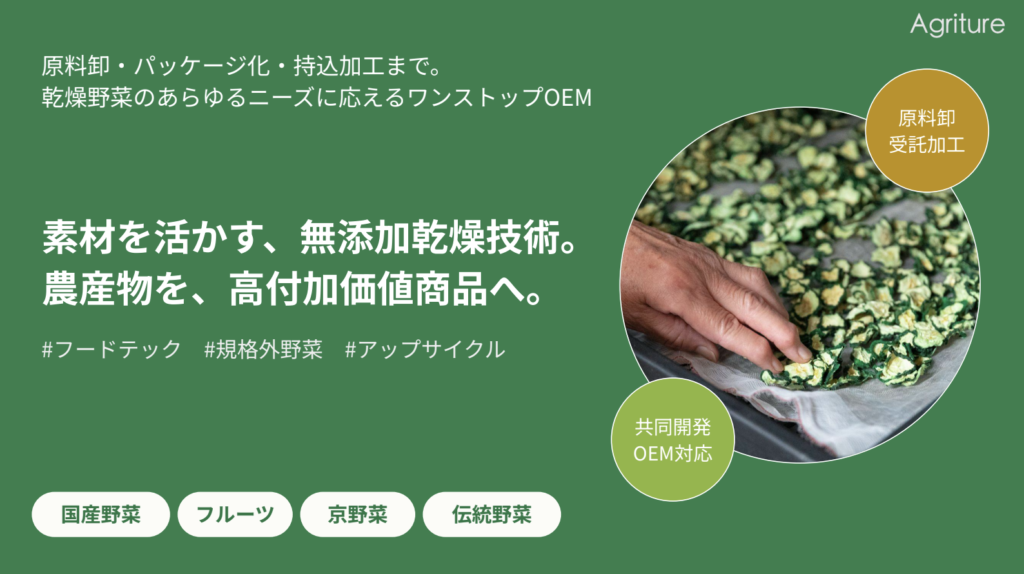
- OEM available from small lots of 10 kg
- Drying of brought-in raw materials also possible
- Support from processing to filling in one place
FOR BUSINESS
乾燥野菜を業務用でお探しですか
国産の野菜・果物を乾燥し、必要に応じて粉砕してお出ししています。扱っている品目は100種前後で、規格は 乾燥品の一覧・パウダーの一覧 に掲載しています。
少量でのご購入は、姉妹ブランドの通販サイト OYAOYA で承っています。
FAQ about the Kyoto-vegetable calendar
Related articles
- Spring Kyoto vegetables | The season of Kyoto bamboo shoots and hanana
- Summer Kyoto vegetables | Manganji peppers and Kamo eggplant
- Autumn Kyoto vegetables | Murasaki zukin and Kyo-kokabu
- Winter Kyoto vegetables | Shogoin daikon and Kujo scallion
- Comprehensive guide to Kyoto vegetables | What are Kyoto's heirloom vegetables
Download the OEM contract processing materials
We will send the materials to your email address based on the information you provide.
- Drying Is Another Kind of Cooking
- As If Meeting a Different Vegetable—Manganji Togarashi and the Story of "Season"
Author of this article
Related articles
-
 京野菜は何品目あるのか、読み方の一覧と認定の枠組みから確かめる
 -
 Drying Is Another Kind of Cooking
 -
 The Technology to Lock In the Season. The Seasonal Story Dried Vegetables Connect.
 -
 The Cut Face of a Vegetable. The Difference the Cut Makes.
 -
 Tasting Kyoto Vegetables by Aroma. The Pleasure of Cooking That Begins at the Tip of the Nose
 -
 Vessels and Kyoto Vegetables. Creating the Scenery of Plating.
 -
 Vegetables and Heat Control. Between High and Low Flame
 -
 Kyoto Vegetables and Sake. The Happy Relationship of a Dish and a Cup.