
How to start vegetarian OEM | Ingredient selection and product planning for vegan support

Summary of this article
As a foundation for vegetarian OEM, this article organizes the differences between dietary restrictions such as lacto, ovo, and vegan, and explains the points to consider in ingredient design and manufacturing processes. It covers the differences from religious diets such as halal and Jainism, planning examples for differentiated products using soy meat and dried vegetables, and how to choose a manufacturer to avoid failure in small-lot OEM, presenting practical points with an eye on inbound tourism and overseas exports.
"We want to develop vegetarian or vegan food through OEM. But we're not sure how far we need to go with ingredient restrictions and manufacturing considerations." More and more companies are voicing this concern. What you'll learn in this article:
- The difference in dietary restrictions between vegetarian and vegan (knowledge that directly informs ingredient design)
- Ingredient and manufacturing-process points to consider in OEM production
- Planning examples for vegetarian products and how to think about differentiation
- Vegan-friendly OEM using Agriture's dried vegetables and dashi tomatoes
For the basic types of vegetarians and the foods they can't eat, see "What Is a Vegetarian? Types, Foods to Avoid, and Market Growth Explained" for a detailed overview. This article focuses on the practical side of OEM development.
The vegetarian and vegan market continues to expand worldwide. The product categories you can develop through OEM are as follows.
| Category | Product example | Main raw materials | OEM difficulty |
|---|---|---|---|
| Plant-based meat | Soy meat patties, soy meat sauce | Soy protein, pea protein | High |
| Plant-based milk | Oat milk, almond milk | Oats, almonds, soybeans | Medium |
| Plant-based soup | Vegan ramen broth, vegetable potage | Dried vegetables, plant-based dashi | Low |
| Vegan sweets | Egg- and dairy-free cookies, vegan chocolate | Rice flour, coconut oil | Medium |
| Vegan seasonings | Plant-based dashi packs, vegan dressing | Kombu, shiitake, dashi tomato | Low |
| Dried vegetable toppings | For soups, salads, cup noodles | Various dried vegetables | Low |
Agriture handles the plant-based soup, vegan seasoning, and dried vegetable topping categories. OEM for plant-based meat and plant-based milk requires working with specialist manufacturers, but Find vegetarian-friendly manufacturers on Food OEM Madoguchi you can also.
The global market for plant-based foods is projected to reach roughly $162 billion by 2030, and within Japan the plant-based food market is showing growth of more than 15% per year. In the context of inbound tourism and e-commerce exports, vegetarian and vegan compatibility will be an essential theme going forward.
TOC
The Difference in Dietary Restrictions Between Vegetarian and Vegan
When developing food through OEM, ingredient design differs significantly between "vegetarian-friendly" and "vegan-friendly." Mistakenly assuming "vegetarian = vegan-friendly" risks missing part of your target audience.
| Type | What they eat | What they don't eat |
|---|---|---|
| Lacto-vegetarian | Vegetables, dairy | Meat, fish, eggs |
| Ovo-vegetarian | Vegetables, eggs | Meat, fish, dairy |
| Lacto-ovo vegetarian | Vegetables, dairy, eggs | Meat, fish |
| Vegan | Vegetables, fruits, grains, legumes only | All animal-derived foods including meat, fish, eggs, dairy, and honey |
In OEM development, you're required to decide first which type you'll cater to. For example:
- Pudding made with cow's milk → OK for lacto-vegetarians, not for vegans
- Granola with honey → OK for vegetarians, not for vegans
- Jelly with gelatin → not OK for either (requires substituting a plant-based gelling agent)
Ingredient Selection for Vegetarian OEM
Points to Watch in Ingredient Selection
For vegan compatibility, you need to watch out for easily overlooked animal-derived ingredients.
| Category | Ingredients to watch | Alternative ingredients |
|---|---|---|
| Dashi and seasonings | Bonito flakes, dried sardines, chicken bones | Kombu, dried shiitake, Tomatoes for dashi |
| Sweeteners | Honey, bone-char-processed white sugar | Maple syrup, beet sugar, coconut sugar |
| Gelling agents | Gelatin (pork- or beef-derived) | Agar, pectin, carrageenan |
| Emulsifiers | Egg-yolk lecithin | Soy lecithin |
| Colorants | Cochineal (insect-derived) | Beetroot, paprika, turmeric |
There are also easily overlooked ingredients. Soy sauce contains wheat, so it needs to be balanced against wheat-allergy compatibility. Mirin contains alcohol, so it must be managed separately from halal compatibility. White sugar is sometimes processed using bone char (cattle bone), so strict vegan standards call for switching to beet sugar or Coconut sugar as a substitute.
Dashi in particular is the most common stumbling block in Japanese food development. To create umami without using animal-based dashi, Tomatoes for dashi's glutamic acid, Dried shiitake's guanylic acid, and Dried onion's sweetness can be effectively combined. Detailed ways to use vegetable dashi.
Cross-Contamination Measures on the Production Line
Beyond ingredients, you also need to consider cross-contamination during the manufacturing process.
- Whether animal-based foods are produced on the same line
- Whether cleaning procedures for shared equipment are clearly defined
- Whether allergen labeling needs to state "produced on the same line as ○○"
- Whether the facility can accommodate third-party audits if obtaining vegan certification
When selecting an OEM manufacturer, always confirm whether they have a track record of producing vegetarian and vegan foods. How to choose an OEM manufacturer.
Planning Examples for Vegetarian OEM Products
Many companies already work on "soy meat" and "soy milk cheese." Here we introduce differentiation angles that make use of dried vegetables.
| Challenge | Product planning example | Ingredients Agriture can supply |
|---|---|---|
| Lacking umami and richness | Plant-based dashi pack (tomato × shiitake × kombu) | Tomatoes for dashi、Dried shiitake |
| Wanting more satisfaction | Dried vegetable mix as a topping ingredient (adds texture) | Dried burdock, dried lotus root, Dried cabbage |
| Wanting to supplement nutrients | Vegetable powder blend fortified with iron and calcium | Dried spinach, dried komatsuna |
| Wanting easy preparation | Just-add-hot-water vegan soup base | Dried vegetable mix + vegetable dashi powder |
| Wanting to export overseas | Halal + vegan dried vegetable set | All 30 items are available animal-free |
Planning Example 1: Detailed Design of a Plant-Based Dashi Pack
A dashi pack that uses no animal-based dashi at all is a product in particularly high demand within vegan development. A formulation using Agriture's ingredients might look like this.
- Base:Tomatoes for dashi (glutamic acid) 3g + Dried shiitake (guanylic acid) 2g
- Sweetness, depth:Dried onion 2g + kombu powder 1g
- Aroma:dried celery 0.5g or Dried ginger 0.5g
- How to use: Add 1 pack to 300 ml of hot water for 3 minutes. As a base for miso soup, soups, and simmered dishes
The combination of glutamic acid from tomato and guanylic acid from shiitake is called "umami synergy," amplifying umami on the same principle as the bonito-flake-and-kombu combination.
Planning Example 2: Vegan-Friendly Instant Soup
Just-add-hot-water vegan soup bases are a category seeing rising demand for convenience stores, e-commerce, and offices.
- Minestrone-style: Dashi tomato + dried onion + Dried cabbage + dried carrot + olive oil powder
- Japanese-style vegetable soup: Dried shiitake + dried Kujo green onion + dried daikon + kombu powder + miso powder
- Asian-style: Dried ginger + dried celery + dried onion + coconut milk powder + lemongrass
All can be designed by combining Agriture's dried vegetables. We also handle stick-pack filling and tea-bag formats, so it's possible to commercialize products in combination with stick-pack filling OEM.
Halal, Religious Diets, and Vegetarian OEMAs inbound tourism and overseas exports grow, vegetarian OEM is closely tied to religious-diet compatibility as well.
| Faith / background | Main dietary restrictions | Notes |
|---|---|---|
| Hinduism | No beef, dairy is OK | Vegetarian rates are very high in South India |
| Jainism | No five pungent roots (garlic, onion, etc.) or root vegetables | There are also restrictions on cooking methods |
| Islam | No pork or alcohol, halal certification required | There are also rules on slaughter methods |
Treating vegetarian compatibility and halal compatibility as "the same thing" undermines credibility. For OEM products, you're required to clarify "which audience the design is aimed at" and separate the approach in terms of both ingredients and manufacturing processes.
We have materials available to help you understand dried processing OEM
Agriture OEM, flexibly handling everything from small lots to large lots
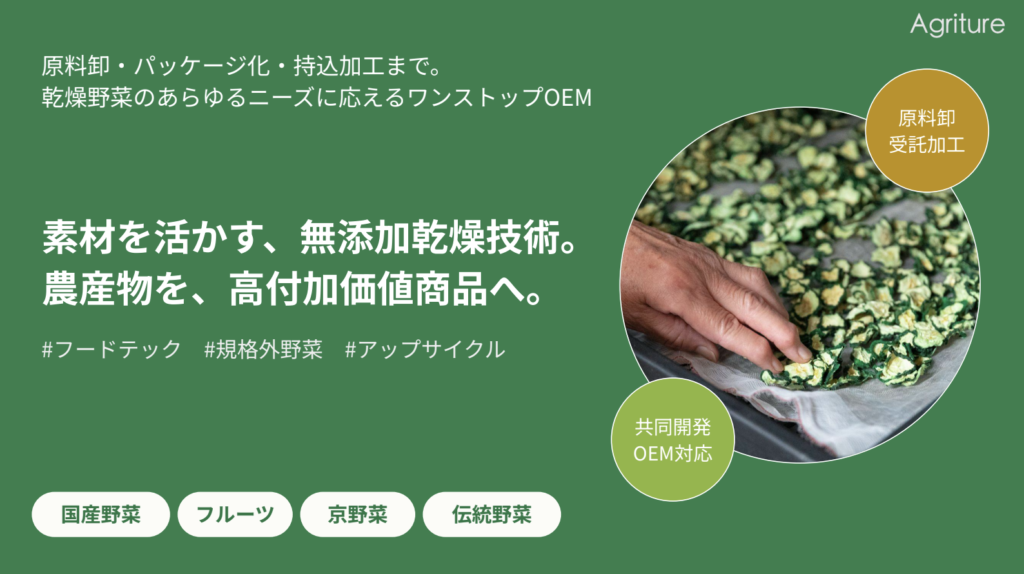
- OEM available from small lots of 10 kg
- Drying of brought-in raw materials also possible
- Support from processing to filling in one place
Vegan OEM and Agriture's Dried Vegetables
All 30 of Agriture's dried vegetable items are free of animal-derived ingredients, and can be used as-is as vegan-friendly food ingredients.
| Item | Details |
|---|---|
| Available items | 30 kinds of dried vegetables, dried fruits, vegetable powder |
| Animal-derived ingredients | None used in any item. Vegan-friendly |
| Featured ingredients | Tomatoes for dashi (a base for plant-based umami), Dried shiitake |
| Minimum lot | Available from small lots. Prototyping possible |
| Processing capabilities | Integrated handling from drying → powdering → blending → filling |
| Features | No glucose added; low-temperature drying preserves natural color and aroma |
The hardest part of vegan food development—substituting for animal-based dashi—can be solved with three ingredients: dashi tomato + dried shiitake + dried onion. Use them as raw materials for a wide range of vegan products such as soups, sauces, dressings, and instant foods.
FOR BUSINESS
乾燥野菜のOEM・受託加工を承ります
国産の野菜・果物の乾燥、100メッシュ相当までの粉砕、10g以上の小袋充填までをお受けしています。小ロットの試作から量産までご相談ください。寄せられた相談の実例は OEM・卸のご相談 に掲載しています。
乾燥品の賞味期限は、出荷日から6ヶ月程度を目安にご案内しています。
Frequently Asked Questions About Vegetarian OEM
We have materials available to help you understand dried processing OEM
Agriture OEM, flexibly handling everything from small lots to large lots
- OEM available from small lots of 10 kg
- Drying of brought-in raw materials also possible
- Support from processing to filling in one place
Summary
In OEM development of vegetarian and vegan foods, you're required to clarify the type you'll cater to, check ingredients for animal-derived components, and take cross-contamination measures on the production line. Substituting animal-based dashi and seasonings in particular is the biggest challenge in Japanese food development, and it can be solved by using plant-based umami ingredients such as dashi tomato and dried shiitake.
All of Agriture's dried vegetables are animal-free and can be used as-is as raw materials for vegan OEM. Start with a sample and give them a try.
Download the OEM contract processing materials
We will send the materials to your email address based on the information you provide.
If you are considering product development with off-spec or your own farm's vegetables:From planning to processing, materials, package printing and novelties, you can consult us through a single point of contact. → Learn more about one-stop product development
- How to Choose Dried Goods, Taught by a Pro | 5 Important Points and How to Tell Them Apart
- A Guide to Using Dried Vegetables as a Pet Food Raw Material
Author of this article
Related articles
-
 Original coffee marketing strategy | Ways to grow sales
 -
 ベジタリアンとは?国の規格が分けている4つの区分と食べられないもの
 -
 長ねぎと白ねぎは同じもの?ねぎの種類と呼び名を国の資料で確かめる
 -
 柚子の種類は何種類あるのか、公の資料で名前が残る系統を数えた
 -
 ゆずの時期は年に二度、青ゆずは7月から黄ゆずは10月から
 -
 ゆずの産地は高知が半分を占め、二位は徳島から愛媛に変わった
 -
 Preventing Food OEM Failures: Common Failure Cases and Countermeasures for Success
 -
 How to find a food OEM | How to efficiently find the best manufacturing partner