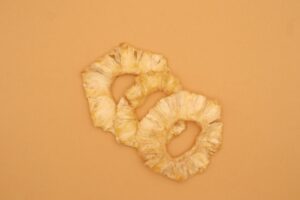
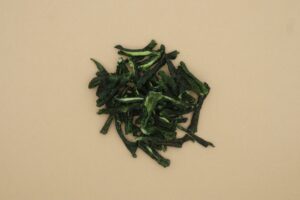
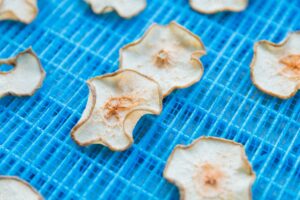
Dried cabbage


Uses cabbage grown by partner farms in Kyotango, Kyoto Prefecture. Cabbage grown in a land with temperature swings has strong sweetness and firm leaf quality. This is cut on the larger side and slowly dried at low temperature. When rehydrated, a crispness like spring cabbage and a sweet umami that spreads with every bite come back to life. Drying concentrates the cabbage's umami, and the vegetable's inherent gentle sweetness — hard to feel when eaten raw — stands out; it is a highly rated raw material as a commercial dried vegetable.
TOC
Agriture's dried cabbage: three points of commitment
01 Kyotango-grown cabbage with sweetness from temperature swings
Kyotango, Kyoto Prefecture, has a Sea-of-Japan-side climate with large day-night temperature swings, a land where vegetables' sugar content readily rises. Cabbage grown under these climatic conditions has strong sweetness and firm leaf quality, and the cabbage's inherent sweetness remains well even after drying. It features a depth of flavor that cabbage from large-scale general-distribution cultivation cannot deliver.
02 Processing that keeps texture with a larger cut
By deliberately cutting it on the larger side, it maintains a crisp texture even after dry processing. The "leaf-chewing texture" that a fine cut cannot express becomes a point of differentiation in commercial menus. As an ingredient that can offer a fresh feel like spring cabbage year-round, it is active in instant noodles, prepared dishes, and soup menus.
03 The soaking liquid can also be used as vegetable dashi
Because dried cabbage releases umami even into the soaking liquid, it can be used as a vegetable dashi for the base of soups and simmered dishes. On the point of using the raw material without waste, it is highly rated by cost-conscious commercial users. A raw material with two uses — the item itself and the soaking liquid — is rare even in commercial use.
Product catalog showing the items we handle
Flexible support from small lots to large lots
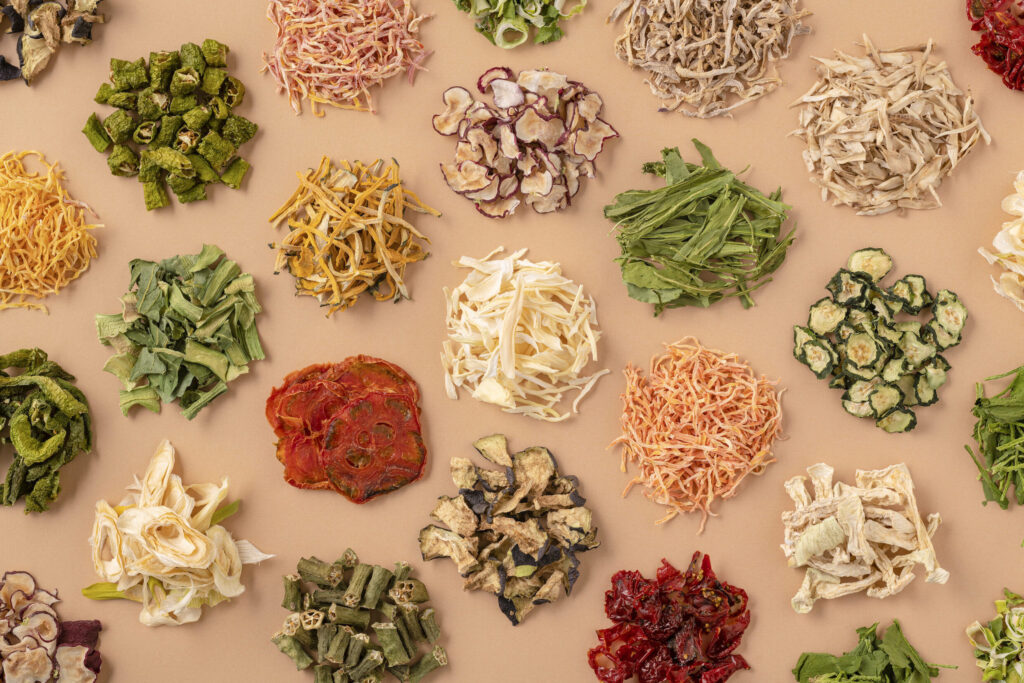
- Sold in small lots from 1 kg
- Handling heirloom vegetables from across Japan
- Dried fruits and herbs also supported
Features of commercial dried cabbage
Sweet Kyotango cabbage
Uses Kyotango-grown cabbage grown in a climate with temperature swings, with concentrated sweetness and umami. Raw material that makes use of the land's climatic conditions is a point that can be differentiated from ordinary dried cabbage products.
Crisp with a larger cut
By cutting it on the larger side, it maintains a crisp texture even after dry processing. As an ingredient with presence after rehydration, it is a specification that also looks good as an ingredient in soups and ramen.
Concentrated natural sweetness
As the moisture is drawn off by drying, the natural sweetness of cabbage — hard to feel when eaten raw — stands out. It pairs well with dishes where you want to produce sweetness without relying on sugar or sweeteners, ideal for additive-free-oriented recipes.
Usable as vegetable dashi
Because umami releases into the soaking liquid too, it can be used as a base for vegetable dashi. A raw material with excellent raw-material cost-performance that lets you use up both the cabbage itself and the soaking liquid.
No glucose added
Without using sugar coating or additives at all, it is processed with the ingredient as-is. It can be adopted as-is for product designs that emphasize additive-free appeal and ingredient-list simplification.
Six-month storage at room temperature
Long-term storage of 6 months from the shipping date is possible. It achieves year-round supply impossible for fresh cabbage, supporting stable product production unaffected by season or weather.
Product specifications
|
Item |
Details |
|---|---|
|
Raw material growing region |
Kyoto Prefecture (partner farm) |
|
Specification |
Larger cut |
|
Storage method |
Room temperature (store away from high heat and humidity) |
|
Best-before date |
6 months from the shipping date |
|
Minimum lot |
From 10 bags / 100 g |
|
Powder |
△ |
|
Manufacturing period |
December |
Customization support
At Agriture, cooperation with partner farms and our own processing facility achieve a stable raw material supply and high-quality manufacturing. We can flexibly handle OEM manufacturing and welcome consultations on specification changes and packaging. Custom-size handling (cut-thickness change, shape adjustment) is available for consultation from orders of 10 kg or more, and for large-lot manufacturing please consult us three months before the manufacturing period.
POWDER
For those looking for cabbage powder or other vegetable powders
Cabbage is high in moisture and takes some skill to powder, but coarse milling can be accommodated. We can also discuss powder demand — soup mix, sub-ingredient for instant noodles, vegetable-dashi powder, and the like. Blend design with other vegetable powders is also possible.
Commitments to variety, grower, and growing region
The raw material used for dried cabbage is cabbage grown by partner farms in Kyotango, Kyoto Prefecture. It is cabbage that has naturally accumulated sweetness through the winter temperature swings, featuring the dense leaf quality and strong sweetness characteristic of winter cabbage. By processing it in a batch timed to the December harvest, we turn it into raw material in the state where the flavor has ridden most.
BRAND
Variety: Winter cabbage. Cabbage with sugar content raised by the winter temperature swings and firmly wrapped, dense leaves. It features a richer sweetness than the large general-distribution cabbage, and that character remains even after dry processing.
PRODUCER
Producer: Partner farms in Kyotango, Kyoto Prefecture. Growers who know the region's climate and soil well set up their cultivation plans timed to the winter harvest season. We value a continuous relationship with partner farms that can stably supply quality and quantity.
REGION
Growing region: Kyotango City, Kyoto Prefecture. Cabbage grown in the temperature swings characteristic of the Sea-of-Japan-side climate and a nature-rich environment features a high density of flavor. By processing it all at once timed to the December harvest, we make it a raw material where you can enjoy winter's sweetness year-round.
CULTIVATION
Cultivation method: Through planned cultivation by partner farms, we adjust the planting timing to match Agriture's processing schedule. With a cultivation policy that reduces chemical-pesticide use, we provide raw material that can meet the quality requirements for food OEM as well.
*Reference: OYAOYA product page
Low-temperature drying technology and quality control
Water-rich leafy vegetables like cabbage have a high difficulty of dry processing, and the finish changes greatly with the balance of temperature and air volume. With a high-temperature, short-duration drying method, the leaf edges scorch easily and the hard-won sweetness is lost, so removing moisture slowly at low temperature is required. At Agriture, we operate a drying program dedicated to leafy vegetables, achieving processing that drives off moisture evenly to the center even with a larger cut while keeping the crisp texture.
💡 TIPS | Drying-processing trivia
When drying cabbage with a larger cut, unevenness in how the moisture escapes tends to appear, so we incorporate a step of changing the air direction during drying. At Agriture, in a drying room dedicated to leafy vegetables, we carry out process management that achieves an even finish.
Use cases and adoption examples
As a raw material for health foods and vegetable products
Adopted by health-food makers and drink brands as a raw material for vegetable soup, green juice, and smoothie-type products. Fresh cabbage tends to face challenges in stable purchase-lot securing and pre-processing labor, but a dried raw material allows long-term room-temperature inventory management, enabling stable product designs while suppressing raw-material-procurement risk from seasonal fluctuation. Because we also handle consultations on processing shapes such as powder, flake, and fine cut, you can consider OEM handling to a specification that matches blend ratios and texture requirements.
As an ingredient for instant noodles and instant foods
You can make use of it in situations where instant-noodle makers and OEM manufacturers of retort soups want to differentiate ingredient quality. Fresh cabbage poses challenges of prep labor and yield variation, but by supplying it as a dried ingredient, room-temperature batch storage and stable hydration-rate management become possible, and incorporation into the production line becomes smooth. For high-value-added lines and health-appeal series, you can consult us on cut shape, size, and moisture-content specifications as required.
For Japanese-style prepared dishes and stir-fry ingredients
A use adopted by prepared-dish makers and the commercial kitchens of restaurant chains as an ingredient for hoikoro, stir-fried vegetables, yakisoba, and okonomiyaki. Fresh cabbage has large pre-processing labor such as core removal and shredding, becoming a burden at prep peak times, but with dried cabbage room-temperature batch storage is possible, and you can rehydrate the needed amount and put it straight in. Because the cut shape — shredded, square-cut, and the like — can be discussed to match the application, OEM handling to a specification matching product standards and plating style is also available.
For school lunches, company cafeterias, and nursing-care meals
At the sites of school lunches, company cafeterias, and nursing-care meals, vegetable loss control and stable supply are major challenges in menu management. Because dried cabbage allows long-term room-temperature storage, it is easy to avoid the price spikes and shortage risk of fresh cabbage from seasonal fluctuation, and because you can build it into cooking simply by rehydrating the needed amount with hot water, it can greatly reduce the pre-processing labor of cooking staff. Because handling in cut shapes such as chopped or short-strip to match the application is also possible, you can consider deployment across a wide range of menus — soup, nibitashi, stir-fries.
Commercial usage and rehydration
Dried cabbage is rehydrated in water for about 5–10 minutes before use. Rehydrating with hot water saves time and can also adapt to uses like instant noodles where you rehydrate by pouring hot water. The texture differs with rehydration time — a short rehydration gives a firm crispness, a long rehydration finishes softer — so it can be adjusted to match the application.
The soaking liquid can be used, without discarding, as a base for vegetable dashi in soups and simmered dishes. The soaking liquid, into which cabbage's sweetness and richness have dissolved, is valued as a material for natural-style soups that do not rely on commercial consommé. When using it in a stir-fry, lightly draining the water after rehydrating keeps the finish from turning watery.
Related cases and articles
- Benefits and Uses of Introducing Dried Vegetables for School and Company Cafeterias (OEM article)
- Country-of-origin labeling rules for dried vegetables|An explanation of the raw material country-of-origin labeling system (OEM article)
- Dried Vegetables for Emergency Food. A Recommendation of "Rolling Stock" to Prepare for Disasters (Column)
Product catalog showing the items we handle
Flexible support from small lots to large lots
- Sold in small lots from 1 kg
- Handling heirloom vegetables from across Japan
- Dried fruits and herbs also supported
Frequently asked questions
Q. What is the minimum lot and prototype handling?
A. You can order from 10 bags (in 100 g units). OEM prototyping can be discussed from 10 kg or more. For large projects for instant noodles, instant foods, and school lunches, the cut specification, packaging, and shipping unit can be customized to match the project.
Q. What is the price range?
A. Because it uses Kyotango-grown domestic cabbage, compared with imported or large-growing-region dried cabbage the unit price is on the somewhat higher side. It is a raw material that can achieve both quality and the value of an origin label. For a specific quote, please consult us via the inquiry form.
Q. What is the lead time?
A. For in-stock items, shipping is possible 1–2 weeks after order. Cabbage's production timing is December, and we process it all at once timed to the winter harvest. For large lots, consulting us 3 months before the production timing lets us accommodate with planned production.
Q. Can you issue a raw-material origin certificate?
A. We can issue a raw-material origin certificate for Kyotango, Kyoto Prefecture. It can also accommodate cases of labeling "Kyoto-grown cabbage used" or "domestic cabbage used" on the product packaging. It can also meet the requirements for raw-material origin labeling under the Food Labeling Act.
Q. Can you submit pesticide residue results or analysis tables?
A. We can submit quality reports such as microbiological testing and general-composition analysis. It can also accommodate the quality requirements demanded for instant-noodle, instant-food, and school-lunch uses. Please consult us in advance on the necessary test items.
Q. Can you handle HACCP and export?
A. Our own factory accommodates the submission of HACCP-compliant documents. Export projects are a case-by-case consultation, but we also have deployment records for overseas-bound instant noodles and Japanese-ingredient uses. Please also consult us on OEM projects for the Asian and Western markets.
Q. Please tell me the OEM consultation flow
A. The flow is: inquiry → concept hearing → sample shipment → paid prototyping → specification finalization → full production. For large projects for instant noodles and instant foods, we provide hands-on support that includes hot-water-rehydration testing and texture evaluation.
RETAIL
For those looking to purchase in small packs
For prototype use or personal consumption, small-quantity packs can also be purchased at the online shop of our sister brand OYAOYA. It is recommended for those who want to check the flavor and texture with a small quantity before commercial use.
Medicinal-diet efficacy (in the case of raw cabbage)
In the world of medicinal diet, cabbage is positioned as "an ingredient that cares for the stomach and intestines and aids digestion." When you feel your stomach is heavy or fatigue does not lift, it is said to be good to eat it raw as a salad or to draw out its sweetness in a simmered dish. As a dependable vegetable whose flavor changes by season, it also appears frequently in medicinal-diet recipes.
Spring cabbage features soft, juicy leaves, has strong sweetness, and is best enjoyed raw for its texture. Autumn-winter cabbage, on the other hand, has firmly wrapped leaves and concentrated sweetness, making it suited to simmered dishes and stir-fries. That you can enjoy a different flavor by season is also cabbage's appeal.
💡 TIPS | Yakuzen trivia
In medicinal diet, cabbage is said to have a "sweet, neutral" nature, treated as an ingredient that neither cools nor warms the body too much and is easy to incorporate in a balanced way into daily meals. When the stomach and intestines are weakened, steaming it soft or adding it to soup and simmering makes it a dish gentle on the body.
Dried cabbage has less moisture than raw cabbage and more occasions for use in heated cooking, so from a medicinal-diet standpoint it is an ingredient "easy to use with warming cooking methods." It is a raw material that can be used without discomfort even when you want to incorporate a medicinal-diet perspective into commercial soup menus and prepared-dish development.
YAKUZEN
For those who want to know more about cabbage from a medicinal-diet perspective
At the sister site Yasai Yakuzen, which introduces recommended ingredients and medicinal-diet recipes by constitution, we explain cabbage's efficacy and how to incorporate it in more detail. We also introduce seasonal ways to eat it and tips for combinations.
Recommended reading
- Benefits and Uses of Introducing Dried Vegetables for School and Company Cafeterias (OEM article)
- Country-of-origin labeling rules for dried vegetables|An explanation of the raw material country-of-origin labeling system (OEM article)
- Dried Vegetables for Emergency Food. A Recommendation of "Rolling Stock" to Prepare for Disasters (Column)
- Cabbage powder
Download the product catalog
We will send the materials to your email address based on the information you provide.