
Creating a regional brand with a Kyoto-vegetable OEM | The complete flow from planning to sales
Novelties
Raw materials & ingredients
Powder
Kyoto vegetables
Heirloom vegetables
Food OEM
Product development
Non-standard vegetables

Summary of this article
京野菜を使ったOEMで地域ブランドを創るための実務ガイド。京の伝統野菜・京のブランド産品の認定ルール、商品化に向く7品目(九条ねぎ・万願寺とうがらし・聖護院大根・京くれない人参・京都産柚子・壬生菜・賀茂茄子)を訴求軸別(色/香り/旨味)に分類し、Agritureのタキイ種苗ファイトリッチ、京都産柚子、万願寺とうがらし、聖護院大根の実績と、じげん様の京野菜ノベルティ事例、貝印Chefonの動画企画まで紹介。企画→試作→製造→販路設計までの完全フローを整理します。
Powder processing of Kyoto vegetables is one of the few options that brings a regional brand into a product at the raw-material level. Kujo green onion・Manganji togarashi・Shogoin daikon・京くれない人参・京都産のYuzu and other heirloom vegetables Kyoto has long nurtured pair well with food OEM in every respect—color, aroma, storytelling—and are easy to price for sales channels like tourist souvenirs and hometown-tax gifts, where the Kyoto name itself becomes value.
For food makers, regional cooperatives, and D2C brands considering Kyoto-vegetable powder OEM, this article lays out the certification system for Traditional Kyoto Vegetables, items suited to powdering, Agriture's track record in Kyoto-vegetable powder OEM, and how to design the sales-channel endpoint. For the powder items and specs we handle, see the the product page for commercial vegetable powder.

TOC
The basics of Kyoto-vegetable OEM and commercialization
Kyoto vegetables is the collective term for vegetables long grown and eaten in Kyoto, characterized by distinctive flavor, color, shape, and storytelling. Powder processing concentrates a vegetable's nutrients and aroma while allowing room-temperature storage, so it can be built into a wide range of products as a commercial ingredient—confectionery, soup, furikake, prepared foods.
The comparison table below summarizes the strengths of powder processing that are hard to achieve with fresh vegetables, along with the direct product-development uses they enable.
| Benefits of powdering | Uses in product development |
|---|---|
| Room-temperature storage makes inventory easy to manage | Commercialize regardless of season |
| Weight and volume compressed to one-tenth or less | Cut logistics costs and widen sales channels |
| Concentrates color, aroma, and nutrition | Add flavor and color with a small amount |
| The storytelling of the Kyoto-vegetable brand | Pairs well with tourism, gifts, and hometown tax donations |
| Upcycling of off-spec vegetables | Enables a food-loss-reduction message |
Classification and certification of Traditional Kyoto Vegetables
The term “Kyoto vegetables” is used broadly, but in practice there are several categories in the certification systems and designations. Grasping this classification before you write item names on packaging or in advertising shows you which labels can be used safely in which sales channels.
| Category | Features | Representative items |
|---|---|---|
| Traditional Kyoto Vegetables (Kyoto Prefecture certified) | Heirloom varieties selected mainly from items grown in Kyoto since before the Meiji era | Shogoin radish, Kamo eggplant, mibuna, Kujo leek, ebi-imo, Kyoto bamboo shoots |
| Equivalent to Traditional Kyoto Vegetables | Varieties descended from the heirloom lineage | Manganji pepper, and others |
| Kyoto Brand Produce | Items brand-certified by Kyoto Prefecture under strict standards | Kyo-Yamashina eggplant, Murasakizukin, Kyo-kokabu, and others |
| General “Kyoto vegetable” labeling | A collective term for vegetables produced within Kyoto Prefecture (separate from certification) | All vegetables grown within Kyoto Prefecture |
⚠️ Labeling note: “Traditional Kyoto Vegetables” and “Kyoto Brand Products” are names under Kyoto Prefecture's certification systems. Unauthorized use can breach brand guidelines or create risk under the Act against Unjustifiable Premiums and Misleading Representations, so always confirm whether an item is certified and agree the packaging wording with your OEM maker in advance.
FOR BUSINESS
乾燥野菜のOEM・受託加工を承ります
国産の野菜・果物の乾燥、100メッシュ相当までの粉砕、10g以上の小袋充填までをお受けしています。小ロットの試作から量産までご相談ください。寄せられた相談の実例は OEM・卸のご相談 に掲載しています。
乾燥品の賞味期限は、出荷日から6ヶ月程度を目安にご案内しています。
Kyoto vegetables suited to commercialization (by form)
Among Kyoto vegetables, we organize the items that powder well and have wide commercialization endpoints. Which item you choose depends on whether you want to appeal through color, aroma, or umami. The table below sorts them into “best for color appeal,” “best for aroma appeal,” and “best for umami appeal.”
| Item | Main appeal axis | Suited use |
|---|---|---|
| Kujo green onion | Color (vivid green) + sweet aroma | Instant noodles, furikake, bread |
| Manganji togarashi | Aroma (fresh) + gentle heat | Flavored snacks, seasonings |
| Shogoin daikon | Umami (sweetness) + white powder | Soup, dashi, Japanese confectionery |
| . Vegetables labeled “2x lycopene” or “high polyphenol” are increasingly appearing in supermarkets, creating an environment where consumers can consciously choose them. Combining color, flavor, and function, these vegetables add health value while preserving the ingredient's own flavor. | Color (vivid red from lycopene) | Confectionery coloring, smoothies |
| mibuna, | Aroma (slight bitterness) + green color | Furikake, Japanese-style herb |
| 京都産柚子 | Aroma (bright) + golden color | Confectionery, drinks, seasonings |
| Kamo eggplant | Color (purple skin) + sweetness | Coloring, flavoring for Japanese dishes |
色訴求なら京くれない人参・九条ねぎ・賀茂茄子、香り訴求なら万願寺とうがらし・京都産柚子・壬生菜、旨味訴求なら聖護院大根が第一候補になります。椎茸・ビーツ・蓮根など京野菜以外の国産素材と組み合わせる設計も一般的ですが、それらは「京野菜」の表示の射程外になる点に注意してください。
Agriture's Kyoto-vegetable OEM track record
Here are three representative Kyoto-vegetable powder projects Agriture has handled. In each, we were involved through powder processing from ingredient selection to manufacturing and packaging, and we organize them strictly around Kyoto items.
Case ①: Powdering Takii Seed's “Kyo-kurenai carrot”
- Ingredient: Kyo-kurenai carrot from “Phytorich,” Takii Seed's vegetable brand containing functional components
- Processing: drying + powdering. Temperature design mindful of retaining color and the functional component (lycopene)
- Suited uses: rollout into confectionery coloring, smoothies, aojiru powder, and herbal tea
- What's distinctive: variety development jointly with a seed company × processing. Also usable as an ingredient candidate for foods with function claims
Project details are published in Collaboration page with Takii Seed.
事例②:京都産柚子のパウダー試作
- 原料: 京都市右京区の柚子(柚子産地として知られる集落の原料)
- Processing: low-temperature drying and fine powdering designed to keep the bright aroma and vivid yellow in the powder
- Suited uses: flavoring for confectionery, drinks, seasonings, and caffeine-free teas
- 案件の固有性: 産地を京都と明記して語れる、地域ストーリー型の素材
The prototyping announcement is京都産柚子パウダー試作のニュース.
Case ③: Standard Kyoto-vegetable powders such as Manganji pepper and Shogoin radish
- Ingredients: Kyoto-grown heirloom vegetables such as Manganji pepper, Shogoin radish, and Kujo leek
- Processing: particle size (20–100 mesh) tailored by use. Low-temperature drying retains color and aroma
- Suited uses: Manganji = flavored snacks/seasonings, Shogoin radish = soup/dashi/Japanese confectionery, Kujo leek = instant noodles/furikake/bread
- What's distinctive: available off the shelf from small lots, with support from test sales through mass production
Reference | Cases of dried and cut Kyoto vegetables
Cases that use Kyoto vegetables as “dried vegetables (cut or sliced)” rather than powder also offer product-planning hints. Combining powder with dried cut produce lets you achieve both the “visual presence of Kyoto vegetables” and the “aroma and color added by powder.”
| Case study | Form | Point |
|---|---|---|
| ZIGExN UPDATERS.EXE | 3-vegetable dried mix (novelty) | Official novelty for a sports team of a company listed on the TSE Prime Market. Shogoin radish, Kamo eggplant, Kyo-kurenai carrot |
| Kai Chefon | Dried vegetables (8 recipe videos) | Cooking videos supervised by the owner of one-Michelin-star “Ichirin” |
| OYAOYA | Dried vegetable / dried fruit D2C | Upcycling non-standard vegetables from northern Kyoto, with overseas rollout |
| Nippon Paper Crecia premium | OYAOYA 8-item set | Adopted as a premium for the “Action for Smile” campaign |
The OEM ordering flow
Kyoto-vegetable powdering OEM splits into two routes by how the raw material is obtained: ① choose from the ready-made lineup, or ② bring in your own farm's or contract farm's Kyoto-vegetable material and commission processing. Bring-in processing can be prototyped from around 100 kg of raw material.
| Step | Details | Period guide |
|---|---|---|
| 1. Concept design | Sorting out the product theme, target, and sales channel | 2–3 weeks |
| 2. Item selection / sample request | Order powder samples (100 g–500 g) of candidate items | 1–2 weeks |
| 3. Prototyping (small lot) | Particle-size and blend testing across 3–5 patterns | 3–4 weeks |
| 4. Finalize specs / contract | Decide the mass-production recipe; prepare test reports and certificates of origin | 1–2 weeks |
| 5. Mass production / filling / inspection | Mass production, quality inspection, packaging (small-bag filling available from 10 bags) | 3 to 6 weeks |
| 6. Delivery | Shipping and sales launch | 1 week |
Key points when producing from your own raw material
- Raw material can be prototyped from around 100 kg (powder yield is roughly one-tenth of the raw material)
- For Kyoto-grown raw material, confirm in advance whether it is certified as a “Traditional Kyoto Vegetable,” etc.
- Match harvest timing and variety to minimize variation in color and flavor
- Agree the transport conditions for fresh produce (temperature control, transport time) with the maker
Designing the sales-channel endpoint for Kyoto vegetables
What matters most in commercializing Kyoto-vegetable powder is “where to sell it.” Deciding first on channels where the Kyoto place name works as value—tourist souvenirs, hometown tax donations, department-store events—makes it easier to align packaging, volume, price range, and story.
| Sales channel | Suited product image | Items to combine |
|---|---|---|
| Hometown tax (furusato nozei) return gifts | Kyoto-vegetable set, furikake, soup set | Kujo leek, Manganji, Shogoin radish |
| Tourist souvenirs (Kyoto Station, bullet-train kiosks) | Single-item powder, mini gifts | Yuzu, Manganji, Kujo leek |
| Department-store pop-ups and events | Season-limited, story-focused products | Mibuna, Kyo-kurenai carrot, Kamo eggplant |
| High-end ryotei and Kyoto cuisine restaurants, B2B | Commercial dashi and seasoning bases | Shogoin radish, yuzu |
| D2C (own EC) | Single items, subscriptions, recipe-included | Standard items bundled together |
| Overseas export (natural, health-conscious) | Japanese ingredients for Asia and the West | Kyoto-vegetable + Japanese-ingredient set |
Agriture's group brand OYAOYA turns non-standard vegetables from northern Kyoto into D2C products, now sold as far as Germany, New York, Hong Kong, and Taiwan. If you want to test affinity with overseas natural and health-conscious markets, our existing export track record is a useful reference.
We have materials available to help you understand dried processing OEM
Agriture OEM, flexibly handling everything from small lots to large lots
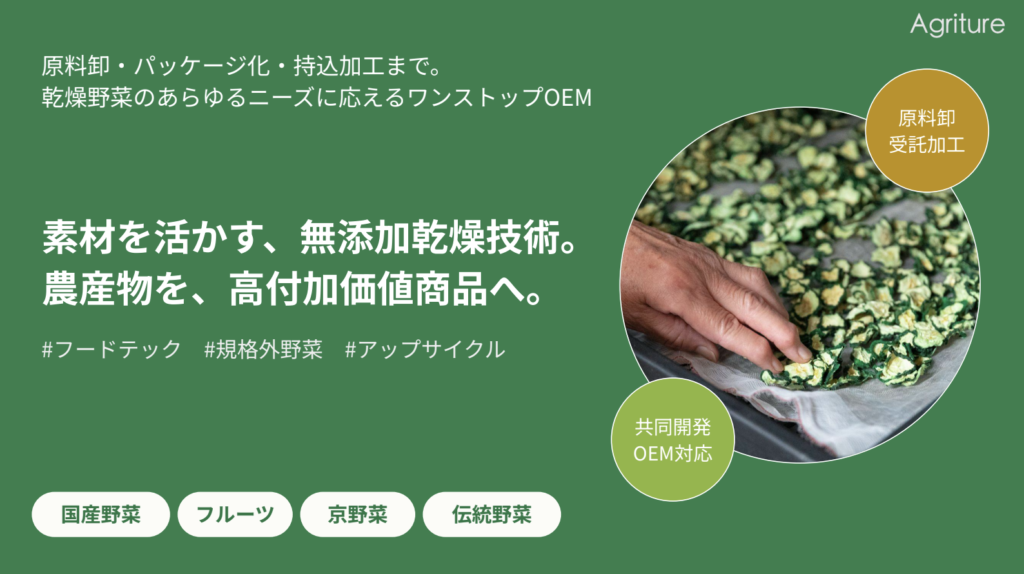
- OEM available from small lots of 10 kg
- Drying of brought-in raw materials also possible
- Support from processing to filling in one place
FOR BUSINESS
乾燥野菜のOEM・受託加工を承ります
国産の野菜・果物の乾燥、100メッシュ相当までの粉砕、10g以上の小袋充填までをお受けしています。小ロットの試作から量産までご相談ください。寄せられた相談の実例は OEM・卸のご相談 に掲載しています。
乾燥品の賞味期限は、出荷日から6ヶ月程度を目安にご案内しています。
FAQ
Can we write “Traditional Kyoto Vegetable” on the product packaging?
To use the Kyoto-Prefecture-certified names “Traditional Kyoto Vegetable” or “Kyoto Brand Product,” you must follow the certification standards and labeling guidelines. For non-certified items, it is safer to keep to general terms like “Kyoto-grown vegetable” or “Kyoto vegetable.” Because unauthorized use can breach brand guidelines or create risk under the Act against Unjustifiable Premiums and Misleading Representations, consult your OEM maker in advance and agree the packaging wording.
What's the minimum lot for Kyoto-vegetable powder?
For ready-made products, some items can be sold from 1 kg units; for fully original-formula OEM, the usual guide is 10–50 kg, and around 100 kg if you bring in your own raw material. Agriture also handles small-bag filling from 10 bags, offering one-stop support from test sales through mass production.
Can we bring in our own farm's Kyoto vegetables to be powdered?
Yes. With around 100 kg of raw material, we can prototype powdering using low-temperature drying and particle-size adjustment. Bringing in produce with matched harvest timing and variety makes it easier to minimize lot-to-lot variation in color and flavor. Agriture has a track record of bring-in projects with regional cooperatives and agricultural corporations.
How do we register a product as a hometown-tax gift?
Registration as a hometown-tax gift goes through screening by each municipality's hometown-tax department. Because required documents differ by municipality—certificate of raw-material origin, location of the manufacturing plant, labeling requirements—consulting the municipal contact early in product planning makes the process smoother.
How is Kyoto-vegetable powder different from other vegetable powders?
Performance as an ingredient varies by variety, but the biggest differentiators for Kyoto vegetables are “brand storytelling” and “connection to Kyoto culture.” They pair strongly with channels where the Kyoto name lifts unit price—tourism, gifts, hometown tax donations, department stores—making it easier to raise the product's price even at comparable nutritional value.
Summary
Kyoto-vegetable powdering OEM is a method that puts the raw material's brand, color, aroma, and story all into the product. Master three points—labeling design that reflects the certification system, item selection matched to your appeal axis, and an endpoint strategy such as tourist souvenirs or hometown tax donations—and you can launch a product line where the Kyoto name lifts the unit price.
Based in Kyoto, Agriture provides contract processing of Kyoto and domestic vegetables into powder and wholesale of commercial powders. For product-development and OEM-ordering inquiries, please see the Agriture's page on Food OEM no Madoguchi.
Download the OEM contract processing materials
We will send the materials to your email address based on the information you provide.
If you are considering product development with off-spec or your own farm's vegetables:From planning to processing, materials, package printing and novelties, you can consult us through a single point of contact. → Learn more about one-stop product development
- Kyoto-style food development | Gift-oriented product development OEM using Kyoto vegetables
- Kyoto ingredient processing OEM | How to make the most of Kyoto vegetables and quality control
Author of this article
Related articles
-
 Original coffee marketing strategy | Ways to grow sales
 -
 ベジタリアンとは?国の規格が分けている4つの区分と食べられないもの
 -
 長ねぎと白ねぎは同じもの?ねぎの種類と呼び名を国の資料で確かめる
 -
 柚子の種類は何種類あるのか、公の資料で名前が残る系統を数えた
 -
 ゆずの時期は年に二度、青ゆずは7月から黄ゆずは10月から
 -
 ゆずの産地は高知が半分を占め、二位は徳島から愛媛に変わった
 -
 Preventing Food OEM Failures: Common Failure Cases and Countermeasures for Success
 -
 How to find a food OEM | How to efficiently find the best manufacturing partner