How to Make Vegetable Furikake: Easy with Dried Vegetables, a Kid-Pleasing Homemade Recipe, and How to Choose

Summary of this article
We explain how to make and choose vegetable furikake, covering an easy homemade recipe using dried vegetables or leftover vegetables, salt-free and additive-free ideas that are easy for children to eat, and how to read the ingredients on store-bought products—tips for a furikake packed with vegetables that tastes good too.
Vegetable furikake, which lets you add vegetables just by sprinkling it over rice, is a reliable ally for households worried about not eating enough vegetables. Commercial products are also increasing in variety, but many voices say they want to choose by looking at the ingredients, or want to use it with peace of mind even for children. Using dried vegetables, you can easily make vegetable-rich furikake even by hand.
This page compiles how to choose commercial vegetable furikake, homemade recipes made with dried vegetables or leftover vegetables, how to use it for children and in weaning food, and storage tips. How to create color and flavor is introduced with the perspective of a maker that handles dried vegetables.
TOC
What is vegetable furikake
Vegetable furikake is furikake that combines dried vegetables with staple ingredients such as nori and sesame. Using vegetables like carrot, kabocha, and spinach adds vegetable flavor with good color. It is chosen by those who want to add a vegetable feel to daily rice.
The difference between commercial and homemade
Commercial vegetable furikake is appealing for the convenience of being usable right out of the pack and keeping well. On the other hand, if homemade, you can adjust the salt and sweetness to taste and freely choose the vegetables to add. Organizing the suitability of each makes it easier to use them by purpose.
- Commercial: usable right away, keeps well, stable flavor
- Homemade: can adjust salt and sweetness, can add your favorite vegetables
- Homemade: can make use of leftover vegetables at home
Combining nori and sesame with vegetables
The base is staple ingredients such as nori, sesame, and bonito flakes. Combining dried vegetables here adds color such as green, yellow, and orange, making a furikake fun to look at too. The vegetables' sweetness and flavor bring out the taste of the rice.
The background to why vegetable furikake is chosen
With dual-income and small households increasing, demand for easily incorporating vegetables is spreading. Vegetable furikake, which adds a vegetable feel just by sprinkling it over rice, gains support for that convenience. Those interested in the nutrition of vegetables will also find the explanation of the nutritional value of kale helpful.
FOR BUSINESS
乾燥野菜を業務用でお探しですか
国産の野菜・果物を乾燥し、必要に応じて粉砕してお出ししています。扱っている品目は100種前後で、規格は 乾燥品の一覧・パウダーの一覧 に掲載しています。
少量でのご購入は、姉妹ブランドの通販サイト OYAOYA で承っています。
How to choose commercial vegetable furikake
When choosing a commercial product, the point is to look at the ingredient labeling on the back of the package. Confirming what is in it makes it easier to choose a product that matches your household's preferences.
How to read the ingredient labeling
Ingredients are written in order of the amount used. Products where sugar, salt, or seasonings come toward the front tend to be firmly seasoned. Some products contain egg, wheat, or soy, so if allergies are a concern, always check the labeling. The presence or absence of colorants is also a guide when choosing.
| What to check | Point to look at |
|---|---|
| Amount of vegetables | Whether vegetables are toward the front of the ingredients |
| Salt / sugar | Whether salt and sugar are modest |
| Allergens | Whether it contains egg, wheat, soy, and the like |
| Colorants | Whether colorants are used |
Choosing additive-free / reduced-salt
Products that do not use colorants or preservatives, and products with reduced salt, are also increasing. Because it is something used every day, it suits those who want to choose one with simple ingredients. A product that produces its vegetable color with the vegetables themselves rather than colorants is one guide when telling them apart.
Points to note when choosing for children
When choosing a commercial product for children, a product whose ingredients are clearly known from the labeling is easier to choose. Confirming whether it contains allergens such as egg or wheat is essential. If you are worried, the homemade option introduced next lets you choose the ingredients to add yourself (adjusting for mild seasoning and amount is explained in the usage section later).
A product catalog that shows around 100 items we handle
Agriture, flexibly handling everything from small lots to large lots
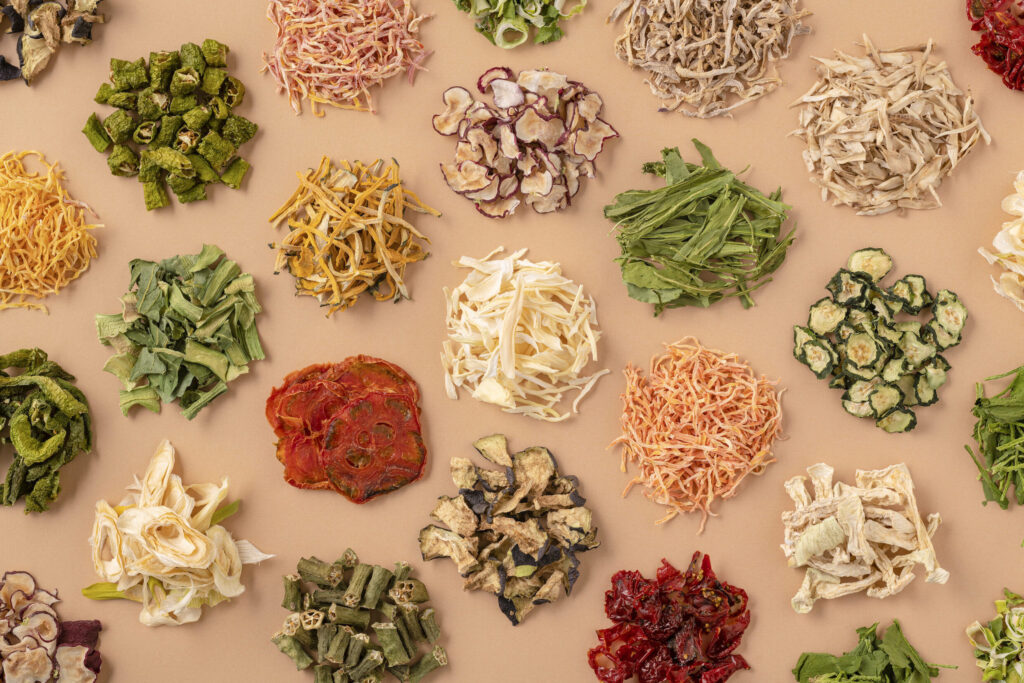
- Available for purchase in small lots from 1 kg
- We handle heirloom vegetables from across Japan
- Dried fruit and herbs also supported
Homemade vegetable furikake made with dried vegetables
If homemade, you can adjust both flavor and vegetables just as you like. Using dried vegetables, you can quickly make colorful furikake just by mixing, without worrying about moisture. It is also welcome that you can use up leftover vegetables without waste.
The basic way to make it
Basically, just combine bonito flakes, roasted sesame, and chopped dried vegetables, and lightly season with soy sauce and a little sugar. Dry-roasting in a frying pan to drive off moisture improves the shelf life and flavor. Adding jako or chopped nori increases the umami and mineral feel.
- Base it on bonito flakes and roasted sesame
- Add chopped dried vegetables (carrot, kabocha, leafy greens, etc.)
- Season with a little soy sauce and a pinch of sugar
- Dry-roast in a frying pan to drive off moisture
- Add jako or chopped nori for umami
How to make use of dried vegetables and leftover vegetables
Vegetables you cannot use up — daikon leaves, turnip leaves, carrot ends, and the like — become fine furikake material once dried. For how to rehydrate and prep dried vegetables, A guide to rehydrating dried vegetables is helpful, and other recipes are introduced in 10 selected dried vegetable recipes as well. Because you can use up vegetables without waste, it also leads to food-loss countermeasures at home.
Produce the color with the vegetables' own color
Even without using colorants, you can create color with the vegetables' own color. From the standpoint of handling dried vegetables, carrot and kabocha retain color even when heated and can produce a bright orange. Leafy greens like spinach mix easily into rice when finely chopped, and beet shows a firm red even in small amounts. Deciding on one or two items as the color lead gives visual cohesion (per our own research).
| Dried vegetables | Color | How to use in furikake |
|---|---|---|
| Carrot / kabocha | Orange / yellow | For bright color aimed at children |
| Spinach / kale | Green | Add leafy-green flavor and green |
| beets, | Red / pink | The color lead, making it look splendid |
| Tomato | Red | Western-style with acidity and umami |
Dried vegetables recommended for beginners
If making vegetable furikake for the first time, choosing from dried vegetables that easily bring out color and flavor and are easy to handle makes failure less likely. From the dried vegetables we handle, we introduce some easy to use in furikake as examples.
| Dried vegetables | Recommended point | For this kind of furikake |
|---|---|---|
| Carrot | Produces color and natural sweetness | For children / color-focused |
| Spinach, | The green stands out and leafy-green flavor comes through | When you want to add nutrition |
| shiitake | Rich umami, gives depth to the flavor | For adults / umami-focused |
| sweet potato, | Gentle sweetness with little quirk | Children / snack rice balls |
| Daikon | Light and easy to combine | A Japanese-style staple furikake |
| kale, | Deep green, can give a nutritious feel | For a health-conscious item |
Used as-is in flake form for a crisp texture, or powdered to blend into rice for a moist finish — you can also change the texture by shape. First choose one or two items and start by combining them with nori and sesame, and it becomes easier to balance the flavor. Once you get used to it, please enjoy an original blend combining several vegetables.
How to use for children and in weaning food
Vegetable furikake is an ingredient easy to use even in households that struggle with how to incorporate vegetables for children. If homemade, you can keep the salt down, so you can adjust to the age in months and to preference.
Keep the salt modest
For small children, a method of keeping soy sauce and salt modest and making up for any lack with the umami of bonito flakes or kombu is suitable. Even when buying a commercial product, choosing one with modest salt gives peace of mind. In weaning food, always confirm the ingredients and the age-in-months guide before giving it.
Sprinkle over rice balls or soup
Beyond sprinkling over rice, you can also add a vegetable feel by mixing it into rice balls or adding a little to soup. Efforts with rice balls using dried vegetables are introduced in the dried-vegetable rice-ball project as well. In the finger-food stage, mixing it into rice balls makes it easier to eat.
Ways to make it easier to eat
Because large vegetable pieces can be hard to eat, for children, finely chopping them or using powdered dried vegetables improves the mouthfeel. Choosing colorful vegetables whets the appetite from the appearance. Add a little at a time and find the flavor you like.
Storing and using up vegetable furikake
Homemade vegetable furikake keeps for different lengths depending on how it is stored. So as not to waste even if you make too much, let's master the storage tips.
Storing homemade furikake
Homemade furikake, thoroughly dry-roasted to drive off moisture, is stored refrigerated in a clean sealed container. Avoiding humidity and using it up quickly is the basic rule. When you want to keep it longer, portioning it out and freezing is one method.
- Thoroughly drive off moisture by dry-roasting
- Store refrigerated in a clean sealed container
- Take it out with a dry spoon and do not let humidity in
- For long-term, portion it out and freeze
Stocking dried vegetables
Dried vegetables used as material can keep for over six months if stored away from humidity and direct sunlight. Keeping them on hand lets you make furikake right away when the idea strikes. For detailed storage tips, see how to store dried vegetables and their best-before date.
Use leftover vegetables without waste
Even vegetables left in small amounts can be dried and stocked to use together as furikake material. The habit of using up vegetables without throwing them away is a device gentle on both the household budget and the environment. A little extra effort in drying greatly extends the storage period of vegetables.
When you want to make a lot or commercialize it
There are also scenes where you want to use vegetable furikake beyond the home range — to serve it at a store, or to make it a product of your own brand. In that case, there is the option of OEM, in which you outsource manufacturing.
For commercial use or large volumes
If using a substantial amount at an eatery or facility, sourcing dried vegetables in commercial format is efficient. How to make use of dried vegetables at eateries is introduced in using dried vegetables for eateries as well. Devising the form of purchasing can also reduce prep labor.
Turning it into an original product / OEM
When you want to sell your own brand's vegetable furikake as a product, OEM, which lets you entrust everything from raw material to manufacturing, is convenient. For how to proceed with product-making that stars dried vegetables, how to start a furikake OEM explains it in detail. Because you can consult from small-lot prototyping, it becomes easier to proceed even with a first commercialization.
A product catalog that shows around 100 items we handle
Agriture, flexibly handling everything from small lots to large lots
- Available for purchase in small lots from 1 kg
- We handle heirloom vegetables from across Japan
- Dried fruit and herbs also supported
FOR BUSINESS
乾燥野菜を業務用でお探しですか
国産の野菜・果物を乾燥し、必要に応じて粉砕してお出ししています。扱っている品目は100種前後で、規格は 乾燥品の一覧・パウダーの一覧 に掲載しています。
少量でのご購入は、姉妹ブランドの通販サイト OYAOYA で承っています。
Frequently asked questions
Summary: Easily enjoy vegetable furikake with dried vegetables
Vegetable furikake is a convenient ingredient that easily adds vegetables to rice. For commercial products, look at the ingredient labeling and choose by checking salt, colorants, and allergens, and you will not go wrong. If homemade, you can freely create both flavor and color using dried vegetables or leftover vegetables.
For children, keeping the salt modest and finishing it to be easy to eat with colorful vegetables is recommended. When you want to make a lot or turn it into a product, OEM, which lets you entrust manufacturing, is also an option. First, please try homemade vegetable furikake with the dried vegetables you have at home.
Download the product catalog
We will send the materials to your email address based on the information you provide.