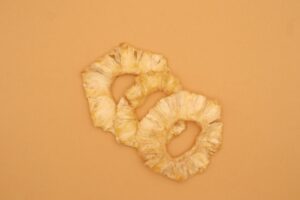
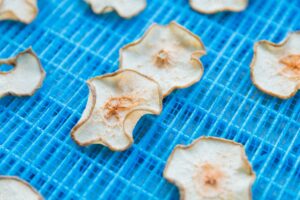
Dried sweet potato

Dried sweet potato is a commercial material for granola, toppings, confectionery ingredients, and snacks that turns the representative root vegetable whose sweetness rises with heating into raw material in three shapes: chip, slice, and dice. It seals in sweet potato's inherent sugar content and the deep sweetness born from starch saccharification by β-amylase through low-temperature drying. At Agriture, we develop it in parallel with Sweet potato powder, which powders the same sweet potato, proposing dried sweet potato for uses where you want to keep texture and sweetness, and the powder for uses where you want to spread color and sweetness evenly.
Compared with sugar- and root-type materials such as kabocha and burdock, sweet potato can differentiate on its "sticky sweetness," "sugar content that stretches with heating," and "soft mouthfeel that can accommodate even weaning and care foods." It is a material for which prototyping inquiries are increasing as a substitute-sweetener raw material for confectionery OEM, granola, cereal bars, and vegan-type sweets.
TOC
Three Commitments Behind Agriture's Dried Sweet Potato
Sweet potato is a material whose sweetness comes out very differently depending on heating and drying conditions. At Agriture, we manage everything from raw-material pre-treatment to finish packaging at our own processing facility, refining a drying design that draws out saccharification while keeping color and texture.
1. Stepwise heating that makes the most of β-amylase to draw out sweetness
Sweet potato's sweetness is amplified by the action of β-amylase, which breaks starch down into maltose around 65–75℃. Drying at high heat from the start deactivates the enzyme before the starch gelatinizes, so the inherent sweetness cannot be drawn out. At Agriture, we base it on stepwise heating that passes for a longer time through the temperature range where the enzyme works best, using as a guide that a sweetness close to steamed or roasted sweet potato spreads when you put a finished chip in your mouth.
2. Three shapes to accommodate use-specific texture design
Chip (thin-slice dried) suits toppings for granola, cereal bars, and snacks, slice (slightly thick julienne) suits confectionery kneading, bread dough, and tea-time snacks, and dice (cubes) suits ingredients for steamed buns, madeleine, ice cream, and potage. Because you can prototype by switching shapes from the same raw material, you can select to match the finished product's texture and look.
3. Choice of peel-on or peeled, and color control
Finished peel-on, the contrast between the purplish-red skin and the yellow-to-orange flesh remains, giving visual presence to granola and toppings. A peeled finish suits cases where you want to unify color for kneading into confectionery dough or weaning-food bases. Material using a purple lineage may also be proposed for prototyping toward confectionery designs and gift products that want to make the most of sweet potato's inherently deep color.
Product catalog showing the items we handle
Flexible support from small lots to large lots
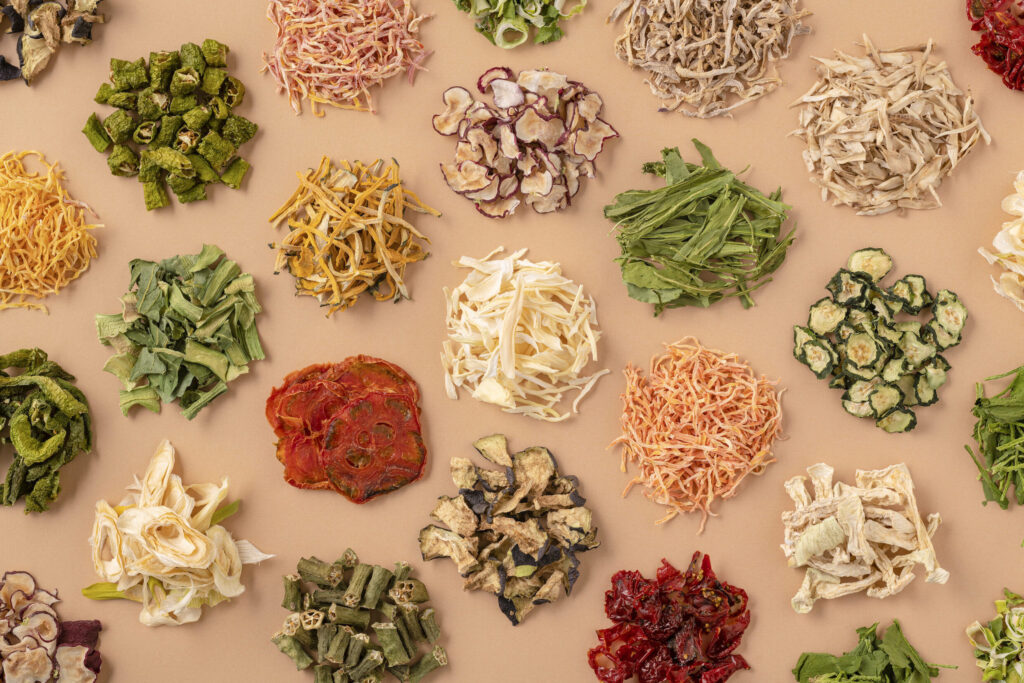
- Sold in small lots from 1 kg
- Handling heirloom vegetables from across Japan
- Dried fruits and herbs also supported
Features of Commercial Dried Sweet Potato
Even among root dried materials, sweet potato is a material with broad design latitude on the three points of sugar content, color, and texture. We organize its strengths—envisioning the uses for chip, slice, and dice respectively—from six perspectives.
A natural sweetness that stretches with heating
The maltose-type sweetness born from saccharification by β-amylase remains even after drying. It is a material easy to use as a core ingredient for confectionery, granola, and vegan sweetness design where you want to keep sugar and sweeteners restrained.
Three shapes usable differently
Chip suits toppings and snacks, slice suits confectionery kneading and tea-time snacks, and dice suits bread, steamed sweets, and potage ingredients. You can prototype by switching shapes from the same raw material.
Contains dietary fiber and jalapin
Representative points of note include dietary fiber, vitamin C, vitamin E, and jalapin (a resin glycoside). It suits designs for confectionery and cereal bars with a health-conscious food concept.
Color and shape become product value
The contrast between the purplish-red skin and the yellow-to-orange flesh is an ingredient feel that comes through even across the packaging. It works for the visual design of granola, gift sweets, and cafe menus.
Handles both rehydration and as-is
Chip as a snack as-is, dice and slice rehydrated in hot water or milk for potage, steamed sweets, and weaning-food bases. Rehydration time and temperature let you control the mouthfeel.
Use in combination with powder
Finely milled Sweet potato powder Using it together with the powder lets you design recipes that combine texture (dried product) with even sweetness and color (powder).
Product specifications (commercial)
Basic specifications at the prototype stage are as follows. Purchase lot, lead time, and packaging format are worked out through individual consultation.
| Item | Details |
|---|---|
| Product name | Dried sweet potato |
| Raw material | Sweet potato (domestically grown) |
| Shape | Three-shape development: chip (thin slice) / slice (thick julienne) / dice (cubes) |
| Appearance | Yellow-to-orange flesh; the peel-on specification has a contrast with the purplish-red skin |
| Aroma | A sweet aroma close to steamed or roasted sweet potato, with richness derived from heat saccharification |
| Net content | Individual quote according to use and lot |
| Best-before date | About 6 months from the shipping date |
| Storage method | Avoid high temperature, high humidity, and direct sunlight; after opening, seal and store in a cool, dark place |
| Processing plant | Our own processing plant within Kyoto Prefecture |
| Minimum prototype lot | From 1 kg of raw material |
Customization support
You can consult us from the prototyping stage on shape, peel treatment, saccharification degree, packaging, and through to finished product. Because we refine the recipe while keeping records, quality stays consistent between prototype and mass production.
| Item | Available | Details |
|---|---|---|
| Shape adjustment | Chip / slice / dice | Design thickness and particle size to match the finished product's texture |
| Skin treatment | With skin / peeled | Choose based on whether you emphasize color contrast or unity with the dough |
| Degree of saccharification | Light / standard / deep | Adjust the time and temperature of steaming to change how the sweetness rises |
| Blend design | Combined with other root vegetables and grains | Pre-mixes with kabocha, burdock, oats, nuts, and the like |
| Packaging form | Commercial bulk / small bags / cans | Handles final packaging such as granola bags, snack bags, and gift cans |
| OEM productization | End-to-end support through the finished product | From planning to production of granola, cereal bars, snacks, and confectionery |
For those looking for a finely milled type
For uses where you want to spread sweet potato's sweetness and color evenly, such as kneading into latte, drinks, weaning food, and confectionery dough, the powdered Sweet potato powder is suitable.
Commitments to variety, grower, and growing region
Sweet potato is a root vegetable of the family Convolvulaceae long familiar in Japan, characterized by high sugar content whose sweetness increases with heating and a broad range of application usable from weaning food to confectionery. At Agriture, we make origin, lineage, and post-harvest storage period the axis of our raw-material design.
BRAND | The positioning of sweet potato raw material
As a root vegetable long familiar in Japan, sweet potato has a broad culture of processed products such as roasted sweet potato, dried sweet potato, and sweet-potato confections. At Agriture, we translate this cultural breadth into a commercial raw material, providing it as a versatile ingredient usable for confectionery, granola, weaning food, and drinks.
PRODUCER | Basic policy for sourcing and coordination
Coordinating off-spec and processing-oriented lots directly with the growing region, we select raw material with the sugar content, moisture, and size suited to drying. At the prototyping stage, we obtain small quantities from multiple suppliers, evaluate them for how readily saccharification builds and for color stability, and then build the supply line for mass-production lots.
REGION | Characteristics of the main growing region
Kagoshima, Ibaraki, Chiba, and Miyazaki are the main domestic producing areas. Kagoshima and Miyazaki readily build sugar content thanks to the good drainage of volcanic-ash soil, and Ibaraki and Chiba have stable distribution due to proximity to the Kanto consumption area. At Agriture, we use these regions differently to suit the application, selecting raw material that balances sugar content, color, and texture.
CULTIVATION | Post-harvest storage and sugar content
Sweet potato rises in sugar content after 2–3 months of storage (curing, aging) rather than right after harvest. At Agriture, by sending raw material properly stored in the growing region to drying, we stably draw out a sweetness close to steamed or roasted sweet potato as a commercial raw material.
Low-temperature drying technology and quality control
Combining steaming and low-temperature drying
By inserting steaming before drying, we pass for a longer time through the temperature range where β-amylase works, breaking starch down into maltose. Then, at the stage of removing moisture, we lower the temperature and control it so that sugar scorching and color darkening do not occur.
Maintaining color and texture
High-temperature, long-time drying browns the yellow-to-orange flesh and turns the sticky texture dry. By switching the drying temperature and airflow stepwise and finishing under conditions matched to the thickness of chip, slice, and dice respectively, we achieve both the heat-derived color and sweetness. When kneading into confectionery dough, lightly rehydrating dice in milk or soy milk before adding transfers the sticky texture to the dough. When using it in potage or soup, rehydrating dice in hot water for 10–15 minutes and blending as-is finishes a soup with deep sweetness in a shorter time than making it from raw sweet potato. For weaning- and care-food bases, simply grinding chips finely and dissolving them in hot water makes a staple-food base with body and sweetness.
Use cases and adoption examples
We organize into six categories the uses for which we receive prototyping inquiries at Agriture. Each is an example of recipe design that wants to make the most of sweet potato's natural sweetness and color.
1. Granola, cereal bars, breakfast
It can be used as a material for baked granola mixed with oats and nuts (sweet potato chip blend of 10–15% as a guide). Making the most of the natural sweetness, it can be kneaded into protein bars and cereal bars to replace sweeteners, or developed into fruit-granola blends that layer sweetness with raisins and cranberries.
2. Confectionery (baked goods, wagashi, sweet potato)
It can be used as a kneading-in material for madeleine, pound cake, and scone dough (5–10 g per 100 g of dough as a guide). It can also be developed into a main ingredient for sweet potato (sweet-potato dessert), imo-kinton, and daigakuimo-style snacks, and into toppings for cookies and biscuits, and tea-time sweets that substitute for glace or peel.
3. Bread / bakery
It can be used as a kneading-in material for white bread and koppepan dough (5–8 g per 100 g of dry ingredients as a guide). Rehydrate the dice in milk and it becomes an ingredient for sweet buns and steamed buns, and it can also be used as a topping for sweet-potato bean-paste buns and melon buns, and as a chunk material for bagels and scones.
4. Soup, potage, weaning food
Rehydrate the dice and blend them, and it can be used as a raw material for sweet-potato potage (10–15 g per serving as a guide). Ground finely and given body, it becomes a staple-food base for baby food and weaning food, and it also suits reinforcing the sweetness and calories of care and dysphagia foods, and cafe autumn-winter seasonal menus.
5. Snacks and toppings
As a sweet-potato chip snack that can be eaten as-is, it can be developed into salt, brown-sugar, and other flavors. It can also be used as a topping for yogurt and ice cream, blended into mixed nuts and dried-fruit mixes, and as a filling or ingredient for craft chocolate.
6. Drinks and cafe menus
Topping the dice, it can be used as an ingredient for sweet-potato latte and roasted-sweet-potato latte. It can also accommodate a sweetness base for smoothies and shakes, rehydrated blending into hot milk and soy-milk drinks, and prototyping as a sub-ingredient for craft beer and craft gin.
Points on commercial use and storage
Rehydration basics
- Chip: can be eaten as-is. For snacks, granola toppings, and pre-bake dough mixing
- Slice: soak lightly in syrup, Western liquor, or milk and rehydrate for 10–15 minutes, for confectionery dough and tea-time snacks
- Dice: rehydrate in hot water, milk, or soy milk for 15–20 minutes before use. For potage, steamed sweets, and weaning food
- Using the rehydration liquid together lets you take the dissolved-out sweetness into the recipe
Blending guide
- Granola: about 10–15% by dry weight ratio as a guide (up to 20% if making it the star)
- Confectionery dough: 5–10 g per 100 g of dry ingredients (partly replacing sweetener)
- Potage: rehydrate and use 10–15 g per serving (200 ml)
- Weaning and care food: powder finely, dissolve in hot water, and adjust from 1–2 teaspoons
How to store
- Before opening: store in a cool, dark place at room temperature, away from heat, humidity, and direct sunlight
- After opening: transfer to a zip bag or airtight container and use up within 1 to 2 months
- The best-before period is about six months from the shipping date. Because sugar content is high, it absorbs moisture easily, so watch for condensation
- Because condensation forms easily right after taking it out of the fridge, let it return to room temperature before opening
Related cases and articles
- Dried Kabocha – a same-sugar-type root material
- Dried Burdock – a root material that makes the most of aroma and texture
- Sweet Potato Powder – a fine powder that spreads even sweetness and color
- List of dried vegetable raw materials
- Consult us on food OEM and raw material supply
Product catalog showing the items we handle
Flexible support from small lots to large lots
- Sold in small lots from 1 kg
- Handling heirloom vegetables from across Japan
- Dried fruits and herbs also supported
Frequently asked questions
How do I use chip, slice, and dice differently?
Chip is a shape made by drying thin slices as-is, suited to snacks, granola toppings, and pre-bake dough mixing. Slice is a thick julienne, suited to uses where you lightly rehydrate it in syrup or Western liquor and knead it into confectionery dough, or serve it as-is as a tea-time snack. Dice is cubes, a shape easy to use as a base for potage, steamed sweets, weaning food, and baby food after rehydrating in hot water or milk. We also accommodate combined orders of multiple shapes in one lot.
How much sugar content and sweetness is there?
In addition to the high sugar content of sweet potato itself, at Agriture we pass it for a longer time through the temperature range where β-amylase works at the steaming stage, breaking starch down into maltose before entering drying. The finish has a sweetness close to steamed or roasted sweet potato, usable as a core ingredient for confectionery and granola where you want to keep sugar and sweeteners restrained. Because the saccharification degree can be chosen from "light / standard / deep," you can adjust it to the strength of sweetness of your final product.
How does it differ from sweet potato powder?
Dried sweet potato suits uses where you want to keep texture, shape, and look, while the powder suits uses where you want to spread sweetness and color evenly. Granola, confectionery ingredients, snacks, and potage ingredients call for the dried product; latte, drinks, weaning-food bases, and coloring of confectionery dough call for the powder. Because both use the same sweet potato as raw material, we can also propose designs that use them together to achieve both recipe depth and uniformity.
Can I choose with-skin or peeled?
You can choose. Peel-on keeps the contrast between the purplish-red skin and the yellow-to-orange flesh, which works for the look of granola and gift sweets. Peeled suits confectionery dough, weaning-food bases, and potage where you want to unify color. There are many cases where both are compared at the prototyping stage and the specification is refined to match the packaging and use of the final product.
Can it be used as a base for weaning food and care food?
What is the minimum prototype lot?
Prototyping starts from 1 kg of raw material. You can run multiple conditions in parallel, such as comparing chip, slice, and dice shapes, comparing the color of peel-on versus peeled, and comparing how the sweetness rises with different saccharification degrees. Full production is from 10 kg, and we can support you through OEM finished-product development. After hearing the specifications, lot size, and schedule of your intended finished product, we will provide an individual quote and lead time.
Please tell me the best-before date and how to store it.
The best-before period is roughly six months from the shipping date. While unopened, avoid heat, humidity, and direct sunlight, and store in a cool, dark place at room temperature. Because sweet potato is high in sugar content and absorbs moisture easily, we recommend transferring to a zip bag or airtight container after opening and using it up within one to two months. Refrigerated storage is also possible, but watch for condensation right after removal, and let it return to room temperature before opening.
Recommended reading
- Sweet Potato Powder – fine powder type
- Dried pumpkin – a high-sugar root-vegetable raw material
- Dried Burdock – a root material of aroma and texture
- List of dried vegetables
- List of powders
Download the product catalog
We will send the materials to your email address based on the information you provide.