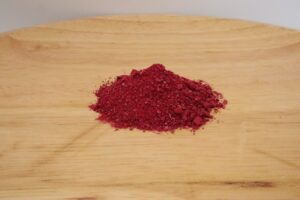
Sweet potato powder

Sweet potato powder is an ingredient made by finely powdering heat-saccharified sweet potato, intended to spread sweetness and a yellow-to-orange color evenly into lattes, drinks, confectionery batters, baby food, and soup-powder bases. At Agriture, using the same raw material as Dried sweet potato, it is an ingredient strong in recipe designs where the dispersibility of the powder is effective—coloring lattes, smoothies, baby food, bakery batters, and the like.
TOC
Agriture's sweet potato powder: three commitments
1. Drawing out saccharification before powdering
The sweetness of sweet potato is created when β-amylase breaks down starch into maltose around 65–75°C. At Agriture, we pass through this temperature range for a longer time during steaming before grinding, advancing saccharification sufficiently before moving on to drying and grinding. We set our finishing standard at a level where a sweetness close to steamed sweet potato spreads the moment you take the powder into your mouth. We organize the strengths unique to sweet potato powder from six perspectives.
Natural sweetness spreads into liquids
Because it is saccharified by steaming before powdering, a sweetness close to steamed sweet potato rises up simply by dissolving it in water, milk, or soy milk. It is suited as a core ingredient for confectionery and beverage designs that aim to reduce the amount of sugar and sweeteners.
Dispersibility in liquids and powders
Even when dissolved in lattes, soups, or dressings, the graininess is hard to notice, and it disperses evenly in powder mixes. A strength of the powder is that it can be used as is, with no reconstitution needed.
Coloring in yellow to orange
Sweet potato's natural yellow to orange gently takes to batters, beverages, and creams. It is suited to product designs that want to produce an autumn-and-winter color gradation without using synthetic coloring agents.
Compatibility with baby food and nursing-care food
Thanks to its natural sweetness, easily digestible starch, and tendency to thicken, it is an ingredient we are often consulted about for the staple-food base of baby food and the dysphagia-food design of nursing-care food. A base can be made simply by dissolving it in hot water.
Use together with the ingredient-shape version
Dried sweet potato By using it together with , you can design recipes that combine uniform sweetness and color (powder) with texture and a sense of ingredient presence (raw-material form).
Product specifications (commercial)
Basic specifications at the prototype stage are as follows. Purchase lot, lead time, and packaging format are worked out through individual consultation.
| Item | Details |
|---|---|
| Product name | Sweet potato powder |
| Raw material | Sweet potato (domestically grown) |
| Shape | Fine powder (steamed sweet potato, ground) |
| Appearance | Yellow-to-orange fine powder; the skin-on specification has a pale brown mixed in |
| Aroma | A sweet aroma close to steamed sweet potato, with richness derived from heat saccharification |
| Net content | Individual quote according to use and lot |
| Best-before date | About 6 months from the shipping date |
| Storage method | Avoid high temperature, high humidity, and direct sunlight; after opening, seal and store in a cool, dark place |
| Processing plant | Our own processing plant within Kyoto Prefecture |
| Minimum prototype lot | From 1 kg of raw material |
Customization support
| Item | Available | Details |
|---|---|---|
| Degree of saccharification | Light / standard / deep | Adjust the strength of sweetness by changing the amount of maltose produced via the steaming time |
| Pre-blending | Premix-compatible | Premix with skim milk, oat flour, spices, and sweeteners |
| Blend design | Combined with root vegetables, grains, and mushrooms | Composite soup bases with pumpkin powder, oat flour, mushroom powder, and the like |
| Packaging form | Commercial bulk / stick / canister | Compatible with latte sticks, drink mixes, and bakery commercial bags |
| OEM productization | End-to-end support through the finished product | From planning to production, covering latte mixes, baby food, cereal bars, and confectionery |
For uses where you want to keep texture and a sense of ingredient presence, the raw-material form is recommended
For uses where you want to make the most of sweet potato's texture and appearance—granola, toppings, snacks, confectionery ingredients, potage ingredients, and the like—uses where you want to make the most of sweet potato's texture and appearance dried sweet potato (chips, slices, dice) is suited. A strength is that it can be reconstituted and used directly as an ingredient.
Commitments to variety, grower, and growing region
Sweet potato is a root vegetable of the Convolvulaceae family that has long been enjoyed in Japan as well, with design latitude in saccharification through storage and the rise of sweetness through heating. As a powder raw material, using individuals with a high sugar level in combination with steaming lets you draw out sweetness and color to the maximum.
BRAND — the positioning of sweet potato powder
As a Japanese root-vegetable powder with the culture of yaki-imo and hoshi-imo in the background, sweet potato powder is a highly versatile ingredient in the confectionery, beverage, baby-food, and cereal fields. At Agriture, we design it as a material starting point for latte, drink-mix, and baby-food OEM.
PRODUCER | Basic policy for sourcing and coordination
We coordinate directly with production areas on off-grade and processing-bound lots and select raw materials that readily take on a high sugar level and have stable color. Sending raw material whose sugar level has risen through storage (curing) to drying and grinding stabilizes the sweetness of the powder.
REGION | Characteristics of the main growing region
Kagoshima, Ibaraki, Chiba, and Miyazaki are the main domestic producing areas. The good drainage of volcanic-ash soil and the warm climate contribute to a tendency toward high sugar levels. At Agriture, we use these producing areas differently according to the use and the finished color and sweetness.
CULTIVATION — storage, saccharification, and powder quality
By going through 2–3 months of storage after harvest, the starch turns into sugar and the sweetness increases. Because lots with little storage remain weak in sweetness even after powdering, we select only raw materials properly matured at the production area for powder use.
Low-temperature drying technology and quality control
For sweet potato powder, how the sweetness, color, and aroma remain changes at each step of steaming, drying, and grinding. At Agriture, we manage everything consistently from raw-material preparation to packaging, and we have a system in place to curb variation between lots.
Making use of β-amylase through steaming
By passing through around 65–75°C for a longer time during the steaming before grinding, the starch is broken down into maltose. If this step is omitted, the sweetness is weak even when finished as powder, and a raw-starch feel remains when dissolved in water.
Drying temperature and maintaining color
Sweet potato, which contains a lot of sugar, turns brown in color and loses its sweet aroma when dried at high temperatures. By lowering the temperature during the moisture-removal stage and drying in stages, we retain a vivid yellow-to-orange color in the powder. We organize the uses we are often consulted about into six categories.
1. Lattes, drinks, and cafe menus
- A sweetness and coloring base for smoothies and shakes
- Stick drinks and instant latte mixes
- Vegan drinks based on soy milk or oat milk
2. Confectionery batters and bakery
- Kneading into batters for madeleines, pound cakes, and chiffon cakes (5–8% of the powder)
- Coloring batters for bread, sweet buns, and steamed buns
- A batter base for cookies, biscuits, and Japanese confectionery
- Coloring and flavoring icing, cream, and fillings
3. Baby food, weaning food, and nursing-care food
- A staple-food base for baby food (dissolve in hot water to add thickening and impart natural sweetness)
- Designing sweetness, calories, and thickening for nursing-care food and dysphagia food
- Sugar-free or low-sugar baby-food ingredients
- A dessert base for hospital and facility meals
4. Soup powders and potages
- A powder base for sweet potato potage (about 12–15 g per serving)
- An autumn-and-winter potage mix blended with pumpkin powder
- A sweetness and color base for instant and stick soups
- Composite design with freeze-dried foods
5. Ice cream, pudding, and cream-based items
- A flavor powder for ice cream, gelato, and soft-serve
- Color and sweetness design for pudding, panna cotta, and mousse
- Flavoring whipped cream and custard cream
- A base for vegan ice cream and soy-milk yogurt
6. Cereal, granola, and alternative sweetening
- A coating powder for granola and muesli
- A sweetness base for protein bars and cereal bars (replacing part of the sugar)
- Natural-sweetness design for sports and energy foods
- A replacement ingredient for vegan sweeteners (partial substitution for sugar and honey)
For composite designs in the root-vegetable and high-sugar range, Dried kabocha squash please also check the page. For uses where you want to keep texture and a sense of ingredient presence, Dried sweet potato, and for designs that spread the aroma of root vegetables, we can also propose using it together with Dried gobo.
How to use the powder and design blends
The raw-material form requires a reconstitution step, but the greatest advantage of the powder is that it can be dissolved directly into liquids. We organize the operational points specific to powders.
Basics of use
- Confectionery batter: replace 5–8 g per 100 g of powder to impart sweetness, color, and flavor
- Soup / potage: dissolve 12–15 g per serving (200 ml) in hot water to use as a base
- Baby food: dissolve 1–2 teaspoons per 100 ml of hot water, and after opening, use it up within 1–2 months as a guide
- If lumps form, sift through a tea strainer before use to disperse it evenly
Related cases and articles
- Dried sweet potato – a raw-material form that keeps texture and a sense of ingredient presence
- Dried pumpkin – a high-sugar root-vegetable raw material
- Dried gobo – an aromatic root-vegetable raw material
- List of powders
- Consult us on food OEM and raw material supply
Product catalog showing the items we handle
Flexible support from small lots to large lots
- Sold in small lots from 1 kg
- Handling heirloom vegetables from across Japan
- Dried fruits and herbs also supported
Frequently asked questions
How do I use dried sweet potato (raw-material form) and sweet potato powder differently?
The raw-material form is suited to uses where you want to keep texture, a sense of ingredient presence, and color contrast—for example granola, snacks, confectionery ingredients, and potage ingredients. The powder is suited to uses where you want to draw out sweetness and color by dissolving it directly without reconstitution—lattes, drinks, baby-food bases, coloring confectionery batters, and soup powders. Because both use the same sweet potato as the raw material, we can also propose designs that use both together to combine texture with uniform sweetness and color. At Agriture, we handle pumpkin powder, oat flour, mushroom powder, and the like on the same line, so you can design an autumn-and-winter potage base combining root vegetables, grains, and mushrooms, or a vegan sweetening premix, from a single raw-material supplier. Layering pumpkin's color and mushroom's umami onto sweet potato's sweetness creates a base with depth that a single powder cannot produce.
What is the minimum prototype lot?
Please tell me the best-before date and how to store it.
The best-before date is about 6 months from the shipping date. While unopened, avoid high temperature, high humidity, and direct sunlight, and store in a cool, dark place at room temperature. Because sweet potato powder is high in sugar and readily absorbs moisture, after opening we recommend transferring it to a zip bag or airtight container and using it up within 1–2 months as a guide. If lumps form, sift through a tea strainer before use to disperse it evenly. Refrigerated storage is also possible, but be careful of condensation right after taking it out.