Dried potato

Dried potato is a commercial material that turns the leading root vegetable (tuber) for a wide range of dishes—soups, stews, gratin, croquettes, and more—into raw material in three shapes: chip, slice, and dice. It seals in potato's inherent fluffy feel and the richness derived from starch through low-temperature drying. At Agriture, we develop it in parallel with Potato powder, which powders the same potato, proposing dried potato for uses where you want to keep texture and ingredient presence, and the powder for adding body and kneading into dough.
Compared with starch- and sugar-type materials such as sweet potato and kabocha, potato can differentiate on its "plain flavor," "starch viscosity," and "broad compatibility with stewed dishes." It is a material for which we receive many prototyping inquiries as an ingredient for retort stew, frozen gratin, instant soup, croquette material, and baby food.
TOC
Three Commitments Behind Agriture's Dried Potato
1. Stepwise drying that curbs gelatinization
Potato starch, when overheated, gelatinizes into a strongly sticky paste, making rehydration after drying heavy. At Agriture, we set the pre-treatment heating temperature on the lower side and center on a low-temperature range even in the drying stage, designing it to seal in the starch in a state close to raw. We aim for a mouthfeel close to floury-boiled potato or fluffy mash when rehydrated.
2. Three shapes: chip, slice, and dice
Chip (thin-slice dried) suits snacks and salad toppings, slice (slightly thick julienne) suits stir-fries and hash browns, and dice (cubes) suits stew, soup, gratin, and croquette ingredients. Because you can prototype by switching shapes from the same raw material, you can select to match the finished product's look and texture.
3. Choice of peel-on or peeled
The peel-on specification suits uses that emphasize an ingredient feel, such as potato butter, German potatoes, and cafe menus. The peeled specification suits uses where you want to unify the mouthfeel, such as stew, croquettes, potato salad, and baby-food bases. You can prototype both in parallel and select to match the concept of your final product.
Product catalog showing the items we handle
Flexible support from small lots to large lots
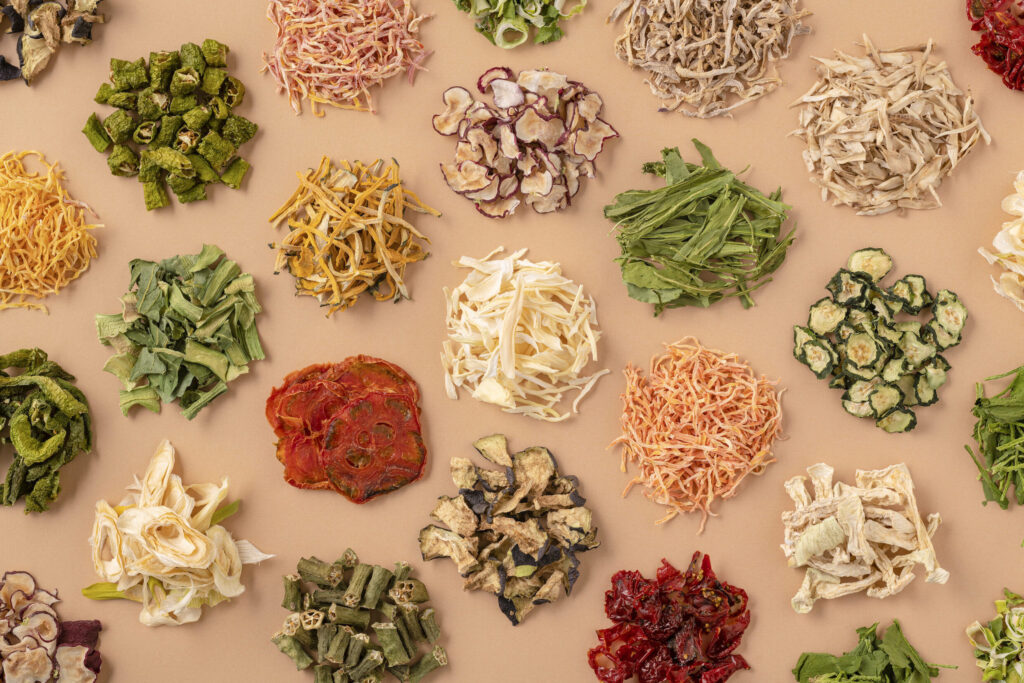
- Sold in small lots from 1 kg
- Handling heirloom vegetables from across Japan
- Dried fruits and herbs also supported
Features of Commercial Dried Potato
Even among root and tuber dried materials, potato is a material with broad design latitude for texture control, breadth of cuisine genres, and the richness derived from starch. We organize its strengths—envisioning the uses for chip, slice, and dice respectively—from six perspectives.
A finish that keeps a fluffy feel
By keeping the heating and drying conditions on the lower side, gelatinization of starch is minimized, and a mouthfeel close to floury-boiled potato or fluffy mash rises when rehydrated. It is a material well suited to the ingredient design of stew, croquettes, and gratin.
Three shapes for use-specific applications
Chip suits snacks and toppings, slice suits stir-fries and hash browns, and dice suits stew, soup, and gratin ingredients. You can prototype by switching shapes from the same raw material.
Contains starch and vitamin C
Representative points of note include starch, vitamin C, potassium, and dietary fiber. As a root vegetable with vitamin C that is not easily lost by heating, it suits ingredients for soups, weaning foods, and care foods that involve nutritional design.
A high degree of freedom in flavor combinations
Because of its plain flavor, it matches any genre—Japanese, Western, or Chinese. It is a versatile base material that takes on diverse seasonings such as butter, cheese, herbs, soy sauce, miso, curry, and cream sauce.
A root material with stable rehydration
Dice rehydrate in 10–15 minutes in hot water, slice in 5–10 minutes, finishing with a texture that varies little by lot. It is a material easy to handle in the processes of commercial cooking, retort, and frozen foods.
Use in combination with powder
Finely milled Potato powder Using it together with the powder lets you design recipes that combine texture (dried product) with body and dough binding (powder).
Product specifications (commercial)
Basic specifications at the prototype stage are as follows. Purchase lot, lead time, and packaging format are worked out through individual consultation.
| Item | Details |
|---|---|
| Product name | Dried potato |
| Raw material | Potato (domestically grown) |
| Shape | Three-shape development: chip (thin slice) / slice (thick julienne) / dice (cubes) |
| Appearance | Pale yellowish-white; the peel-on specification has a contrast with the ochre to light-brown peel |
| Aroma | A gentle aroma characteristic of potato; rehydrated, a starch-derived richness rises |
| Net content | Individual quote according to use and lot |
| Best-before date | About 6 months from the shipping date |
| Storage method | Avoid high temperature, high humidity, and direct sunlight; after opening, seal and store in a cool, dark place |
| Processing plant | Our own processing plant within Kyoto Prefecture |
| Minimum prototype lot | From 1 kg of raw material |
Customization support
You can consult us from the prototyping stage on shape, peel treatment, heating degree, packaging, and through to finished product. Because we refine the recipe while keeping records, quality stays consistent between prototype and mass production.
| Item | Available | Details |
|---|---|---|
| Shape adjustment | Chip / slice / dice | Design thickness and particle size to match the finished product's texture |
| Skin treatment | With skin / peeled | Choose based on whether you emphasize ingredient feel or unified mouthfeel |
| Heating degree | Light / standard / deep | Adjust the time and temperature of pre-heating to change the fluffy feel and ease of rehydration |
| Blend design | Combined with other root vegetables and legumes | Stew mixes with carrot, onion, and green peas |
| Packaging form | Commercial bulk / small bag / individual wrapping | Handled through to stew ingredient packs and soup ingredient sealing |
| OEM productization | End-to-end support through the finished product | From planning to production of retort stew, frozen gratin, instant soup, and croquettes |
For those looking for a finely milled type
For uses where you want to spread potato's starch evenly, such as adding body to potage, dough binding, and kneading into bread or sweets, the powdered Potato powder is suitable.
Commitments to variety, grower, and growing region
Potato is a tuber of the family Solanaceae, and it exists in high-starch lineages and waxy lineages, a root vegetable used differently by application. At Agriture, we make origin, lineage, and storage period the axis of our raw-material design.
BRAND | The positioning of potato raw material
Potato has been used across a wide range of cuisine genres regardless of Japanese or Western style—stew, croquettes, nikujaga, potato salad, French fries, and more. At Agriture, we translate this versatility as-is into a commercial raw material, providing it as an ingredient usable in a wide range of final products from retort and frozen foods to instant soup and baby food.
PRODUCER | Basic policy for sourcing and coordination
Coordinating off-spec and processing-oriented lots directly with the growing region, we select raw material with the starch content, size, and sugar content suited to drying. At the prototyping stage, we obtain small quantities from multiple suppliers, evaluate them for fluffy feel and color stability, and then build the supply line for mass-production lots.
REGION | Characteristics of the main growing region
Hokkaido, Nagasaki, Kagoshima, and Aomori are the main domestic producing areas. Hokkaido is the center of stable supply with autumn-harvested storage crops, and Kyushu yields raw material with the juiciness characteristic of new potatoes from the spring harvest. At Agriture, we use these regions differently to suit the application, selecting raw material that balances starch content, texture, and color.
CULTIVATION | Starch content and storage
Potato is a tuber whose nature changes to floury or waxy by lineage and storage period. For stew and croquettes we use floury, high-starch lots, and for soups and simmered dishes we use waxy lots that resist shape breakdown. Storage crops rise in sugar content and produce flavor readily, while new potatoes are light in texture and rehydrate easily.
Low-temperature drying technology and quality control
Pre-treatment that curbs gelatinization
By keeping the pre-heating temperature on the lower side and minimizing gelatinization of starch, we keep the fluffy feel when rehydrated. If heating is too deep, rehydration after drying becomes a sticky paste, so we finish it by balancing temperature and time.
Curbing browning
When a potato's cut surface touches air, polyphenols oxidize and turn it black. Through post-cut water-soaking and pre-heating steps, we curb oxidation and design the process to keep the color after drying a pale yellowish-white. For gratin, rehydrating dice in milk and combining them directly with bechamel dissolves out the potato's sweetness for a sense of unity. When using it as croquette material, rehydrating dice in hot water and lightly mashing them lets you do the prep with better yield than making it from raw potatoes. For instant soup and potage, sealing in chips as-is and designing them to rehydrate with a 5-minute hot-water pour finishes it into a soup with a vegetable feel.
Use cases and adoption examples
We organize into six categories the uses for which we receive prototyping inquiries at Agriture. Each is an example of recipe design that makes the most of potato's fluffy feel and starch-derived richness.
1. Stew, soup, and stewed dishes
It can be used as dice ingredients for retort stew and beef stew. Because the specification resists shape breakdown, it also suits potato ingredients for curry, and can be developed broadly, from root-vegetable bases for pot-au-feu and minestrone to ingredients for cream soup and potage.
2. Frozen gratin and gratin-type dishes
It can be used as a base for frozen potato gratin and doria. Because a fluffy texture returns when rehydrated, it can be developed broadly, from ingredients for German potatoes and hash browns to a main ingredient for cheese- and spice-baked dishes and toppings for oven dishes. Its room-temperature storage and the ability to skip peeling and cutting are also valued on the production site.
3. Instant soup and cup-noodle ingredient
As a dice ingredient for cup soup and cup noodles, it can accommodate designs that rehydrate with about a 5-minute hot-water pour. It can be used as a vegetable ingredient for instant potage and corn soup, a sealed-in material as a freeze-dried substitute, and an added-ingredient material for instant miso soup.
4. Snacks, prepared foods, toppings
It can be used as a material for potato-chip-style snacks that make the most of the chip shape as-is. It suits product designs that make the most of texture, such as toppings for salads and hors d'oeuvres, ingredients for pizza and open sandwiches, and snack materials that go with beer and wine.
5. Croquette and potato-salad material
Rehydrate and mash the dice, and it can be used as a croquette material that replaces the prep of raw potatoes. It can also be used as a potato-salad base rehydrated and dressed with mayonnaise, a time-saving material for mashed potatoes, and a binding ingredient for hamburgers and meatloaf.
6. Baby food and care food
Rehydrate finely and add body, and it can be used as a staple-food base for weaning food. Because it rehydrates soft and also serves as a calorie source, it also suits reinforcing care foods and dysphagia foods, as a vegetable source for hospital and facility meals, and as an instant-cooking material for outdoor and emergency foods that rehydrate with hot water.
Commercial usage and rehydration
Rehydration basics
- Chip: can be eaten as-is. For snacks, salad toppings, and instant-soup sealing
- Slice: rehydrate in hot water for 5–10 minutes. For stir-fries, hash browns, and prepared foods
- Dice: rehydrate in hot water, milk, or soup for 10–15 minutes. For stew, gratin, and croquette material
- Because the rehydration liquid contains dissolved-out starch and sweetness, using it as-is in soups adds richness
Blending guide
- Stew: rehydrate and use 10–15 g dry weight per serving (250 ml)
- Cup soup: seal in 3–5 g directly per serving (200 ml)
- Croquette material: about 450–550 g rehydrated weight per 100 g dry
- Potato salad: 100 g dry equals roughly 500–600 g fresh-potato equivalent
How to store
- Before opening: store in a cool, dark place at room temperature, away from heat, humidity, and direct sunlight
- After opening: transfer to a zip bag or airtight container and use up within 1 to 2 months
- The best-before date is about six months from the shipping date. Note that unevenness in rehydration occurs if it absorbs moisture
- Refrigerated storage is possible. Because condensation forms right after taking it out, return it to room temperature before opening
Related cases and articles
- Dried Sweet Potato – a sugar-type root material
- Dried Kabocha – a starch-type root material
- Potato Powder – a fine powder for adding body
- List of dried vegetable raw materials
- Consult us on food OEM and raw material supply
Product catalog showing the items we handle
Flexible support from small lots to large lots
- Sold in small lots from 1 kg
- Handling heirloom vegetables from across Japan
- Dried fruits and herbs also supported
Frequently asked questions
How do I use chip, slice, and dice differently?
Chip is a shape made by drying thin slices as-is, suited to snacks, salad toppings, and sealing as an instant-soup ingredient. Slice is a thick julienne, suited to uses where you rehydrate it and then use it in stir-fries, hash browns, and prepared foods. Dice is cubes, a shape easy to use as a base for stew, gratin, croquettes, and potato salad after rehydrating in hot water or milk. We also accommodate combined orders of multiple shapes in one lot.
How much fluffy feel remains?
By setting pre-heating and drying temperature on the lower side, we minimize gelatinization of starch and design it so that a mouthfeel close to floury-boiled potato or fluffy mash results when rehydrated. Used as stew ingredients or croquette material, we aim for a texture close to that made from raw potatoes as a guide. Because the heating degree can be chosen from "light / standard / deep," you can adjust it to the intended texture of your final product.
How does it differ from potato powder?
Dried potato suits uses where you want to keep texture and ingredient presence, while the powder suits adding body, dough binding, and even dispersion. Stew, gratin, and croquette ingredients call for the dried product; adding body to potage and kneading into bread dough and sweets dough call for the powder. Using both together lets you design dishes that combine ingredient presence with richness.
Can I choose with-skin or peeled?
You can choose. Peel-on suits uses that emphasize an ingredient feel, such as German potatoes, cafe menus, and izakaya menus. Peeled suits uses where you want to unify color, such as stew, croquettes, potato salad, and baby-food bases. There are many cases where both are compared in parallel at the prototyping stage and the specification is refined to match the packaging and use of the final product.
Can it be used as a base for baby food and care food?
What is the minimum prototype lot?
Prototyping starts from 1 kg of raw material. You can run multiple conditions in parallel, such as comparing chip, slice, and dice shapes, comparing peel-on versus peeled, and comparing how the fluffy feel rises with different heating degrees. Full production is from 10 kg, and we can support you through OEM finished-product development. After hearing the specifications, lot size, and schedule of your intended finished product, we will provide an individual quote and lead time.
Please tell me the best-before date and how to store it.
The best-before period is roughly six months from the shipping date. While unopened, avoid heat, humidity, and direct sunlight, and store in a cool, dark place at room temperature. Because potato rehydrates unevenly if it absorbs moisture, we recommend transferring to a zip bag or airtight container after opening and using it up within one to two months. Refrigerated storage is also possible, but watch for condensation right after removal, and let it return to room temperature before opening.
Recommended reading
- Potato Powder – fine powder type
- Dried Sweet Potato – a sugar-type root material
- Dried Kabocha – a starch-type root material
- List of dried vegetables
- List of powders
Download the product catalog
We will send the materials to your email address based on the information you provide.