Dried taro

Dried taro is a commercial material that turns Japan's traditional root vegetable—with a distinctive sticky texture and deep, savory umami—into raw material in two shapes: slice and dice. Low-temperature dried into shapes easy to use as ingredients for simmered dishes, soups, wagashi, and prepared foods, it is finished so that the stickiness and smooth mouthfeel characteristic of taro rise when rehydrated. At Agriture, we develop it in parallel with Taro powder, which powders the same taro, proposing dried taro for uses where you want to keep texture and ingredient presence, and the powder for adding body and kneading into dough.
Compared with other tubers such as potato and sweet potato, taro can differentiate on its "sticky stickiness," its "savory umami that is plain yet deep," and its "compatibility with Japanese cuisine, shojin cuisine, and traditional wagashi." It is a material for which we receive many prototyping inquiries as an OEM material for retort simmered dishes, Japanese-style soups, and shojin cuisine, and as a bean-paste material for wagashi.
TOC
Three Commitments Behind Agriture's Dried Taro
Taro is a root vegetable whose quality is governed by the yield of the peeling step, the handling of the sliminess, and the retention of the sticky feel during drying. At Agriture, we integrally manage washing, peeling, parboiling, and drying at our own processing facility, designing it so that a stickiness close to fresh taro is restored when rehydrated.
1. A pre-treatment design that makes the most of the sliminess
Taro's sliminess (viscous polysaccharides such as galactan) is the factor that determines the stickiness and mouthfeel when rehydrated. Remove too much sliminess during parboiling and the taro-like texture is lost; leave too much and it discolors during drying. At Agriture, we adjust the temperature and time of parboiling to leave a moderate amount of sliminess, designing it so the distinctive texture is restored upon rehydration after drying.
2. Two shapes: slices and dice
Slice (rounds) suits simmered dishes, takikomi rice, and oden, and dice (cubes) suits soups, miso soup, Japanese-style stew, and wagashi ingredients. Because you can prototype by switching shapes from the same raw material, you can select to match the finished product's look and texture.
3. Achieving both stickiness and color
When taro is dried at high temperature for a long time, the slimy component denatures, giving a dry finish, and the color also browns. At Agriture, we design it to remove moisture slowly in a low-temperature range, finishing it so that taro's inherent stickiness and a white-to-beige color are kept when rehydrated.
Product catalog showing the items we handle
Flexible support from small lots to large lots
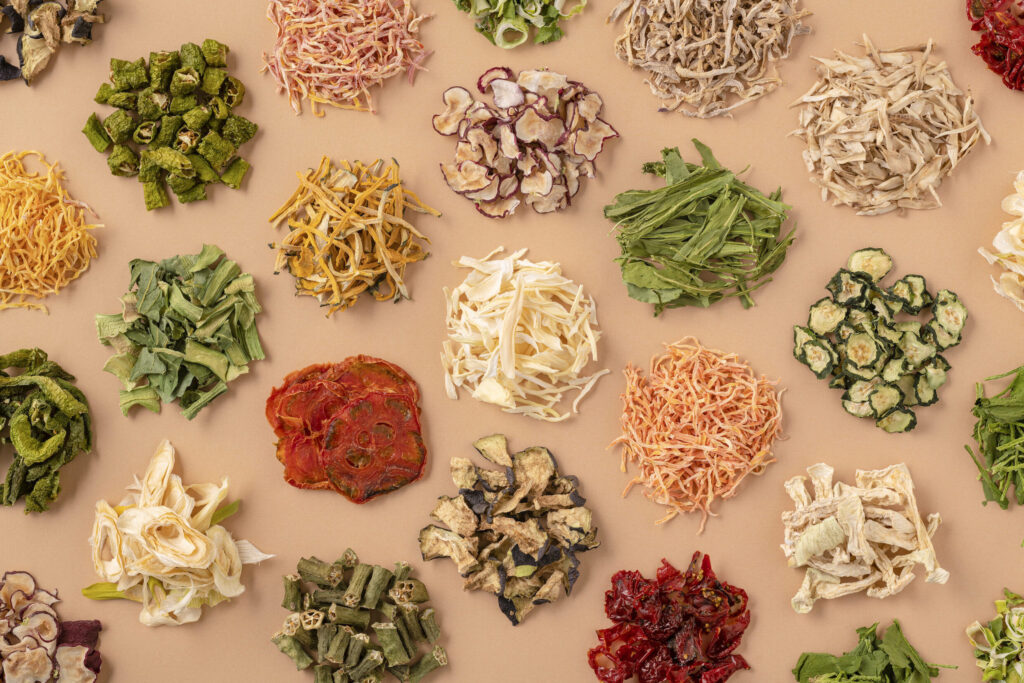
- Sold in small lots from 1 kg
- Handling heirloom vegetables from across Japan
- Dried fruits and herbs also supported
Features of Commercial Dried Taro
Even among root dried materials, taro is a material with a unique position for stickiness, savory umami, and compatibility with Japanese cuisine. We organize its strengths—envisioning the uses for slice and dice respectively—from six perspectives.
A distinctive sticky texture
The sliminess and stickiness characteristic of taro are a mouthfeel that potato and sweet potato cannot reproduce. Used as an ingredient for simmered dishes, soups, and wagashi, the ingredient's identity comes through in the finish as-is.
Two shapes for application-specific use
Slice suits simmered dishes, takikomi rice, and oden, and dice suits soups, Japanese-style stew, and wagashi ingredients. You can prototype by switching shapes from the same raw material.
Contains dietary fiber and potassium
Representative points of note include dietary fiber, potassium, and viscous polysaccharides such as galactan. As a low-calorie root vegetable that produces a feeling of fullness, it suits designs for health foods based on shojin and Japanese cuisine.
Saves Time on the Peeling Step
Fresh taro takes labor to peel and is slippery from the sliminess in commercial cooking, which is a drawback. Because dried taro is pre-processed, it is a shape easy to use in institutional and prepared-food settings as a time-saving material usable as-is after rehydration.
Compatibility with Japanese and shojin cuisine
It is a raw material that absorbs flavor readily when combined with soy sauce, miso, white dashi, and mirin, blending easily into the basic seasoning of Japanese cuisine. It can be used in recipes contiguous with Japanese food culture, such as simmered dishes, kenchin-jiru, and zoni.
Use in combination with powder
Finely milled Taro powder Using it together with the powder lets you design recipes that combine texture (dried product) with body and dough binding (powder).
Product specifications (commercial)
Basic specifications at the prototype stage are as follows. Purchase lot, lead time, and packaging format are worked out through individual consultation.
| Item | Details |
|---|---|
| Product name | Dried taro |
| Raw material | Taro (domestically grown) |
| Shape | Two-shape development: slice (rounds) / dice (cubes) |
| Appearance | White to pale beige; rehydrated, it takes on a smooth surface characteristic of taro |
| Aroma | A restrained, earthy aroma characteristic of taro; rehydrated, a savory, Japanese-cuisine-like flavor rises |
| Net content | Individual quote according to use and lot |
| Best-before date | About 6 months from the shipping date |
| Storage method | Avoid high temperature, high humidity, and direct sunlight; after opening, seal and store in a cool, dark place |
| Processing plant | Our own processing plant within Kyoto Prefecture |
| Minimum prototype lot | From 1 kg of raw material |
Customization support
You can consult us from the prototyping stage on shape, parboiling degree, sliminess adjustment, packaging, and through to finished product. Because we refine the recipe while keeping records, quality stays consistent between prototype and mass production.
| Item | Available | Details |
|---|---|---|
| Shape adjustment | Slice / diced | Design thickness and particle size to match the finished product's texture |
| Sliminess adjustment | More retained / standard / restrained | Adjust the strength of stickiness by parboiling time |
| Parboiling degree | Light / standard / deep | Adjust rehydration time and softness of mouthfeel |
| Blend design | Combined with other root vegetables, mushrooms, and beans | Kenchin-jiru mix with carrot, burdock, and shiitake |
| Packaging form | Commercial bulk / small bag / individual wrapping | Handled through to simmered-dish ingredient packs and soup ingredient sealing |
| OEM productization | End-to-end support through the finished product | From planning to production of retort simmered dishes, Japanese-style soups, shojin cuisine, and wagashi |
For those looking for a finely milled type
For uses where you want to spread taro's stickiness and savory umami evenly, such as adding body to soups, wagashi dough, and kneading into health foods, the powdered Taro powder is suitable.
Commitments to variety, grower, and growing region
Taro is a tuber of the family Araceae, a traditional root vegetable long familiar in Japan as a material for staple foods, side dishes, and traditional sweets. At Agriture, we make origin, lineage, and harvest season the axis of our raw-material design.
BRAND | The positioning of taro raw material
Taro, which had a period as a Japanese staple food before rice cultivation, is an ingredient essential to celebrations and seasonal events—zoni, nishime, imoni, kenchin-jiru, and more. At Agriture, we translate this culinary-cultural depth into a commercial raw material, providing it as a material usable for traditional Japanese cuisine, shojin cuisine, and wagashi.
PRODUCER | Basic policy for sourcing and coordination
We select lots with consistent post-peeling size, sliminess, and starch content, coordinating directly with the growing region. At the prototyping stage, we obtain small quantities from multiple suppliers, evaluate them for stickiness and color stability when dried, and then build the supply line for mass-production lots.
REGION | Characteristics of the main growing region
Saitama, Chiba, Miyazaki, and Ehime are the main domestic producing areas. The Kanto region centers on medium-size household-distribution ones, and Kyushu and Shikoku have stable supply of large processing-oriented lots. At Agriture, we use these regions differently to suit the application, selecting raw material that balances sliminess, texture, and color.
CULTIVATION | Harvest season and texture
Taro is a root vegetable harvested from autumn through winter; right after harvest it has high moisture and a juicy texture, and after storage, starch accumulates and the umami deepens. At Agriture, we use the harvest season differently by application—storage crops for simmered dishes, juicy lots for soups—to control the finish.
Low-temperature drying technology and quality control
Parboiling conditions and control of sliminess
Taro's sliminess is the factor that determines the texture when rehydrated, but leave too much and it discolors during drying; remove too much and the stickiness will not restore. By adjusting the temperature and time of parboiling and moving to drying with a moderate amount of sliminess left, we achieve a finish with high restorability.
Texture retention through low-temperature drying
Because high-temperature drying causes denaturation of the slimy component and browning, we design it to remove moisture slowly, centered on a low-temperature range. Finishing it at temperature and airflow matched to the thickness of slice and dice respectively, we use as a guide that taro's characteristic stickiness and smooth mouthfeel are restored when rehydrated. For kenchin-jiru or kenchin udon, adding dice directly to the boiling broth and simmering while rehydrating in 5–7 minutes spreads taro's umami through the whole broth. As a wagashi ingredient, rehydrating dice in a thin sugar water and combining with white bean paste makes a rustic, sweet imo-kinton-style confectionery base. For shojin-cuisine simmered dishes, simmering to soak with soy sauce, mirin, and dashi lets you skip the prep of raw taro while getting an equivalent finish.
Use cases and adoption examples
We organize into six categories the uses for which we receive prototyping inquiries at Agriture. Each is an example of recipe design that makes the most of taro's stickiness, savory umami, and Japanese-cuisine character.
1. Simmered dishes and Japanese prepared dishes
It can be used as dice ingredients for retort taro simmered dishes, chikuzen-ni, and nishime. Because you can skip the peeling and parboiling steps, prep is streamlined all the way to side dishes for prepared-food packs and bento, and ingredient packs for oden and osechi. Rehydrated, taro's inherent sticky texture returns, and it also suits as a main ingredient for shojin cuisine.
2. Soups, soups, and Japanese-style stews
It can be used as ingredient packs for kenchin-jiru, noppei-jiru, and imoni-jiru, or as dice ingredients for miso soup and zoni. Because a sticky texture emerges when rehydrated, it also suits as a base for Japanese-style potage and Japanese-style stew, and as a sealed-in material for instant soups and cup miso soups.
3. Takikomi rice and grain mixes
As an ingredient mix for taro rice and takikomi rice, it can be used simply by cooking it together with the rice. Because it can be stored long-term at room temperature, it can also be developed into grain-rice blends, ingredients for okayu and zosui, and raw material for preserved and emergency foods combined with alpha rice.
4. Wagashi and traditional sweets
It can be used as a base raw material for imo-kinton and imo confections. Because grinding and heating bring out a sticky stickiness, it can be applied broadly as a wagashi material, such as Japanese-style sweets like taro pudding and mousse, a bean-paste substitute for dorayaki and monaka, and kneading into kintsuba and yokan.
5. Institutional, facility, and care food
As an ingredient for simmered dishes and soups in school lunches and company cafeterias, it can be used without prep even in large-volume cooking. Because it rehydrates soft into a sticky texture, it is also a raw material easy to use for Japanese menus in hospital and facility meals, materials for care and dysphagia foods, and staple-food ingredients for late-stage weaning food.
6. Shojin cuisine, vegan, macrobiotic
It can be used as a main ingredient for shojin-cuisine kits, or as a substitute for animal ingredients in vegan Japanese and macrobiotic cooking. Because the sticky texture gives a satisfying bite, it is a plant-based material well suited to materials for temple and Zen cuisine and ingredients for organic Japanese meal kits.
Commercial usage and rehydration
Rehydration basics
- Slice: rehydrate in water for 15–20 minutes, or in hot water for 8–10 minutes. For simmered dishes and takikomi rice
- Dice: rehydrate in hot water for 10–15 minutes. For soups, miso soup, and wagashi ingredients
- Adding directly to soup: dice can also be put directly into boiling broth and simmered for 5–7 minutes
- Because the rehydration liquid contains taro's umami and thickening, using it as-is in soups adds richness
Blending guide
- Simmered dishes: rehydrate and use 10–15 g dry weight per serving
- Kenchin-jiru and miso soup: put 3–5 g directly per serving (200 ml)
- Takikomi rice: rehydrate 20–30 g dry and cook together per 2 go of rice
- Wagashi material: 100 g dry equals roughly 450–550 g fresh-taro equivalent
How to store
- Before opening: store in a cool, dark place at room temperature, away from heat, humidity, and direct sunlight
- After opening: transfer to a zip bag or airtight container and use up within 1 to 2 months
- The best-before period is about six months from the shipping date. Take care, as texture is impaired if it absorbs moisture
- Refrigerated storage is possible. Because condensation forms right after taking it out, return it to room temperature before opening
Related cases and articles
- Dried Potato – a starch-type root material
- Dried Sweet Potato – a sugar-type root material
- Taro Powder – a fine powder for adding body
- List of dried vegetable raw materials
- Consult us on food OEM and raw material supply
Product catalog showing the items we handle
Flexible support from small lots to large lots
- Sold in small lots from 1 kg
- Handling heirloom vegetables from across Japan
- Dried fruits and herbs also supported
Frequently asked questions
How should I use slice and diced differently?
Slice is a round shape, suited to uses where you want to make the most of a taro-like look, such as simmered dishes, takikomi rice, and oden. Dice is cubes, suited to designs that call for uniform ingredient presence, such as direct sealing into soups, miso soup, wagashi ingredients, and retort simmered dishes. We also accommodate combined orders of both shapes in one lot.
How much sticky feel is there when rehydrated?
Because it is dried with a moderate amount of slimy component left by adjusting the temperature and time of parboiling, rehydrating brings up a sticky feel close to raw taro that has been prepped and simmered. Because the sliminess degree can be chosen from "more retained / standard / restrained," you can adjust it to the texture design of your final product. Used in simmered dishes or soups, a taro-like savoriness spreads, rehydration liquid and all.
How does it differ from taro powder?
Dried taro suits uses where you want to keep texture and ingredient presence, while the powder suits adding body, dough binding, and even dispersion. Simmered-dish, soup, and wagashi ingredients call for the dried product; adding body to soups, kneading into wagashi dough, and powder blending for health foods call for the powder. Using both together lets you design recipes that combine ingredient presence with thickening.
Can I save the labor of peeling?
Because dried taro is already peeled and parboiled, you can use it in cooking just by rehydrating. Fresh taro leaves sliminess on your hands during peeling, so yield tends to drop, and it is a work step with high time-saving needs in commercial cooking. We receive inquiries as a raw material that greatly reduces prep time on the sites of institutional, prepared, and retort foods.
Can it be used for shojin cuisine and vegan uses?
This is one of the uses we are asked about most. Taro is an important material carrying texture and umami in Japanese cuisine that uses no animal ingredients. Because it is a dried product, it stores at room temperature and is a shape usable with good convenience even at temples and shojin-cuisine specialty shops. It is used as a core raw material for recipes you want to finish with plant-based materials, such as vegan Japanese cuisine, macrobiotics, and organic Japanese meal kits.
What is the minimum prototype lot?
Prototyping starts from 1 kg of raw material. You can run multiple conditions in parallel, such as comparing slice and dice shapes, comparing texture by different sliminess degrees, and comparing rehydration time by different parboiling degrees. Full production is from 10 kg, and we can support you through OEM finished-product development. After hearing the specifications, lot size, and schedule of your intended finished product, we will provide an individual quote and lead time.
Please tell me the best-before date and how to store it.
The best-before period is roughly six months from the shipping date. While unopened, avoid heat, humidity, and direct sunlight, and store in a cool, dark place at room temperature. Because taro loses its texture and stickiness restorability if it absorbs moisture, we recommend transferring to a zip bag or airtight container after opening and using it up within one to two months. Refrigerated storage is also possible, but watch for condensation right after removal, and let it return to room temperature before opening.
Recommended reading
- Taro Powder – fine powder type
- Dried Potato – a starch-type root material
- Dried Sweet Potato – a sugar-type root material
- List of dried vegetables
- List of powders
Download the product catalog
We will send the materials to your email address based on the information you provide.