Dried garlic

Dried garlic locks in the aromatic-and-umami cornerstone of cooking—its allicin-derived aroma unique to garlic and the deep richness that rises with heat—stably, through low-temperature drying. At Agriture, we run it in parallel with finely milled Garlic powder, proposing a split by use: dried garlic where you want to keep texture and visible granularity, and powder for pre-seasoning, seasoning blends, and dispersion into liquid seasonings.
Compared with other aromatic ingredients like ginger, green onion, and onion, garlic differentiates itself on "strong allicin-derived aroma," "richness that changes with heat," and "staple status in processed meats and spice mixes." It's an ingredient with frequent prototyping inquiries as a raw material for processed-meat OEM, spice mixes, dressings, yakiniku sauce, pasta sauce, and frozen foods.
TOC
Three Commitments Behind Agriture's Dried Garlic
1. Low-Temperature Design That Doesn't Blow Off the Aroma
Garlic's aroma components (allicin and its breakdown products) are heat-sensitive, and drying at high temperature for long periods blows off much of the aroma. At Agriture, we move it promptly into the drying process right after cutting, with a design that draws out moisture slowly in a low-temperature range. Our benchmark is that when you put the finished dried garlic straight in your mouth, an aroma close to just-chopped fresh garlic rises. By shortening the time from cutting to the start of drying and minimizing air contact during drying, the process design keeps the finish a white-to-pale-cream color.
Product catalog showing the items we handle
Flexible support from small lots to large lots
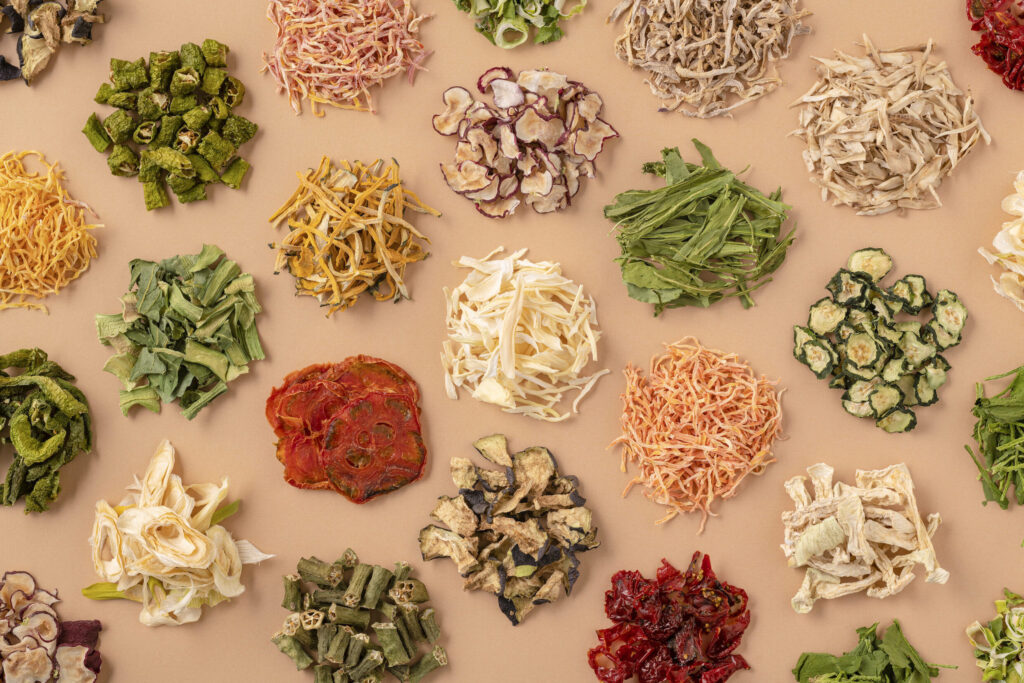
- Sold in small lots from 1 kg
- Handling heirloom vegetables from across Japan
- Dried fruits and herbs also supported
Features of Commercial Dried Garlic
Strong Allicin-Derived Aroma
It locks in garlic's characteristic allicin and the distinctive aroma from its breakdown products through low-temperature drying. An aroma that rises close to just-chopped fresh garlic makes it an ingredient that decides a dish.
Contains Allicin and Sulfur Compounds
Representative points of interest include allicin, sulfur compounds, and their bonding affinity with vitamin B1. It's an ingredient used as a raw material for health foods and anti-fatigue products with aroma- and stamina-oriented concepts.
Saves Time on the Peeling Step
Fresh garlic takes effort to peel, and yield tends to be an issue in commercial cooking. Dried garlic is already prepped, so it's a time-saving raw material you can use rehydrated or heated as-is.
Use in combination with powder
Finely milled Garlic powder Used together with , you can design recipes that reconcile granularity (dried product) with uniform aroma and pre-seasoning (powder).
Product specifications (commercial)
Basic specifications at the prototype stage are as follows. Purchase lot, lead time, and packaging format are worked out through individual consultation.
| Item | Details |
|---|---|
| Product name | Dried garlic |
| Raw material | Garlic (domestically grown) |
| Appearance | White-to-pale-cream color, a tone that curbs browning through low-temperature drying |
| Aroma | Strong allicin-derived aroma, a rise close to freshly chopped |
| Net content | Individual quote according to use and lot |
| Best-before date | About 6 months from the shipping date |
| Storage method | Avoid high temperature, high humidity, and direct sunlight; after opening, seal and store in a cool, dark place |
| Processing plant | Our own processing plant within Kyoto Prefecture |
| Minimum prototype lot | From 1 kg of raw material |
Customization support
| Item | Available | Details |
|---|---|---|
| Degree of drying | Standard / deeper | We can also accommodate a spec with even more moisture removed for long-term storage |
| Blend design | Combined with other spices and salt | A seasoning blend combined with black pepper, chili, and salt |
| Packaging form | Commercial bulk / small bags / seasoning bottles | We accommodate everything from processed-meat premixes to spice shakers |
| OEM productization | End-to-end support through the finished product | From planning to production of processed meats, sauces, seasonings, and frozen foods |
For those looking for a finely milled type
For uses where you want to spread garlic's aroma uniformly—dressings, liquid seasonings, even mixing into pre-seasoning, dispersion into seasoning salt—finely milled Garlic powder is suitable.
Commitments to variety, grower, and growing region
Garlic is a bulb vegetable of the lily family, an aromatic ingredient used as a flavoring vegetable in cuisines around the world. At Agriture, we make growing region, lineage, and storage period the axes of our raw-material design.
BRAND | The Positioning of Garlic as a Raw Material
Garlic is the aromatic vegetable indispensable to every cuisine genre—Japanese, Western, Chinese—widely used in seasonings, processed meats, and spice mixes. At Agriture, we translate this versatility into a commercial raw material, offering it as an ingredient usable in a wide range of final products, from processed meats and sauces to seasonings and frozen foods.
PRODUCER | Basic policy for sourcing and coordination
We select lots with consistent bulb fullness, aroma strength, and size by coordinating directly with growing regions. At the prototype stage, we take small amounts from multiple suppliers, evaluate them on aroma retention and color stability during drying, and then assemble the supply line for mass-production lots.
REGION | Characteristics of the main growing region
Aomori is the central domestic growing region, characterized by the strong aroma and bulb fullness of cold-climate cultivation. It's also grown in Kagawa, Yamagata, and elsewhere, and aroma strength, pungency, and sweetness differ by region. At Agriture, we use these regions selectively by application, choosing raw material that balances aroma, color, and size.
CULTIVATION | Storage Period and Aroma
Garlic is a bulb vegetable harvested in summer and then distributed after dry storage. The longer the storage period, the more moisture is drawn out and the more the aroma concentrates, but managing sprouting is important for long-stored goods. At Agriture, we prioritize turning lots into raw material at the time when aroma and freshness are in balance.
Low-temperature drying technology and quality control
Shortening the Time from Cutting to Drying
In garlic, allicin forms after cutting, while oxidation advances at the same time from air contact. By moving promptly from cutting to the drying process, we finish it under conditions that activate the aroma while curbing browning.
Aroma Retention Through Low-Temperature Drying
High-temperature drying volatilizes the aroma components, weakening the finished aroma. By designing to draw out moisture over time in a low-temperature range, we make a raw material where an aroma close to fresh garlic rises the moment you open the seal. Both are examples of recipe design that harnesses garlic's aroma and richness.
1. Processed Meats and Meat Products
- A secret ingredient for hamburg steak and meatballs
- Pre-seasoning and finishing for char siu and chashu
- A seasoning raw material for jerky and salami
2. Spice Mixes and Seasonings
- A base formulation for curry powder and spice mixes
- A main raw material for garlic salt and seasoning shakers
- Blending steak spice and BBQ rubs
- Seasoning for popcorn and snacks
3. Sauces, Dips, and Dressings
- An ingredient in yakiniku sauce and steak sauce
- Scenting pasta sauces (peperoncino, arrabbiata)
- A raw material for Caesar dressing and aioli
- A flavoring in gyoza dipping sauce and Chinese sauces
4. Frozen and Retort Foods
- An aroma material for frozen pasta and garlic rice
- Formulation for retort curry and pasta sauces
- An ingredient and topping for frozen pizza and pilaf
- Seasoning for microwave-ready foods
5. Garlic Chips and Toppings
- Garlic-chip snacks (designed to eat as-is)
- A topping material for ramen and udon
- A finishing topping for salads and soups
- A finish for steak and meat dishes
6. Health-Food and Supplement Materials
- A raw material for stamina-type health foods
- A base for anti-fatigue and nourishing products
- A combination with herbal teas and blended ingredients
- A material for natural spice series
For designing aromatic and flavoring combinations, see the Dried Ginger and Dried onion page too. For uniform dispersion into pre-seasoning, seasoning, and liquid seasonings, Garlic powder combined use with is suitable.
Commercial usage and rehydration
Basics of use
- Slices: put straight into oil to draw out aroma. Also suited to frying as garlic chips
- Chips: use as-is as an ingredient in stir-fries, garlic rice, and sauces
Blending guide
- Scenting pasta: 5–10 slices per serving
How to store
- Before opening: store in a cool, dark place at room temperature, away from heat, humidity, and direct sunlight
- After opening: transfer to a zip bag or airtight container and use up within 1 to 2 months
- Best-before date is about 6 months from the shipping date. Note that aroma drops if it absorbs moisture
- To prevent aroma transfer and scattering—and because heat spreads the aroma further—it shows its effect in stir-fries and kneaded into processed meats. The degree of drying can be chosen from "standard / deeper," and a spec for long-term storage is also available.
How do you use dried garlic versus garlic powder?
Dried garlic is for "uses where you want to keep granularity, appearance, and texture," while powder is for "uniform dispersion into liquid seasonings, pre-seasoning, and seasoning salt." Garlic chips, processed meats, and yakiniku-sauce ingredients suit the dried product; blending into dressings, sauces, and seasoning salt suits the powder. Using both together enables recipe design that reconciles granularity with uniform pre-seasoning.
Can it be used in processed meats and sausages?
What is your process for curbing greening and browning?
By shortening the time from cutting to drying, we curb browning from oxidation, and by drawing out moisture in a low-temperature range, we create conditions in which greening (the reaction of allicin with iron) is unlikely to occur. The finished color is white to pale cream, a raw material whose color tone stays stable when blended into spice mixes and processed meats. Because color also changes with moisture absorption during storage, sealed storage is recommended.
What is the minimum prototype lot?
Please tell me the best-before date and how to store it.
The best-before date is about 6 months from the shipping date. While unopened, avoid high heat, humidity, and direct sunlight, and store it at room temperature in a cool, dark place. Because garlic loses aroma and changes color easily when it absorbs moisture, after opening transfer it to a zip bag or airtight container and use it up within 1–2 months as a guide. To prevent aroma scattering and transfer to other ingredients, store it separately from spices.
Recommended reading
- Garlic Powder – Fine-Milled Type
- Dried Ginger – An Aromatic Flavoring Raw Material
- Dried Onion – An Aromatic Base Raw Material
- List of dried vegetables
- List of powders
Download the product catalog
We will send the materials to your email address based on the information you provide.